Thulite: Norway's pink stone and what it's actually used for
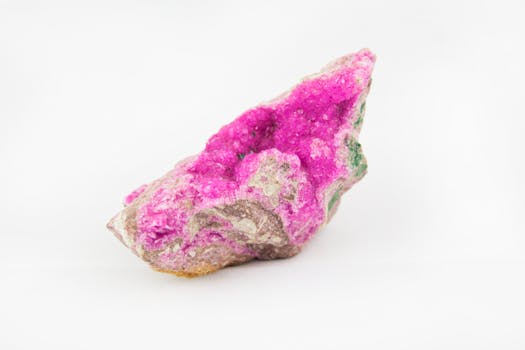
In 1820, a Norwegian mineralogist named Morten Thrane Esmark found an unusual pink stone near the town of Lom in the mountains of central Norway. He sent a sample to his father, Jens Esmark, a professor of mineralogy, who recognized it as a manganese-rich variety of zoisite. They named it "thulite" after Thule, the ancient Greek and Roman name for the far north, a mythic place beyond the edges of the known world. The name stuck, and so did the stone's association with Norway, where the finest specimens still come from today.
What thulite is, geologically speaking
Thulite is zoisite with enough manganese in its crystal structure to turn it pink. Regular zoisite is gray, green, or brown. It's interesting to geologists but not much to look at. Add manganese, and you get a range of pink shades from pale salmon to deep rose, often with white or gray streaks running through it. The color comes from Mn2+ ions substituting for calcium in the crystal lattice. More manganese means deeper pink, though the relationship is not perfectly linear because other trace elements affect the final color too.
Zoisite has a few famous varieties. Tanzanite, the violet-blue stone discovered in Tanzania in 1967, is probably the most commercially successful. Anyolite, a green and red combination of zoisite with ruby and pargasite, has its fans too. Thulite is the pink member of this family, and while it's the oldest known variety (discovered 147 years before tanzanite), it has always been the least commercially important.
Thulite versus tanzanite: a family comparison
Both stones are Ca2Al3(SiO4)(Si2O7)O(OH). Both have a hardness of 6-6.5 on the Mohs scale. The difference is trace chemistry. Vanadium and chromium produce tanzanite's blue-violet, while manganese produces thulite's pink. For market value, the gap is absurd. Fine tanzanite sells for $300-800 per carat. Thulite rarely breaks $5-15 per carat, and most material sells by the gram or by the piece for carvings and beads.
Tanzanite's dominance comes down to color saturation and marketing. The deep violet-blue of top-grade tanzanite is genuinely rare in nature, and Tiffany & Co.'s 1968 marketing campaign turned it into a household name. Thulite has a pleasant but not exceptional pink. No major jewelry brand has ever pushed it. It remains a niche stone, known mostly to mineral collectors and people who specifically seek out Norwegian materials.
Physical properties and durability
At 6-6.5 on the Mohs scale, thulite is harder than apatite (5) but softer than quartz (7). That puts it in a usable range for jewelry. You can wear a thulite pendant or pair of earrings without constant anxiety. But it's not ideal for daily-wear rings. The stone has perfect cleavage in one direction, which means it can split if struck at the wrong angle. A good jeweler will set thulite in a protective mount and advise against wearing it during heavy activity.
The specific gravity is 3.1-3.4, slightly heavier than average for a translucent stone. Thulite is opaque to translucent. You're not going to get faceted gems with internal brilliance. Virtually all thulite jewelry uses cabochon cuts or beads. The opaque nature is actually part of its appeal. The swirled pink-and-white patterns have a painterly quality that faceting would ruin.
What thulite is actually used for
Despite its decent hardness, thulite is rarely cut into fine jewelry. The market has settled on a few specific uses:
Carvings and figurines are the primary use. Thulite takes a nice polish and the pink color works well for decorative objects like small animals, hearts, eggs, and abstract shapes. Lapidaries in Norway, China, and India produce a steady supply of these. The quality varies enormously. Norwegian material tends to have better color and tighter patterns. Mass-market carvings from China are cheaper but often paler.
Beads are the second major use. Thulite bead strands, whether round, chip, or irregular, show up in craft stores and online marketplaces at modest prices. A 16-inch strand of 8mm round thulite beads typically costs $8-25 depending on color intensity and origin. Makers of wrap bracelets and casual necklaces like thulite for its warm pink tone.
Some silversmiths set thulite cabochons in sterling silver pendants and rings. This is where the stone works best in jewelry. The silver protects the edges, and the opaque cabochon does not need to show brilliance, just color. You can find these pieces at mineral shows, on Etsy, and in shops that specialize in Scandinavian jewelry.
Where thulite comes from
Norway remains the most important source, particularly the Lom and Holtålen municipalities. Norwegian thulite has the deepest, most consistent pink color and the finest grain. The stone is Norway's unofficial mineral, not legally designated, but popular enough that you'll find it in souvenir shops set into everything from keychains to cufflinks.
Other sources exist but produce lower-quality material. North Carolina in the United States has some thulite deposits, as do parts of Australia, South Africa, and Japan. Chinese thulite appears in the market too, usually in the form of inexpensive carvings. None of these sources produce material that competes with Norwegian thulite on color.
The Norwegian connection: more than geology
Thulite's identity is wrapped up in Norway in a way that few stones are tied to a single country. You can find turquoise from a dozen countries, amethyst from five continents, and quartz literally everywhere. Thulite is different. When people think of thulite, they think of Norway. That geographic specificity gives the stone a cultural weight that goes beyond its mineral properties.
Norwegian thulite appears in the country's craft traditions in ways that feel organic rather than commercial. Local silversmiths have worked with thulite for over a century, often combining it with Scandinavian silver designs that emphasize clean lines and natural materials. The stone shows up in bunad jewelry, the traditional Norwegian costume that people wear for weddings, national holidays, and formal occasions. A thulite brooch set in silver filigree is a genuinely traditional Norwegian accessory, not a modern marketing invention.
Thulite meaning and cultural significance
In crystal lore, thulite is often associated with love, emotional healing, and happiness. The connection is straightforward: it's pink, and pink stones get assigned love-related meanings across virtually every crystal tradition. Some people also connect thulite with Norway's scenery and the idea of finding beauty in harsh environments. These are cultural associations, not scientific claims.
In Norway, thulite has a practical cultural role beyond crystal meanings. It shows up in traditional Norwegian craft, sometimes inlaid into wooden objects or used as a decorative element in silver jewelry. The stone's Norwegian origin gives it a patriotic appeal separate from any crystal healing tradition.
As a financial investment, no. Thulite is abundant enough and inexpensive enough that it is unlikely to appreciate significantly. You are buying it because you like the color, not because you expect to profit.
How to evaluate thulite quality
Color is the primary quality factor. The best thulite has a saturated, even pink with good contrast against any white or gray inclusions. Pale, washed-out material is common and less desirable. Hold a piece up to natural light and look for depth of color. If the pink reads as faint or muddy, it is lower grade.
Pattern matters too. Some thulite has a mottled, almost watercolor effect where the pink and white blend softly. Other pieces have sharper boundaries between pink and lighter areas. Neither pattern type is inherently better, but collectors tend to prefer material with interesting, non-uniform patterns over blocks of flat color.
Polish quality is a practical concern, especially for carvings and cabochons. Thulite takes a good polish, but cheap, mass-produced pieces often have surface scratches or uneven polish that dull the color. Run your finger over the surface. If it feels rough or inconsistent, the piece was not finished properly. Better quality thulite has a smooth, glassy surface that lets the color speak for itself.
Size affects price but not as dramatically as with rare stones. A small thulite carving might cost $10-20, while a large, high-quality piece could reach $100-300. The jump is mostly about the quality of the material and the craftsmanship, not the weight of the stone.
Is thulite worth buying?
As a material for personal use, thulite is genuinely pleasant. The pink is warm and inviting, the stone polishes well, and the price is low enough that you can experiment without stress. A strand of thulite beads costs less than a decent lunch. A Norwegian thulite carving makes a thoughtful gift for anyone with Scandinavian connections.
The honest assessment: thulite is a pretty, affordable stone that has found its level in the market. It will never be tanzanite. It doesn't need to be.
Thulite care and maintenance
Cleaning thulite is straightforward. Warm water, mild soap, and a soft cloth or brush. Avoid ultrasonic cleaners because thulite's perfect cleavage in one direction means vibrations could potentially crack it along that plane. Steam cleaners are also a bad idea for the same reason.
Store thulite separately from harder stones. Quartz (hardness 7) will scratch it, and corundum (ruby and sapphire, hardness 9) will really damage it. A soft cloth pouch or a separate compartment in your jewelry box is sufficient. Thulite is not particularly sensitive to light or heat, so you do not need to worry about fading the way you would with amethyst or kunzite.
For thulite carvings and display pieces, an occasional wipe with a damp cloth is enough to keep them looking good. Avoid any chemical cleaners, polishing compounds, or abrasive materials. If a thulite piece loses its polish over time, a lapidary can re-polish it relatively easily because the stone takes a nice finish.
Comments