Protection Mala Combinations: 7 Stone Blends ...
June 5, 2026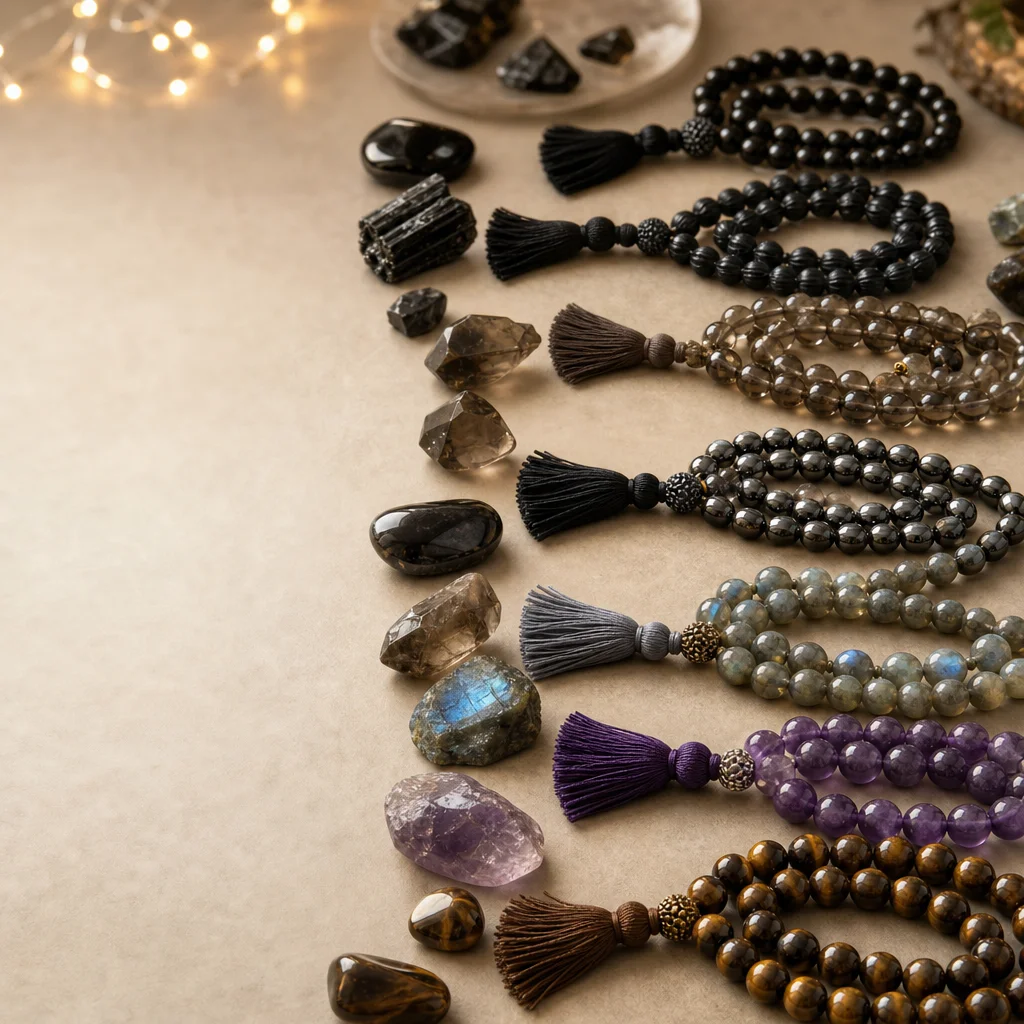
Why Use a Mala for Spiritual Protection?
Mala beads have been used across spiritual traditions for thousands of years — Buddhist monks, Hindu practitioners, and Sufi mystics all count prayer beads during meditation. But beyond their role in mantra repetition, the stones themselves carry distinct energetic properties that can form a protective field around the wearer.
A protection mala is different from a generic crystal bracelet. With 108 beads accumulating focused intention through thousands of repetitions, the energetic imprint becomes significantly stronger than a single stone worn alone. Each time you pass your fingers over a bead during Japa meditation, you're reinforcing a specific frequency — whether that's grounding, shielding, or clearing negative energy.
The key lies in stone combinations. Just as a chef balances flavors, an experienced mala maker balances crystal energies. Some stones ground and anchor, others shield and deflect, and still others purify and transmute negativity. When arranged thoughtfully across 108 beads, the result is a multi-layered energetic defense system you carry with you throughout the day.
Crystals are not a substitute for medical treatment or professional mental health support. They work as complementary tools within a broader wellness practice.
The 7 Protection Mala Combinations
1. Black Tourmaline + Obsidian: The Absolute Shield
This is the most direct protection combination available, and it's the one I recommend to anyone who feels emotionally porous or regularly deals with difficult environments.
Why it works: Black Tourmaline is renowned in crystal healing traditions as the premier energetic shield. Its pyroelectric properties mean it can generate a slight electric charge under pressure, which practitioners associate with repelling negative energy. Obsidian, formed from rapidly cooled volcanic lava, carries the raw protective force of the earth itself. Together, they create a dense, almost impenetrable energetic boundary.
Bead arrangement (108 beads): Use a 54+54 split — 54 Black Tourmaline beads followed by 54 Obsidian beads. The guru bead can be a larger Black Tourmaline specimen. This arrangement creates two distinct energy zones: the Tourmaline half acts as a proactive shield pushing energy away, while the Obsidian half absorbs and grounds any negativity that gets through.
Best for: Healthcare workers, teachers, customer-facing professionals, empaths, and anyone who absorbs other people's stress like a sponge.
2. Hematite + Smoky Quartz: Grounding Fortress
Not all protection needs to be aggressive. Sometimes the best defense is being so grounded that negative energy simply can't find a foothold.
Why it works: Hematite, with its high iron content (up to 70% Fe₂O₃), is one of the most grounding minerals available. Its weight alone — significantly heavier than most gemstones at a specific gravity of 5.26 — serves as a physical reminder to stay present and centered. Smoky Quartz gets its color from natural irradiation of aluminum impurities within the silicon dioxide crystal lattice, a process that takes millions of years. Practitioners associate this slow, deep transformation with the ability to transmute negative energy at its root rather than simply deflecting it.
Bead arrangement: Alternate in groups of 9 — 9 Hematite, 9 Smoky Quartz, repeating 6 times to reach 108. The number 9 is considered significant in numerology as the number of completion and universal wisdom. The guru bead should be a natural Smoky Quartz point.
Best for: People who feel scattered, anxious, or disconnected from their body. Also excellent during stressful life transitions — moving, changing jobs, or ending relationships.
3. Amethyst + Lepidolite: Spiritual Safeguard
This combination protects not from external negativity but from internal energetic vulnerability. Think of it as psychic armor for your subtle body.
Why it works: Amethyst contains trace amounts of iron that, when exposed to natural radiation over geological time, produce its characteristic purple color through a process involving charge transfer between Fe⁴⁺ and Fe³⁺ ions. In crystal healing traditions, this deep violet frequency is associated with the third eye and crown chakras, creating a protective dome of spiritual awareness. Lepidolite is a lithium-bearing mica mineral (K(Li,Al)₃(Al,Si,Rb)₄O₁₀(F,OH)₂) — yes, the same lithium used in mood-stabilizing medications. Practitioners believe Lepidolite's natural lithium content creates a calming, stabilizing field that prevents energy vampires from draining your reserves.
Bead arrangement: Use a three-section pattern — 36 Amethyst, 36 Lepidolite, 36 Amethyst. This sandwiches the Lepidolite between Amethyst zones, creating an energetic feedback loop where the Amethyst amplifies the Lepidolite's calming influence. The guru bead can be a Chevron Amethyst (banded white and purple) for both protection and clarity.
Best for: Highly sensitive people, energy healers, meditation practitioners, and those who do intuitive or psychic work regularly.
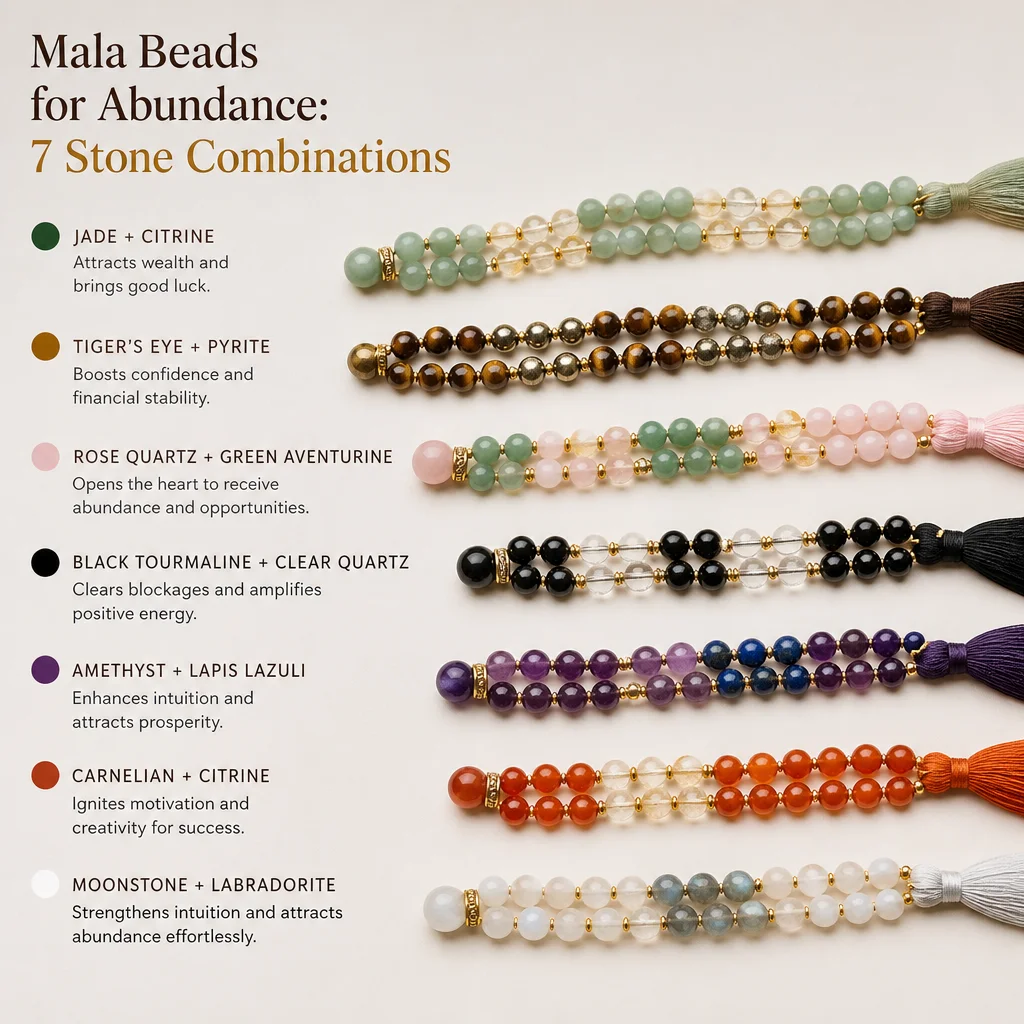
4. Black Tourmaline + Clear Quartz: Amplified Barrier
Clear Quartz is called the "master healer" for a reason — its piezoelectric properties and hexagonal crystal structure make it an excellent energetic amplifier. Paired with Black Tourmaline, it doesn't just protect; it amplifies the protective field.
Why it works: Clear Quartz (SiO₂) has a Mohs hardness of 7 and a well-documented piezoelectric effect — apply mechanical pressure and it generates an electrical charge. This property is used in watches, radios, and ultrasound equipment. In crystal healing, it's understood that Clear Quartz takes the energy of any stone it's paired with and amplifies it. When combined with Black Tourmaline's protective qualities, the result is a protection mala that projects its shielding field outward rather than keeping it close to the body.
Bead arrangement: Place 1 Clear Quartz bead every 9 beads, with the remaining positions filled by Black Tourmaline. That gives you 12 Clear Quartz amplifier beads and 96 Black Tourmaline shield beads. Position the Clear Quartz beads at the 9th, 18th, 27th positions and so on. The guru bead should be a clear, well-formed quartz point.
Best for: Public speakers, performers, leaders, and anyone who needs to maintain their energetic boundaries while remaining visible and accessible to others.
5. Tiger's Eye + Red Jasper: Warrior's Guard
This is the mala you reach for when you need confidence, courage, and the ability to stand your ground — think of it as protective energy with an assertive edge.
Why it works: Tiger's Eye is a chatoyant variety of quartz where crocidolite (blue asbestos) fibers have been replaced by iron oxide during geological transformation. This process, called pseudomorphosis, creates the characteristic silky, moving light effect (chatoyancy) that mimics a cat's eye. The golden-brown color comes from iron oxide (limonite) replacement of the original crocidolite. Practitioners associate this transformational origin with personal power and the ability to see through deception. Red Jasper is a microcrystalline quartz colored by iron inclusions (Fe₂O₃), giving it a deep, brick-red appearance. It has been used as a protective stone since at least 4000 BCE — archaeologists have found Red Jasper amulets in Egyptian tombs and Roman battle sites.
Bead arrangement: Alternate in pairs — 2 Tiger's Eye, 2 Red Jasper, repeating 27 times for 108 beads. The pairing creates a rhythm of assertive energy (Tiger's Eye) followed by steadfast endurance (Red Jasper). Use a single large Red Jasper sphere as the guru bead.
Best for: Negotiations, confrontations, job interviews, legal proceedings, or any situation requiring both confidence and composure.
6. Shungite + Pyrite: Electromagnetic Shield
In our modern world, protection isn't only about negative emotions or bad intentions. Electromagnetic fields from phones, computers, WiFi routers, and power lines create a constant low-level energetic stress that many people feel but can't explain.
Why it works: Shungite is a rare carbon-based stone found primarily in the Karelia region of Russia. It contains fullerenes — hollow, cage-like carbon molecules (C₆₀) discovered in 1985 and awarded the Nobel Prize in Chemistry in 1996. These fullerenes are powerful antioxidants, and Shungite's unique carbon structure is used in water filtration systems across Russia. Practitioners believe Shungite can neutralize electromagnetic frequencies. Pyrite (FeS₂), iron disulfide, has been used as a protective amulet since ancient Greece — the name comes from "pyr," meaning fire, because striking it against steel creates sparks. Its metallic luster and cubic crystal structure create a reflective, deflective quality.
Bead arrangement: Use a 3:1 ratio — 81 Shungite beads with 27 Pyrite beads distributed evenly. Place a Pyrite bead every 4th position. The guru bead should be a well-formed Pyrite cube — the geometric perfection of the crystal adds a layer of structural protection symbolism.
Best for: Office workers, anyone who spends 6+ hours daily on electronic devices, people living near power lines, and those who feel drained after screen time.
7. Labradorite + Black Moonstone: Intuitive Guardian
Not all protection is about blocking. Sometimes the best protection is enhanced awareness — sensing danger before it arrives, reading a room accurately, or knowing when to trust your gut.
Why it works: Labradorite is a feldspar mineral that displays labradorescence — an iridescent play of blue, green, gold, and sometimes purple light caused by light interference between microscopic, alternating layers of albite and orthoclase within the stone. Each thin layer has a slightly different refractive index, and when light enters the stone, it bounces between these layers and separates into spectral colors. In crystal healing, Labradorite is the stone of intuition and psychic protection — it's said to strengthen your ability to read energetic situations while shielding you from picking up unwanted impressions. Black Moonstone, a darker variety of orthoclase feldspar with a silver-blue sheen, combines Moonstone's intuitive properties with Black Moonstone's additional grounding qualities.
Bead arrangement: Create a gradient effect — start with 54 Black Moonstone beads (grounding base), transition through 27 mixed beads (alternating both), and finish with 27 Labradorite beads (intuitive peak). The guru bead should be a high-quality Labradorite with strong blue flash.
Best for: Therapists, counselors, social workers, intuitives, and anyone whose work requires deep emotional perception without losing themselves in other people's experiences.
How to Arrange 108 Beads: Design Principles
Beyond the specific combinations above, there are universal principles for arranging any protection mala:
Knotting Between Every Bead
This is non-negotiable for any mala that will be worn daily. Knotting between each bead with silk thread serves three purposes. First, if the string breaks, you lose one bead instead of all 108 scattering everywhere. Second, the knots create a tiny buffer of space between each bead, allowing it to roll freely over your fingers during Japa meditation — beads that are strung tightly together feel clunky and interrupt the meditative flow. Third, knots prevent beads from rubbing against each other, which can chip softer stones like Lepidolite (hardness 2.5-3) or Shungite (hardness 3.5-4).
Guru Bead Positioning
The guru bead sits at the center of the mala, marking the start and end point of your 108 repetitions. It should be the most energetically significant stone in your combination — typically the primary protective stone of your blend. The tassel hangs from the guru bead, and many practitioners hold it during the closing moments of their Japa practice.
Marker Beads for Counting
Some traditions place larger or differently colored beads at positions 27, 54, and 81 — dividing the mala into four quarters. This is practical for shorter meditation sessions (27 or 54 repetitions instead of the full 108) and also creates intentional energy zones within the mala.
Daily Protection Japa Mantras
The power of a protection mala increases dramatically when combined with intentional mantras during meditation. Here are four mantras specifically suited for protection work:
For the Absolute Shield (Black Tourmaline + Obsidian)
"Om Gam Ganapataye Namaha" — This is a Ganesha mantra, traditionally used to remove obstacles. Ganesha is the remover of both physical and energetic obstacles. Repeat once per bead, completing 108 repetitions. Best practiced in the morning before facing your day.
For Grounding (Hematite + Smoky Quartz)
"Lam" (pronounced "lahm") — This is the bija (seed) mantra for the root chakra (Muladhara). A single syllable repeated 108 times creates a powerful grounding vibration. Focus your awareness on the base of your spine as you repeat it. This takes approximately 12-15 minutes at a steady pace.
For Spiritual Protection (Amethyst + Lepidolite)
"Om Mani Padme Hum" — The six-syllable Chenrezig mantra from Tibetan Buddhism. Each syllable is said to purify one of the six realms of existence. It's widely considered one of the most powerful protective mantras in Buddhist practice. Move one bead per syllable (18 cycles through the mala for the full mantra sequence).
For EMF Shielding (Shungite + Pyrite)
"Ham" (pronounced "hahm") — The bija mantra for the sixth chakra (Ajna, the third eye). Practitioners believe this mantra strengthens energetic perception, helping you become aware of when electromagnetic stress is affecting you so you can take breaks or adjust your environment.
Meditation-Only vs. Daily Wear: Know the Difference
Some protection malas are designed for active meditation practice, while others are meant to be worn throughout the day. The distinction matters for both durability and energetic effectiveness.
Meditation-only malas can include fragile stones like Selenite, Celestite, or Angelite. These are beautiful and energetically powerful, but they scratch easily (Selenite has a Mohs hardness of just 2 — you can scratch it with a fingernail) and can fracture if knocked against a hard surface. Reserve these malas for your meditation space.
Daily-wear malas should be built from stones with a minimum hardness of 5-6. Black Tourmaline (7-7.5), Obsidian (5-5.5), Clear Quartz (7), and Jasper (6.5-7) are all excellent choices. If you want to include a softer stone (like Lepidolite at 2.5-3), position it near the guru bead at the back of the neck where it's less likely to impact hard surfaces.
Caring for Your Protection Mala
Protection malas absorb and transmute negative energy by design — which means they need regular cleansing to maintain their effectiveness. I recommend a weekly cleansing routine:
Selenite charging: Lay your mala on a Selenite charging plate overnight. Selenite is one of the few stones that doesn't need cleansing itself, making it an ideal charging base. This is the gentlest method and safe for all stone types.
Sound cleansing: Use a singing bowl or tuning fork near the mala (not touching it). The vibration disrupts stored energetic patterns and resets the beads. This method is particularly effective for malas used in heavy emotional work — therapy sessions, crisis response, or conflict resolution.
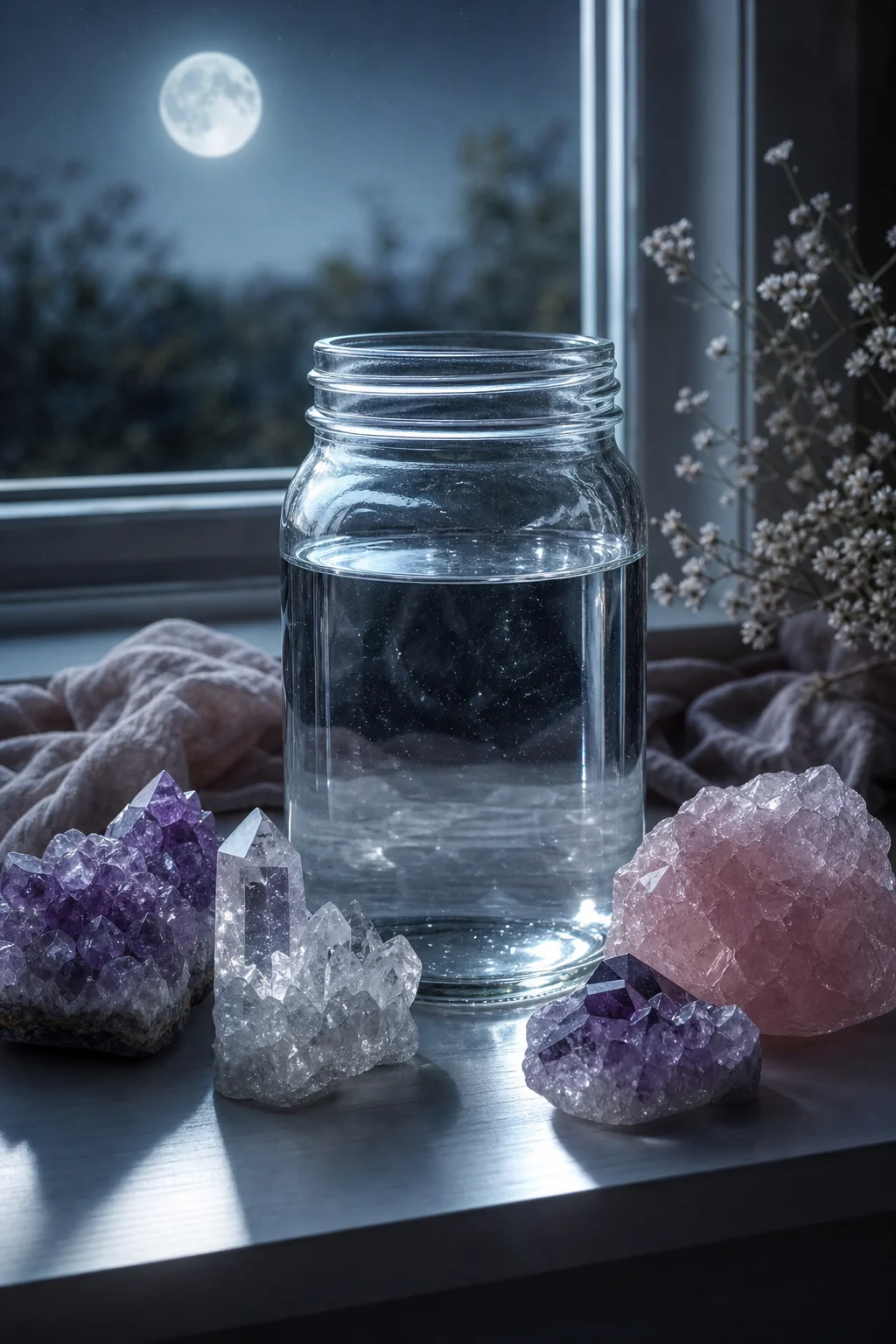
Full moon bathing: Place your mala in indirect moonlight overnight during the full moon. This is a traditional practice across many crystal-working traditions and adds a renewing, purifying quality. Avoid direct sunlight — it can fade stones like Amethyst and Rose Quartz.
FAQ
How many beads should a protection mala have?
Traditional mala beads have 108 beads plus one guru bead. This number has significance across multiple traditions — in Hinduism, there are 108 Upanishads; in Buddhism, there are 108 earthly desires to overcome; in yoga, there are 108 nadis (energy channels) in the body. For protection purposes, the cumulative effect of 108 beads worn together creates a stronger energetic field than fewer beads. However, wrist malas with 16-27 beads can also be effective for targeted protection.
Can I mix more than two stone types in a protection mala?
Absolutely. Some of the most effective protection malas use three or even four stone types. The key is understanding each stone's role: grounding stones (Hematite, Black Tourmaline, Jasper) anchor your energy, shielding stones (Obsidian, Shungite) deflect negativity, and purifying stones (Clear Quartz, Selenite) cleanse the field. A well-designed three-stone mala includes at least one from each category.
How often should I replace or restring my protection mala?
Silk thread naturally degrades over time, especially with daily wear. Inspect your mala monthly by gently tugging the string between beads — if it shows any signs of fraying or thinning, it's time to restring. Most quality malas last 1-3 years before needing restringing. The stones themselves don't expire, but if you feel the mala has become energetically "heavy" despite regular cleansing, it may be time to give it a thorough reset or retire it from daily wear.
Frequently Asked Questions
Which crystals offer the strongest spiritual protection in a mala?
Black tourmaline, obsidian, and tiger's eye are widely regarded as the most powerful protection stones for mala beads. Black tourmaline shields against negative energy, obsidian creates a barrier against psychic attacks, and tiger's eye grounds and stabilizes. Combining any two of these with clear quartz amplifies their protective properties throughout your japa practice.
How do I cleanse and activate my new protection mala?
To cleanse your protection mala, place it under moonlight overnight, smudge it with sage or palo santo, or rest it on a selenite charging plate. Avoid water cleansing with stones like obsidian or tiger's eye. To activate it, hold the mala in your hands, set a clear protection intention, and chant your chosen mantra 108 times to program the beads with your spiritual purpose.


Comments