<h2>Obsidian Stone: Complete Guide to Meaning, Types, Uses, and Care</h2>
Chemical composition
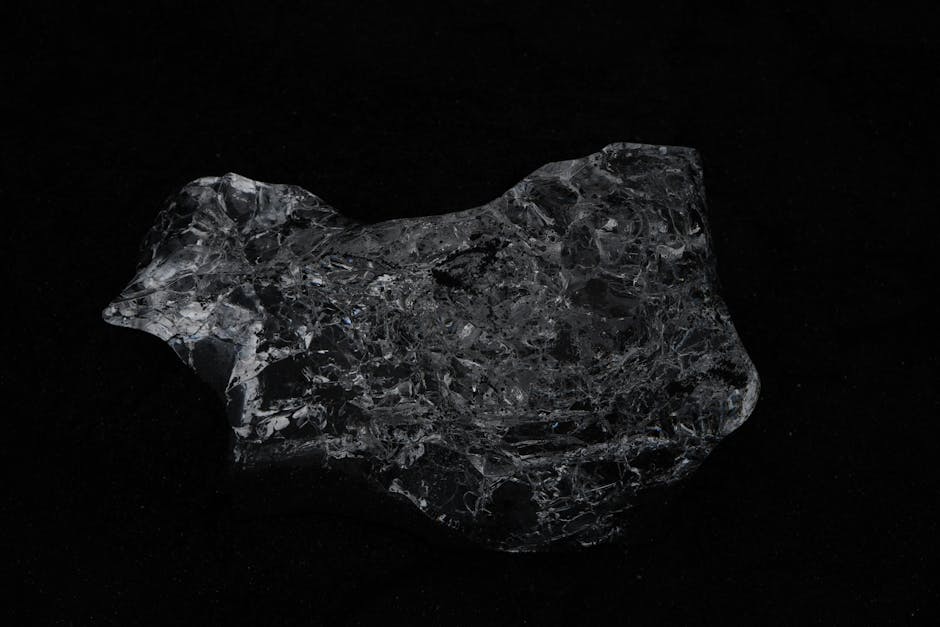
Obsidian is primarily silicon dioxide (SiO₂), the same chemical compound as quartz, amethyst, citrine, and agate. But the similarity ends at the molecular formula. In quartz, the SiO₂ molecules are arranged in a repeating three-dimensional lattice — a crystal structure. In obsidian, the SiO₂ molecules are frozen in a random, disordered arrangement, exactly like window glass. Geologists call this an "amorphous solid" or a "mineraloid" — it has the chemical composition of a mineral but lacks the ordered internal structure that defines one.
The SiO₂ content in obsidian typically ranges from 70% to 75%, with the remainder being oxides of aluminum, potassium, sodium, calcium, iron, and magnesium. The exact trace element profile varies by eruption and location, which is why obsidian from different sources can look and behave differently. Iron oxide (Fe₂O₃) is what gives most obsidian its black color — usually 1% to 5% iron content, though some specimens can contain up to 10%, producing very dark, nearly metallic pieces.
This chemical overlap with quartz but structural difference is what makes obsidan unique among gemstone materials. It's the same building blocks, assembled differently. Think of it like carbon — graphite and diamond are both carbon, but one is soft and opaque while the other is the hardest natural substance on Earth. The structure matters as much as the chemistry.
How obsidian forms
Obsidian is born from volcanic eruptions — specifically, from felsic lava that is rich in silica. When this lava erupts, it contacts water or air and cools extremely rapidly, sometimes within minutes or hours. The fast cooling doesn't give the SiO₂ molecules time to arrange themselves into an orderly crystal lattice. Instead, they're locked into place in their random, disordered state.
This is why obsidian is only found near volcanic activity. It doesn't form slowly underground like most crystals. You need the specific conditions of a rapid surface eruption of silica-rich lava. Most obsidian is geologically young — less than 50 million years old, and often much younger. Older obsidian tends to crystallize over time, a process called devitrification, where the amorphous structure gradually converts to microcrystalline quartz. So truly ancient obsidian is rare.
The temperature range for obsidian formation is roughly 700°C to 900°C at the surface, with cooling rates that need to be rapid enough to prevent crystal nucleation. If the same lava cools slowly underground, it forms rhyolite or granite instead. The difference between a chunk of granite and a piece of obsidian, chemically, is mostly just cooling speed.
Major types of obsidian
Black obsidian is the most common variety and what most people picture. It's uniformly dark, sometimes with a slightly glossy sheen, and can be nearly transparent in very thin pieces. Most of the world's obsidian production is black.
Rainbow obsidian contains microscopic inclusions of magnetite (Fe₃O₄) nanoparticles that create iridescent bands of color when the stone is viewed at the right angle. The colors — typically greens, purples, golds, and blues — aren't pigments; they're caused by light interference patterns, similar to the rainbow effect on the surface of a soap bubble or oil slick. The best rainbow obsidian comes from Mexico, particularly from deposits in Jalisco.
Snowflake obsidian gets its name from white or grayish radial clusters of cristobalite — a high-temperature polymorph of SiO₂ — that formed as the glass began to partially crystallize. These "snowflakes" are actually tiny crystal spherulites, and their distribution and size vary considerably between specimens. The contrast between the black glass and white cristobalite is what makes this variety popular for decorative pieces.
Gold sheen and silver sheen obsidian contain oriented inclusions of gas bubbles or mineral particles that create a metallic luster. Gold sheen obsidian gets its color from tiny inclusions of magnetite or ilmenite, while silver sheen comes from gas bubble inclusions that reflect light. The effect is visible when the stone is rotated under a light source — it appears to have a metallic sheen on the surface, almost like a holographic sticker.
Mahogany obsidian contains iron oxide inclusions that produce reddish-brown banding against a black background. The coloration resembles mahogany wood, hence the name. It's relatively common and is often used for cabochons and decorative objects.
Mohs hardness and physical properties
Obsidian ranks between 5 and 5.5 on the Mohs hardness scale. That's harder than window glass (which is about 5) but softer than steel knife blades (around 5.5) and significantly softer than quartz (7). For context, you can scratch obsidian with a steel file but not easily with a copper coin (Mohs 3).
What obsidian lacks in hardness, it makes up for in sharpness. Obsidian fractures conchoidally — meaning it breaks with smooth, curved surfaces — and the edge of a freshly broken obsidian flake can be just a few nanometers thick. Under an electron microscope, an obsidian edge is smoother and sharper than the finest surgical steel scalpel. This is why obsidian was the preferred material for cutting tools and weapons across multiple cultures for thousands of years.
Obsidian is also relatively dense, with a specific gravity of 2.35 to 2.60, compared to 2.65 for quartz. It has no cleavage planes (because it's not crystalline), a conchoidal fracture, and a vitreous to dull luster. It's brittle — it won't bend or deform, it shatters — which is both what makes it useful for knapping and what makes it challenging to set in jewelry without special care.
Where obsidian comes from
Significant obsidian deposits exist on every continent except Antarctica and Australia (though small deposits have been found in both). The most commercially important sources today are:
Mexico is the world's largest producer, with major deposits in Jalisco, Puebla, and the State of Mexico. Mexican rainbow obsidian and snowflake obsidian are considered some of the finest in the world. The United States has substantial deposits, particularly in the western states — Oregon, California, Idaho, Arizona, New Mexico, and Colorado all have significant obsidian flows. Glass Buttes in Oregon is a well-known collecting site that produces multiple varieties including rainbow, gold sheen, and fire obsidian.
Italy's Lipari Islands and Mount Arci in Sardinia have been sources since antiquity. Obsidian from these Mediterranean sources was traded across Europe during the Neolithic period. Iceland, Turkey (particularly the Cappadocia region), Japan, Kenya, and Armenia all have notable deposits. Armenia's obsidian — sometimes called "Armenian glass" — was a major trade commodity in the ancient Near East.
What's interesting from a geological perspective is that obsidian from different sources has different trace element "fingerprints." By analyzing the concentrations of elements like rubidium, strontium, zirconium, and niobium using X-ray fluorescence (XRF) or neutron activation analysis, archaeologists can determine exactly which volcanic flow a particular obsidian artifact came from. This has been invaluable for reconstructing ancient trade routes.
Historical uses
Humans have been working with obsidian for at least 1.5 million years, making it one of the oldest materials in our toolmaking history. The earliest known obsidian tools come from sites in East Africa, and the material's use spread with human migration across the globe.
Obsidian was the scalpel of the ancient world. The Aztecs used obsidian blades for bloodletting rituals and surgical procedures. Archaeological evidence from sites in Peru shows that Inca surgeons performed successful trepanation (skull surgery) using obsidian blades — and patients often survived, based on bone healing patterns around the surgical sites. Obsidian scalpels are still used in specialized surgical applications today, primarily in eye surgery, because the ultrasharp edge causes less tissue damage and faster healing than steel blades.
In the ancient Near East, obsidian was a luxury material alongside lapis lazuli and gold. It was used for mirrors (polished flat pieces reflect light reasonably well), seals, vessels, and decorative inlays. The Egyptians valued obsidian for both practical and ceremonial objects. Roman naturalist Pliny the Elder wrote about obsidian in his Natural History, noting its volcanic origins — one of the earliest correct geological observations in Western literature.
Obsidian was also a medium for art. Mesoamerican cultures carved elaborate masks, figurines, and jewelry from obsidian. The Aztec sun stone, while primarily basalt, incorporates obsidian inlays. Polynesian cultures used obsidian for tools, and it shows up in Japanese prehistoric sites as well.
Modern uses
Today, obsidian's primary use is decorative and ornamental. Cabochons, beads, carvings, and tumbled stones make up the bulk of commercial production. The gem and mineral market values obsidian for its visual appeal rather than its rarity — it's not particularly scarce, but attractive specimens with good color play (rainbow, sheen effects) command premium prices.
Beyond decoration, obsidian has niche industrial applications. Crushed obsidian is used as an abrasive in some industrial processes. Obsidian blades are used in specialty surgical contexts, as mentioned. And obsidian's chemical composition makes it a subject of ongoing geological research — studying obsidian helps scientists understand volcanic processes and magma chemistry.
In cultural and spiritual contexts, obsidian has been traditionally associated with protection and grounding in various traditions. Mesoamerican cultures considered it a mirror of the soul. In some contemporary practices, black obsidian is used for scrying — gazing into a polished surface to induce a meditative state. Whether or not one finds personal meaning in these practices, the stone's reflective surface and deep black color do lend themselves to contemplative use.
How to care for obsidian
Obsidian is relatively easy to care for, but it does have a few vulnerabilities worth knowing about. It's glass, and like all glass, it can chip or crack if dropped onto a hard surface. The Mohs hardness of 5-5.5 means it can be scratched by harder materials — quartz, topaz, sapphire, diamond — so storing obsidian loose in a jewelry box with harder stones is asking for surface damage.
Cleaning is straightforward: warm water and mild soap, with a soft cloth or brush. Avoid ultrasonic cleaners — while obsidian doesn't react chemically to ultrasonic cleaning, its brittleness means the vibrations could potentially cause internal fractures in pieces with existing micro-cracks. Steam cleaning carries the same risk. Chemical cleaners, acids, and solvents should be avoided.
Long-term storage should be in a soft pouch or compartmented jewelry box, away from direct sunlight (prolonged exposure can very slightly affect the surface sheen) and extreme temperature changes. Obsidian is chemically stable and won't degrade under normal conditions, which is why archaeological obsidian artifacts survive for thousands of years with minimal deterioration.
One thing to watch for: some commercially sold "obsidian" is actually manufactured glass slag from industrial processes, or dyed glass. Genuine volcanic obsidian has characteristic micro-crystalline inclusions and flow structures visible under magnification. If you're paying a premium for a specimen, a quick look with a 10x loupe can help confirm authenticity.
How to tell real obsidian from fakes
The obsidian market isn't flooded with fakes the way some other gemstone markets are, but synthetic and imitation materials do show up. Here's how to spot them.
Real obsidian has microscopic inclusions — tiny mineral crystals, gas bubbles, or flow structures — that are visible under magnification. Even the most visually perfect black obsidian will show some irregularity at 10x magnification. Manufactured glass, by contrast, is often eerily uniform and "too perfect" under magnification. If it looks completely clean and homogeneous, that's actually a red flag.
The weight can also be a clue. Obsidian has a specific gravity of 2.35-2.60, which feels lighter than many people expect for its size. Glass slag from industrial processes sometimes has a different density, and lead glass (used in some decorative pieces) is noticeably heavier. Heft a piece in your hand and compare it to a known genuine specimen if you can.
Temperature is another subtle indicator. Obsidian feels colder to the touch than plastic or resin imitations, similar to how real glass feels cooler than plastic. This isn't definitive, but it's a quick initial check.
For rainbow or sheen obsidian specifically, the color play in genuine specimens shifts naturally with the viewing angle and lighting. Dyed glass often has a flat, uniform color that doesn't change with perspective. If the "rainbow" looks painted on rather than emerging from within the stone, be suspicious.
Price guide
Obsidian is one of the more affordable gemstone materials, which is part of its appeal. Raw or rough black obsidian sells for $1 to $5 per pound in bulk from mineral suppliers. Tumbled black obsidian stones typically run $2 to $8 each depending on size and quality. Cabochons of common black obsidian range from $5 to $25 for standard sizes (10-20mm).
Premium varieties command higher prices. Good quality rainbow obsidian cabochons sell for $15 to $60, with exceptional specimens featuring vivid, well-defined color bands reaching $100 or more. Snowflake obsidian is in a similar range — $10 to $50 for cabochons, with large, well-patterned pieces at the higher end. Gold sheen and silver sheen obsidian fall between $15 and $75 depending on the quality of the sheen effect.
Fire obsidian, which displays iridescent color play from thin-film interference (different mechanism from rainbow obsidian), is the most valuable variety. High-quality fire obsidian cabochons from Glass Buttes, Oregon can sell for $100 to $500, with exceptional pieces reaching into the thousands. This is the obsidian collector's market — it's a niche, and prices reflect the rarity of top-tier material.
Carved obsidian pieces, spheres, and decorative objects vary enormously in price based on size, craftsmanship, and material quality. A small obsidian skull carving might be $20, while a large, detailed piece from a skilled lapidary could be $500 or more.
For most collectors and jewelry makers, obsidian offers an accessible entry point into working with natural stone materials. The prices are reasonable, the material is widely available, and the variety of types means there's always something interesting to find.
Comments