Lemurian Seed Quartz: Ancient Wisdom in Crysta..
June 2, 2026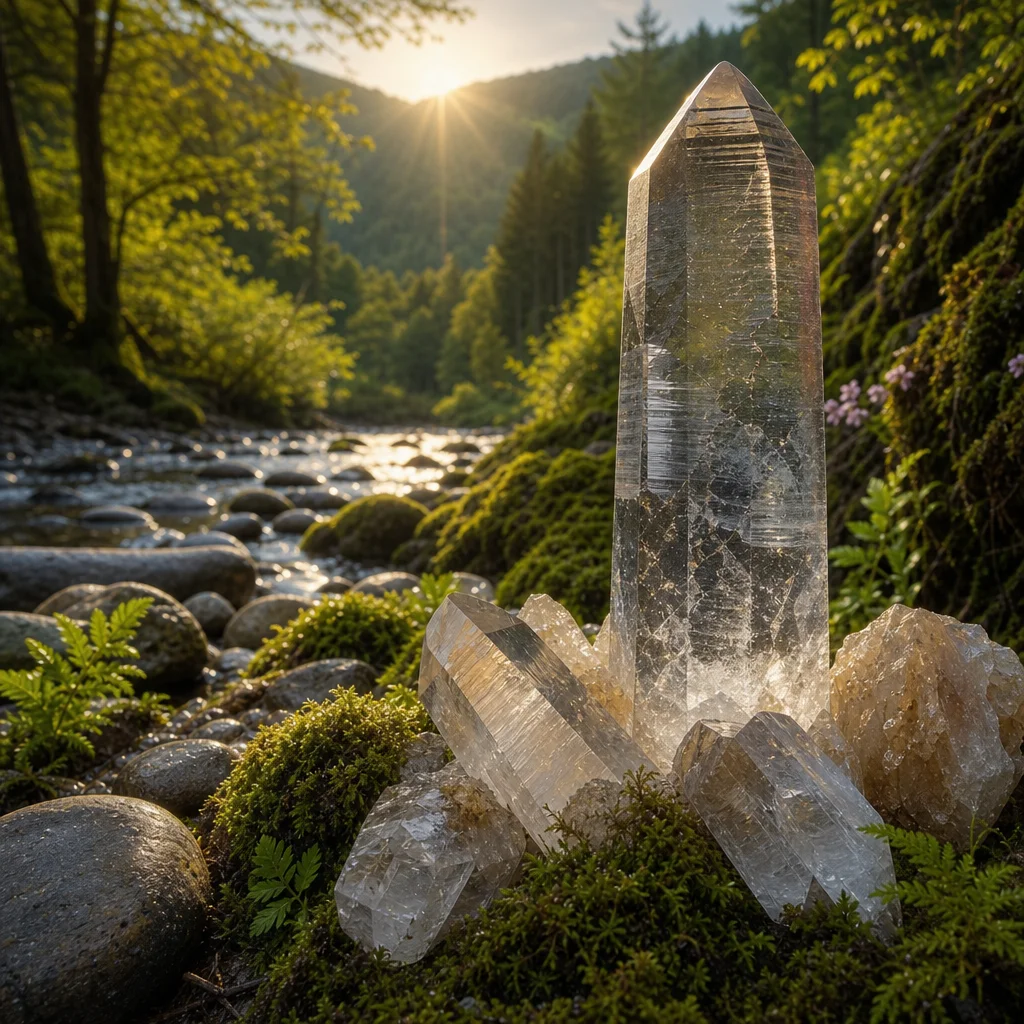
The Allure of Lemurian Seed Quartz
Among the specialized varieties of clear quartz that have captured the crystal community's imagination, Lemurian Seed Quartz holds a unique position. Its distinctive horizontal striations — parallel lines running across the crystal faces that resemble barcodes — set it apart visually from virtually every other quartz variety. These lines aren't surface scratches; they're growth features that record the crystal's formation history in a way that's both scientifically interesting and aesthetically striking.
Beyond their physical characteristics, Lemurian Seed Quartz crystals carry a rich mythology that has developed around them. The name refers to the legendary continent of Lemuria — a hypothesized lost landmass that, according to esoteric traditions, existed in the Pacific Ocean and was home to an advanced, spiritually evolved civilization. According to this mythology, Lemurians encoded information into these crystals before their civilization's decline, leaving behind "seed crystals" that future generations could access.
Whether or not you find the mythology compelling, there's no denying that Lemurian Seed Quartz is a genuinely unusual and collectible variety of quartz. Understanding the geological reality behind these distinctive crystals makes them even more interesting.
Geological Origin: Minas Gerais, Brazil
Authentic Lemurian Seed Quartz comes from a specific geological environment in the state of Minas Gerais, Brazil. This region is one of the world's most prolific sources of mineral specimens, producing not only exceptional quartz but also tourmaline, beryl (emerald and aquamarine), topaz, and dozens of other minerals. The geology that makes Minas Gerais so mineral-rich also created the specific conditions needed for Lemurian Seed Quartz to form.
Minas Gerais sits within the São Francisco Craton, one of the oldest geological formations in South America, dating back over 2.5 billion years. The region has experienced multiple cycles of volcanic activity, hydrothermal fluid flow, and tectonic deformation over geological time. These processes created extensive pegmatite veins — coarse-grained igneous intrusions that are the primary source of gem-quality quartz crystals in Brazil.
Within these pegmatite systems, quartz crystals grew in cavities over millions of years. The specific conditions that produced Lemurian Seed Quartz involved:
- Hydrothermal silica-rich fluids flowing through fractures in the pegmatite
- Cyclical variations in fluid chemistry or temperature that caused periodic changes in crystal growth rate
- Growth interruption and resumption patterns that created the characteristic horizontal striations
- Sufficient space for long, well-formed crystals to develop with minimal matrix contact
The Barcode Striations: What They Really Are
The defining feature of Lemurian Seed Quartz — the horizontal parallel lines — has a straightforward geological explanation. These striations are growth lines, also known as "striations" or "growth horizons." They form when a growing crystal experiences periodic interruptions or changes in its growth conditions.
Imagine a tree trunk's growth rings, but in mineral form. Each horizontal line represents a moment when the crystal's growth paused, changed direction, or shifted in some way — perhaps the silica concentration in the surrounding fluid dropped temporarily, or the temperature shifted slightly, or a minor seismic event disturbed the growth environment. When conditions improved, growth resumed from the existing crystal face, creating a new layer that sits slightly offset from the previous one.
Over many growth cycles, these layers stack up as faint horizontal lines visible on the crystal faces. In most quartz crystals, growth lines are invisible to the naked eye or appear only on specific faces. Lemurian Seed Quartz is unusual in having these lines prominently displayed across multiple faces, particularly the m-faces (the steep faces between the main termination and the body of the crystal).
The barcode appearance is so distinctive that experienced crystal dealers can identify Lemurian Seed Quartz at a glance. However, some other quartz varieties can show similar growth striations, which is why source verification (confirmed Minas Gerais origin) adds confidence to identification.
Physical Characteristics of Genuine Lemurian Seed Quartz
Shape and Form
Most Lemurian Seed Quartz crystals share certain morphological features:
- Elongated hexagonal shape: Typically more slender and elongated than common quartz crystals
- Well-defined termination: Usually a sharp, clear point with well-formed faces
- Horizontal striations: Prominent barcode-like lines across multiple crystal faces, running parallel to each other and roughly perpendicular to the crystal's c-axis
- Often frosted or matte body: The main body of many Lemurian crystals has a semi-frosted or satin-like surface, while the termination point is typically clear
- Occasionally slightly curved: Some specimens show gentle curvature along their length
Size Range
Lemurian Seed Quartz is found in a wide range of sizes, from small thumbnail specimens under 2 centimeters to impressive museum-quality crystals exceeding 30 centimeters in length. The most commonly available pieces fall in the 5-15 centimeter range — large enough to show clear striations and handle comfortably, small enough to be affordable.
Clarity and Inclusions
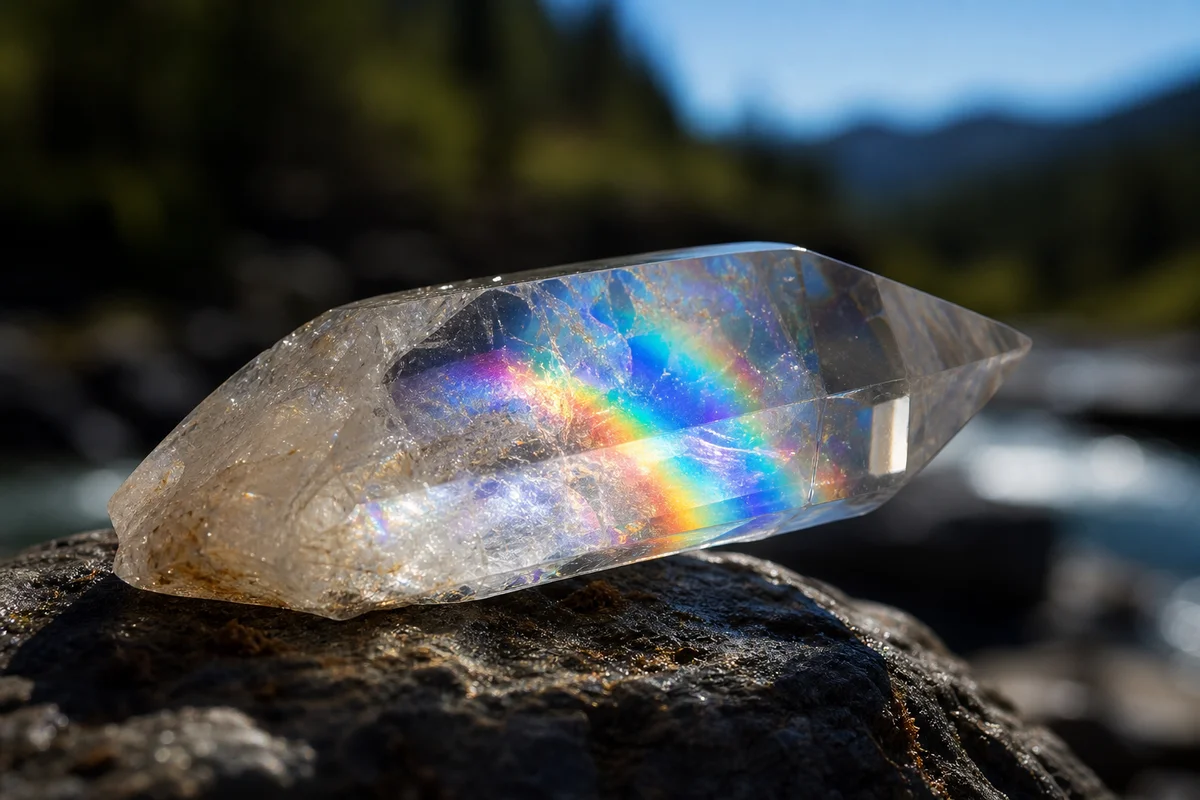
Clarity varies significantly. Some Lemurian crystals are water-clear with minimal inclusions, making the striations appear as subtle etchings on transparent quartz. Others are more included, with phantom growth zones, rainbow inclusions (thin internal fractures that diffract light into spectral colors), or tiny mineral inclusions. Both extremes and everything between are genuine — the clarity is a matter of formation conditions, not authenticity.
Identifying Genuine vs. Artificial Striations
As Lemurian Seed Quartz has gained popularity, some sellers have attempted to create "Lemurian-like" pieces by artificially etching or lasering lines onto regular quartz crystals. Here's how to distinguish genuine from artificial:
Natural striations follow the crystal geometry: Genuine growth lines conform to the underlying crystal structure. They run parallel to each other on each face and maintain consistent spacing. If lines appear irregular, wavy, or don't follow the crystal's natural geometry, they may be artificial.
Natural striations are subtle: True growth lines are shallow — you can feel them with your fingernail, but they're not deeply carved. Artificially etched lines tend to be deeper, more V-shaped in cross-section, and more sharply defined than natural growth lines.
Natural striations have geological consistency: If lines appear on only one face while adjacent faces are completely smooth, this is suspicious. Natural growth striations typically appear on multiple faces of the crystal, though they may be more prominent on some faces than others.
Source verification: The most reliable way to confirm authenticity is purchasing from reputable dealers who can document the Minas Gerais origin of their specimens. While non-Brazilian quartz can show similar growth features, the term "Lemurian Seed Quartz" specifically refers to material from this geological context.
How People Work With Lemurian Seed Quartz
In crystal healing and meditation practices, Lemurian Seed Quartz has developed a specific set of associations and usage patterns that reflect its distinctive appearance.
"Reading" the Striations
The most common practice with Lemurian Seed Quartz involves running a finger along the striations (often called "barcodes" in crystal community language). Practitioners believe that by gently tracing these lines, one can access information or wisdom encoded in the crystal. The horizontal movement (as opposed to the vertical movement of rubbing a worry stone) is said to align with the way information was "programmed" into the crystal.
Whether or not you subscribe to the metaphysical framework, the physical act of slowly tracing the striations is genuinely meditative. The ridges provide tactile feedback that anchors your attention and creates a rhythmic, repetitive motion — both established meditation aids. Many people report that the practice naturally induces a calm, focused state.
Meditation Anchor
Lemurian Seed Quartz is widely used as a meditation focus object. The elongated shape fits comfortably in the hand, the striations provide tactile interest, and the visual complexity of the crystal faces rewards sustained contemplation. Some practitioners hold the crystal vertically with the termination pointing upward during meditation, believing this orientation aligns with energy flow patterns.
Grid and Altar Work
Due to their distinctive appearance and the mythology surrounding them, Lemurian Seed Quartz crystals are popular in crystal grids and on personal altars. Their elongated shape makes them effective as "linking stones" in grids — positioned between other stones to create energetic connections. In altar settings, a single prominent Lemurian crystal can serve as a focal point and conversation piece.
Care and Maintenance
Clear quartz is one of the easiest minerals to care for (Mohs 7, chemically inert, non-reactive), but a few considerations apply specifically to Lemurian Seed Quartz:
- Protect the striations: While the growth lines are part of the crystal structure and can't be worn away through normal handling, storing Lemurian crystals loose in a bag with harder minerals could cause surface scratching that makes the striations harder to see.
- Cleaning: Warm water with mild soap works perfectly. A soft brush can be used for the striation grooves if dust accumulates. Avoid abrasive cleaners.
- Display: For display specimens, position the crystal to maximize visibility of the striations — typically with the striated faces facing forward under good lighting.
- Charging: If you follow crystal charging traditions, moonlight (particularly full moon) is commonly recommended for Lemurian crystals. From a practical standpoint, moonlight exposure is harmless and won't damage the crystal.
Collecting Lemurian Seed Quartz
For mineral collectors, Lemurian Seed Quartz offers a specific collecting challenge: finding high-quality specimens with well-defined, clearly visible striations and good overall crystal form. The best specimens combine sharp terminations, prominent striations on multiple faces, and interesting clarity or inclusion features.
Prices vary widely based on size, clarity, and striation quality. Small specimens (2-5 cm) with visible striations are typically $10-30. Medium specimens (5-15 cm) with good striations and clear terminations range from $30-100. Large, museum-quality pieces with exceptional striations can command hundreds to thousands of dollars.
As with any mineral specimen, buy from reputable dealers who can provide source information and accurate photographs. The Minas Gerais origin is a significant factor in authenticity, and dealers who specialize in Brazilian minerals are generally the best sources for genuine Lemurian Seed Quartz.
Whether you're drawn to Lemurian Seed Quartz for its mythology, its geological uniqueness, or simply its striking appearance, these crystals deserve their reputation as one of the most distinctive quartz varieties available. The barcode striations tell a genuine geological story of cyclical growth conditions that no other quartz variety displays quite as dramatically — and that alone makes them worth knowing about.
Frequently Asked Questions
Where are Lemurian Seed Quartz crystals naturally found?
The original and most famous Lemurian Seed Quartz crystals were discovered in the Diamantina region of Minas Gerais, Brazil. While similar quartz specimens have since been unearthed in other global locations, this specific Brazilian mine remains the primary and most highly regarded source for authentic stones.
What is the spiritual legend associated with Lemurian Seed Quartz?
In the crystal healing community, these stones are believed to have been programmed by the ancient, mythical civilization of Lemuria with encoded universal wisdom and unconditional love. Legend suggests they were intentionally seeded across the globe to be discovered by future generations when humanity was finally ready to access their higher consciousness.
Do Lemurian Seed Quartz crystals come in different colors?
While they are most commonly found as clear quartz, authentic Lemurian crystals can also naturally occur in pale pink, smoky, or golden tan hues. Pink Lemurians are particularly prized among collectors and get their delicate coloration from a fine dusting of hematite or other trace minerals present during their formation.
How is Lemurian Seed Quartz used in energy work and meditation?
Practitioners often use these distinct crystals to access higher states of consciousness by holding them during deep, focused meditation sessions. They are highly valued as energetic tools believed to stimulate the release of stored cosmic information, promote deep inner peace, and facilitate a stronger connection to spiritual realms.
How do you properly cleanse and care for Lemurian Seed Quartz?
Because it ranks at a 7 on the Mohs scale of mineral hardness, you can safely clean this durable crystal using warm water, mild soap, and a soft brush. For energetic clearing and recharging, collectors recommend placing the stones under natural moonlight, bathing them in sound frequencies, or using smoke from sage or palo santo.

Comments