How to Tell if a Sapphire Is Real: 9 Practica...
June 5, 2026
Why Verifying a Sapphire Matters
Sapphires sit at the top of the colored gemstone market, and where there's value, imitations follow. The market is flooded with synthetic sapphires grown in laboratories, glass substitutes, and even doublets — thin slices of real sapphire glued to a glass or synthetic base. Knowing how to tell a real sapphire from a fake one protects your investment and ensures you're getting what you paid for.
The good news is that sapphire's physical properties are distinctive enough that several reliable identification methods don't require a gemology lab. You can run meaningful tests at home with basic tools. No single test is conclusive on its own, but combining two or three of these checks will give you high confidence about whether your stone is genuine natural sapphire, synthetic sapphire, or something else entirely.
Test 1: The Scratch Test (Mohs Hardness)
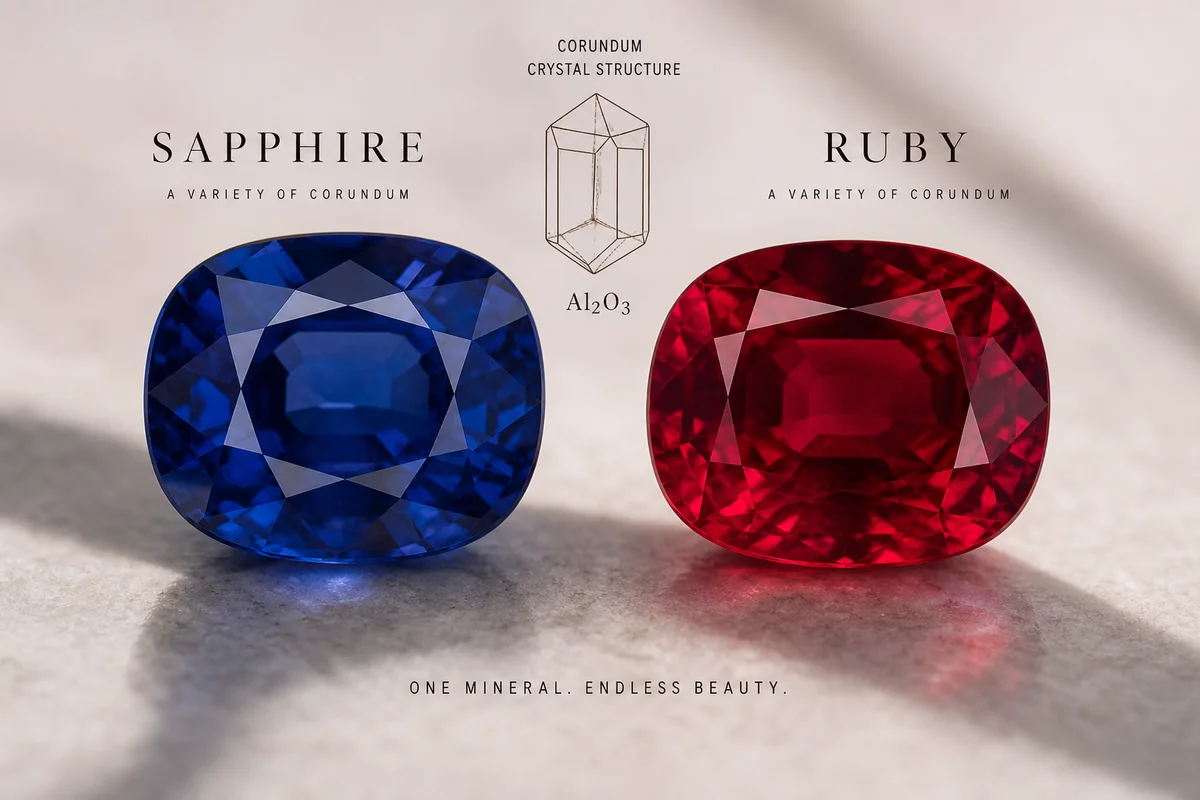
Corundum — the mineral family that includes both sapphire and ruby — ranks 9 on the Mohs hardness scale. Only diamond is harder. This means a genuine sapphire will scratch glass easily and will resist being scratched by almost any common material.
Find a piece of scrap glass or an old mirror. Press the sapphire firmly against the surface and drag it with moderate pressure. A real sapphire will leave a clear scratch mark on the glass. Glass imitations will not — the glass might even scratch the fake stone instead. Keep in mind that synthetic sapphire (grown in a lab) is also corundum with the same hardness, so this test distinguishes real corundum from glass but doesn't separate natural from lab-grown.
Be cautious with this test. Don't use it on a mounted stone in a delicate setting, and avoid pressing so hard that you chip or fracture the gem. A controlled, moderate drag is sufficient.
Test 2: The Breath Fog Test
This is one of the simplest and most accessible tests. Real sapphire has exceptional thermal conductivity — it conducts heat away from its surface very quickly. When you breathe warm, moist air onto the surface of a genuine sapphire, the fog should dissipate almost instantly, within one or two seconds.
Hold the stone close to your mouth and exhale a warm breath onto it, like you would to fog up a window. Watch how quickly the condensation clears. Real sapphire: the fog vanishes almost before you finish exhaling. Glass imitations: the fog lingers for three to five seconds or more, just like fog on any glass surface. Cubic zirconia also clears fairly quickly, but not as fast as corundum.
Test 3: Check for Inclusions Under Magnification
This is where things get interesting because the type of inclusions tells you not just whether the stone is genuine but whether it's natural or synthetic. You need a jeweler's loupe (10x magnification) or, at minimum, a decent magnifying glass.
Natural sapphire typically contains a chaotic assortment of inclusions: tiny needle-like crystals (rutile silk), tiny crystals of other minerals (zircon, apatite, spinel), small liquid-filled cavities, fingerprints of growth zoning, and sometimes silk-like patterns that create a star effect in star sapphires. These inclusions are random, asymmetric, and feel "organic" in their arrangement.
Synthetic sapphire (Flame Fusion / Verneuil method) shows curved growth lines, like the lines on a phonograph record, visible under magnification. These curved striae are a dead giveaway for Verneuil-grown stones. Flux-grown synthetics may contain flux residue — tiny hexagonal or angular inclusions of the flux material. Czochralski (pulling) method synthetics show straight growth zoning rather than curved lines.
Glass imitations may contain round bubbles — perfectly spherical, evenly distributed. Natural sapphire almost never contains round gas bubbles.
Test 4: Color Consistency and Saturation
Natural sapphire rarely has perfectly even color throughout the stone. Look at the stone from multiple angles and under different lighting conditions — daylight versus incandescent versus fluorescent. Natural sapphire often shows color zoning: areas of deeper blue next to slightly lighter zones, or subtle variations in hue. This is especially true for unheated stones from Sri Lanka or Madagascar.
Synthetic sapphires, particularly Verneuil-grown stones, tend to have unnaturally even color. If the color is absolutely uniform from every angle and under every light source, and the saturation seems almost too perfect, that's a flag. Lab-grown stones often display colors that are slightly "off" — either too vivid or with a slightly artificial tone compared to natural stones.
Beware of sapphires with color that only exists on the surface. Some treatments use diffusion coating to add a blue layer to the outside of a pale or colorless stone. If you can see color concentration around the facet junctions or if the color seems shallower near the girdle, it may be a diffusion-treated stone.
Test 5: UV Fluorescence Check
Many sapphires fluoresce under ultraviolet light, but the pattern varies between natural and synthetic stones. A basic UV flashlight (long-wave, 365nm) costs about $10 online and provides useful data.
Sri Lankan sapphires often show strong red fluorescence under long-wave UV due to chromium content. Australian sapphires (iron-rich) typically show no fluorescence at all. Synthetic sapphires from the Verneuil process may fluoresce greenish or show no response. A strong, even green fluorescence is actually more typical of flux-grown synthetics than naturals.
This test isn't definitive on its own because fluorescence varies enormously among natural sapphires depending on their geographic origin and trace element content. But unusual fluorescence combined with other red flags is worth noting.
Test 6: The Density Test
Corundum has a specific gravity of 3.98-4.05 — roughly four times the density of water. If you have a precision scale (accuracy to 0.01g or better), you can run a simple density calculation.
Weigh the stone in air. Then suspend it in water using thin thread or wire and weigh it again. Divide the air weight by the difference between air weight and water weight. The result should be approximately 4.0 for real sapphire. Glass has a specific gravity of about 2.5, cubic zirconia about 5.6-6.0, and spinel about 3.6.
This test clearly separates corundum from most common imitations. Synthetic sapphire will give the same reading as natural since they share identical mineral composition, but at least you'll know whether you have real corundum or a glass substitute.
Test 7: Refraction and Light Behavior
Place the sapphire table-down on a printed page or a line of text. Look through the stone from above. If the text appears doubled, that's birefringence — a property of doubly refractive minerals. However, corundum is actually uniaxial, so the doubling effect is subtle compared to strongly doubly refractive stones like calcite.
A more useful visual test: hold the stone face-up under a strong light and look through the side of the pavilion. Natural sapphire tends to produce a slightly "sleepy" or silk-like internal appearance due to rutile needle inclusions. Glass and synthetic stones often look excessively clean and "bright" in a way that seems clinical.
Test 8: The Transparency and Brilliance Check
Real sapphire, even opaque or heavily included specimens, has a distinctive internal "life" when viewed under strong light. The way light plays inside the stone — bouncing between internal inclusions, revealing subtle zoning, producing a soft glow — differs from the static, flat look of glass or plastic imitations.
Certified gemologists call this "fingerprint character." Every natural stone has one. Glass imitations look too uniform, and while high-quality synthetics can mimic internal features, they often do so with a mechanical regularity that feels wrong to an experienced eye. This is subjective, but after comparing a few genuine stones with known fakes, most people develop an instinct for it.
Test 9: Price Reasonableness
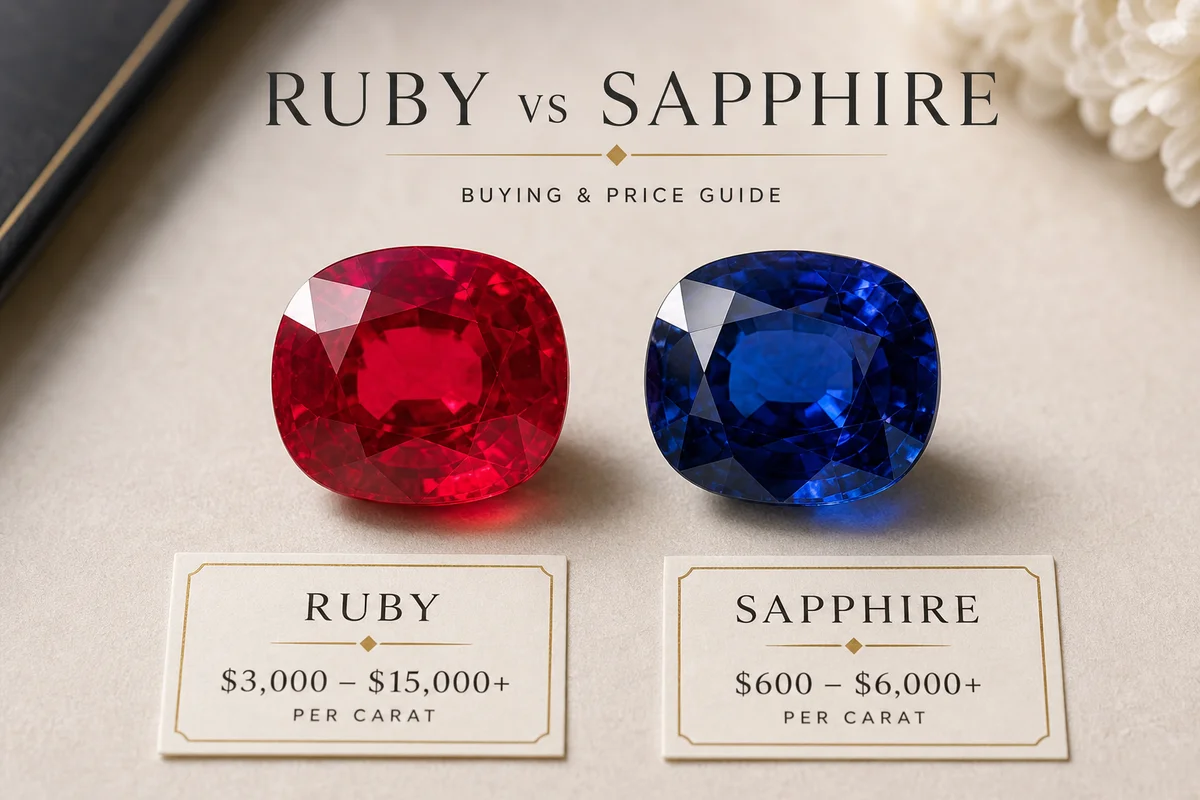
Not a physical test, but often the most telling indicator. Natural sapphire is genuinely expensive — even lower-quality commercial-grade stones cost significant money. A 1-carat heated blue sapphire with decent color retails for $300-800 minimum. Unheated stones with strong color command $1,000-3,000 per carat and up.
If someone offers you a large, deeply colored sapphire for $50, it's almost certainly synthetic or glass. Natural sapphire doesn't come cheap, and prices that seem too good to be true almost always are. This doesn't mean every expensive sapphire is natural — but every suspiciously cheap sapphire is definitely not.
When to Seek Professional Verification
If you're dealing with a valuable stone — anything over $500 — invest in a professional gemological certification. The Gemological Institute of America (GIA), the American Gem Society (AGS), and the Swiss Gemmological Institute (SSEF) all provide reliable certification that identifies natural vs. synthetic origin and notes any treatments.
A GIA report for a sapphire typically costs $150-300 depending on the stone's weight. That's a small price to pay for confidence when you're investing thousands. The report will specify color origin (natural vs. treated), any clarity enhancements, and whether the stone is natural or laboratory-grown.
Frequently Asked Questions
Can synthetic sapphire pass all these tests?
Synthetic sapphire is real corundum with the same hardness, density, and refractive index as natural sapphire. It will pass the scratch test, density test, and fog test. The main giveaway is under magnification: look for curved growth lines (Verneuil method) or gas bubbles in flux-grown stones. A gemologist can identify most synthetics with a loupe.
Does a real sapphire always have inclusions?
Not always. Some natural sapphires — particularly heat-treated stones from certain origins — can be remarkably clean. However, flawless sapphires are rare and valuable. If a stone is perfectly clean, large, and inexpensive, synthetic is the most likely explanation.
What's the difference between heated and unheated sapphire?
Heat treatment is an accepted industry practice that improves color by dissolving rutile silk and reducing blue-green tones. Over 90% of commercial sapphires are heated. Unheated stones command a significant premium because they retain their natural state. Both are "real" — heat treatment is permanent and doesn't degrade the stone.
Frequently Asked Questions
Can a real sapphire scratch glass?
Yes, a real sapphire can easily scratch glass. Ranking 9 on the Mohs hardness scale, sapp
Frequently Asked Questions
Does a real sapphire have bubbles inside?
Natural sapphires form over millions of years, creating unique mineral traits like tiny crystals or rutile silk. If you examine a gem with a loupe and see perfectly round bubbles inside, it is almost certainly glass or a cheap synthetic simulant. At SagStone, our artisans hand-select genuine, earth-grown crystals, celebrating their authentic natural beauty rather than artificial perfection.

Comments