How to Tell if a Diamond Is Real at Home: 10 ...
June 5, 2026
The Stakes of Diamond Verification
Diamonds are the most valuable gemstone per carat on the commercial market, and that value attracts imitations. Moissanite, cubic zirconia (CZ), synthetic diamonds, glass, and even polished white sapphire all circulate as diamond substitutes — sometimes fraudulently, sometimes openly marketed as alternatives. Knowing how to run basic verification tests at home protects you from overpaying and helps you understand what you actually own.
These tests are ordered from easiest to most technical. No single test conclusively proves a diamond is real, but combining several tests dramatically increases your confidence. The goal is to narrow the field from "could be anything" to "almost certainly diamond" or "probably not diamond." For valuable stones, professional gemological certification is still the gold standard, but these home methods give you a meaningful starting point.
Test 1: The Water Drop Test
This is the simplest and most accessible test, requiring nothing but water and the stone. Diamond has exceptional surface tension properties — water beads up on a genuine diamond surface rather than spreading out into a thin film.
Place the stone on a flat surface with the table (top flat face) facing up. Using a pipette or simply your fingertip, place a single drop of water on the surface. A real diamond will hold the water in a tight, round bead. The surface tension of diamond is among the highest of all natural materials, so the drop maintains its shape. Glass, CZ, and moissanite have lower surface tension, and the water droplet will spread out more quickly and flatten.
The test works best on clean stones. Oils, lotions, or residues on the surface will interfere with the water behavior. Clean the stone with rubbing alcohol and a soft cloth before testing.
Test 2: The Fog or Breath Test
Diamond has extremely high thermal conductivity — roughly four times that of copper. When you breathe warm, moist air onto a diamond surface, the heat dissipates almost instantly, and any condensation vanishes within one to two seconds.
Hold the stone close to your mouth and exhale forcefully (like fogging a window). A real diamond: the fog clears almost immediately, within a second or two. Moissanite: clears fairly quickly too, though slightly slower than diamond. Cubic zirconia: fog persists for three to five seconds, similar to glass. This test separates diamond and moissanite (both high thermal conductivity) from glass and CZ (lower conductivity), but doesn't reliably distinguish diamond from moissanite.
Test 3: The Newspaper Read-Through Test
This test checks a diamond's refractive properties. Real diamonds have a high refractive index (2.42), which means they bend light sharply and don't allow clear visibility through the stone when viewed from above.
Place the stone table-down on a piece of newspaper with regular-sized text. Try to read the text through the stone. A real diamond refracts light so strongly that you won't be able to read the text clearly — it'll be a blurred, distorted mess. Cubic zirconia (refractive index 2.15-2.18) still allows some text legibility, though distorted. Glass is nearly transparent through. Moissanite (2.65-2.69) actually bends light even more than diamond, so this test alone won't separate them.
The test works best with round brilliant cuts because the pavilion facets redirect light effectively. Emerald cuts or other step-cut styles allow more light to pass straight through, which can give misleading results. Always test on a well-lit surface.
Test 4: UV Fluorescence Check
About 30% of natural diamonds fluoresce under ultraviolet light, and the fluorescence is typically blue. This is a useful diagnostic because the fluorescence pattern can help distinguish natural diamond from some synthetics and simulants.
Use a UV flashlight (365nm long-wave). In a dark room, shine the UV light directly on the stone. Blue fluorescence strongly suggests natural diamond. No fluorescence doesn't rule out diamond — roughly 70% don't fluoresce. Yellow fluorescence can indicate certain treatments or high-nitrogen diamonds.
Moissanite typically shows green fluorescence, which is a useful differentiator from diamond. CZ may fluoresce yellow or orange, or not at all. Glass usually shows no fluorescence. A blue response combined with strong thermal conductivity (Test 2) is a strong indicator of natural diamond.
Test 5: The Weight vs. Size Test
Diamond has a specific gravity of 3.52 — fairly consistent across all diamonds regardless of quality or color. If you have a precision scale and know the stone's approximate dimensions, you can calculate whether the density matches diamond.
Most jewelry store diamonds are already weighed, so compare the stated carat weight against the visible size. A 1-carat round brilliant diamond measures approximately 6.4mm across. If you have a "1-carat" stone that appears larger than 6.5mm, it may be CZ (specific gravity 5.6-6.0, so a 1-carat CZ looks smaller than a 1-carat diamond) or glass (specific gravity ~2.5, so a 1-carat piece of glass looks significantly larger). Moissanite (specific gravity 3.22) is close to diamond but slightly lighter, so a 1-carat moissanite will be marginally larger than a 1-carat diamond of the same cut.
The density calculation (air weight ÷ (air weight - water weight)) gives a specific gravity number. 3.50-3.54 = diamond. 5.6-6.0 = CZ. 3.17-3.24 = moissanite. 2.4-2.5 = glass.
Test 6: The Scratch Test (With Caution)
Diamond ranks 10 on the Mohs hardness scale — it's the hardest natural substance known. A genuine diamond will scratch corundum (ruby/sapphire, hardness 9) and, of course, any material softer than corundum. Glass scratches easily under diamond.
However, this test has limited practical value at home because very few common materials are harder than diamond. If the stone scratches glass, that narrows the field to diamond, moissanite (hardness 9.25), and corundum (hardness 9) — but you probably already know it's not ruby or sapphire. More importantly, this test is destructive: you'll scratch your glass surface, and if the stone is set in a ring, you risk damaging the mounting.
Use this test only on loose stones and scrap glass. Never use it on mounted stones in settings you value. The risk of damaging the prongs or setting outweighs the limited diagnostic value.
Test 7: Fire and Brilliance Observation
Diamond's high dispersion (0.044) creates visible "fire" — those rainbow flashes of color that separate from white light when it enters and exits the stone. Under strong light, a well-cut diamond shows distinct rainbow spectral colors flashing across the facets as you tilt the stone.
Compare the fire intensity of your stone to what you'd expect from a diamond. CZ has higher dispersion (0.060) and actually shows more fire than diamond — excessively so, with almost gaudy rainbow effects. Moissanite has much higher dispersion (0.104) and displays overwhelming rainbow fire that's immediately recognizable to experienced gemologists. If the fire seems too much, too colorful, or too perfectly rainbow-ordered, it may be CZ or moissanite rather than diamond.
This test requires some experience to interpret. If you don't regularly handle diamonds, it's hard to calibrate what "normal" fire looks like. Visit a jeweler and look at known diamonds under strong halogen or LED light to develop a baseline for comparison.
Test 8: The Thermal Probe (Electronic Diamond Tester)
Small electronic diamond testers are available for $10-30 online. These devices use thermal conductivity sensors to distinguish diamond (high thermal conductivity) from CZ and glass (low thermal conductivity). Most have a simple indicator: green/red light or beep/no-beep.
These testers work well for distinguishing diamond from CZ, glass, and most simulants. The critical limitation: they cannot reliably distinguish natural diamond from moissanite, because moissanite also has high thermal conductivity. If the tester says "diamond," you need to know whether it's also testing for moissanite. Higher-end testers ($50-150) include moissanite detection via electrical conductivity testing, which is the more reliable method for that specific distinction.
For quick screening, a basic thermal tester is useful. For definitive identification, you need a tester that checks both thermal and electrical conductivity.
Test 9: Setting and Metal Quality
Real diamonds are typically set in high-quality metals — platinum, 18K gold, or sometimes 14K gold in more affordable pieces. The setting craftsmanship provides clues: genuine diamond rings have secure, professional prongs, well-seated stones, and often a hallmark indicating metal purity.
If a stone set in sterling silver is claimed to be a 2-carat diamond, be deeply suspicious. Sterling silver settings for large diamonds are extremely rare in legitimate jewelry. Similarly, if the prongs are poorly formed, the stone sits loosely, or the metal shows signs of cheap casting, the stone may not be what's claimed.
This is circumstantial evidence, not a definitive test. But in combination with the physical tests above, setting quality provides additional data points for your assessment.
Test 10: Professional Certification
For stones over $500 in estimated value, professional certification is the only way to be certain. The Gemological Institute of America (GIA) and the International Gemological Institute (IGI) are the two most widely recognized certifying bodies. A GIA diamond grading report provides an unambiguous statement about whether the stone is natural or laboratory-grown, its exact weight, color grade, clarity grade, and cut quality.
GIA certification costs $80-200+ depending on the stone's weight and the level of detail in the report. For expensive diamonds, this cost is trivial compared to the value of the stone. Always request certification before purchasing a diamond of significant value, and be skeptical of sellers who offer excuses for why their stones aren't certified.
Understanding Lab-Grown Diamonds
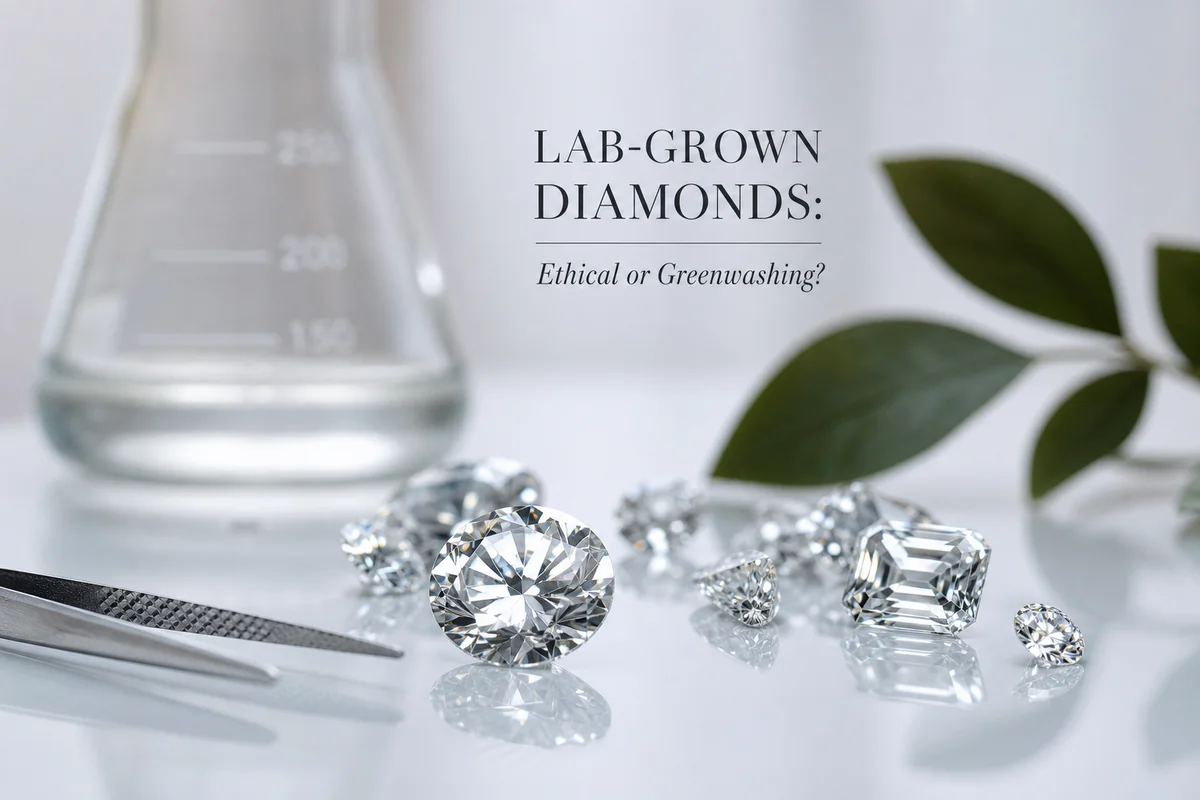
Laboratory-grown diamonds are real diamonds — chemically, physically, and optically identical to natural diamonds. They have the same hardness (10), the same refractive index (2.42), and the same thermal conductivity. They will pass every physical test on this list. The only way to distinguish them from natural diamonds is through specialized laboratory equipment that detects growth patterns, trace element signatures, or the presence of certain defects characteristic of the growth method (HPHT vs. CVD).
Lab-grown diamonds are typically 30-70% cheaper than natural diamonds of comparable quality. They're not "fake" diamonds — they are diamonds, just produced in a laboratory instead of the Earth's mantle. However, if someone sells you a lab-grown diamond as a natural diamond at natural diamond prices, that's fraud, and you have legal recourse.
Frequently Asked Questions
What's the easiest single test to do at home?
The breath fog test (Test 2) requires nothing but the stone and your breath. If the fog disappears almost instantly, the stone has high thermal conductivity consistent with diamond or moissanite. If it lingers for several seconds, it's probably glass, CZ, or another simulant. It's not definitive but takes five seconds and gives you useful information.
Can a jeweler tell if my diamond is real in seconds?
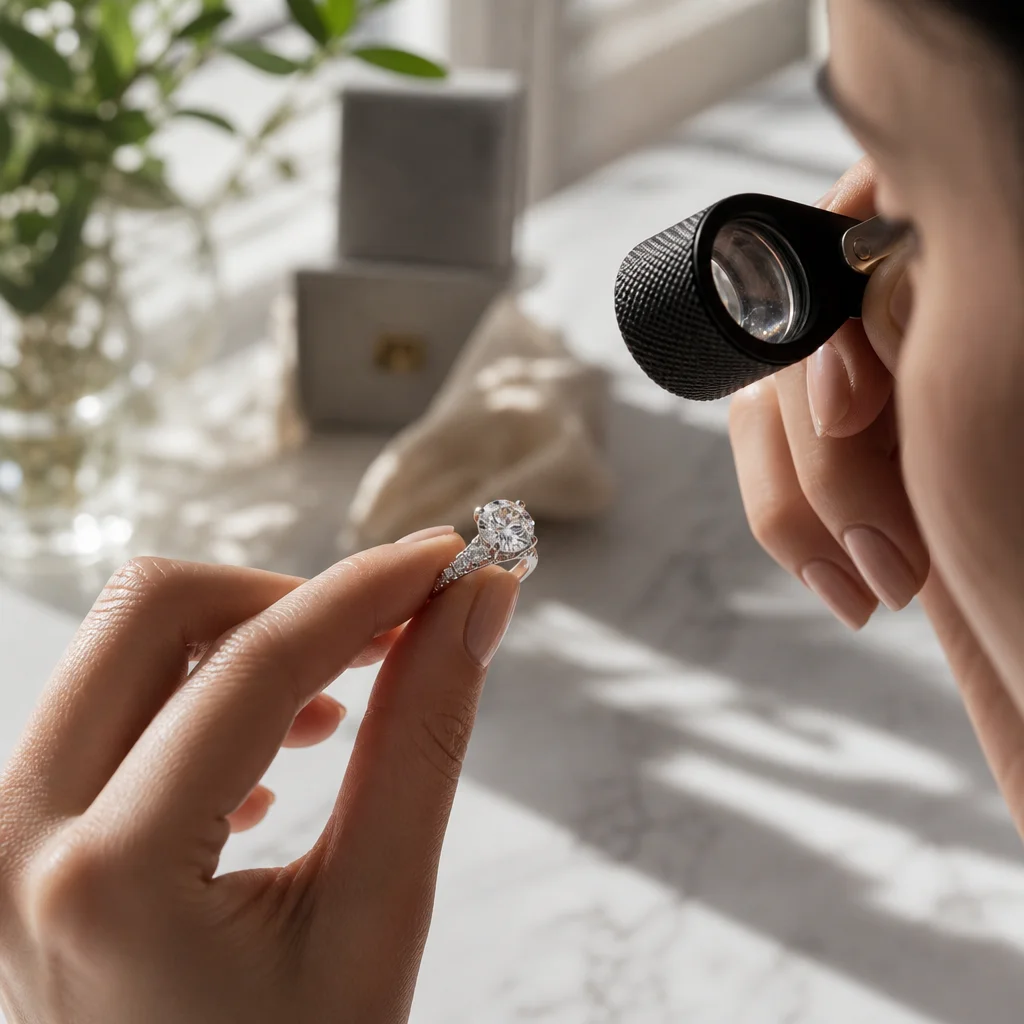
Yes. An experienced jeweler with a loupe can usually identify a diamond within 30 seconds. They're checking for the characteristic brilliance pattern, inclusions typical of natural diamond, and growth features that distinguish it from simulants. A thermal conductivity tester provides additional confirmation in about two seconds.
Do real diamonds always have inclusions?
No. Flawless diamonds (internally flawless or VVS1 clarity) exist and are valuable precisely because they're rare. However, most natural diamonds in the SI-I range have visible inclusions under 10x magnification. If a stone appears completely clean under magnification and is also affordable, lab-grown diamond is the most likely explanation.
Frequently Asked Questions
Does a real diamond scratch glass?
Yes, a genuine diamond is hard enough to scratch glass because it ranks at the top of the Mohs hardness scale. However, this scratch test can be risky. At SagStone, we advise caution with DIY tests, as you could accidentally damage your beautiful stone or the glass. Instead of risking your artisan handcrafted jewelry, try safer methods like the fog test, or rely on a professional appraisal to verify your stone's true quality.
Do real diamonds glow under UV light?
Many natural diamonds emit a soft blue glow under ultraviolet light, known as fluorescence. However, not all authentic diamonds will glow, so a lack of fluorescence does not mean your stone is fake. If you are admiring a piece from our SagStone handcrafted collection and want to explore its unique traits, using a UV light can be a fun way to see its natural reaction, but it should not be your only method for testing a stone's authenticity.


Comments