Real Aquamarine Identification Guide
May 31, 2026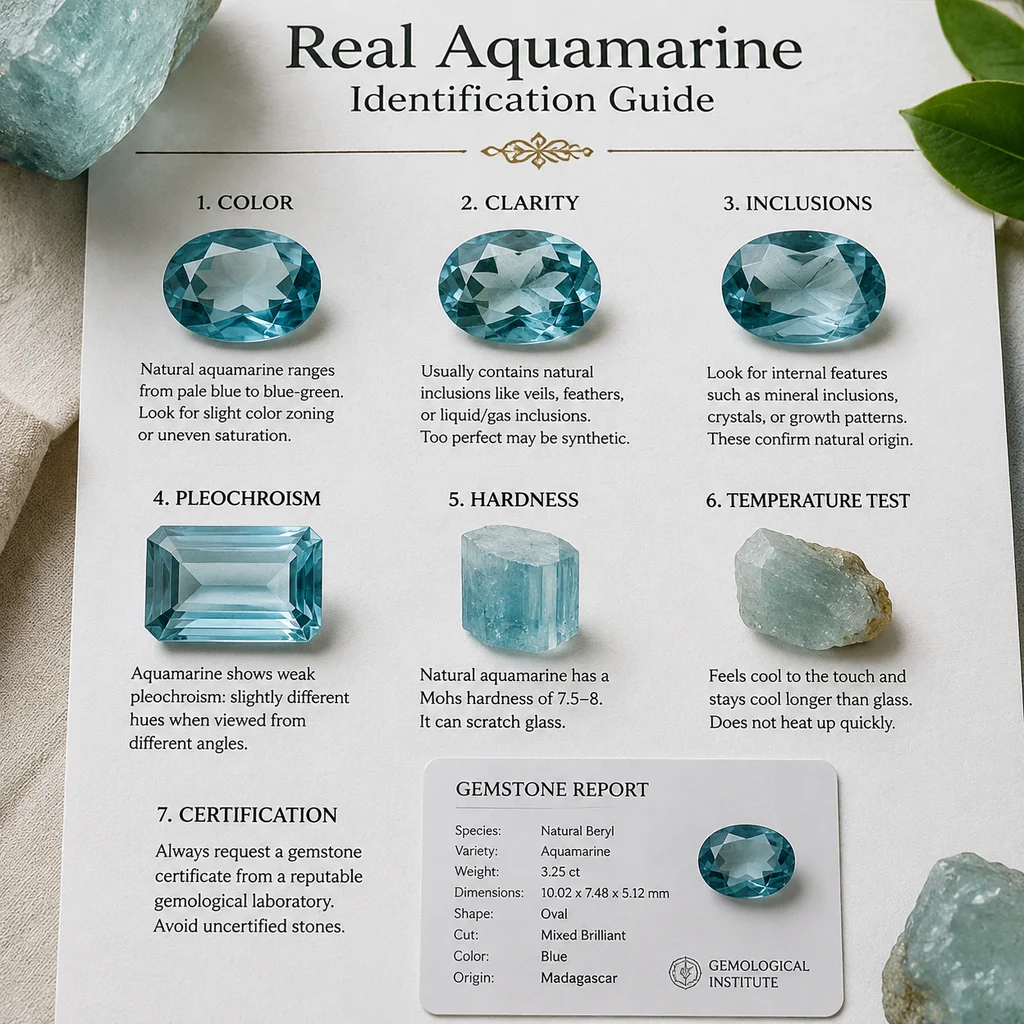
Why Authenticity Testing Matters More Than You Think
Aquamarine sits in the beryl family alongside emerald and morganite. Its chemical formula—Be₃Al₂Si₆O₁₈—makes it a beryllium aluminum silicate, and that specific composition gives it properties no ordinary glass can replicate. The problem? Fake aquamarine has flooded the market over the past decade, and the fakes have gotten better at mimicking the real thing.
I've handled hundreds of aquamarine specimens over the years, from rough mine-run material to faceted gemstones costing thousands per carat. The fakes I encounter most often fall into three categories: glass filled with blue dye, lab-grown beryl that technically shares the same chemistry but lacks geological formation, and blue topaz that's been heat-treated to look nearly identical to aquamarine. Each of these requires a different detection method, which is why a single "quick test" won't cut it.
Let me walk you through the five tests that actually separate real aquamarine from convincing imposters, ranked from easiest to most reliable.
Test 1: The Scratch Test (Mohs Hardness 7.5–8)
Aquamarine ranks 7.5 to 8 on the Mohs hardness scale. That's harder than steel (5.5), glass (6.5), and most metals you'd encounter in daily life. This hardness is one of the most reliable identifiers because fakes made from glass, plastic, or resin simply can't match it.
Here's how to perform the scratch test safely:
Step 1: Find a piece of unglazed porcelain (the bottom of a ceramic mug works). The porcelain has a Mohs hardness of about 6–6.5.
Step 2: Drag the aquamarine firmly across the porcelain surface. Real aquamarine will leave a faint white streak (the porcelain being scratched), while the stone itself remains undamaged.
Step 3: Reverse the test—try scratching the aquamarine with a steel knife or a copper coin. Neither should leave a mark on genuine aquamarine.
Warning: Never attempt this on a faceted gemstone. The scratch test is meant for rough or cabochon specimens where a minor surface scratch won't destroy value. If you're testing a finished piece of jewelry, skip to Test 2.
A glass imitation will either scratch the porcelain AND show damage on itself from the steel knife, or it may feel noticeably softer when you run a fingernail across it. Most dyed glass fakes score around 5–6 on the Mohs scale, making them vulnerable to a steel knife blade.
Test 2: The Double Refraction Check
Aquamarine is doubly refractive, meaning light splits into two rays when it enters the stone. This is a property shared by most beryl minerals, and it creates a subtle but detectable visual effect called "doubling."
To check for double refraction:
Method A — The Line Test: Place the aquamarine over a printed line or text on white paper. Look through the stone from directly above. In genuine aquamarine, the line will appear slightly split or doubled, as if there's a ghost image offset by a fraction of a millimeter. Glass and synthetic spinel (another common fake) are singly refractive, so the line stays crisp and undoubled.
Method B — The Polarized Light Test: If you have access to two polarizing filters (or polarized sunglasses), place the aquamarine between them and rotate one filter. Real aquamarine will alternately appear light and dark as you rotate—this is called "extinction" and it occurs because of the stone's double refraction. Glass will stay uniformly dark throughout the rotation.
This test takes about 30 seconds once you know what you're looking for, and it catches the majority of glass fakes on the market. The doubling effect is subtle in light-colored aquamarine, so use a fine-point line or hair for best results.
Test 3: UV Fluorescence — The Silent Detector
Most natural aquamarine is inert under ultraviolet light—it won't glow at all under a standard UV flashlight (both long-wave 365nm and short-wave 254nm). This sounds like a negative test, but that's exactly what makes it useful. Many aquamarine substitutes DO fluoresce:
- Synthetic spinel: Often shows a strong blue-white fluorescence under long-wave UV
- Blue topaz: May show a faint yellow or blue fluorescence
- Glass: Some types fluoresce greenish under short-wave UV (depending on the additives)
- YAG (yttrium aluminum garnet): Strong yellow fluorescence under short-wave UV
Darken the room, shine a UV flashlight on the stone for 15–20 seconds, and observe. No reaction? That's actually a good sign for aquamarine. A strong glow in blue, green, or yellow suggests you're looking at a synthetic or artificial material.
The one caveat: some aquamarine from specific deposits (notably Brazilian material) can show a very faint greenish fluorescence. This is rare and subtle—nothing like the vivid glow you'd see from spinel or YAG. When in doubt, combine this test with the scratch and refractive tests for a more confident conclusion.
Test 4: Color Evaluation — The Heat Treatment Question
Here's where things get nuanced. A significant percentage of aquamarine on the market has been heat-treated to improve its color—and this is accepted industry practice, not fakery. However, heat-treated blue topaz is sometimes misrepresented as aquamarine, and that IS fake.
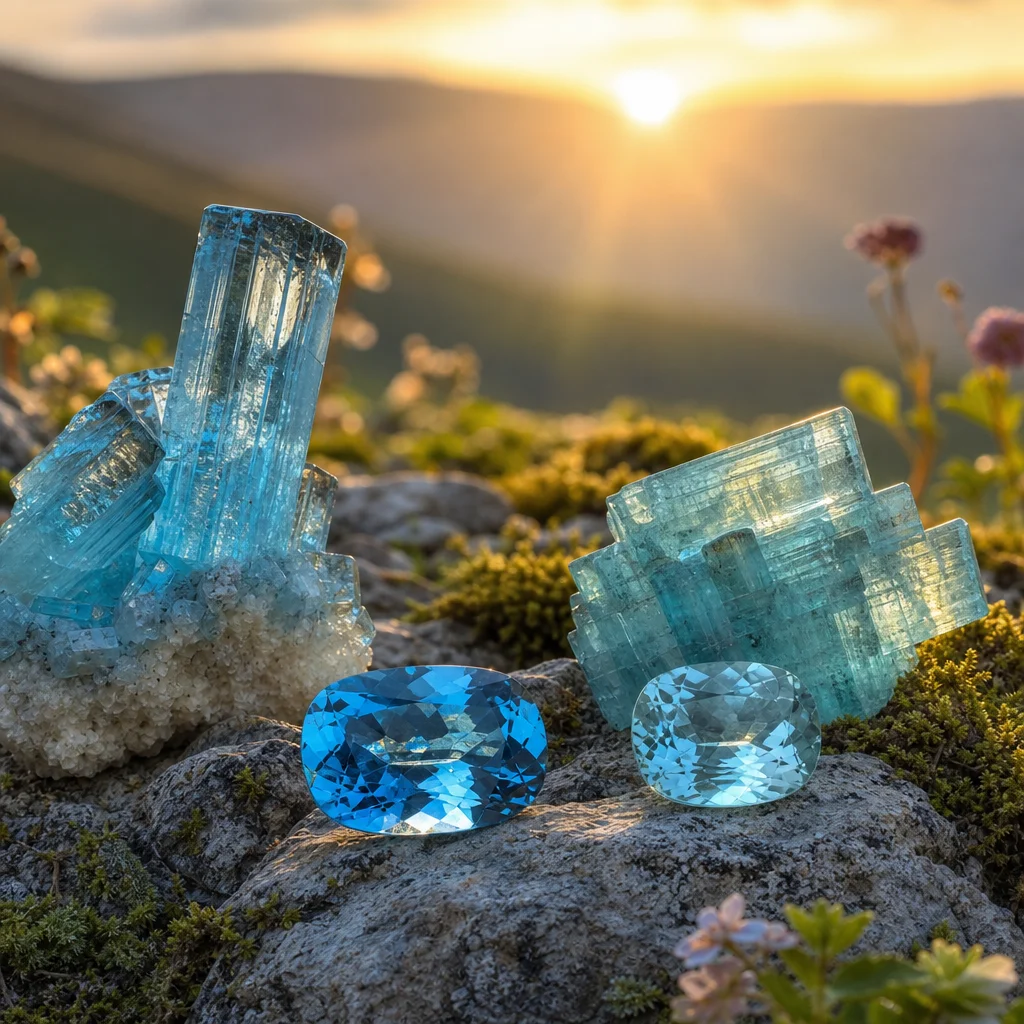
Real aquamarine colors range from pale ice-blue to a rich sea-green blue. The most valuable stones have a deep, saturated blue with just a hint of green (often called "Santa Maria" color, after the famous Brazilian mine). Key color characteristics of genuine aquamarine:
- The blue is typically more green-leaning than pure blue
- Color is often stronger in larger stones; small aquamarines tend to be quite pale
- There may be subtle color zoning—bands or patches of lighter/darker blue within the same stone
- Under different light sources (daylight vs. incandescent), real aquamarine shifts slightly but subtly
Blue topaz, by contrast, tends to be a purer, more electric blue without green undertones. If the stone looks like a perfect, uniform, saturated blue throughout—like it was designed in a lab—it's worth being suspicious. Heat-treated blue topaz is the most common aquamarine imposter, and it's typically cheaper by a factor of 5–10.
Also pay attention to the price. Genuine aquamarine in the 1–3 carat range with good color sells for $100–400 per carat from reputable dealers. If someone is offering a "5-carat aquamarine ring" for $49, it's almost certainly glass or synthetic.
Test 5: The Inclusion Pattern Study
Under a jeweler's loupe (10x magnification) or a USB microscope, real aquamarine reveals characteristic inclusions that are extremely difficult to fake convincingly:
Common natural inclusions in aquamarine:
- Tubular growth channels: Long, thin, hollow tubes running parallel to the crystal's C-axis. These are liquid-filled inclusions trapped during formation and are considered a strong indicator of natural origin.
- Feather-like inclusions: Fractures that healed during the crystal's growth, creating wispy, feathery patterns.
- Twin planes: Flat, reflective surfaces where the crystal grew in two directions simultaneously.
- Tiny mineral crystals: Microscopic inclusions of other minerals (like biotite mica or hematite) trapped inside the aquamarine.
Glass fakes often contain perfectly round bubbles—nature doesn't create round bubbles in beryl crystals. Synthetic beryl (grown in a lab) may be internally too clean, with an almost suspicious lack of inclusions. If you see gas bubbles, swirl patterns, or flow lines, you're almost certainly looking at glass.
Don't worry if you don't have professional equipment. Even a decent smartphone camera with a clip-on macro lens can reveal enough detail to spot obvious bubbles or flow lines in a glass fake.
Quick Reference: Real vs. Fake Aquamarine at a Glance
| Property | Real Aquamarine | Glass Fake | Blue Topaz Fake |
|---|---|---|---|
| Hardness | 7.5–8 (Mohs) | 5–6 | 8 |
| Double Refraction | Yes (line doubling) | No | No |
| UV Fluorescence | Usually inert | May glow green | May glow faint |
| Color | Blue-green, may have zoning | Uniform blue | Pure blue, no green |
| Inclusions | Tubes, feathers, mineral crystals | Bubbles, flow lines | Clean or needle-like |
| Price (1-3ct) | $100–400/ct | Under $10/ct | $10–30/ct |
Frequently Asked Questions
Can lab-grown aquamarine be considered "real"?
Lab-grown aquamarine has the same chemical composition and crystal structure as natural aquamarine. Whether it's "real" depends on context—it IS real beryl, but it lacks the geological formation history that gives natural stones their value. The tests above will identify it as beryl but can't always distinguish lab-grown from natural without advanced gemological equipment.
Does heat treatment ruin aquamarine?
No. Heat treatment is a standard and accepted practice in the gem trade. It permanently enhances the blue color by removing greenish tones. The stone remains genuine aquamarine; it's simply been optimized. This should always be disclosed by the seller, though it often isn't for modestly-priced stones.
What's the easiest way to spot a fake without any tools?
Check the price first—if it seems too good to be true, it probably is. Then examine the color through a clear glass of water (the water acts as a lens). Real aquamarine maintains its color saturation when wet, while some dyed stones lose intensity. Finally, hold it up to a bright light—genuine aquamarine shows subtle color variation, while glass looks flatly uniform.
Can I test aquamarine jewelry without removing the stone?
Yes, for most tests. The scratch test is the only one that risks damage. The line test, UV fluorescence check, and visual color assessment all work perfectly on mounted stones. For the inclusion study, a 10x jeweler's loupe works fine on set stones—just angle the light to illuminate the interior.
Frequently Asked Questions
How can I tell if my aquamarine is just colored glass?
The most common imitation is colored glass. Real aquamarine forms naturally, so it typically shows tiny internal imperfections or fine veins under magnification. Glass is often perfectly flawless or contains round bubbles. Furthermore, glass is much softer than genuine aquamarine and will scratch easily. SagStone guarantees only authentic, natural stones are used in our artisan jewelry designs.

Comments