How to Choose Your First Healing Crystal: Answers to the Questions Nobody Tells You
How to Choose Your First Healing Crystal: Answers to the Questions Nobody Tells You
Walking into a crystal shop for the first time is overwhelming. There are hundreds of stones, dozens of colors, and zero clear instructions. The person behind the counter might be helpful, or they might launch into a speech about chakras and vibrations that leaves you more confused than when you walked in.
This guide answers the most common questions people have when they're just starting out. No jargon, no mysticism required, just practical advice from someone who's been through the process.
How Do I Know Which Crystal Is Right for Me?
The honest answer: you don't, at first. And that's okay.
The most common advice in crystal communities is "let the crystal choose you." Which sounds mystical but is actually practical. What people mean is: walk into the shop, look around without overthinking, and notice which stone you keep coming back to. Which one do you pick up? Which one do you set down and then reach for again? Which one just feels right in your hand?
This isn't magic. It's your brain responding to color, texture, weight, and shape preferences you already have but don't consciously track. If you're drawn to cool blues and smooth textures, you'll probably gravitate toward stones like blue lace agate or sodalite. If you like warm colors and rough textures, you might pick up citrine or a rough piece of carnelian.
Start with what you're drawn to visually and tactilely. You can always learn about the traditional associations later. The stone you actually want to hold and look at every day is more useful than the stone that's "supposed" to be good for your specific issue but doesn't appeal to you at all.
If you want a more structured approach, start with what's bothering you and work backward:
Stress and anxiety: Black tourmaline, amethyst, howlite, lepidolite
Sleep problems: Amethyst, selenite, howlite
Low energy or motivation: Citrine, carnelian, tiger's eye
Focus and clarity: Clear quartz, fluorite, sodalite
Emotional difficulty (grief, heartbreak, frustration): Rose quartz, amazonite, rhodonite
These are traditional associations, not prescriptions. Use them as a starting point, not a rulebook.
Do I Need to Cleanse My Crystals?
"Cleansing" is a big topic in crystal communities, and opinions range from "absolutely essential" to "completely unnecessary." Here's a grounded take.
Cleansing, in the traditional sense, means clearing any accumulated energy from a crystal so it's "fresh" for use. Common methods include running it under water, leaving it in moonlight, burying it in salt, or smudging it with sage.
From a practical standpoint, cleaning your crystals just means keeping them physically clean. Dust, skin oils, and residue from lotion or hand sanitizer will build up on stones you handle regularly. A damp cloth and mild soap work fine for most polished stones. Rinse and dry thoroughly.
A few caveats: some stones dissolve or degrade in water. Selenite, halite, and malachite should never be soaked. Some stones fade in prolonged sunlight — amethyst and citrine can lose their color over weeks of direct exposure. When in doubt, a soft dry cloth is the safest option.
If the ritual aspect of cleansing appeals to you — the act of intentionally setting aside time to care for your stones — there's nothing wrong with that. Rituals are psychologically meaningful, and the process of handling each stone, wiping it, and setting it back in its place is inherently meditative. Just don't stress about doing it "right." There's no wrong way to wipe a rock.
Where Should I Put My Crystals?
Where you place a crystal depends on what you're using it for. Here are the most common placements and what they're good for:
Bedside table or nightstand: Sleep-focused stones — amethyst, selenite, howlite. Keep them within arm's reach so you can grab one if you wake up in the middle of the night. Avoid placing sharp or heavy stones where you might knock them over in the dark.
Work desk: Focus, stress relief, and communication stones — clear quartz, fluorite, black tourmaline, amazonite. Place them where your hand naturally rests, not in a decorative corner. The goal is interaction, not display.
Meditation space: Whatever stone supports your practice. Many people hold a crystal during meditation or place it in front of them as a visual focus point. Larger stones or clusters work well here since they're not being moved around.
Living room or common areas: Stones you want to interact with casually throughout the day. A piece of rose quartz on the coffee table, a chunk of citrine near the window where it catches afternoon light. These are ambient — you see them, they make you feel something, and that's enough.
Car or bag: Small, durable stones for on-the-go grounding. Black tourmaline and hematite are tough enough to survive being jostled around. Wrap them in a cloth or pouch so they don't scratch other items.
One practical consideration: pets and small children. Some stones are toxic if ingested — malachite and galena are the main ones to watch out for. Keep those out of reach. If you have a cat that knocks everything off every surface (and you definitely do), don't put fragile stones on high shelves with no backing.
How Much Should I Spend on My First Crystal?
Less than you think. The crystal industry has a massive markup, and beginners routinely overspend because they don't know what things should cost.
Tumbled stones — small, polished, palm-sized pieces — typically cost $2 to $8 each at independent shops. Online, you can find them for even less, often sold in sets. These are perfect starting points. They're durable, easy to carry, and don't require any special display.
Raw chunks and rough pieces are often cheaper per gram than polished stones and have more visual character. A palm-sized piece of raw amethyst or black tourmaline usually runs $5 to $15.
Things get expensive fast when you move into large specimens, jewelry, or rare varieties. A one-inch tumbled piece of lapis lazuli is $5. A necklace with a high-quality lapis pendant can be $50 to $200. For your first crystal, skip the jewelry and go for a simple tumbled stone or raw chunk.
A good first purchase budget is $15 to $30 total. That gets you two or three stones in different colors and textures, which is enough to start figuring out what you like.
What's the Difference Between Raw, Tumbled, and Cut Stones?
Three main forms you'll encounter:
Raw (natural): The stone as it comes out of the ground, broken into pieces but not shaped or polished. These are the most affordable and have the most natural look. Great for display, less comfortable to carry in a pocket (rough edges).
Tumbled: Put through a tumbling machine with abrasives until smooth and rounded. These are the most common form for beginners. Comfortable to hold, consistent in size, easy to find, and usually the cheapest option per piece.
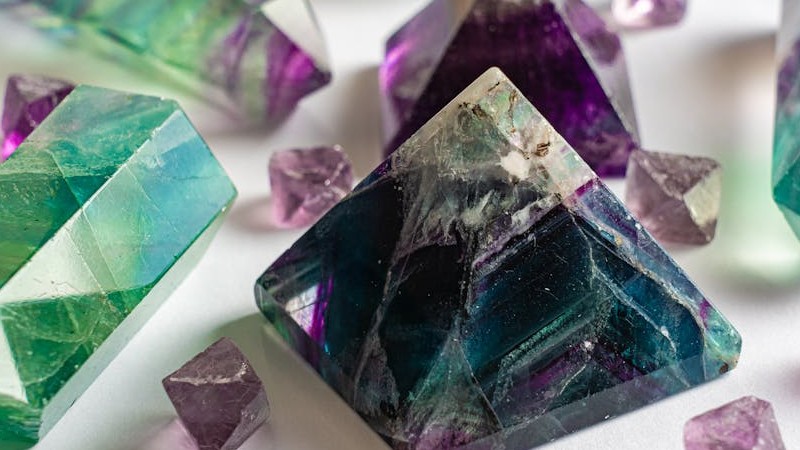
Cut and polished: Faceted, carved, or shaped into specific forms — points, spheres, pyramids, hearts. These are more expensive because of the labor involved. They look impressive on a shelf but aren't inherently "better" for practical use.
For a first crystal, tumbled is the way to go. It's practical, affordable, and you can hold it without thinking about orientation or angles. Save the fancy shapes for later if you get into it.
How Do I Know if a Crystal Is Real or Fake?
This matters more than you'd think. The market is full of dyed glass, synthetic stones, and mislabeled minerals sold at premium prices. Here's what to watch for:
Citrine: Most "citrine" on the market is heat-treated amethyst. Real citrine is relatively rare and has a different color profile — more honey-yellow vs. the orange of treated amethyst. For beginner purposes, either works fine, but don't pay a premium for "natural citrine" without doing your research.
Turquoise: Howlite dyed blue is commonly sold as turquoise. Real turquoise is expensive and usually comes with certification. If the price seems too good, it probably is.
Clear quartz: Glass is sometimes sold as quartz. Real quartz is cold to the touch and has natural inclusions and imperfections. Glass is perfectly uniform and warms up quickly in your hand.
General rule: Buy from reputable shops, ask questions, and be wary of stones that look too perfect or are priced well below market rate. A $2 piece of amethyst from a trusted shop is probably real. A $2 piece of turquoise from a random website is almost certainly not.
Can I Use Crystals With My Other Wellness Practices?
Absolutely. Crystals pair well with meditation, journaling, yoga, breathwork, and pretty much any mindfulness-based practice. They also work alongside professional mental health care — therapy, medication, whatever your treatment plan looks like. A crystal is an add-on, not a replacement.
Some people integrate crystals into existing routines naturally: holding one during a morning meditation, placing one next to their journal, keeping one on their yoga mat. Others build new routines around them. There's no wrong approach. The goal is to create a practice you'll actually stick with, and if a small stone makes that practice more engaging or meaningful to you, that's a win.
What if It Doesn't Work for Me?
Then it doesn't work for you, and that's completely fine. Not everyone connects with crystals, and there's no obligation to keep trying. Some people find the practice meaningful from day one. Others try it, feel nothing, and move on. Both responses are valid.
If you gave it an honest try — picked a stone you liked, carried it for a week, used it as a focus point during stressful moments — and it didn't add anything to your life, you're out maybe five dollars and a week of mild curiosity. That's a pretty low-risk experiment.
The worst outcome of trying crystals is that you end up with a pretty paperweight. The best outcome is that you find a small, quiet practice that helps you navigate your days with a bit more calm and intention. Either way, you haven't lost anything.
Comments