<h2>8 Gemstones That Look Identical But Are Completely Different Minerals</h2>
1. Ruby vs Red Spinel
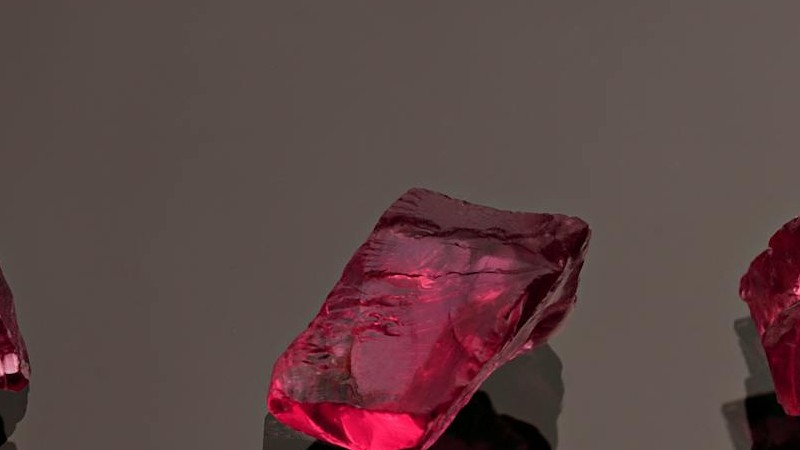
These two red stones have confused gemologists and royalty alike for hundreds of years. Ruby is aluminum oxide (Al₂O₃) colored by chromium, while red spinel is magnesium aluminum oxide (MgAl₂O₄) with a different crystal structure entirely. On the Mohs scale, ruby sits at 9 and spinel at 8. That single point of hardness matters more than you'd think when it comes to daily wear durability.
The most famous mix-up sits in the British Imperial State Crown. The Black Prince's Ruby, a 170-carat stone that Henry V supposedly wore at the Battle of Agincourt, was identified as spinel in the 18th century. Nobody corrected the name. The British royal family still calls it a ruby.
Price-wise, the gap is enormous. A fine Burmese ruby can sell for $10,000 to $1,000,000 per carat depending on color and clarity. Red spinel, even from the same Burmese deposits, typically runs $200 to $5,000 per carat. Same mountains, different mineral, dramatically different price tag.
How to tell them apart: Spinels are singly refractive, meaning they don't split light into two rays. Rubies are doubly refractive. Under a polariscope, this difference becomes visible. Spinels also tend to have slightly more orange-red tones, while top-quality rubies lean toward a pure pigeon-blood red.
2. Sapphire vs Tanzanite
Blue sapphire and tanzanite can look remarkably similar under warm lighting, but they have almost nothing in common beneath the surface. Sapphire is aluminum oxide (Al₂O₃), the same mineral family as ruby, colored by iron and titanium. Tanzanite is a variety of zoisite with the formula Ca₂Al₃Si₃O₁₂(OH), colored by trace amounts of vanadium.
Sapphire deposits span Sri Lanka, Kashmir, Madagascar, Australia, and Montana. Tanzanite comes from exactly one place on earth: a five-square-mile area near Mount Kilimanjaro in Tanzania. That geographic monopoly is the main reason tanzanite prices have stayed relatively high since the stone was discovered in 1967.
Hardness separates them clearly. Sapphire rates a 9 on the Mohs scale, making it one of the hardest natural substances available for jewelry. Tanzanite sits at 6.5 to 7. That means tanzanite scratches far more easily and is generally unsuitable for rings worn daily unless set in a protective mounting.
The price gap reflects this. Fine Kashmir sapphires can exceed $50,000 per carat at auction. Tanzanite, even in rich violet-blue, usually costs $300 to $800 per carat for gems over 5 carats. For the money, tanzanite offers a lot of visual impact. For durability, sapphire wins by a mile.
3. Emerald vs Green Tourmaline
Both of these stones can display a vivid green that stops people in their tracks, but their chemistry tells very different stories. Emerald is beryllium aluminum silicate (Be₃Al₂Si₆O₁₈) colored by chromium or vanadium. Green tourmaline belongs to a complex boron silicate group with the formula NaLi₃Al₆(BO₃)₃Si₆O₁₈(OH)₄.
The presence of beryllium in emerald's formula is no small detail. Beryllium is a rare element, and the geological conditions that concentrate it enough to form emerald crystals are unusual. That rarity drives prices up to $500 to $10,000 per carat for fine Colombian stones. Green tourmaline, which is far more abundant, typically costs $50 to $500 per carat for comparable quality.
Emeralds are notorious for inclusions. The French even have a word for it: "jardin," meaning garden, because the internal fractures and mineral traces look like foliage under magnification. Most emeralds sold commercially have been treated with cedar oil or resin to fill these fractures. Green tourmalines are generally cleaner stones with fewer inclusions.
On the hardness scale, emerald rates 7.5 to 8, while green tourmaline comes in at 7 to 7.5. The bigger difference is toughness. Emerald's internal fractures make it prone to chipping. Tourmaline has better structural integrity despite being slightly softer.
4. Aquamarine vs Blue Topaz
Aquamarine and blue topaz are both popular choices for March and December birthstone jewelry respectively, and lighter specimens of each can appear nearly identical. Aquamarine is beryllium aluminum silicate (Be₃Al₂Si₆O₁₈) colored by iron, making it a beryl, the same mineral family as emerald. Blue topaz is aluminum fluosilicate with the formula Al₂SiO₄F(OH).
The beryllium connection matters here too. Like emerald, aquamarine requires rare geological conditions to form. Blue topaz, by contrast, is far more common. Most blue topaz on the market starts as colorless or pale topaz and is irradiated and heated to produce its blue color. Natural blue topaz exists but is quite rare.
Hardness favors topaz at 8, compared to aquamarine's 7.5 to 8. In practice, both are durable enough for daily wear. The real distinction is in the color range. Aquamarine naturally occurs in a soft, pale blue-green that many people find appealing for its subtlety. Treated blue topaz can achieve a much more intense blue, sometimes rivaling sapphire, though the color is man-made.
Pricing reflects availability. Aquamarine typically costs $100 to $500 per carat for stones with good color. Blue topaz, even in larger sizes, usually runs $20 to $80 per carat. If you see a 10-carat blue stone selling for under $200, it's almost certainly treated topaz, not aquamarine.
5. Amethyst vs Purple Fluorite
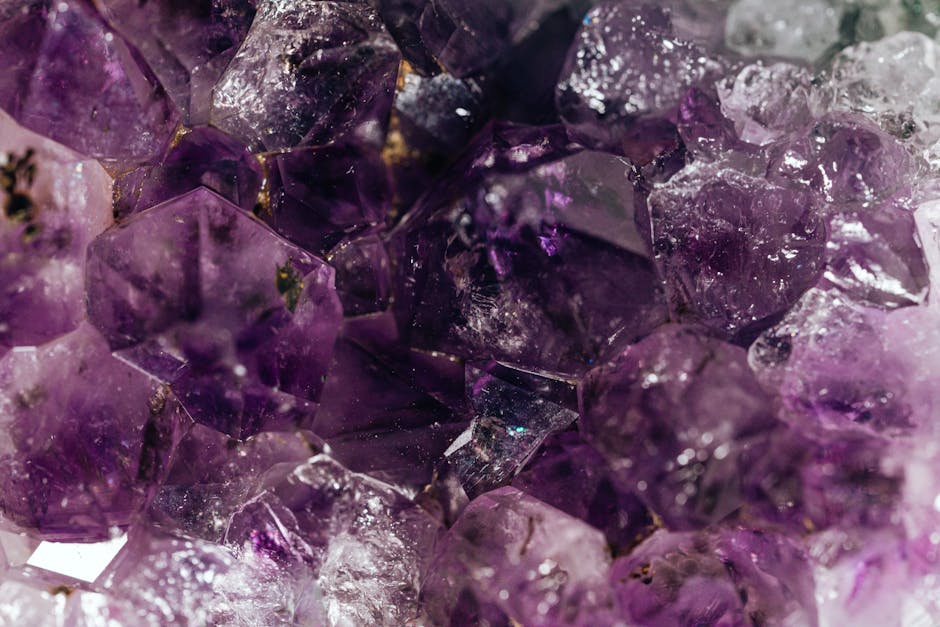
Both of these minerals can display a lovely purple color, but their physical properties diverge dramatically. Amethyst is silicon dioxide (SiO₂), a variety of quartz. Purple fluorite is calcium fluoride (CaF₂). The chemical difference shows up clearly in hardness: amethyst rates a 7 on the Mohs scale, while fluorite is only a 4.
A hardness of 4 means fluorite can be scratched with a copper coin or even a fingernail. It's far too soft for most jewelry applications. Fluorite is primarily a collector's mineral, prized for its cubic crystal formations and range of colors rather than its wearability. Amethyst, on the other hand, has been used in jewelry for thousands of years and holds up well in rings, pendants, and earrings.
Fluorite also has a property called fluorescence, and it's the mineral that gave the phenomenon its name. Under ultraviolet light, many fluorite specimens glow blue, green, or purple. Amethyst does not fluoresce. This is a quick identification test that anyone with a UV flashlight can perform.
Price-wise, the difference is moderate but meaningful. Fine amethyst with deep, even color runs $20 to $100 per carat. Purple fluorite, sold as mineral specimens rather than gemstones, typically costs $5 to $30 per piece depending on size and color quality. If someone tries to sell you a "purple fluorite ring" for daily wear, be skeptical about its longevity.
6. Peridot vs Green Glass
Peridot has one of the most distinctive yellow-green colors in the gemstone world, but synthetic green glass has been used as a convincing imitation for decades. Peridot is magnesium iron silicate (Mg₂SiO₄), a variety of the mineral olivine. It is the only gem-quality variety of olivine that exists in nature. Glass, of course, is amorphous silicon dioxide with various metal oxides added for color.
Peridot has a couple of identifying characteristics that glass cannot replicate. First, peridot is doubly refractive, which means you can see a doubling effect when looking through the stone at a facet junction. Glass is singly refractive, so no doubling occurs. Second, peridot has a refractive index of about 1.64 to 1.69, while glass sits lower, around 1.50 to 1.52.
The most telling difference appears under magnification. Natural peridot frequently contains tiny, rounded mineral inclusions called "lily pads" that are unique to this stone. Glass imitations may contain gas bubbles or swirl marks from the manufacturing process, but they never contain natural mineral inclusions.
Peridot prices have been dropping over the past decade as mining in Myanmar, Pakistan, and Arizona has increased supply. You can find peridot for $10 to $80 per carat depending on size and color saturation. Green glass is, well, essentially free in comparison.
7. Garnet vs Red Glass
Garnets come in every color except blue, but the deep red varieties (almandine and pyrope) are the ones most commonly imitated by colored glass. Garnet is not a single mineral but a group of related silicate minerals with varying compositions. The most common red garnets are iron aluminum silicate (almandine, Fe₃Al₂Si₃O₁₂) and magnesium aluminum silicate (pyrope, Mg₃Al₂Si₃O₁₂).
Red glass imitations have been around since Roman times, when glassmakers figured out how to add copper or manganese to produce a deep red. The problem for counterfeiters is that garnet has a higher refractive index (1.73 to 1.89, depending on variety) than glass (around 1.52). This means garnet has more brilliance and fire than any glass imitation can match.
Natural garnets also contain characteristic inclusions: tiny rounded crystals, needle-like rutile, or curved stress fractures that form during the stone's geological creation. Glass may contain bubbles or swirl marks, but these look nothing like natural inclusions under a jeweler's loupe.
Most red garnets sell for $20 to $200 per carat. The rarest varieties, like tsavorite (green garnet) or demantoid (green andradite), command thousands per carat. Red glass, even cut and polished to look like a gem, costs pennies by comparison.
8. White Topaz vs White Sapphire vs Diamond
This trio is where the lookalike problem gets genuinely difficult, because all three can appear as brilliant, colorless stones to the naked eye. White topaz is Al₂SiO₄F(OH). White sapphire is Al₂O₃, the same mineral as colored sapphire but without the trace elements that produce color. Diamond is pure crystallized carbon (C).
The critical difference between them is refractive index, which determines how much light the stone bends and returns to the viewer's eye. Diamond has a refractive index of 2.42, the highest of any natural gemstone. White sapphire comes in at 1.77. White topaz is 1.63. This single measurement explains why diamonds have that distinctive sparkle that sapphires and topaz cannot fully match, no matter how well they're cut.
Hardness follows a similar ranking. Diamond is 10 on the Mohs scale (the reference standard). White sapphire is 9. White topaz is 8. For engagement rings and daily-wear jewelry, both sapphire and diamond perform well. Topaz, while harder than many alternatives, will show wear over years of daily use.
Price separates them decisively. A one-carat diamond averages $5,000 to $10,000 for a decent quality stone. A one-carat white sapphire runs $200 to $800. A one-carat white topaz can be found for $10 to $50. White sapphire has become a popular diamond alternative for people who want durability and brilliance without the price, while white topaz is often used as a placeholder stone in engagement rings.
The easiest way to distinguish them is the "fog test." Breathe on the stone. Diamond disperses heat so quickly that the fog vanishes almost instantly. Sapphire and topaz hold the fog for a moment or two. A thermal conductivity tester, which any jeweler owns, makes the distinction definitive.
Why This Matters When You're Buying
Misidentification isn't just an academic curiosity. It has real financial consequences. A stone sold as "ruby" that turns out to be spinel could mean you overpaid by a factor of ten or more. A "sapphire" that's actually tanzanite might scratch or chip far sooner than you expected.
The safest approach is to ask for a certificate from a recognized laboratory like GIA, IGI, or AGL. These organizations test the stone's physical and chemical properties and identify it definitively. If a seller won't provide certification on stones above a few hundred dollars, that's a meaningful red flag.
Understanding the mineral behind the beauty also helps you make smarter buying decisions. Knowing that tanzanite is soft and sourced from a single depleting deposit might make you choose a sapphire for an everyday ring while keeping tanzanite for occasional-wear pieces. Knowing that most blue topaz is color-enhanced sets realistic expectations for the stone's natural rarity.
At the end of the day, there's nothing wrong with choosing the more affordable option. Spinel makes beautiful jewelry. Tanzanite is genuinely stunning in person. The problem only arises when you're paying for one mineral and receiving another. Know what you're looking at, and you'll get exactly what you paid for.
Comments