How crystals actually form underground (and why most of what you hear is wrong)
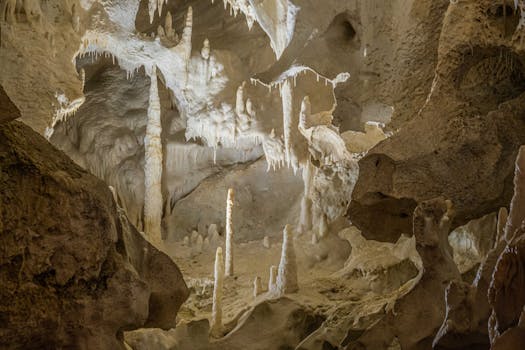
The quartz crystal you're holding started forming somewhere between 30 million and 500 million years ago, deep underground, in conditions that would kill you in seconds. I think that's worth knowing before we get into the details — because most of what gets repeated about crystal formation is either oversimplified to the point of being wrong, or wrapped in language that sounds scientific but isn't.
Let me be direct about something upfront: there is no single "crystal formation process." That phrase implies a uniform mechanism, and minerals don't work that way. A diamond and a piece of halite (rock salt) both qualify as crystals, but they form through completely different chemistry, at wildly different temperatures and pressures, on completely different timescales. Grouping them under one explanation is like describing how both concrete and soufflés are "made by mixing ingredients and applying heat."
The basic physics: atoms arranging themselves
At the atomic level, a crystal is a repeating three-dimensional pattern. When atoms, ions, or molecules arrange themselves in a regular, repeating lattice, that's a crystal. Snowflakes are crystals. So is the steel in a knife blade. So is table salt. The word covers an enormous range of materials.
What makes a mineral crystal form underground comes down to two conditions: the right chemical ingredients need to be present, and they need to be in an environment where they can move slowly enough to lock into that repeating pattern. "Slowly" is doing a lot of work in that sentence — we're talking about geological timescales, not hours or days.
Most mineral crystals form from a solution (hydrothermal) or from cooling magma (igneous). There are other pathways — metamorphic recrystallization, evaporation, precipitation from gas — but those two account for the vast majority of crystals that end up in rock shops and jewelry.
Hydrothermal formation: the hot water route
This is the big one. Hydrothermal processes create the majority of the well-formed mineral crystals people actually collect: quartz, amethyst, citrine, calcite, fluorite, tourmaline, beryl (emerald and aquamarine), and dozens of others.
Here's what actually happens. Deep underground, water gets trapped in rock fractures and pores. This water isn't pure — it's brine loaded with dissolved minerals, sometimes with temperatures exceeding 400°C (750°F) and pressures hundreds of times atmospheric pressure. At those conditions, water stays liquid far above its normal boiling point.
As this superheated mineral-rich water moves through fractures in the rock, it cools gradually. Different minerals crystallize at different temperatures, a process called fractional crystallization. The first minerals to drop out of solution are typically those with the highest melting points. As the solution continues cooling, new minerals crystallize in sequence.
The crystals grow on the walls of the cavity. If the cavity is enclosed — called a geode or vug — the crystals grow inward toward the open space, which is why they often terminate in well-formed points. Open cavities give crystals room to develop their characteristic shapes. Crystals that form in solid rock without cavities tend to be intergrown and irregular, because they're competing for space with their neighbors.
A typical amethyst geode from Brazil might have taken 10 to 50 million years to fill. The crystal points grow at rates measured in millimeters per century, sometimes per millennium. The color comes from trace amounts of iron that got incorporated into the quartz lattice, plus exposure to natural radiation from surrounding rock. More on that later.
Igneous formation: from molten rock
Magma is molten rock, and when it cools, minerals crystallize from it directly. The rate of cooling determines crystal size. Lava that erupts at the surface and cools in hours or days (basalt) produces microscopic crystals — you need a microscope to see them. Magma that cools slowly deep underground (plutonic rock) can produce enormous crystals over millions of years.
Pegmatites are a special case worth knowing about. These form in the very late stages of magma cooling, when the remaining melt is enriched in water and rare elements. The high water content lowers the viscosity of the melt, allowing atoms to move more freely, which means crystals can grow very large very quickly (geologically speaking — still thousands to millions of years). That's where you get tourmaline crystals a foot long, beryl crystals the size of your arm, and spodumene crystals that weigh tons.
The Harding Mine in New Mexico produced a spodumene crystal over 12 meters (42 feet) long. The Etta Mine in South Dakota had spodumene crystals estimated at 14 meters. These aren't anomalies — they're what pegmatites do when conditions are right. Most gem-quality tourmaline, aquamarine, and topaz come from pegmatites.
Why "growing crystals at home" tells you almost nothing
You can grow alum or copper sulfate crystals on your kitchen counter in a week. This leads to a common misunderstanding: people assume all crystals form the same way, just slower. Dissolve something in water, let the water evaporate, and the dissolved material crystallizes. Simple.
Except that describes evaporite minerals — halite, gypsum, selenite — not the silicate minerals that make up most of the crystals people care about. Quartz doesn't form from evaporation. Beryl doesn't form from evaporation. The kitchen-counter analogy works for maybe 5% of the mineral kingdom and gives completely wrong intuitions about the rest.
Most silicate minerals require hydrothermal conditions or magmatic cooling. The chemistry is fundamentally different. You're not just dissolving and reprecipitating the same substance — you're dealing with complex reactions between multiple elements at high temperatures and pressures, where crystal formation depends on the interplay of temperature, pressure, chemical composition, pH, and the presence of specific impurities.
Impurities are the interesting part
Pure quartz (SiO₂) is clear and colorless. But almost no quartz in nature is chemically pure. Trace elements — iron, titanium, manganese, aluminum — get incorporated into the crystal lattice during growth, and they change the crystal's color, optical properties, and sometimes its shape.
Amethyst gets its purple color from iron impurities (Fe³⁺) in the quartz lattice, activated by natural gamma radiation from potassium-40 in surrounding rock. Citrine's yellow comes from a different oxidation state of iron (Fe³⁺ in a different structural position) or from heat treatment of amethyst. Smoky quartz gets its brown-to-black color from natural irradiation of trace aluminum in the lattice. Rose quartz owes its pink color to microscopic inclusions of dumortierite, not to trace elements in the lattice itself.
These color mechanisms are specific, measurable, and well-studied. They are not mysterious. But you'd never know that from most popular writing about crystals, which tends to hand-wave the whole thing as "minerals absorb colors from their surroundings."
Time, pressure, and the myth of "instant" crystals
Social media occasionally features videos of crystals "growing" in real time, usually in supersaturated solutions. These are real physical processes, but they're a terrible model for how natural crystals form. The timescales are wrong by factors of millions to billions. The chemistry is different. The crystal structures that form from rapid precipitation are often different from what you get from slow growth — fast-grown crystals tend to have more defects, inclusions, and irregular faces.
Natural crystals grow slowly enough that imperfections tend to heal themselves. Atoms at the crystal surface have time to find the lowest-energy positions. The result is a crystal with clean faces, good optical clarity, and fewer internal fractures. That's why a natural amethyst point looks different from a lab-grown one, even when they're chemically identical.
I'm not making a value judgment here — lab-grown crystals have the same chemical composition and crystal structure. But the growth conditions leave detectable differences: growth zoning, characteristic inclusions, and trace element patterns that a trained gemologist can identify.
What most people get wrong
Three misconceptions come up over and over:
First, the idea that crystals "grow from the center outward" like biological organisms. They don't. Crystals grow by adding atoms to their outer surfaces. A crystal doesn't have a central seed that expands — it has faces that advance outward as material deposits on them. Different faces can grow at different rates, which determines the final shape.
Second, the belief that larger crystals are older. Not necessarily. A pegmatite tourmaline that's 30 centimeters long might have grown in 10,000 years. A tiny quartz crystal in a sandstone matrix might be 200 million years old. Growth rate depends on the supply of material and the temperature gradient, not just time.
Third, the assumption that crystal formation is a one-time event. Many crystals undergo multiple growth phases. A quartz crystal might start growing, get partially dissolved by a later hydrothermal event, then resume growing with a different chemistry. These growth interruptions leave visible zoning patterns inside the crystal — you can literally read the growth history if you cut it open.
Why this matters
Understanding how crystals actually form makes the whole hobby more interesting. A piece of amethyst isn't just "purple quartz" — it's a record of specific conditions at a specific depth in the earth, at a specific time in geological history, involving specific chemistry. The purple tells you about iron content and radiation exposure. The crystal size tells you about growth rate and available space. The inclusions tell you about what else was in the fluid.
Every crystal is a data point about the Earth's interior. Mineralogy is geology's forensic science. The pretty colors are a side effect — the real story is in the chemistry.
Comments