What is a cabochon (and why are so many gems cut this way)
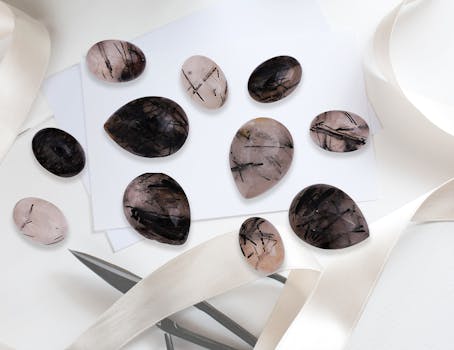
Most people picture a diamond when they hear "gemstone" — that familiar sparkle of precisely angled flat facets catching light from every direction. But walk into any gem show or jewelry shop and you'll notice something: a huge number of stones look nothing like that. They have smooth, rounded tops. No facets at all. That's a cabochon, and it's one of the oldest and most practical cuts in lapidary history.
The basics: what a cabochon actually is
A cabochon is a gemstone that has been shaped and polished into a dome on top with a flat (or slightly curved) bottom. The word comes from the Middle French caboche, meaning "head." That's literally what it looks like — a small, smooth, rounded head sitting on a flat base.
There are no flat facets cut into the surface. The entire top is one continuous curved surface. The bottom is either completely flat for easy setting into jewelry, or it has a very slight convex curve called a "convex base." The flat-bottom version is by far the most common because it sits neatly in a bezel or prong setting.
The typical cabochon has a dome height of about 40-60% of its width. Too flat, and the stone looks lifeless. Too domed, and it becomes hard to set without towering awkwardly above the metal. Most lapidaries aim for that middle range.
Why not just facet everything?
Faceting works beautifully on transparent stones — diamonds, sapphires, rubies, aquamarine — because light enters through the top, bounces off the internal facets, and comes back to your eye. That's brilliance. It's a light-management trick, and it only works when light can pass through the stone relatively cleanly.
Now consider turquoise. It's opaque. Light hits the surface and stops. There's nothing to bounce around inside. If you cut turquoise into facets, you get a dull, flat-looking stone with a bunch of flat surfaces that do absolutely nothing for the appearance. The color is the whole point, and a smooth dome actually makes turquoise look better by concentrating the color under a curved surface that catches ambient light.
Opal is another perfect example. The play-of-color in opal comes from microscopic silica spheres diffracting light. Facets would break up that effect and make the stone look fragmented. A cabochon's smooth dome gives the light a clean surface to interact with those internal structures, and the result is that characteristic rolling flash of color opal is famous for. Almost all quality opals on the market are cut as cabochons — it's not a choice, it's practically a requirement.
Moonstone has its own reason. The adularescence — that soft, floating blue or white glow — is caused by light scattering between thin layers of feldspar within the stone. A domed surface concentrates that glow into a visible sheen. Facet a moonstone and you scatter the effect into nothing.
Then there's the hardness question. Some stones are simply too soft to hold facets. Turquoise ranks 5-6 on the Mohs scale. Facets create tiny edges that chip and wear down over time. A smooth dome has no edges to chip. The same logic applies to rhodonite (5.5-6.5), malachite (3.5-4), and hematite (5.5-6.5). A cabochon is a pragmatic cut for softer materials that need to survive daily wear.
The optical effects that only cabochons reveal
Some of the most visually striking phenomena in gemology only show up in cabochon cuts, or at least show up dramatically better in cabochons.
Chatoyancy (the cat's eye effect)
Chatoyancy comes from the French chat oeil, meaning "cat's eye." When a stone contains parallel needle-like inclusions (usually rutile or other mineral fibers), a cabochon cut with the dome oriented perpendicular to those needles will produce a sharp band of light that moves across the surface as the stone tilts. It looks exactly like the slit pupil of a cat's eye.
The most famous chatoyant stone is chrysoberyl cat's eye, but the effect shows up in tiger's eye (quartz with crocidolite fibers), apatite, tourmaline, and several other minerals. The key is that cabochon dome — facet the stone and the cat's eye band breaks into scattered reflections.
For the best cat's eye effect, the dome needs to be moderately high, and the stone must be oriented precisely. The difference between a spectacular cat's eye and a dull stone with a vague line is often just a few degrees of rotation during cutting.
Asterism (the star effect)
When a stone has needle-like inclusions running in two or three directions at roughly 60-degree angles, the cabochon dome concentrates reflected light into a multi-rayed star. Star sapphires and star rubies are the classic examples, usually showing a six-rayed star (three sets of needles at 60 degrees each).
The star effect is evaluated by the sharpness of the rays and whether the star is centered on the dome. A poorly centered star or fuzzy rays dramatically reduce the value. The best star stones are cut with the dome centered directly over the intersection point of the inclusion groups.
Star garnets (four-rayed, from Idaho) and some diopside and spinel also show asterism. Like chatoyancy, faceting destroys the effect almost entirely.
Adularescence and labradorescence
Moonstone's soft glow (adularescence) and labradorite's flash of spectral color (labradorescence) both depend on light interacting with internal layers at specific angles. The smooth dome of a cabochon provides a consistent surface that lets these effects display properly across the whole stone.
Cabochon shapes
The oval is by far the most popular cabochon shape, accounting for probably 70% or more of all cabochons cut commercially. It's a practical shape — it fits well in standard jewelry settings, looks good on the hand and neck, and wastes less rough material than round cuts.
Round cabochons are common for smaller stones, especially for use as accent stones or in cluster settings. They're less common for large center stones because they can look a bit plain compared to an oval's more dynamic outline.
Cushion cabochons (rounded squares or rectangles) have been gaining popularity. They fit well in more modern jewelry designs and offer a nice alternative to the standard oval.
Freeform cabochons are cut to follow the natural shape of the rough material. The cutter makes decisions based on where the color is strongest, where fractures run, and what shape the stone naturally wants to be. Freeform stones are popular in artisan and handmade jewelry because no two are alike.
Other shapes include rectangular (often with slightly rounded corners, called "buff tops"), teardrop or pear, and heart shapes. Each has its setting challenges, but the fundamental cutting approach is the same: shape, dome, polish.
Calibrated vs. free-size cabochons
This distinction matters more than most people realize. Calibrated cabochons are cut to standard millimeter dimensions — 6x4mm, 8x6mm, 10x8mm, 12x10mm, 14x10mm, 18x13mm, 20x15mm, 25x18mm, 30x22mm, and so on. These standard sizes fit into mass-produced jewelry findings, making them essential for production jewelers who need stones that drop into pre-made bezels.
The tradeoff is material waste. To hit an exact 18x13mm oval, a cutter might have to discard significant amounts of valuable rough. This is why calibrated cabochons in expensive materials (high-grade turquoise, fine opal) cost noticeably more per carat than free-size stones of equivalent quality.
Free-size cabochons are cut to whatever dimensions make the most sense for the specific piece of rough. The cutter maximizes the yield and the visual quality. Custom jewelers often prefer free-size stones because they can design settings around the stone rather than forcing the stone into a standard bezel.
The cutting process (and why it's cheaper than faceting)
Cabochon cutting requires basic equipment: a series of grinding wheels (silicon carbide or diamond-impregnated) in progressively finer grits, polishing compounds (cerium oxide, tin oxide, or diamond paste), and a flat lap for the bottom. The process is straightforward — shape the outline on coarse wheels, dome the top on progressively finer wheels, flat-lap the bottom, then polish.
A competent hobbyist can learn to cut a decent cabochon in a weekend workshop. The equipment is relatively affordable (a basic cabochon machine runs $200-500 new, used equipment much less), and the learning curve is gentle. This accessibility is why cabochon cutting is one of the most popular entry points into lapidary work.
Faceting, by contrast, requires a faceting machine ($500-3000+), a much deeper understanding of light behavior, precise angle control (often to within 0.1 degrees), and significantly more practice before results are acceptable. A bad cabochon looks a bit lumpy. A bad faceted stone looks catastrophically wrong — the facets don't meet properly, the stone is off-center, and the brilliance is dead.
So cabochons are cheaper not because they're inferior, but because the manufacturing process is simpler and more forgiving. A skilled cabochon cutter can produce 20-30 stones per day. A skilled faceter might produce 2-5 in the same time, depending on the complexity of the cut.
Which stones almost always get cabochon cuts?
Some stones are so strongly associated with the cabochon cut that faceted versions are rare curiosities:
Opal is the obvious one. The play-of-color demands it. You'll occasionally see faceted Ethiopian opal (which can be transparent enough for it), but Australian precious opal is almost exclusively cabochon.
Turquoise is another near-universal cabochon stone. The opaque, porous nature of most turquoise makes faceting pointless, and the stone's cultural significance in Native American and Middle Eastern jewelry is built entirely around cabochon-cut stones set in silver.
Moonstone, star sapphire, star ruby, chrysoberyl cat's eye, tiger's eye, labradorite, rhodonite, malachite, lapis lazuli, hematite, and jade (both jadeite and nephrite) are all predominantly cabochon-cut.
Some transparent stones get cabochon cuts too, but for different reasons. Rose quartz and smoky quartz are sometimes cabochon-cut not because they need it optically, but because the cabochon shape shows off color zoning and inclusions that would be distracting in a faceted stone. A rose quartz cabochon with visible rutile needles (rutilated quartz) can be far more interesting than a clean faceted rose quartz.
The bottom line
Cabochons aren't a compromise cut. They're a deliberate choice that makes sense for a wide range of gemstones — opaque, translucent, soft, optically special, or just plain better-looking without facets. The cut is thousands of years old, still going strong, and honestly, it's a lot more fun to look at than another round brilliant diamond. The variety of materials, shapes, and optical effects available in cabochons is enormous, and for anyone getting into gemstones or jewelry making, it's where a lot of the real character lives.
Comments