Healing Crystals for Beginners: 12 Stones to ...
May 29, 2026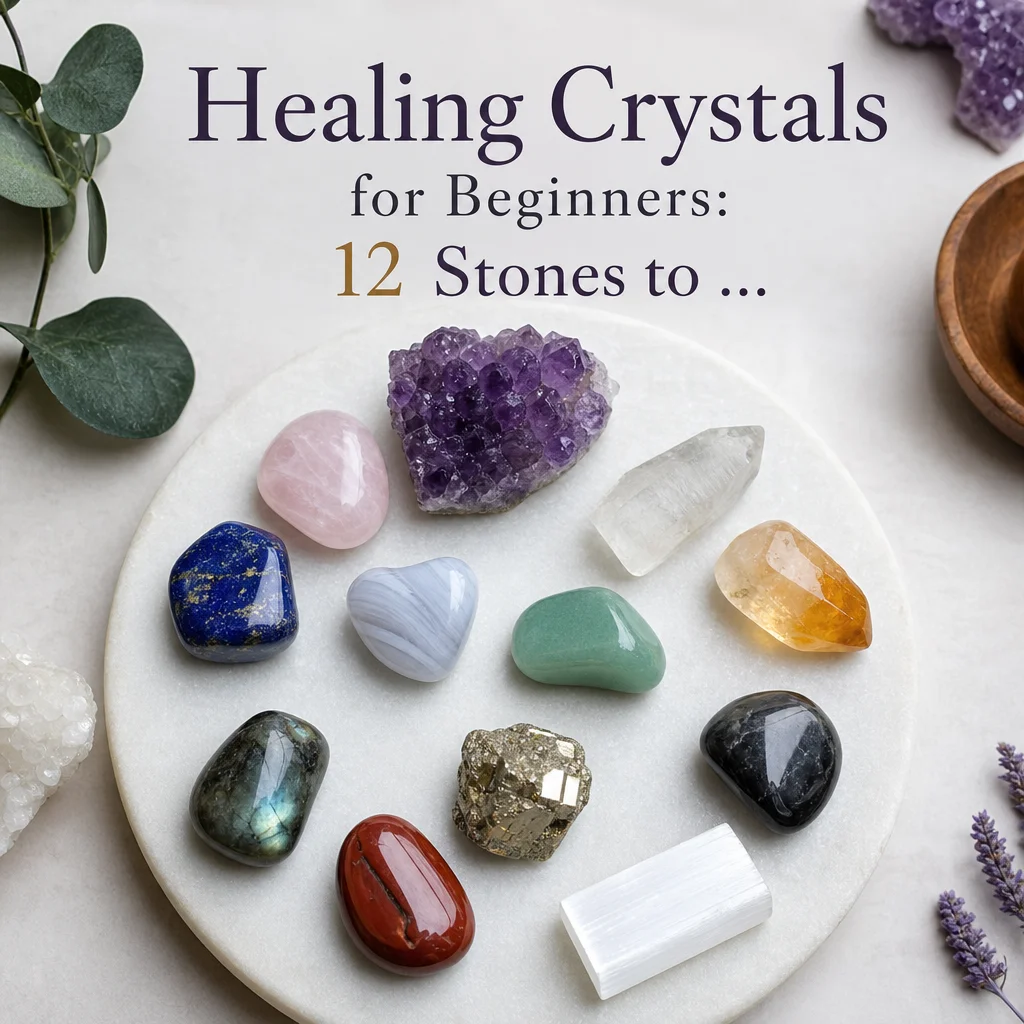
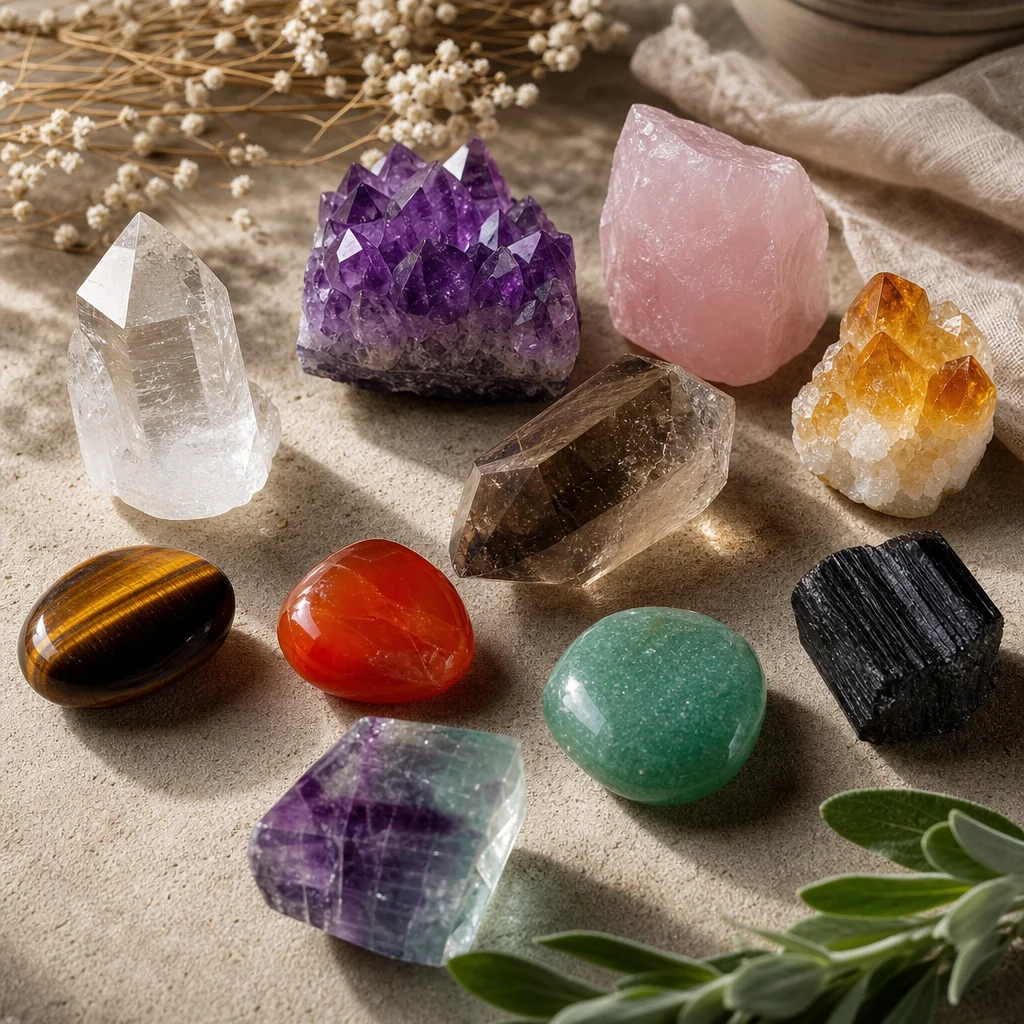
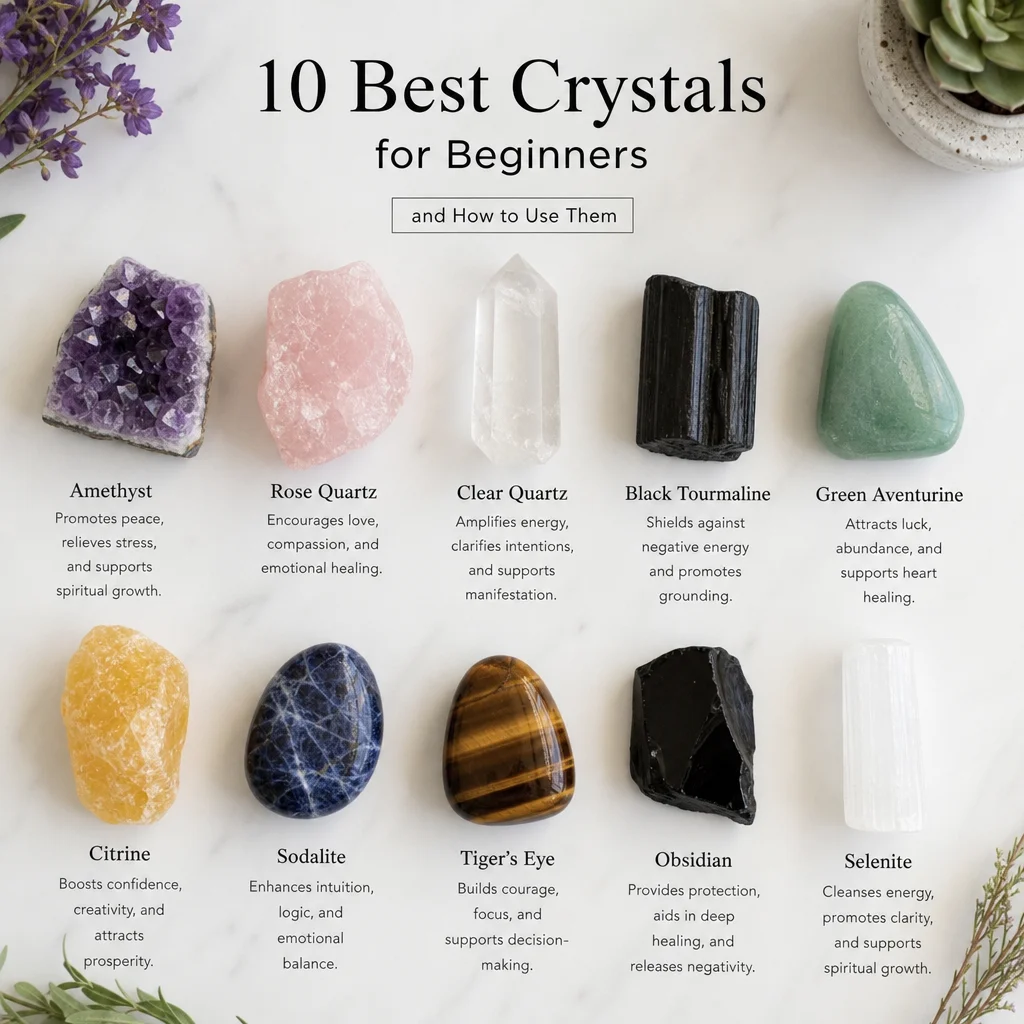
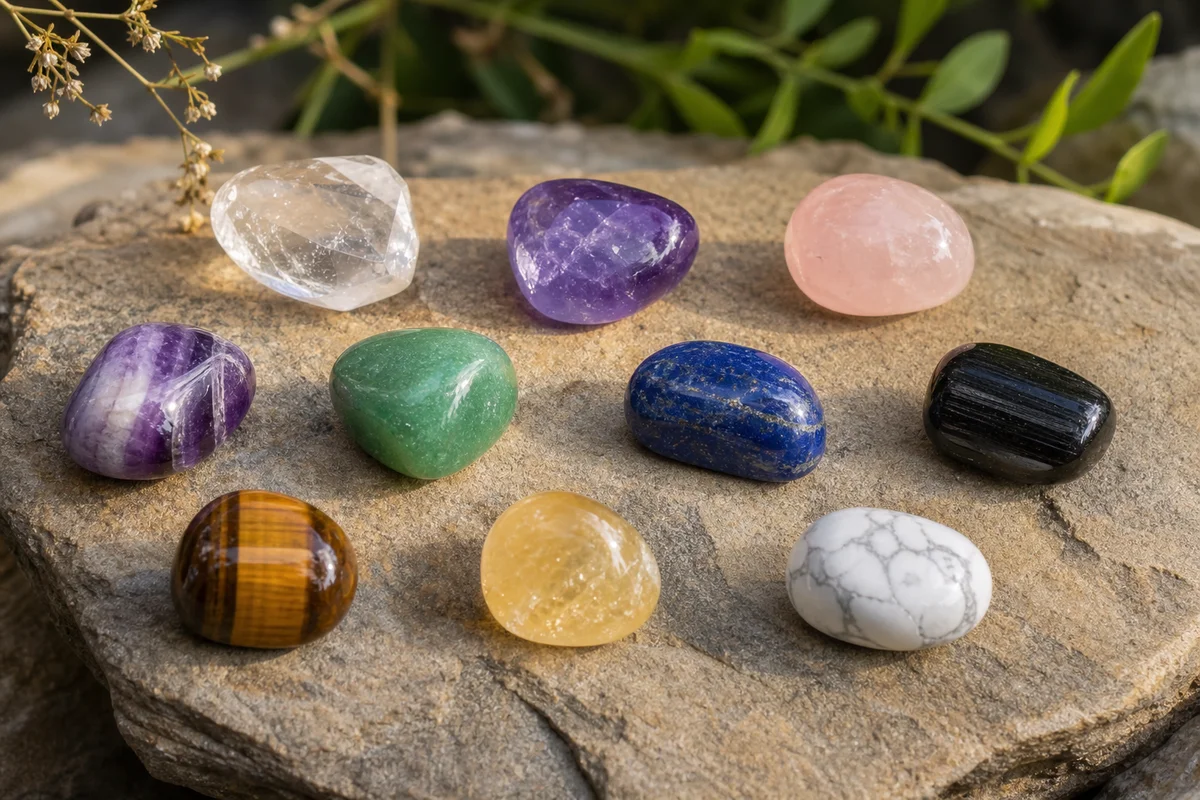
Walking into a crystal shop for the first time is overwhelming. Hundreds of stones in every color, prices ranging from two dollars to two thousand, and everyone behind the counter has a different opinion about what you "need." Here is the honest truth: you do not need much to start. Twelve well-chosen stones give you a foundation that covers the full spectrum of what crystals can offer aesthetically, culturally, and practically.
This guide covers each stone's physical properties, what it traditionally represents, what you should expect to pay, and — critically — how to make sure you are getting the real thing and not dyed glass.
The Starter Kit: 12 Stones
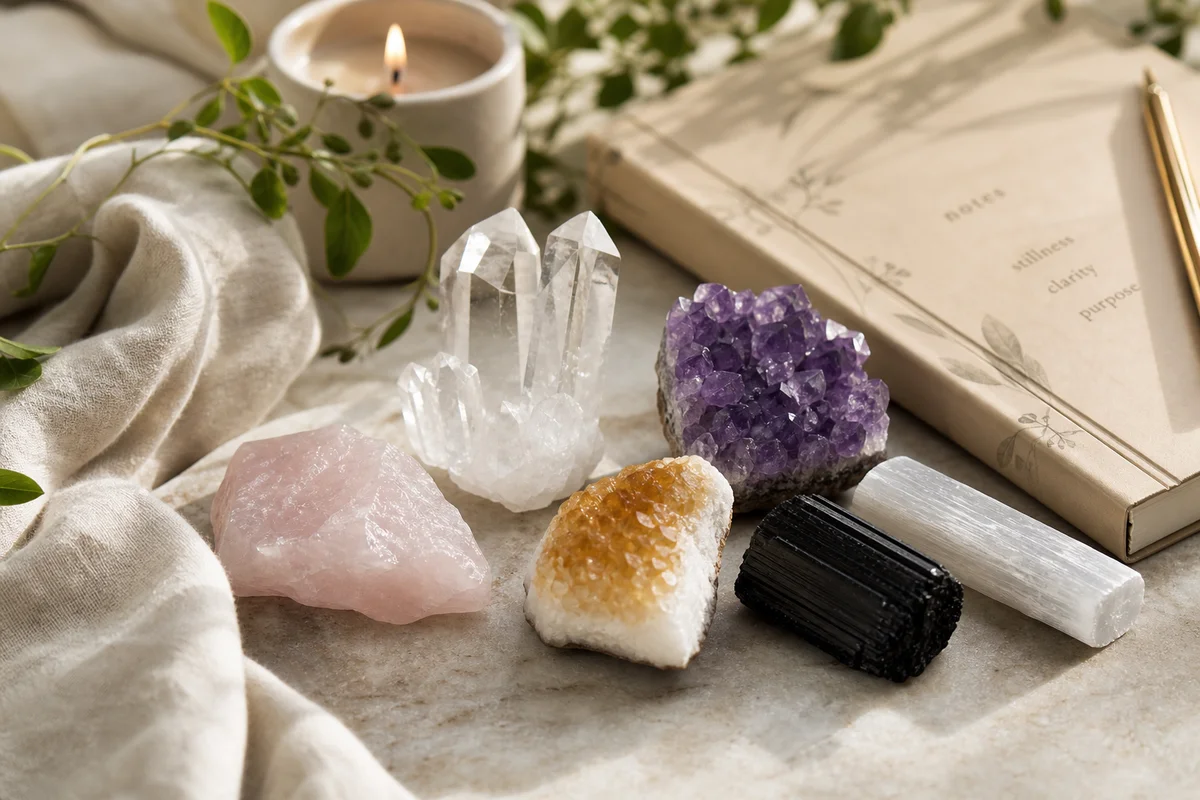
1. Clear Quartz (SiO₂)
The Swiss Army knife of crystals. Clear quartz is silicon dioxide, the most abundant mineral in the Earth's crust. It is hard (7 on the Mohs scale), durable, and completely colorless when pure.
- Price: $3-8 for a nice tumbled stone, $5-15 for a small point
- Source: Worldwide — Brazil, Madagascar, Arkansas (USA), Himalayas
- Why start here: It is the reference standard. Once you know what real quartz looks and feels like, you have a baseline for comparing every other stone. Clear quartz is also the most versatile display piece.
- Traditional association: Clarity, focus, amplification
- Fake alert: Glass is the main fake. Real quartz is heavier (SG 2.65 vs glass ~2.5) and may contain tiny natural inclusions. Perfectly flawless "clear quartz" at a suspiciously low price is probably glass.
2. Amethyst (SiO₂ — purple quartz)
Purple amethyst is iron-bearing quartz colored by natural radiation. The color ranges from pale lavender to deep royal purple. Hardness 7.
- Price: $4-12 tumbled, $8-25 for a small cluster
- Source: Brazil, Uruguay, Zambia, Mexico
- Why start here: It is one of the most visually striking stones at any price point. A dark purple amethyst cluster on your shelf looks like it cost three times what you paid.
- Traditional association: Calm, clarity, restful sleep
- Fake alert: Dyed quartz or purple glass. Real amethyst often has subtle color zoning — slight variations in shade within the same stone. Perfectly uniform color is a yellow flag.
3. Rose Quartz (SiO₂ — pink quartz)
Pink quartz colored by trace amounts of titanium, iron, and manganese. Usually translucent to opaque. Hardness 7.
- Price: $3-8 tumbled, $5-15 for a polished heart or sphere
- Source: Brazil, Madagascar, Mozambique, India
- Why start here: It is affordable, durable enough for jewelry, and the soft pink color works in almost any decor style.
- Traditional association: Love, compassion, emotional healing
- Fake alert: Dyed quartz. Real rose quartz is a gentle, muted pink — not hot pink or magenta. If the color looks artificially intense, it probably is. Also, genuine rose quartz often has a slightly milky or hazy appearance.
4. Citrine (SiO₂ — yellow quartz)
Yellow-to-orange quartz colored by iron. Most commercial citrine is heat-treated amethyst, which is standard and accepted in the trade. Hardness 7.
- Price: $4-10 tumbled, $8-20 for a small point
- Source: Brazil, Madagascar (natural citrine from Bolivia is rarer and pricier)
- Why start here: It is the warm counterpart to amethyst's cool tones, and it adds color variety to a beginner's collection.
- Traditional association: Positivity, energy, abundance
- Fake alert: Heat-treated amethyst sold without disclosure is common but not exactly "fake." Actual fakes include yellow glass and dyed quartz. Real citrine (even heated) has a warm, honey-like tone. Bright yellow or orange-red suggests aggressive heating or dye.
5. Black Tourmaline (Schorl — complex sodium iron borosilicate)
Black tourmaline is the most common variety of the tourmaline group. It is opaque, jet black, and has a distinctive vertical striation pattern on its crystal faces. Hardness 7-7.5.
- Price: $3-10 for a raw piece, $5-15 for a tumbled stone
- Source: Brazil, Mozambique, Pakistan, Maine (USA)
- Why start here: It is the classic "protection" stone and a staple in almost every crystal collection. The raw crystals with their natural striations look impressive on a shelf.
- Traditional association: Protection, grounding, shielding from negative energy
- Fake alert: Less common than with other stones because black tourmaline is already inexpensive. But some sellers substitute dyed black onyx or black glass. Real tourmaline has visible vertical striations and is noticeably heavier than glass.
6. Green Aventurine (SiO₂ — quartz with fuchsite inclusions)
A variety of quartz containing tiny flakes of fuchsite mica, which give it a characteristic sparkly appearance known as aventurescence. Hardness 7.
- Price: $3-8 tumbled, $5-12 for a palm stone
- Source: India, Brazil, Russia, Tanzania
- Why start here: It is affordable, durable, and the sparkly green surface catches light in a way that makes people pick it up and turn it in their hands.
- Traditional association: Luck, prosperity, opportunity
- Fake alert: Sometimes confused with jade (aventurine is much cheaper and less dense). Some green aventurine on the market is dyed to enhance the green color. Natural aventurine ranges from pale sage green to medium green — neon green is a red flag.
7. Selenite (CaSO₄·2H₂O — gypsum)
Selenite is a crystallized form of gypsum — calcium sulfate dihydrate. It is soft (hardness 2), transparent to translucent, and has a pearly or silky luster. It often forms in long, flat, blade-like crystals.
- Price: $4-12 for a tower or wand, $8-20 for a larger slab
- Source: Morocco, Mexico, Poland, USA (Oklahoma)
- Why start here: Selenite towers are among the most dramatic display pieces you can buy for under $15. They look like pillars of moonlight.
- Traditional association: Cleansing, peace, spiritual connection
- Fake alert: Real selenite is very soft — you can scratch it with your fingernail (hardness 2). If you cannot scratch it, it is not selenite. Also, real selenite has a fibrous or satiny texture, not a glassy one.
8. Carnelian (SiO₂ — orange chalcedony)
A translucent orange-to-reddish-brown variety of chalcedony (microcrystalline quartz). Hardness 6.5-7.
- Price: $3-8 tumbled, $5-15 for a bead bracelet
- Source: India, Brazil, Uruguay, Madagascar
- Why start here: The warm orange color complements the cooler stones in your collection, and carnelian is one of the best stones for bead jewelry — it takes a beautiful polish.
- Traditional association: Motivation, courage, creativity
- Fake alert: Dyed agate is the main concern. Real carnelian has a waxy luster and subtle color variations. Bright, uniform orange with a glassy shine may be dyed. The "heat test" is unreliable — both natural and dyed carnelian are routinely heat-treated to improve color.
9. Lepidolite (K(Li,Al)₃(Si,Al)₄O₁₀(F,OH)₂ — mica group)
A lithium-rich mica that is typically lilac to pinkish-purple with a flaky, layered structure. Hardness 2.5-3.
- Price: $4-10 tumbled, $8-20 for a raw specimen
- Source: Brazil, Madagascar, USA (California), Czech Republic
- Why start here: It is one of the few minerals that contains significant lithium — the same element used in mood-stabilizing medications. Whether or not you believe in crystal energy, the mineralogy connection is genuine.
- Traditional association: Emotional balance, stress relief, transition
- Fake alert: Sometimes confused with muscovite mica or synthetic purple mica. Real lepidolite has a distinctive lilac color and flaky texture. It should leave a slight white streak on unglazed porcelain.
10. Hematite (Fe₂O₃ — iron oxide)
A metallic gray-black iron oxide mineral with a distinctive red streak. Hardness 5.5-6.5.
- Price: $2-5 tumbled, $5-10 for a bracelet
- Source: Brazil, China, Australia, England
- Why start here: It is the heaviest common crystal — picking up a hematite sphere is always surprising. The metallic luster is unique among affordable stones.
- Traditional association: Grounding, stability, focus
- Fake alert: Magnetic "hematite" is common. Real hematite is very weakly magnetic or not magnetic at all. If a magnet strongly attracts your "hematite," it is probably a manufactured magnetic ceramic (sometimes called "hematine").
11. Howlite (Ca₂B₅SiO₉(OH)₅ — borate mineral)
A white mineral with gray or black veining, often used as a turquoise imitation. Hardness 3.5.
- Price: $2-5 tumbled, $5-10 for a sphere
- Source: Canada (Nova Scotia), USA (California), Turkey
- Why start here: It is one of the cheapest stones available and the gray veining gives it a distinctive look. It is also the stone most commonly dyed to imitate turquoise — knowing what real howlite looks like helps you spot fake turquoise.
- Traditional association: Calm, patience, stress relief
- Fake alert: Howlite itself is rarely faked (it is too cheap). The issue is howlite being sold as turquoise. If the "turquoise" has a web-like matrix pattern and was suspiciously affordable, it is probably dyed howlite.
12. Labradorite (plagioclase feldspar)
A feldspar mineral famous for its "labradorescence" — flashes of blue, green, gold, or red when the stone is moved under light. Hardness 6-6.5.
- Price: $5-15 tumbled, $10-30 for a polished freeform
- Source: Madagascar, Canada (Labrador/Nfld), Finland, Russia
- Why start here: The color flash makes it one of the most magical-looking stones at any price. A good labradorite piece stops people in their tracks.
- Traditional association: Intuition, transformation, inner strength
- Fake alert: Low-grade labradorite with minimal flash is sometimes treated with oil or resin to enhance the play of color. Look for a natural, slightly gritty surface texture on rough pieces.
The 5-Stone Starter Bundle
If $100 feels like a lot, start with five: clear quartz, amethyst, rose quartz, black tourmaline, and labradorite. You can buy all five as tumbled stones for under $30 total, and you have a representative collection that covers the major colors and traditional uses.
Five Fake Crystals Beginners Fall For
Where to Buy
Mineral and gem shows offer the best combination of price, selection, and the ability to handle specimens before buying. Prices are typically 30-50% lower than retail shops because you are buying directly from dealers.
Online specialty dealers (not Amazon or eBay) are the next best option. Look for sellers who provide locality information, disclose treatments, and have clear return policies.
Crystal shops in tourist areas are the most expensive option but can be fine for individual pieces if you know what you are looking for and can evaluate quality in person.
Avoid buying "crystal mystery boxes" or unverified bulk lots from online marketplaces. These are the most common source of fakes and misidentified material.
Building a crystal collection should be enjoyable, not stressful. Start with these twelve stones, learn what real minerals look and feel like, and expand from there. Every expert collector started with a handful of tumbled stones and a curiosity about what makes each one different.
Crystals are not a substitute for medical treatment. The cultural and traditional associations described in this article are for informational purposes.
How to Cleanse and Charge Your New Crystals
Bringing a new crystal home is exciting, but before you start working with its energy, you need to reset its baseline. From the moment a stone is mined to the time it reaches your hands, it passes through dozens of people, places, and environments. Cleansing your crystals clears away any lingering, stagnant energy they may have absorbed along their journey, turning them into a blank slate for your personal intentions.
One of the most effective and accessible ways to cleanse your beginner stones is by using sound or smoke. Passing your crystals through the smoke of burning sage or palo santo is a traditional method that swiftly clears the energetic field. Alternatively, you can use sound waves from a singing bowl or a tuning fork; the pure vibrations easily break up unwanted energy without risking any physical damage to softer stones like selenite.
Once a stone is cleansed, it is ready to be "charged" or programmed with your specific goals. The easiest way to charge your crystals is by placing them in direct moonlight overnight, especially during a full moon. The lunar energy gently revitalizes the stones without fading their colors—a risk you face if you leave certain stones in harsh, direct sunlight. Hold the crystal in your hands, take a deep breath, and clearly state what you wish to achieve.
Understanding Crystal Shapes and Formations
Walk into any crystal shop, and you will notice that the stones come in vastly different shapes. While the mineral itself holds specific properties, the physical shape of the crystal actually influences how its energy moves and interacts with your space. As a beginner, understanding these basic formations will help you choose the perfect tool for your needs.
Tumbled stones are the most popular choice for beginners. These are natural stones that have
Frequently Asked Questions
How do I know which healing crystal is right for me?
Trust your intuition! The best way for beginners to choose a crystal is by noticing which stones naturally catch your eye. Whether you are drawn to a specific color or the meaning behind the stone, your energy is guiding you. At SagStone, we believe the right handcrafted crystal jewelry will always find its way to you when you need its specific healing properties the most.
Which wrist should I wear my healing crystal bracelet on?
In crystal healing practices, your left hand is the receiving side, ideal for drawing in positive energy and internal healing. Your right hand is the giving side, used to release negative energy outward. For example, wear Amethyst on the left to invite calm, and Black Tourmaline on the right to push away bad vibes. Choose the wrist that aligns with your daily intention.
How long does it take for healing crystals to start working?
There is no set timeline for when you will feel the benefits of natural crystals, as it depends on your personal awareness and intentions. Some people feel an immediate shift in their mood when wearing handcrafted crystal jewelry, while others notice subtle changes over weeks. Consistency is key—wear your stones daily, set clear intentions, and stay open to their grounding energy.
Can I wear multiple different crystal jewelry pieces at the same time?
Yes, you can absolutely layer multiple natural crystals! However, it is best to combine stones with complementary energies to avoid feeling overwhelmed. For instance, pairing Clear Quartz with Rose Quartz beautifully amplifies loving vibrations. As a beginner, start by wearing just one or two handcrafted pieces until you understand how each stone affects your personal energy field.
What is the best crystal for manifesting money and good luck?
Citrine and Green Aventurine are widely considered the ultimate stones for attracting wealth and opportunity. Citrine is famous for its ability to manifest abundance and success, while Green Aventurine is known as the "Stone of Opportunity," often used to bring luck. Wearing these natural stones in a beautiful handcrafted pendant keeps their prosperous energy close to you all day.
Comments