Inclusions in gemstones: flaws or features
Turn a diamond over in good light and you might see a tiny speck, a hairline crack, or a faint cloud inside the stone. Most people call these "flaws." Gemologists call them "inclusions," and the word matters more than you might think. An inclusion is not necessarily a defect. In many stones, it's proof that the gem is natural, a fingerprint of how and where it formed. Sometimes it's even the reason the stone is valuable.
Let me explain what inclusions actually are, because the conversation around them is full of misunderstandings — especially in the diamond world, where the marketing has convinced people that a perfect stone is the only good stone.
What an inclusion actually is
An inclusion is any material that became trapped inside a gemstone as it was forming. This includes other minerals, pockets of liquid or gas, fractures, growth lines, color zoning, and even microscopic crystals of the gemstone's own material that started growing in a different orientation.
Gemstones form over millions of years (natural ones) in environments that are messy, hot, pressurized, and chemically complex. Very few form in pristine isolation. Most form in the presence of other minerals, in rocks that are cracking and shifting, with fluids percolating through them. It would actually be weird if more stones were perfectly clean.
Think of it this way: an inclusion is a fossil record of the stone's birth. It tells you what other elements were present, what temperatures and pressures the stone experienced, and sometimes even where on Earth it formed.
The diamond industry's obsession with clarity
I need to address diamonds first, because diamond clarity grading has done more to confuse people about inclusions than anything else.
The GIA clarity scale runs from Flawless (FL) to Included (I3), with most of the commercial market falling in the VS (Very Slightly Included) to SI (Slightly Included) range. Flawless diamonds — stones with zero inclusions visible at 10x magnification — represent well under 1% of all diamonds mined. They're astronomically expensive and, frankly, unnecessary.
Here's what most people don't realize: the VVS (Very Very Slightly Included) and VS grades have inclusions that are invisible to the naked eye. Even SI1 stones often have inclusions that you literally cannot see without a jeweler's loupe. The entire bottom half of the clarity scale (I1, I2, I3) is where inclusions become visible, and I1 stones can still be attractive if the inclusion is off-center or a light color.
The diamond industry has trained consumers to chase clarity grades they don't need. A VS2 diamond looks identical to a Flawless diamond to anyone who isn't examining it under 10x magnification. The price difference can be 200-400%. You're paying for something you can't see.
For colored gemstones, clarity standards are completely different and generally much more lenient. Which brings us to the interesting part.
When inclusions are normal (and expected)
In colored gemstones, inclusions are the rule, not the exception. Some stones are almost never found without them.
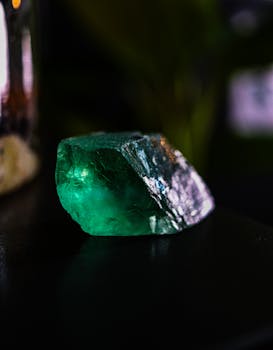
Emerald is the classic case. The vast majority of natural emeralds have visible inclusions. The French even have a term for it: jardin, meaning "garden," because the network of inclusions inside an emerald can look like tiny foliage under magnification. A clean emerald is so rare that it's almost certainly either synthetic or treated beyond recognition. The idea of an "eye-clean" emerald is, for most practical purposes, a contradiction.
The emerald trade has its own clarity standards. Unlike diamonds, where visible inclusions dramatically reduce value, emeralds are valued primarily for color. A rich, vivid green emerald with visible inclusions is worth far more than a pale green emerald that's perfectly clean. The inclusions are simply accepted as part of the deal.
Ruby and sapphire are similar. Clean stones exist but are uncommon, and the finest colors (pigeon blood red in ruby, cornflower blue in sapphire) almost always come with some inclusions. The silk — fine needle-like inclusions of rutile — in Kashmir sapphires is partly responsible for their velvety appearance. Remove the silk and you lose part of what makes the stone special.
When inclusions add value
This is where it gets genuinely interesting. Some gemstones are valuable specifically because of their inclusions.
Rutilated quartz
Rutilated quartz is clear or smoky quartz containing needle-like crystals of rutile (titanium dioxide). The needles can be gold, silver, red, or black, and they form in patterns that range from random tangles to remarkably organized parallel arrays. A well-patterned rutilated quartz cabochon, with bright golden needles radiating through clear quartz, is a striking gemstone that's worth more than the clean quartz would be.
The rutile inclusions are literally the point. Nobody buys rutilated quartz despite the inclusions. They buy it because of them.
Demantoid garnet
Demantoid garnet — the green variety of andradite garnet — is one of the rarest and most valuable colored gemstones. The finest demantoids, particularly those from the Ural Mountains in Russia, contain "horsetail" inclusions: fibrous, radiating bundles of byssolite (a type of asbestos mineral) that look like a spray of golden-brown hair frozen inside the stone.
These horsetail inclusions are so distinctive and so closely associated with the Russian origin that their presence actually increases the value of the stone. A Russian demantoid with a visible horsetail inclusion is worth more than a clean demantoid from another source. This is one of the clearest cases where an inclusion is a feature, not a flaw.
Other inclusion-valued stones
Tourmalinated quartz (quartz with black tourmaline needles) works on the same principle as rutilated quartz — the inclusions are the attraction. Dendritic quartz, containing manganese or iron oxide inclusions that form branching, tree-like patterns (dendrites), is another example where inclusions create the visual interest.
Trapiche emeralds from Colombia contain dark impurities (usually carbonaceous material or albite) that form a six-rayed star pattern inside the stone when viewed from above. These are among the most valuable emeralds in the world, and the inclusion pattern is the entire reason why.
Types of inclusions and what they mean
Mineral crystals
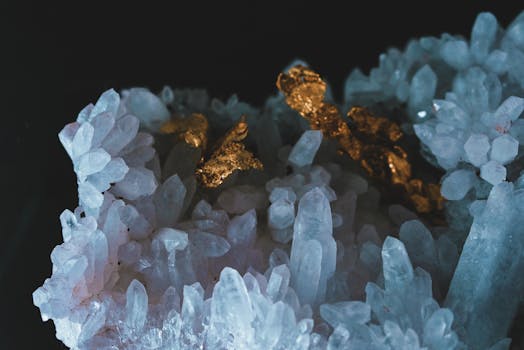
Small crystals of other minerals trapped inside the host gem. Common examples: pyrite cubes in lapis lazuli, zircon crystals in sapphire, calcite in emerald. These can help identify the stone's geographic origin — certain inclusion assemblages are characteristic of specific mines or regions.
Three-phase inclusions
These are tiny pockets containing a solid mineral, a liquid (usually water or brine), and a gas (usually CO2), all coexisting in a single cavity. Three-phase inclusions are a diagnostic feature of emeralds from Colombia. They form when the stone grows in a hydrothermal environment, and their presence is strong evidence of natural origin. Synthetic emeralds rarely replicate this exact three-phase assemblage.
Needles and silk
Thin, needle-like mineral inclusions, often rutile. In corundum (ruby and sapphire), silk needles create a softening effect on the stone's appearance and can help identify origin — Thai rubies tend to have different silk patterns than Burmese rubies. Silk can also indicate whether a stone has been heat-treated: high-temperature heat treatment dissolves silk needles, so the presence of intact silk suggests the stone is unheated.
Growth zoning
Visible bands of color or varying clarity that represent different stages of the crystal's growth. Common in sapphire (color zoning), tourmaline, and many other minerals. Growth zoning is normal and generally doesn't affect value unless it creates an unattractive color pattern.
Fractures and feathers
Internal cracks that may have formed during growth or been caused by tectonic stress. In diamonds, feathers are one of the most common inclusion types. Their significance depends on their size, location, and whether they reach the surface (which can affect durability). Small, internal feathers are generally harmless. Large feathers extending to the surface can be a structural concern.
Halos and tension halos
Small cracks or stress patterns that form around a crystal inclusion because the inclusion has a different thermal expansion coefficient than the host gem. When the stone cools from formation temperatures, the inclusion and host contract at different rates, creating stress fractures in a circular pattern around the inclusion. These are common in sapphire and garnet.
How inclusions help identify origin and authenticity
Gemologists use inclusions as one of their primary tools for determining where a stone came from and whether it's natural or synthetic.
Origin determination is partly an inclusion-matching game. Kashmir sapphires have a characteristic combination of silk, color zoning, and tiny mineral inclusions that differs from Burmese, Sri Lankan, or Madagascar sapphires. Colombian emeralds have those distinctive three-phase inclusions. Russian demantoids have horsetails. These inclusion "fingerprints" aren't always definitive on their own, but combined with spectroscopic analysis and other tests, they give gemologists a reasonable basis for origin claims.
Synthetic stones can be harder to identify visually, but they often have different inclusion characteristics. Flux-grown synthetic emeralds may contain flux remnants (curved wisps of the molten growth medium) that look different from natural inclusions. Hydrothermal synthetic emeralds may have distinctive nail-head spicules or chevron growth patterns. CVD lab-grown diamonds can have subtle graining patterns visible under magnification. HPHT lab-grown diamonds often contain tiny metallic flux inclusions.
None of these are visible to the naked eye. But under 30-60x magnification by an experienced gemologist, they can be conclusive.
The practical take
Inclusions are not flaws in any universal sense. They're information. In diamonds, the clarity grading system has turned them into a pricing metric, and the market has done a good job of convincing people to spend money on invisible differences. In colored gemstones, inclusions are largely expected and often accepted or even valued.
If you're buying a diamond, buy SI1 or VS2 and save your money. The inclusions at those grades are invisible without magnification, and the stone will look identical to a VVS or Flawless diamond in every normal viewing situation.
If you're buying colored gemstones, accept that inclusions are part of the territory. Don't reject a beautiful stone because it has visible inclusions — evaluate the overall appearance, the color quality, and the durability. A well-cut emerald with jardin inclusions and vivid green color is a far better stone than a pale, lifeless emerald that happens to be clean.
And if you ever encounter a stone where the inclusions are the attraction — rutilated quartz, tourmalinated quartz, a demantoid with horsetails, a trapiche emerald — appreciate what you're looking at. Those inclusions are the rarest kind of imperfection: the kind that makes something more beautiful, not less.
Comments