Crystals for Study & Exam Season: Student Sur...
June 5, 2026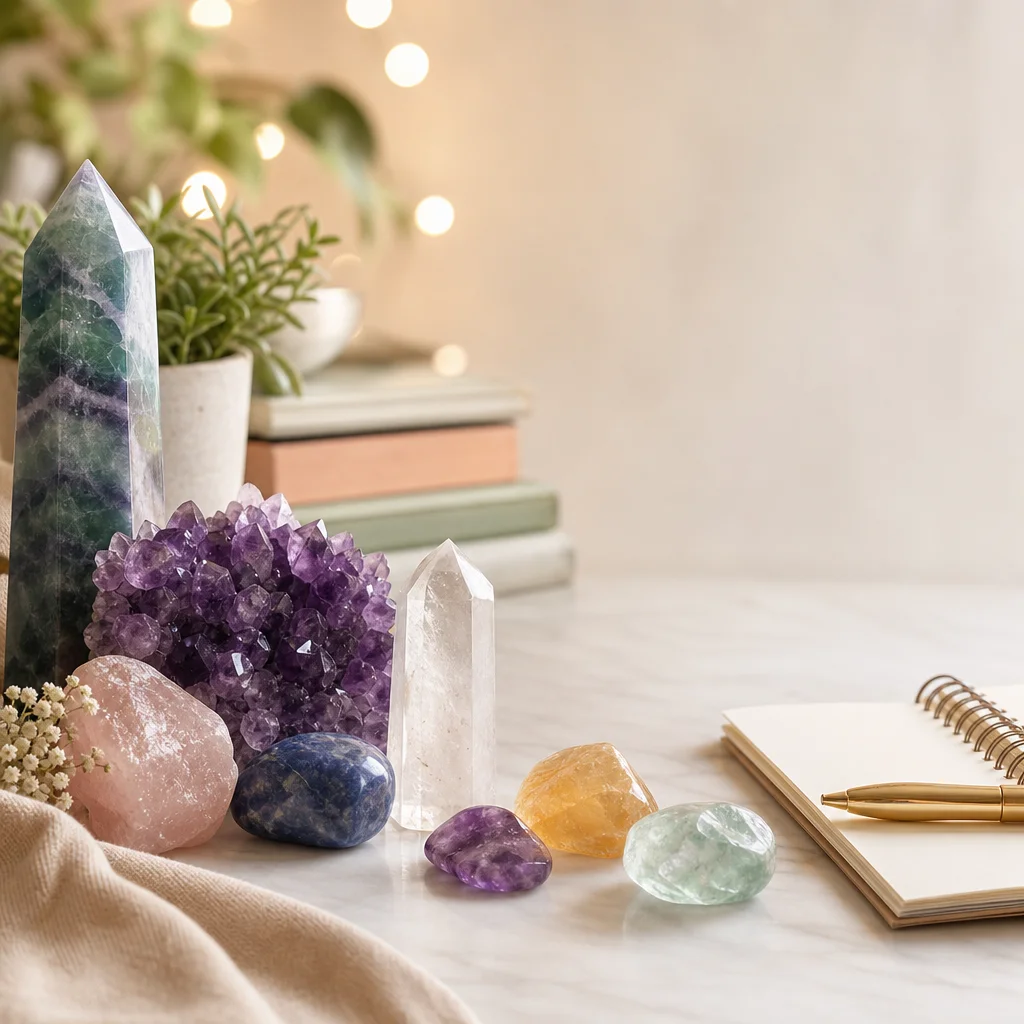
Why Students Turn to Crystals During Exam Season
Exam season creates a perfect storm of stress, burnout, and information overload. Whether you're cramming for finals, preparing for a professional certification, or grinding through a dissertation, the mental demands pile up fast. Plenty of students have started placing crystals on their desks or wearing them during study sessions — not as a magic solution, but as a tangible focus tool that grounds their attention and creates a dedicated study environment.
The idea has historical roots. Scholars in ancient Greece carried polished stones like hematite for mental endurance. Roman students wore amber pendants, believing the fossilized resin sharpened thought. In modern practice, the approach works on a simpler level: a crystal on your desk becomes a physical anchor, a reminder to breathe, focus, and stay present when your mind wants to wander to everything except organic chemistry.
This guide covers the best-studied and most popular crystals for academic performance, how to arrange them in a study space, and practical tips that don't require any mystical belief — just an open mind and a willingness to try something that might help you study a little better.
Fluorite: The MVP of Mental Clarity
Fluorite earns its reputation as the top study crystal for good reason. This mineral comes in a rainbow of colors — purple, green, blue, yellow — and often displays multiple hues in a single specimen. It forms in cubic or octahedral crystals that catch light in an almost architectural way, which is part of why people gravitate toward it visually.
For studying, fluorite is prized for its association with mental organization and clear thinking. The theory is straightforward: keeping a piece of fluorite near your workspace helps cut through mental fog and keeps your thoughts structured. Practically, having a striking crystal on your desk creates a visual focal point. When you catch yourself staring at it instead of your textbook, use that moment to take a deep breath and redirect your attention — it's a built-in mindfulness trigger.
Rainbow fluorite, which contains bands of purple and green, is especially popular. Purple fluorite connects with focused concentration while green fluorite relates to growth and learning. A single piece gives you both. Place it where you can see it from your primary study position, not tucked behind your laptop where it becomes invisible.
Clear Quartz: The Memory Amplifier
Clear quartz is the most abundant and versatile crystal in the mineral kingdom, and it shows up in almost every crystal recommendation list for a reason. Its primary association in study contexts is mental clarity and memory enhancement. In crystal healing traditions, clear quartz is called the "universal amplifier" — it's believed to strengthen the properties of any other stone it's paired with.
From a practical standpoint, clear quartz's value for students comes from its simplicity. It doesn't compete for attention with flashy colors. A clear, well-polished point or sphere on your desk serves as a clean visual anchor. Some students tape a small quartz point to their exam lucky charm or keep one in their pencil case. The idea isn't that the stone has supernatural powers — it's that interacting with it (touching it, looking at it, holding it) creates a micro-moment of grounding during high-stress moments.
For maximum effect in study setups, clear quartz pairs well with almost any other crystal. Set a clear quartz point near your fluorite or amethyst, and the arrangement becomes a small crystal grid specifically tuned for concentration and memory.
Amethyst: Stress Relief for the Overworked Student
If fluorite handles the focus side of studying, amethyst takes care of the stress side. Amethyst is the purple variety of quartz, colored by iron impurities and natural irradiation over millions of years. It's one of the most widely used crystals for calming energy and anxiety relief, which makes it directly relevant to the exam-season experience.
Test anxiety is real. Your heart races, your thoughts scatter, and no amount of studying seems to prepare you for the wave of panic that hits when you hear the words "you may begin." Amethyst is associated with soothing nervous energy and promoting a calm, centered state of mind. For students who experience exam nerves, keeping an amethyst cluster on the desk or wearing an amethyst pendant during study sessions provides a tangible comfort object.
Place amethyst near your bed during exam week, not just at your desk. Sleep quality directly affects cognitive performance, and amethyst's calming reputation extends to rest. Some students keep a small amethyst tumbled stone under their pillow — whether this helps through any energetic mechanism or simply serves as a psychological comfort signal, the result is often better sleep and clearer thinking the next morning.
Citrine: Confidence and Positive Mindset
Studying isn't just about focus and calm — attitude matters enormously. Students who approach their work with confidence perform measurably better than those locked in self-doubt. Citrine, the golden-yellow variety of quartz, is the crystal most associated with self-confidence, motivation, and a positive outlook.
Natural citrine is relatively rare. Most citrine on the market is actually heat-treated amethyst, which transforms purple quartz into shades of amber, gold, and yellow through controlled heating. Whether natural or treated, the resulting stone carries the same warm, energizing energy that students find motivating. The golden color itself is psychologically uplifting — yellow tones are associated with alertness and mental energy in color psychology research.
Keep citrine visible during difficult study sessions. When you're slogging through material you don't understand and the temptation to give up rises, looking at that warm golden stone can serve as a small visual cue to push through. Some students carry a citrine tumble in their pocket on exam day as a confidence talisman.
Lapis Lazuli: Deep Thinking and Intellectual Depth
Lapis lazuli has been prized for intellectual pursuits since ancient Egypt, where pharaohs and scribes wore it as a symbol of wisdom. This deep blue rock speckled with golden pyrite inclusions is stunning to look at, and its historical connection to scholarship makes it a natural choice for academic environments.
Lapis lazuli is associated with intellectual ability, deep thinking, and effective communication — all essential skills for writing essays, defending theses, and presenting research. The stone's visual richness (deep blue with metallic gold flecks) makes it a compelling desk companion. It's the kind of crystal that prompts questions from study partners and professors, which can spark conversations about the very topics you're studying.
For written assignments and creative projects, lapis lazuli is particularly recommended. Its association with clear expression and truthful communication translates practically: having it nearby while writing can serve as a reminder to be direct, precise, and confident in your arguments. Students working on literature reviews, research papers, or any writing-intensive task often report feeling more articulate with lapis nearby.
Black Tourmaline: Shielding Your Study Space
Here's one most students don't think about: electromagnetic field (EMF) protection. Your laptop, phone, tablet, desk lamp, and monitor all generate electromagnetic fields. While the health effects of low-level EMF exposure remain debated, many people report feeling mentally fatigued after long hours surrounded by electronic devices. Black tourmaline is the go-to crystal for EMF shielding.
Black tourmaline is a complex borosilicate mineral that forms in long, striated prismatic crystals. Its black color comes from high iron content. In crystal healing, it's considered the premier protective stone — against negative energy, psychic interference, and environmental stressors including EMF. For students who spend 8+ hours at a desk surrounded by electronics, placing a piece of black tourmaline between yourself and your devices creates a simple protective arrangement.
Black tourmaline is also grounding. When study stress makes you feel scattered, spacey, or disconnected, this stone's heavy, dark presence can help you feel more physically anchored. Try holding a tumbled piece of black tourmaline in your non-dominant hand during intensive reading sessions — the physical weight and texture give your nervous system something to focus on besides racing thoughts.
Building Your Study Crystal Grid
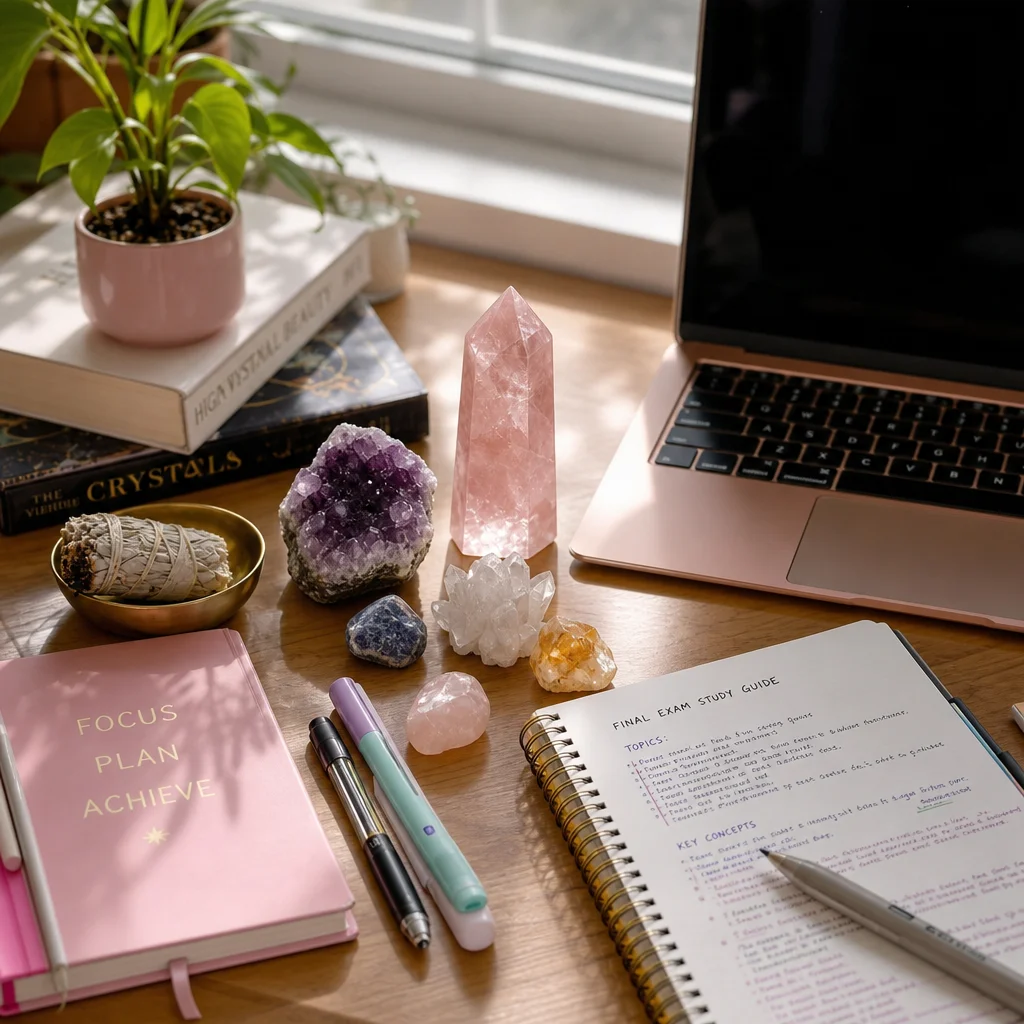
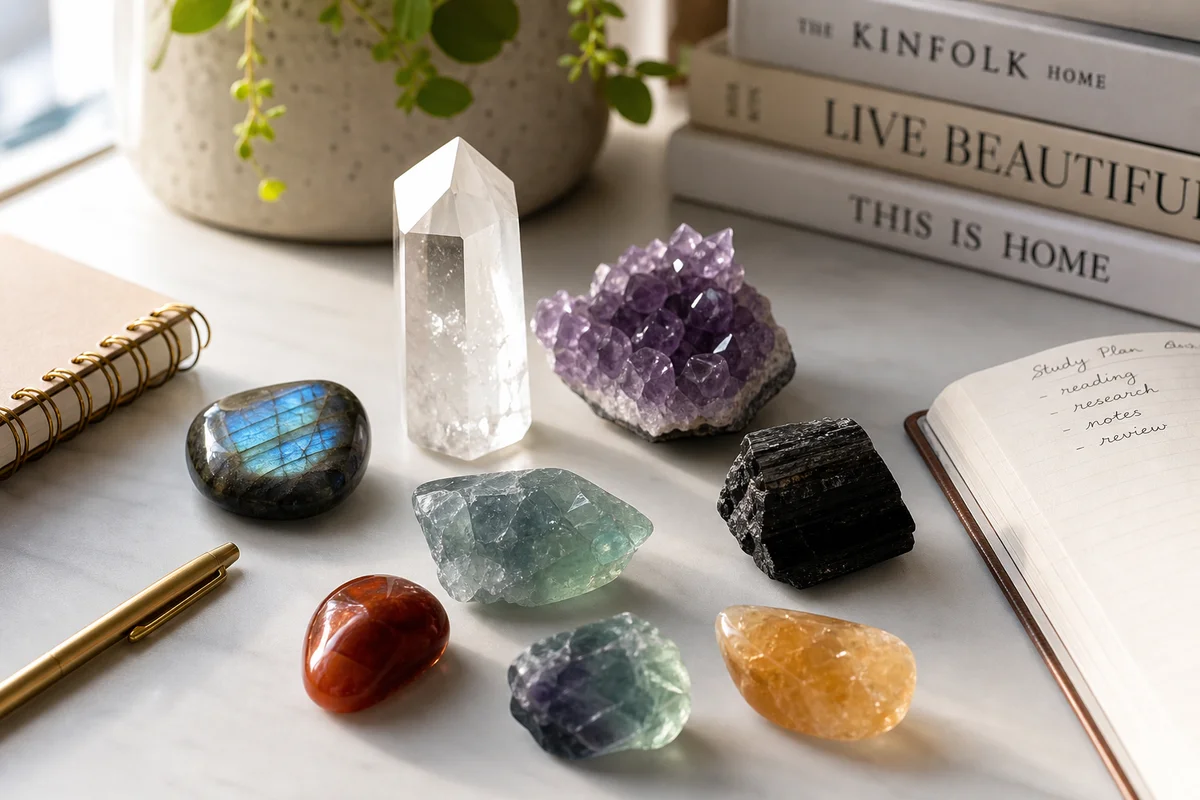
Individual crystals help, but a purposeful arrangement amplifies the effect. A study crystal grid is simply a deliberate placement of multiple stones in a pattern around your workspace. Here's a basic layout that covers all the bases:
The Center: Place a clear quartz point or sphere in the center of your desk. This acts as the amplifier and focal point of the entire grid.
Front-Left (Near Your Dominant Hand): Fluorite, positioned where you can reach it easily. This is your active study stone — touch it when you need to reset your focus.
Front-Right: Amethyst, for stress regulation. Having calming energy on your dominant side helps counteract the tension that builds in your writing hand during long sessions.
Back-Left: Citrine, behind and to the left, supporting sustained motivation. Its position in your peripheral vision provides passive visual encouragement.
Back-Right: Lapis lazuli, positioned for intellectual depth during research and writing tasks.
Between You and Electronics: Black tourmaline, creating a buffer between you and your laptop or monitor.
This arrangement covers concentration, calm, confidence, clarity, and protection. Adjust positions based on your desk layout and personal preference — the best grid is the one you actually use consistently.
Pre-Exam Meditation With Crystals
The morning of an exam, most students rush through last-minute review and show up already anxious. A 5-minute crystal meditation before leaving can shift your nervous system from fight-or-flight into a more composed state. Here's a simple routine:
Sit comfortably with your study crystals arranged in front of you. Hold fluorite in your dominant hand and amethyst in your non-dominant hand. Close your eyes and take 10 slow, deep breaths — inhale for 4 counts, hold for 4, exhale for 6. With each exhale, consciously release the tension in your shoulders, jaw, and hands. After the breathing sequence, open your eyes, look at the fluorite, and silently set an intention: "I am prepared, focused, and calm." Carry a small crystal (any from your grid) in your pocket to the exam as a physical connection to your study space.
This practice takes five minutes. Even if you're skeptical about crystals, the controlled breathing and intention-setting alone reduce cortisol and improve cognitive function. The crystals make the routine memorable and repeatable — you build an association between touching the stones and entering a focused mental state.
Which Stones to Avoid During Study Sessions
Not every crystal helps with studying. Some stones are associated with energy and stimulation that can work against the calm, sustained focus you need. Avoid placing the following on your study desk:
Red Jasper: A grounding stone connected to physical energy and stamina. Great for workouts, counterproductive for long reading sessions where you need to sit still.
Carnelian: Highly stimulating and creative. While creativity is valuable for certain assignments, carnelian's high-energy vibe can make it harder to settle into methodical, detailed work like solving equations or reviewing flashcards.
Any stone you find visually distracting: If a crystal is so beautiful or unusual that you keep picking it up and examining it instead of studying, move it off your desk. The whole point is enhanced focus, not a new distraction.
Caring for Your Study Crystals
Crystals sitting on a desk accumulate dust, and crystals that you handle frequently absorb oils from your skin. Once a week, rinse your study crystals under cool running water (skip this for soft or water-sensitive stones like selenite) and dry them with a soft cloth. You can also leave them on a windowsill during a full moon overnight — this serves dual purposes of cleansing in crystal tradition and simply keeping them clean and charged with natural light.
If you're studying during a particularly stressful exam period, you might notice your crystals feel "heavy" or less vibrant to you. This is subjective, but the solution is simple: set them outside in direct sunlight for an hour (for hard stones like quartz and fluorite) or on a piece of selenite overnight (for any stone). Whether or not you believe in energetic cleansing, the ritual of consciously refreshing your study tools resets your own mental association with them.
Frequently Asked Questions
Do crystals actually help you study better?
There's no peer-reviewed scientific evidence that crystals directly improve academic performance. What they can do is create a focused environment, serve as mindfulness anchors, and provide psychological comfort during stressful periods. Many students report that having crystals on their desk makes study sessions feel more intentional and less punishing, which indirectly improves concentration and endurance.
How many crystals should I keep on my desk?
Start with two or three that address your biggest challenges — perhaps fluorite for focus and amethyst for stress. Add more as you develop a personal connection with the practice. A cluttered desk with 15 crystals defeats the purpose; three to five well-placed stones create a clean, purposeful arrangement.
Can I wear crystals instead of putting them on my desk?
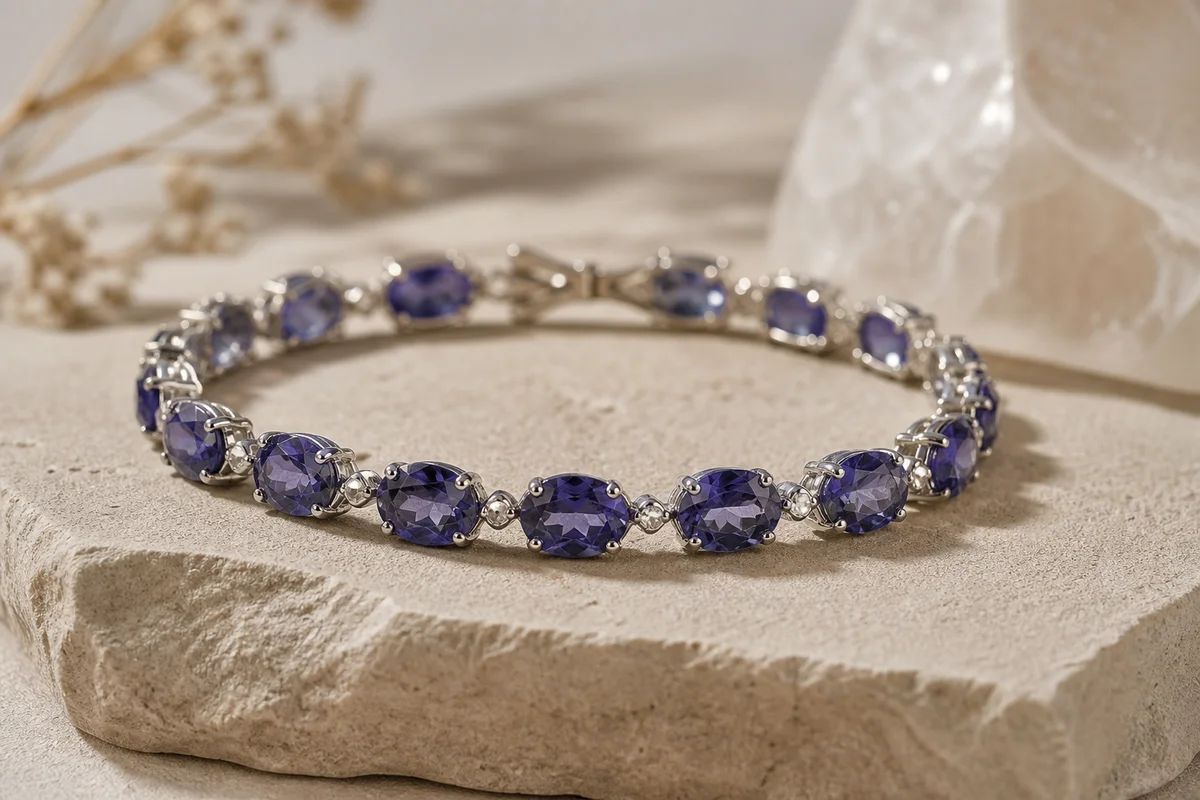
Absolutely. A fluorite pendant, an amethyst bracelet, or a citrine ring keeps the crystal's energy in your personal field throughout the day. For exam days, wearing your study crystals is actually preferable to leaving them at home. Choose jewelry with tumbled stones or small points — they're comfortable and won't distract you during the test.
Frequently Asked Questions
Which crystals should you avoid when studying?
When prepping for exams, it is best to avoid stones known for deep sleep or vivid dreaming. For example, dreamy moonstone or heavy sleep-inducing stones might make it hard to stay focused and alert. At SagStone, we recommend sticking to high-energy, mentally clarifying handcrafted pieces like Fluorite or Clear Quartz to keep your energy up during late-night study sessions!
How do I meditate with crystals before a test?
To ease pre-exam anxiety, hold a calming crystal like Amethyst or a confidence-boosting stone like Citrine in your hands. Close your eyes, take deep breaths, and visualize yourself successfully recalling the information. Wearing handcrafted crystal jewelry from SagStone allows you to carry that grounding, focused energy directly into the exam room with you.


Comments