Crystal Shapes Explained: What Tumbled Stones, Raw Crystals, Points, and Spheres Actually Do
Why Crystal Shape Matters More Than You Think
Walk into any crystal shop and you'll see the same stone in a dozen different forms — polished smooth, left raw and jagged, carved into points, shaped into spheres. It's easy to assume the shape is purely decorative, but in crystal traditions stretching back centuries, the form of a crystal is considered just as significant as the mineral itself.
Different shapes direct energy in different ways. A raw chunk of amethyst radiates differently than a tumbled piece or a precisely cut tower. Understanding these differences helps you choose the right form for your intention — whether that's carrying a calming stone in your pocket, building a meditation altar, or placing a statement piece in your living room.
This guide covers every major crystal shape you'll encounter, what each one is traditionally used for, and how to pick the right form based on what you actually want to do with it. No jargon, no gatekeeping — just practical knowledge for anyone curious about crystals.
Tumbled Stones: The Everyday Essential
Tumbled stones are the gateway crystal for most people, and for good reason. These small, smooth stones are created by placing rough crystal pieces in a tumbling machine with grit and water, where they tumble for weeks until their edges round off and their surfaces become silky smooth.
The result is a pocket-sized piece that's pleasant to hold, easy to carry, and gentle in its energy. Many crystal enthusiasts describe tumbled stones as having a softer, more diffuse vibration compared to their raw counterparts.
What Tumbled Stones Are Best For
Beginners. If you're just starting your crystal collection, tumbled stones are the obvious first buy. They're affordable (often $3–8 each), widely available, and you can build a diverse collection without spending much.
Daily carry. Their smooth, rounded shape makes them perfect for pockets, purses, and medicine bags. Unlike raw crystals, tumbled stones won't snag fabric or scratch surfaces.
Crystal grids. When building a grid, tumbled stones serve as excellent surrounding elements. They're uniform in size, easy to arrange, and don't overshadow the central focus stone.
Gifts. Giving someone a crystal for the first time? A tumbled stone feels approachable and unintimidating. There's something satisfying about holding a smooth, cool stone in your palm.
Things to Keep in Mind
Tumbled stones have been through an abrasive process, which some practitioners believe slightly alters the stone's natural energy. In most traditions, the difference is described as subtle — the stone's essential character remains, just expressed more gently. For most people, this is actually preferable. If you want a more intense experience, raw stones might be a better fit. For a deeper comparison, check out our guide on raw crystals versus tumbled stones.
If you're interested in wearing your crystals, tumbled stones are the foundation of most crystal bracelets for beginners — small, drilled tumbles strung on elastic cord are the most common form of crystal jewelry.
Raw and Rough Crystals: Unfiltered Energy
Raw crystals are exactly what they sound like — stones in their natural, unworked state, pulled directly from the earth with no cutting, polishing, or shaping. They look the way nature intended: jagged, textured, often with matrix rock still attached.
In crystal healing traditions, raw stones are considered the most potent form because they haven't been altered by human processing. The idea is that the crystal's energy is at its purest and most powerful when left in its natural state. Whether or not you subscribe to energetic beliefs, there's an undeniable appeal to holding something that looks like it just came out of the ground.
Why People Choose Raw Crystals
Meditation and ritual. Many practitioners prefer raw crystals for deep meditation work. The rough texture provides tactile grounding, and the stone's natural form is seen as a direct connection to the earth.
Value for money. Raw crystals are typically less expensive than their polished counterparts because they skip the labor-intensive cutting and finishing process. You can often get a substantially larger raw piece for the same price as a small tumbled stone.
Home decor with character. A chunk of raw amethyst or rose quartz on a bookshelf makes a striking natural decoration. The irregular, organic shapes add visual interest that polished pieces sometimes lack.
Authenticity. There's something grounding about a crystal that hasn't been processed. It looks like a geological specimen, because that's exactly what it is.
Practical Considerations
Raw crystals can be sharp. They'll scratch tabletops, snag clothing, and aren't comfortable in a pocket. They're best suited for stationary use — on an altar, a desk, a shelf, or held during seated meditation. For more on this topic, our raw versus tumbled comparison breaks down the practical differences in detail.
Crystal Points and Towers: Directed Focus
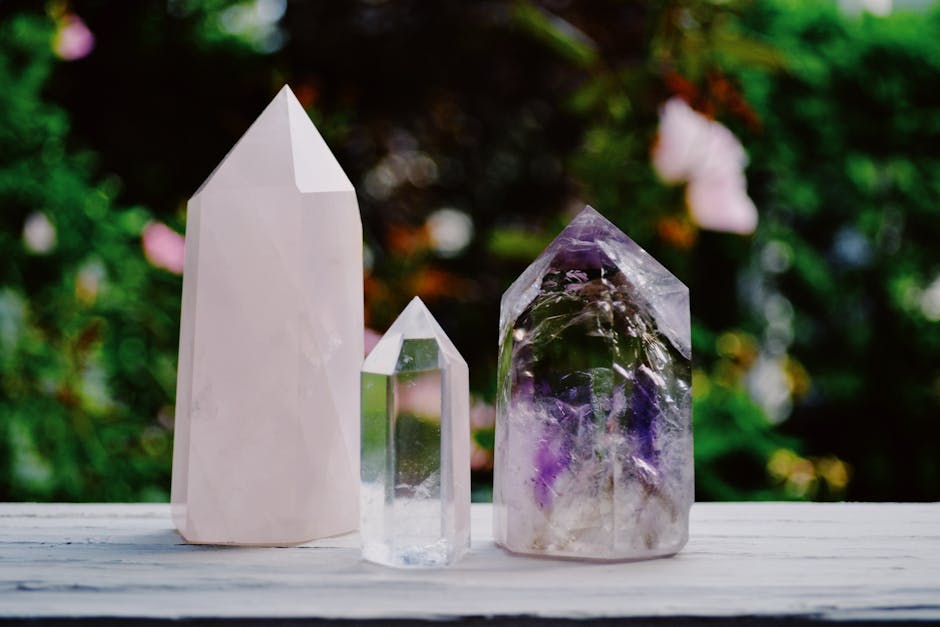
Crystal points are stones that naturally terminate in a single point at one end. Towers are similar but have been cut and polished into a more uniform, elongated shape. Both share a defining characteristic: energy is believed to flow outward through the pointed end.
This directional quality makes points and towers the go-to shape for intentional energy work. Whether you're pointing a clear quartz tower at a specific chakra during a healing session or directing a crystal's energy toward a particular intention, the shape serves as a natural funnel.
Common Uses for Points and Towers
Healing sessions. Crystal healers frequently use points to direct energy toward specific areas of the body. The pointed tip allows for focused work, while the wider base provides a stable grip.
Crystal grids. A tower or large point often serves as the central "anchor" stone in a crystal grid, with its directional energy radiating outward through the arrangement.
Space clearing. Some traditions place crystal points in corners of a room, with the tips directed inward, to create a contained energetic field.
Writing and work spaces. A clear quartz or fluorite tower on a desk is popular among people who want a focused, clarifying presence near their workspace.
Natural vs. Cut Points
Natural points form as the crystal grows — you can see the natural termination faces. Cut and polished towers are shaped by lapidary work. Both are widely used. Natural points appeal to those who prefer unaltered stones, while polished towers offer consistency in shape and a refined aesthetic. Neither is inherently "better" — it comes down to personal preference and what you find visually and energetically appealing.
Crystal Spheres: Balanced and Radiant
Crystal spheres are perhaps the most visually satisfying crystal shape. A perfectly round stone catches light from every angle and feels satisfying to hold and roll between your palms. But spheres also have a distinct traditional purpose: they radiate energy evenly in all directions.
Unlike points, which direct energy in a specific direction, spheres are said to emit a uniform, 360-degree field. This makes them ideal for situations where you want a balanced, all-encompassing presence rather than a focused beam.
Traditional Uses for Spheres
Scrying and divination. Crystal spheres have a long history in fortune-telling traditions. The classic image of a gypsy gazing into a crystal ball isn't just pop culture — crystal spheres have been used for scrying across multiple cultures for centuries. Clear quartz and obsidian are the most traditional scrying stones.
Meditation. Holding or gazing into a crystal sphere during meditation can serve as a focal point. The smooth, continuous surface has a naturally calming quality.
Room placement. A sphere on a coffee table or altar creates a peaceful, balanced energy in a space. Because the energy radiates equally in all directions, spheres are well-suited to central placement.
Massage. Crystal spheres are sometimes used in facial and body massage. The smooth, rounded surface glides easily over skin, and different stones are chosen for their specific associations — rose quartz for self-care, jade for tradition.
What to Know Before Buying
Large, optically clear crystal spheres are expensive because so much raw material is lost in the cutting process. Small spheres (1–2 inches) are affordable and perfectly functional for most purposes. Don't feel like you need a massive sphere to get the benefit — a small rose quartz sphere in your palm during meditation works just as well as a large display piece on a shelf.
Crystal Clusters: Natural Energy Amplifiers
A crystal cluster is a group of crystals that grew together on a shared base. Instead of a single crystal, you get a formation of multiple points all emerging from the same matrix. Clusters are found exactly as they formed in the earth, often with beautiful geometric arrangements.
In crystal traditions, clusters are valued as natural energy amplifiers. The multiple points are believed to radiate energy simultaneously, creating a stronger field than any single point could produce alone. Clusters are also widely used for cleansing other crystals — the shared energetic field is thought to refresh and recharge stones placed on or near them.
Popular Ways to Use Clusters
Cleansing station. Place your tumbled stones and smaller crystals on or near a cluster overnight. Many practitioners consider this the gentlest form of crystal cleansing — no water, no sunlight, no smoke required.
Altar centerpiece. A good-sized amethyst or quartz cluster makes an impressive focal point for any altar or sacred space. They're visually striking and carry the energy of an entire crystal formation.
Space harmony. Clusters are often placed in shared spaces like living rooms or offices where their broad, multi-directional energy is believed to create a harmonious atmosphere.
Why Amethyst Clusters Are So Popular
If you've seen one crystal cluster, it was probably amethyst. These purple formations are among the most common and visually dramatic clusters available. The deep violet color, combined with the natural geometric crystal points, makes them instantly recognizable. Our complete guide to amethyst covers the stone's properties in depth, but for cluster purposes specifically, amethyst is valued for its calming, protective associations.
Crystal Hearts: Emotional Connection
Crystal hearts are carved into a heart shape — smooth, polished, and designed to be held or worn. The heart shape carries obvious symbolic weight: love, compassion, emotional healing, and heart-centered awareness.
Hearts are one of the most popular carved crystal shapes, and they're especially associated with heart chakra work. Rose quartz hearts are the most common, but you'll find hearts carved from virtually every crystal type.
When to Choose a Crystal Heart
Self-love practices. Holding a rose quartz heart during a self-love meditation or placing it over your heart center is a common practice. The shape reinforces the intention.
Gifts for loved ones. A crystal heart is one of the most meaningful crystal gifts you can give. It's a tangible expression of care that the recipient can keep on their desk, nightstand, or altar.
Emotional processing. During difficult emotional periods, some people find comfort in simply holding a smooth crystal heart. The tactile experience combined with the heart symbolism creates a grounding, comforting ritual.
Heart chakra focus. In chakra-based practices, placing a green or pink stone carved into a heart shape directly on the chest is believed to support emotional balance and openness.
Crystal Skulls: Ancient Symbolism Meets Modern Practice
Crystal skulls have perhaps the most dramatic reputation of any crystal shape. Carved into the form of a human skull, these pieces carry layers of symbolism — mortality, wisdom, transformation, and the mysteries of consciousness.
The fascination with crystal skulls has roots in Mesoamerican culture, where carved stone skulls held ritual significance. Modern crystal skulls are carved from various minerals and are used primarily in meditation and contemplative practice.
How People Use Crystal Skulls
Meditation companions. Many practitioners meditate with a crystal skull placed in front of them, treating it as a focal point for contemplation. The skull shape is believed to encourage deep reflection and connection with higher awareness.
Altar pieces. A crystal skull on an altar adds a powerful symbolic element. It serves as a reminder of impermanence and the importance of present-moment awareness.
Collecting. Crystal skulls have a dedicated collector community. High-quality carvings, especially in unusual stones, can be quite valuable.
A Note on the Mystique
Crystal skulls have attracted a lot of sensational claims over the years — stories of ancient, supernaturally powerful skulls with mysterious origins. Most of these claims don't hold up to scrutiny. The value of a crystal skull in practice isn't about supernatural properties; it's about what the shape represents to the person working with it. If the skull symbolism resonates with you, that's reason enough to use one.
Geodes: Hidden Treasures
Geodes are one of nature's most surprising creations. From the outside, they look like ordinary, unremarkable rocks. Crack them open (or buy them pre-cut), and you find a hollow interior lined with sparkling crystals. It's a literal hidden treasure.
Geodes form when mineral-rich water fills a cavity in volcanic rock. Over millions of years, crystals slowly grow inward from the cavity walls, creating the stunning crystal-lined interior. The most common geode crystals are quartz and amethyst, but geodes containing calcite, celestite, and other minerals also exist.
Why Geodes Make Special Crystal Pieces
Decorative impact. A cut and polished amethyst geode is one of the most visually impressive crystal pieces you can own. They function as both natural art and energetic tools.
Energetic containment. The hollow, enclosed shape of a geode is believed to contain and amplify energy within its crystal-lined interior. Some practitioners place small objects or intentions inside geodes as a form of energetic charging.
Conversation starters. Geodes are inherently interesting. Even people with no interest in crystals tend to be fascinated by them. They work as natural centerpieces that draw attention and curiosity.
Connection to geological processes. More than any other crystal form, geodes tell a story about the earth. They're a tangible reminder of the slow, powerful forces that create beauty over geological time scales. If you're curious about these processes, our guide on how crystals form explains the science behind it.
How to Choose the Right Shape for Your Needs
With so many shapes available, the selection process can feel overwhelming. Here's a practical breakdown based on what you actually want to do:
For Daily Carry and Wear
Tumbled stones are your best bet. They're smooth, portable, and won't damage your belongings. String a few on elastic for a bracelet, keep one in your pocket, or toss a few in a small pouch. Raw crystals are too rough for pockets, and most other shapes are too large or fragile for daily carry.
For Meditation and Personal Practice
This depends on your style. If you prefer grounding, tactile experiences, go with raw crystals — their rough texture connects you to the earth. If you want a smooth, calming focal point, a sphere or heart works well. For directed intention work, a point or tower gives you that sense of focused energy. Crystal skulls, if the symbolism speaks to you, make powerful meditation companions.
For Home Decor
Geodes and large clusters are the showpieces here. An amethyst geode on a shelf or a quartz cluster on a coffee table creates visual impact. Spheres work well in central locations where their even energy distribution is an advantage. Raw crystals add organic, natural texture to any space.
For Energy Work and Healing
Points and towers are essential tools for directed energy work. Clusters serve as cleansing stations and energy amplifiers. Raw crystals provide strong, unfiltered energy for intensive work. The specific stone you choose matters too — labradorite's protective qualities might lead you to a different shape choice than amethyst's calming energy.
Combining Different Shapes: A Practical Guide
You don't have to pick just one shape. In fact, combining different crystal forms can create more nuanced and effective arrangements. Here are some proven combinations:
Altar setup: A large cluster as the centerpiece, flanked by a tower on each side for directional energy, with a sphere in front for balanced radiance. Add a heart for emotional warmth and a raw piece for grounding.
Desk workspace: A small tower for focus (clear quartz or fluorite), a tumbled stone for calm (amethyst or lepidolite), and a raw piece for grounded energy. Keep them within arm's reach and hold whichever one calls to you in the moment.
Crystal grid: Use a large point or tower as the center anchor, surrounded by tumbled stones arranged in your chosen geometric pattern. The center piece directs the grid's energy, while the tumbles distribute it outward.
Bedroom: A sphere on the nightstand for peaceful, balanced energy, with a small cluster to keep your personal crystals charged. A heart-shaped stone under your pillow is a common practice for those seeking more restful sleep.
The key principle is variety. Different shapes do different things. Having multiple forms gives you options and allows your crystal practice to be responsive to your changing needs.
Frequently Asked Questions
Does the shape really make a difference, or is it just aesthetic?
From a traditional perspective, shape matters because it influences how energy moves through and around the crystal. A point directs, a sphere radiates, a cluster amplifies. From a practical perspective, shape absolutely matters because it determines how you interact with the stone — you can carry a tumbled stone but not a geode, you can gaze into a sphere but not a raw chunk. Both perspectives are valid.
Are raw crystals stronger than tumbled stones?
In most crystal traditions, raw crystals are described as having more intense, unfiltered energy because they haven't been processed. Tumbled stones are described as gentler and more diffuse. "Stronger" is subjective — it depends on what you want. If you're looking for a subtle, constant presence, tumbled might be better. If you want something more intense for focused work, raw might be the way to go.
Can I use multiple shapes of the same crystal type together?
Absolutely. Having a raw amethyst chunk, a tumbled amethyst piece, and an amethyst point all in the same space is common practice. Each form brings a different quality of the same stone's energy. Many practitioners build collections this way intentionally.
What's the most versatile crystal shape to start with?
Tumbled stones, hands down. They're affordable, portable, and useful in virtually every context — carry, grid, gift, display, meditation. Start with five to ten different tumbled stones, and you'll have a versatile foundation that you can build on with more specialized shapes as your interest grows.
How should I clean different crystal shapes?
Most shapes can be cleaned with a soft, dry cloth. Tumbled stones are durable enough for lukewarm water and mild soap. Raw crystals with delicate formations or water-soluble minerals should be kept dry. Clusters should be cleaned gently with a soft brush to remove dust from between the points. Spheres can be wiped with a damp cloth. When in doubt, dry cleaning is always safe.
Final Thoughts
The world of crystal shapes is richer than it first appears. What starts as a simple preference for smooth versus rough quickly opens into a nuanced understanding of how form influences function, energy, and experience. The best approach is experiential — try different shapes, notice how each one feels, and trust your own response. Crystal practice is deeply personal, and the "right" shape is ultimately the one that resonates with you.
Start with what draws your eye. Build from there. And remember that there's no wrong way to work with crystals — only the way that works for you.
This article was created with the assistance of AI writing tools. While the information has been researched and reviewed for accuracy, we believe in transparency about how our content is produced. The perspectives and traditions described here are drawn from widely available crystal knowledge and should be considered cultural and educational information rather than scientific or medical advice.

Comments