Crystal Intention Setting With Mala: 21-Day P...
June 5, 2026
Why 21 Days? The Science Behind the Practice
The 21-day commitment is rooted in a widely cited concept: it takes roughly three weeks to form a new habit. While modern neuroscience suggests the actual range is 18 to 254 days depending on the behavior, 21 days represents a meaningful enough window to create neural pathways that make a practice feel natural rather than forced. For mala meditation and intention setting, three weeks gives you enough consecutive days to experience the practice's rhythm, notice patterns in your thoughts and experiences, and decide whether it's worth continuing.
When you combine mala bead meditation with crystal intention setting, the 21-day framework becomes especially powerful. Each day of reciting a mantra while touching each of the 108 beads reinforces both the verbal repetition and the physical habit. By day 7, the motion feels automatic. By day 14, your mind settles into the practice more quickly. By day 21, the mala itself has become a trigger — simply picking it up starts shifting your mental state toward focus and intention.
This guide walks you through every aspect of the practice: choosing the right mala for your specific intention, designing your daily Japa meditation, creating tracking systems that keep you accountable, and understanding which crystals align with which types of goals.
Choosing Your Mala by Intention
The crystal material of your mala beads matters because different stones are traditionally associated with different types of energy and goals. While you can use any mala for any intention, matching the crystal to your goal creates a more coherent practice. Your subconscious mind responds to the visual and tactile qualities of the stone, reinforcing the intention each time you handle the beads.
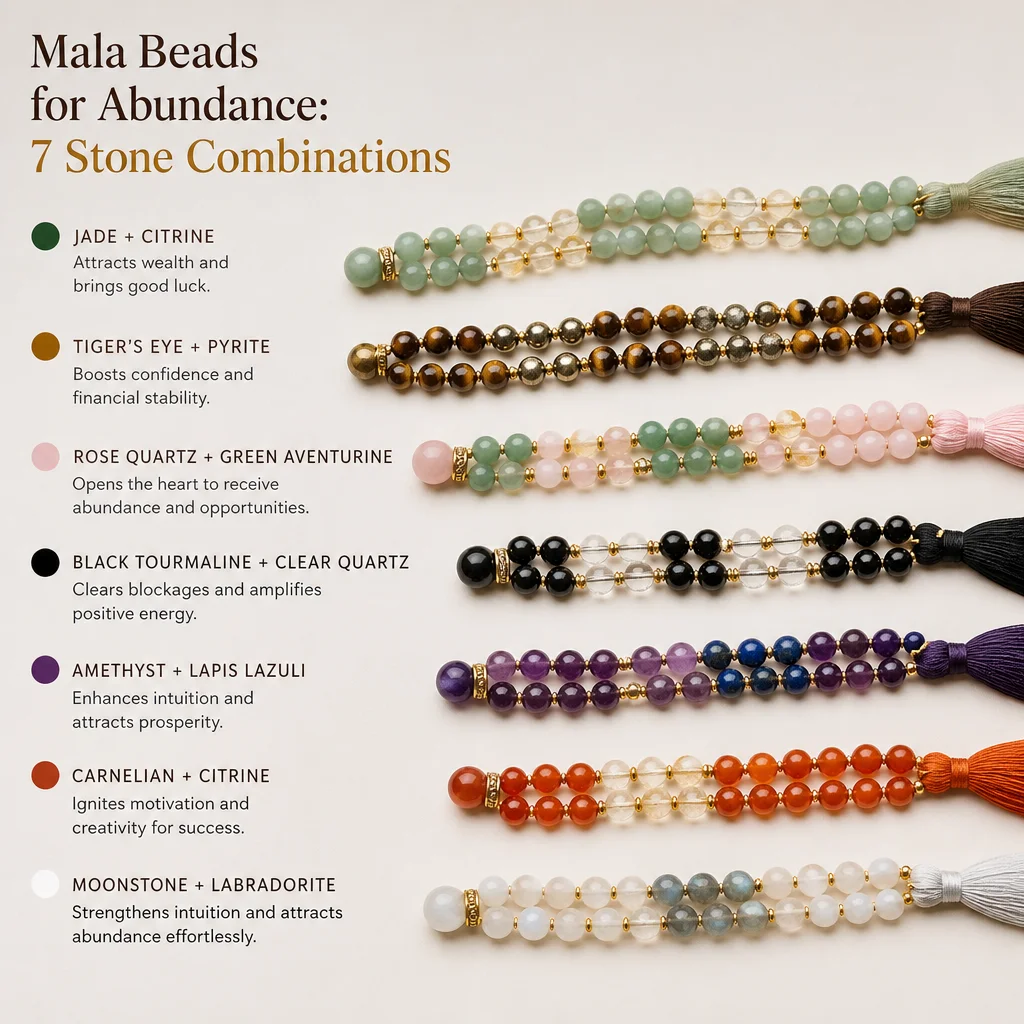
Abundance and Prosperity: Citrine mala beads align with wealth, success, and opportunity. The golden color psychologically connects to solar energy and growth. Jade mala beads also work well for prosperity, with jade's cultural history of symbolizing wealth in Chinese tradition stretching back thousands of years. Pyrite mala, while heavier and more unusual, is considered the ultimate stone for financial manifestation.
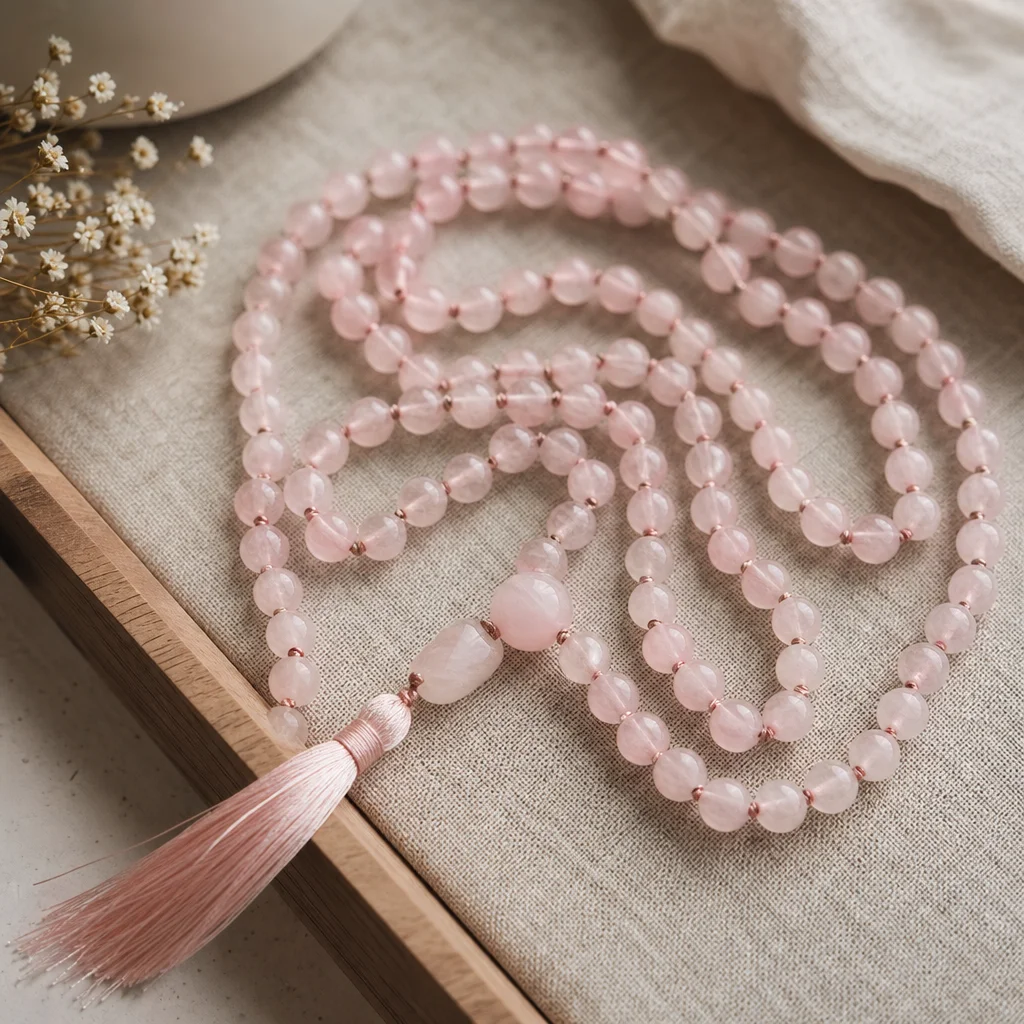
Love and Relationships: Rose quartz mala beads are the obvious choice for matters of the heart — self-love, romantic love, compassion, and emotional healing. Rhodochrosite mala beads work specifically for healing past relationship wounds and opening the heart to new connections. Kunzite mala beads support emotional openness and vulnerability, which is essential for building authentic relationships.
Protection and Grounding: Black tourmaline mala beads provide strong protective energy and are recommended when your intention involves boundaries, shielding from negative influences, or feeling safe in your environment. Hematite mala beads are equally grounding, with their heavy, cool iron presence creating an immediate physical sense of stability. Smoky quartz offers a gentler protective energy that still provides meaningful shielding.
Focus and Clarity: Clear quartz mala beads serve as universal amplifiers — they strengthen whatever intention you're working with and help clarify your thoughts during meditation. Fluorite mala beads specifically target mental organization and concentration. Amethyst mala beads combine focus with calm, making them ideal for intentions related to study, work performance, or creative projects.
Health and Vitality: Carnelian mala beads are associated with physical energy, stamina, and motivation. They're excellent for intentions related to exercise goals, dietary changes, or recovering from illness. Bloodstone mala beads have a long tradition in crystal healing for physical wellness and courage during health challenges.
Structuring Your Daily Japa Meditation
Japa meditation is the practice of reciting a mantra while moving through the beads of a mala. A traditional mala has 108 beads plus one larger "guru bead." You recite the mantra once for each of the 108 beads, which typically takes about 15 minutes at a comfortable pace. Here's how to structure your daily session:
Preparation (1 minute): Sit comfortably with your mala draped over your middle or ring finger of your right hand. Take three deep breaths. Hold your intention clearly in your mind — phrase it as an affirmative statement, not a wish. For example, "I am attracting financial abundance with ease and gratitude" rather than "I hope I make more money." The difference matters because your subconscious responds to the language of certainty.
Opening (1 minute): Hold the guru bead (the large bead at the center) and state your intention aloud or silently three times. Feel the weight of the mala in your hands. Set the energy for the practice.
Japa Recitation (12-15 minutes): Begin moving the beads through your fingers, one bead per mantra repetition. Use your thumb to push each bead past your middle finger (this is the traditional method). Recite your mantra — it can be a Sanskrit mantra, a personal affirmation, or a simple word like "peace," "love," or "abundance." The key is consistency: use the same mantra for all 21 days. The repetition builds depth over time that switching mantras would disrupt.
Completion (1 minute): When you reach the guru bead again, do not cross over it — this is considered disrespectful in the tradition. Instead, pause, take three deep breaths, and offer gratitude for the practice. Gently set the mala down. Sit in silence for 30-60 seconds before returning to your day.
Choosing Your Mantra
The mantra you choose should directly support your intention. For abundance, "Om Shrim Maha Lakshmiyei Namaha" is traditional, but "I am open to receiving abundance" works just as effectively if Sanskrit doesn't resonate with you. For love, "Om Mani Padme Hum" is classic, or use "I radiate love and attract loving connections." For protection, "Om Ram Ramaya Namaha" or "I am safe, protected, and grounded." The best mantra is the one you'll actually repeat 108 times every day for three weeks.
Week 1: Building the Foundation (Days 1-7)
The first week is about establishing the habit. Don't worry about deep meditative states or dramatic results — focus simply on showing up and completing the practice every day. Set a specific time (morning is ideal because it sets the tone for the entire day) and stick with it.
Day 1: Write your intention on paper. Be specific. "I want more money" is too vague. "I earn $5,000 in additional income this quarter through work I enjoy" gives your subconscious a clear target. Place this written intention under your mala when you're not using it.
Days 2-4: You'll likely experience resistance. Your mind will say you don't have time, the practice feels pointless, or you're doing it wrong. This is normal — it's the old neural patterns resisting the new behavior. Push through with discipline, not motivation. Motivation fades; discipline persists.
Days 5-7: The practice starts to feel more natural. You might notice that simply holding your mala begins to calm your nervous system before you even start reciting. Pay attention to these micro-shifts — they're evidence that the neural pathways are forming.
Week 2: Deepening the Practice (Days 8-14)
The second week is where many people experience the first meaningful synchronicities or inner shifts. Your mantra has been repeated over 1,500 times by this point, and the word or phrase has embedded itself in your consciousness at a deep level.
Start adding a brief visualization to your Japa session. After the first 54 beads, close your eyes and spend 30 seconds visualizing your intention as already accomplished. See yourself in the situation you're intending — feel the emotions, notice the details, experience the reality as if it's happening now. Then complete the remaining 54 beads with this visual energy active.
Pay attention to opportunities that arise during the week. Crystal intention setting works partly by priming your reticular activating system — the brain network that filters information and highlights things relevant to your goals. When your intention is "attract abundance," you'll start noticing opportunities you would have overlooked before. Act on these opportunities. The mala creates the focus; action creates the results.
Week 3: Integration and Results (Days 15-21)
By the third week, the practice should feel as natural as brushing your teeth. The discipline battle has been won. Now you can focus on deepening the quality of your meditation rather than simply completing the form.
Extend your session slightly — try adding 5 minutes of silent sitting after completing your 108 repetitions. This post-meditation silence is when many practitioners report their clearest insights and strongest intuitive hits. Don't force anything; just sit and observe what arises.
Review your tracking journal at the end of day 21. Compare your emotional state, energy level, and life circumstances to day 1. Write a brief summary of what shifted, what didn't, and what surprised you. Most people find that even if their primary intention hasn't fully manifested in 21 days, significant movement has occurred — new opportunities, changed perspectives, or unexpected progress in related areas.
Moon Phase Integration
Aligning your 21-day practice with lunar cycles can enhance the intention-setting process. The two most powerful moon phases for manifestation work are:
New Moon: The new moon represents new beginnings and is the ideal time to start a 21-day intention practice. Set your intention, write it down, perform your first Japa session under the new moon energy, and let the growing moon light symbolize your intention's growth over the coming weeks.
Full Moon: The full moon represents culmination and release. If your 21-day window includes a full moon, use that day for an extended meditation — perhaps 216 repetitions (two full rounds of the mala) or a special ritual that amplifies your practice. The full moon's energy is about bringing things to completion, so focus on gratitude and trust that your intention is manifesting.
Tracking Your Progress
Accountability dramatically increases follow-through. Use a simple tracking system: a notebook where you record the date, time, and any observations after each session. Don't overthink it — a single sentence per day is enough. Examples: "Felt scattered today, took 10 minutes to settle in" or "Had a vivid visualization during second half, felt genuine excitement about my goal" or "Slept better last night than I have in weeks."
At the end of 21 days, review the progression. Most people discover that what felt forced on day 1 became genuinely enjoyable by day 14. This shift is evidence that the practice has integrated into your daily rhythm rather than remaining an external obligation.
After the 21 Days: Continuing or Resetting
When your 21-day commitment ends, you have three options. First, continue the same practice indefinitely if it's producing results and you enjoy it. Second, switch to a new intention with the same or a different mala. Third, reduce the frequency — perhaps daily practice becomes three times per week, or you switch to a shorter mantra recitation.
There's no wrong answer. The point of the 21-day structure isn't to create a permanent obligation but to give you enough consistent practice to determine whether mala meditation and intention setting genuinely serve your life. If they do, the discipline of the initial 21 days will have built enough momentum to carry you forward naturally.
Frequently Asked Questions
Can I use any mala for any intention?
Yes, technically any mala works for any purpose. However, matching the crystal to the intention creates a more cohesive practice. A rose quartz mala used for abundance intentions isn't "wrong," but a citrine mala aligned with the same goal creates stronger visual and psychological reinforcement during the 108 repetitions.
What if I miss a day?
Don't restart the counter. Missing one day doesn't erase the neural pathways you've built. Simply resume the next day. If you miss two or more consecutive days, acknowledge that the habit isn't fully formed yet and recommit. The goal is progress, not perfection.
Do I have to use Sanskrit mantras?
Not at all. While Sanskrit mantras have centuries of tradition behind them, personal affirmations in your native language work just as well for intention setting. In fact, they may work better because you understand the meaning directly, which allows deeper emotional engagement with each repetition.
Frequently Asked Questions
How do I cleanse my crystal mala before starting my intention?
Before beginning your 21-day journey, it is essential to clear any lingering energy from your handcrafted mala so it aligns perfectly with your goal. You can cleanse your natural crystal beads by placing them under moonlight overnight, smudging them with palo santo, or resting them on a selenite charging plate. This ensures your jewelry is a pure vessel, ready to absorb your daily meditation vibrations.
What does it mean if my mala breaks during the 21 days?
In many spiritual traditions, a mala breaking during a dedicated intention practice is actually a positive sign. It often signifies that your 21-day meditation has successfully cleared a major energetic blockage, or that the specific intention you set has been fully received and manifested. If this happens, view it as a sign of completion. You can restring the artisan beads or keep them in a sacred space as a reminder.



Comments