Crystal Grids for Beginners
May 28, 2026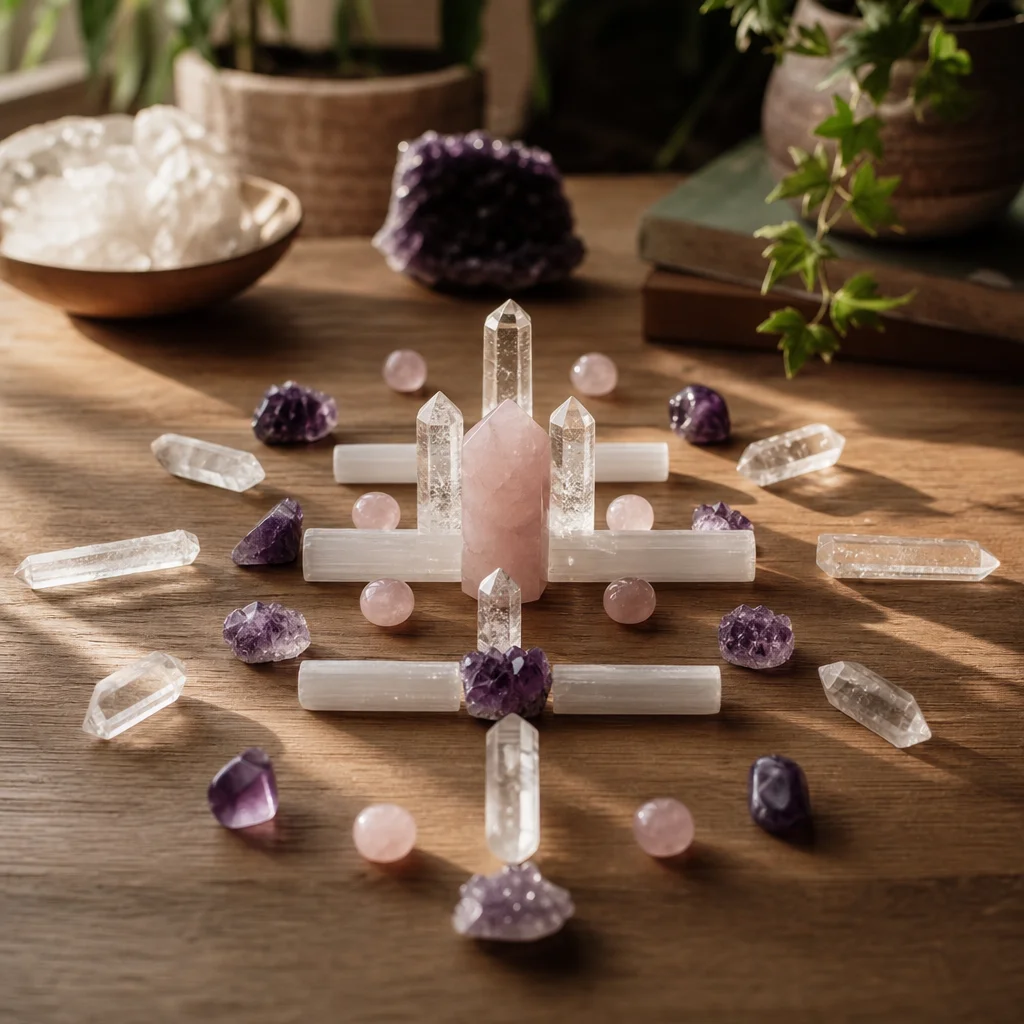
Crystal Grids for Beginners: Layouts, Stones & How to Activate
What a Crystal Grid Actually Is
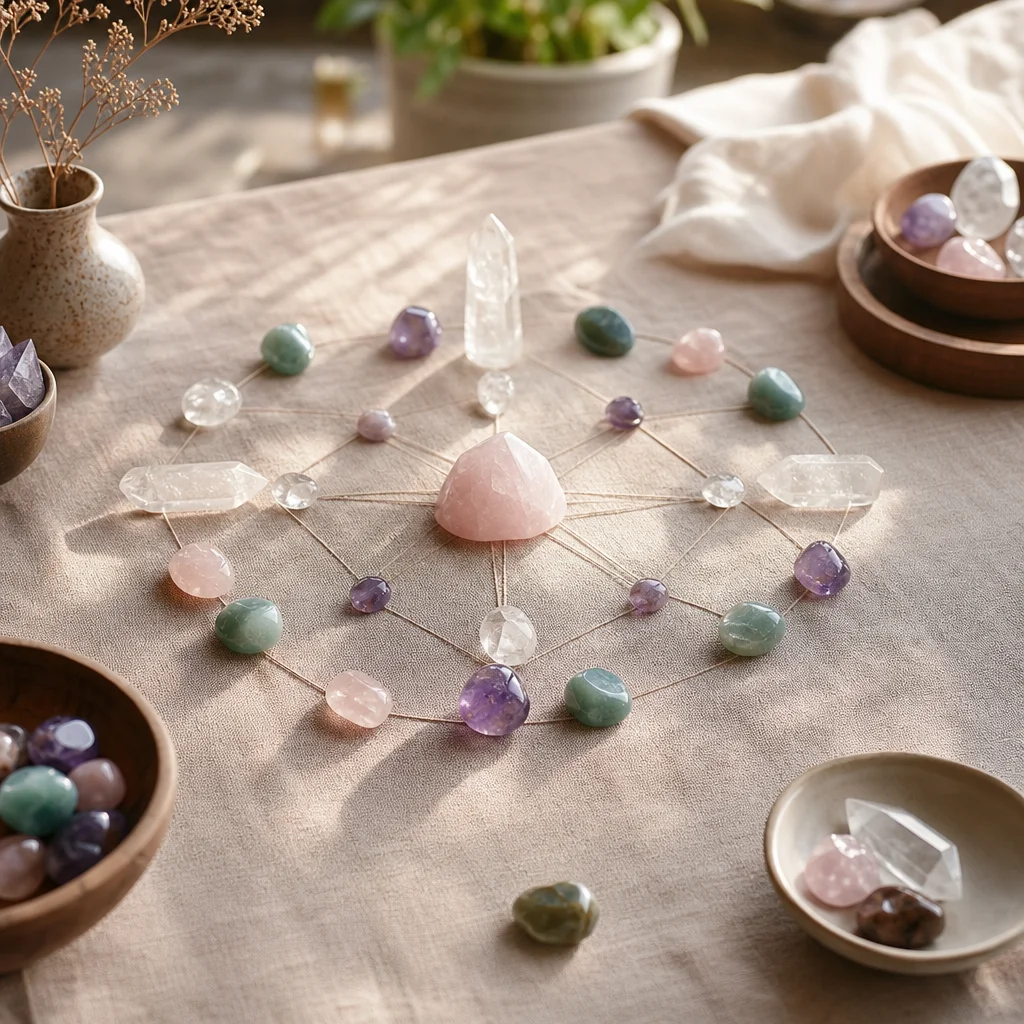
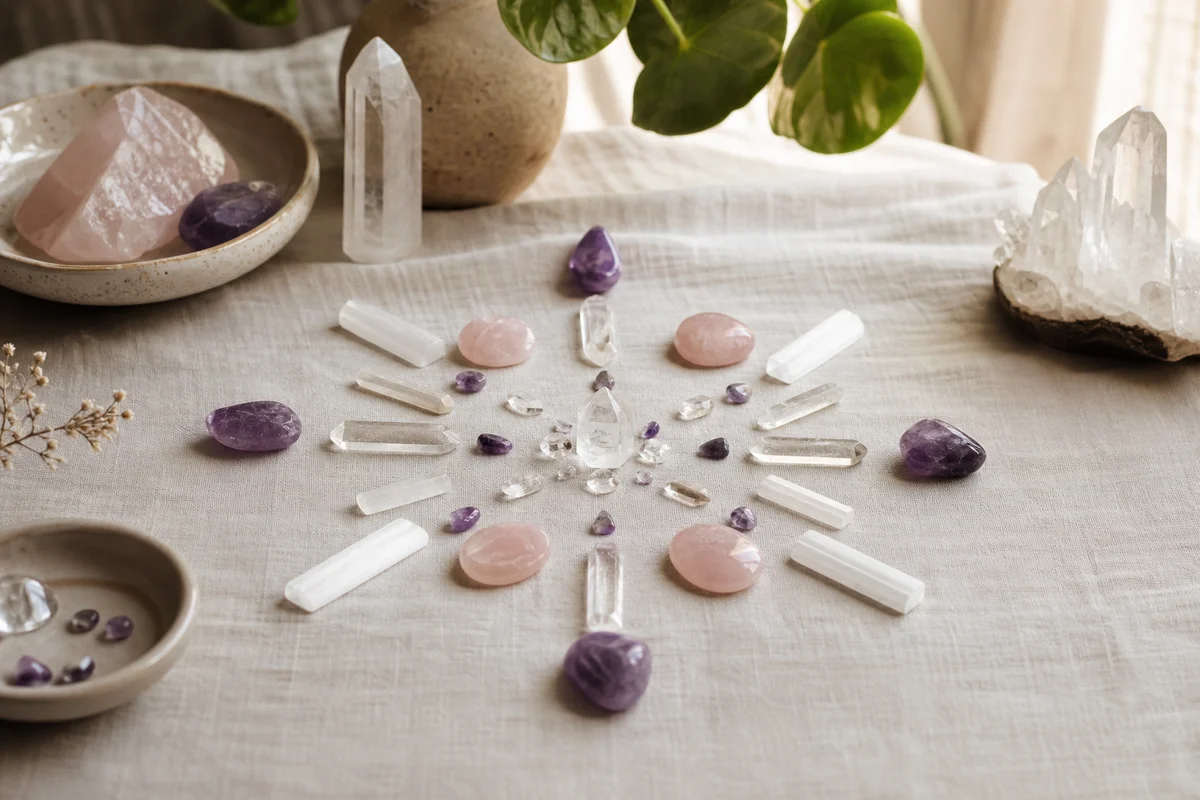
A crystal grid is a deliberate arrangement of stones placed in a geometric pattern, typically around a central "focus stone," with the intention of amplifying a specific goal — whether that's calm, clarity, abundance, or something else entirely. Think of it as a physical layout that mirrors a mental framework. You're not just placing stones randomly; you're building a structure that represents what you want to focus on.
The geometric patterns used in crystal grids — circles, triangles, hexagons, Metatron's Cube, the Flower of Life — are found throughout nature, architecture, and sacred art across dozens of cultures. There's a reason these patterns feel satisfying to create and look at: human brains are wired to recognize and respond to geometric order. Whether you consider that response spiritual, psychological, or aesthetic is entirely up to you.
The Components of a Crystal Grid
Every crystal grid has three basic components:
1. The Focus Stone (Center)
This is the anchor — the stone at the center of your grid that represents your primary intention. It's usually the largest or most visually prominent stone in the arrangement. The focus stone doesn't need to be expensive or rare; it needs to feel meaningful to you.
Common focus stones by intention:
- Clarity and focus: Clear quartz, selenite
- Calm and grounding: Black tourmaline, smoky quartz
- Love and compassion: Rose quartz, rhodonite
- Abundance and motivation: Citrine, pyrite, green aventurine
- Intuition and insight: Amethyst, labradorite
- Protection: Black tourmaline, hematite, obsidian
2. The Way Stones (Surrounding Ring)
These stones surround the focus stone and support the intention. They don't need to match the focus stone — in fact, complementary pairings often work better. If your focus stone is clear quartz (clarity), your way stones might be amethyst (insight), sodalite (communication), and blue lace agate (calm expression).
3. The Desire Stones (Outer Ring)
These are the outermost stones in the grid, placed at the perimeter. They represent the outcome you're working toward. You can use the same type of stone throughout the outer ring or mix different stones that relate to the same theme.
Choosing Your Grid Pattern
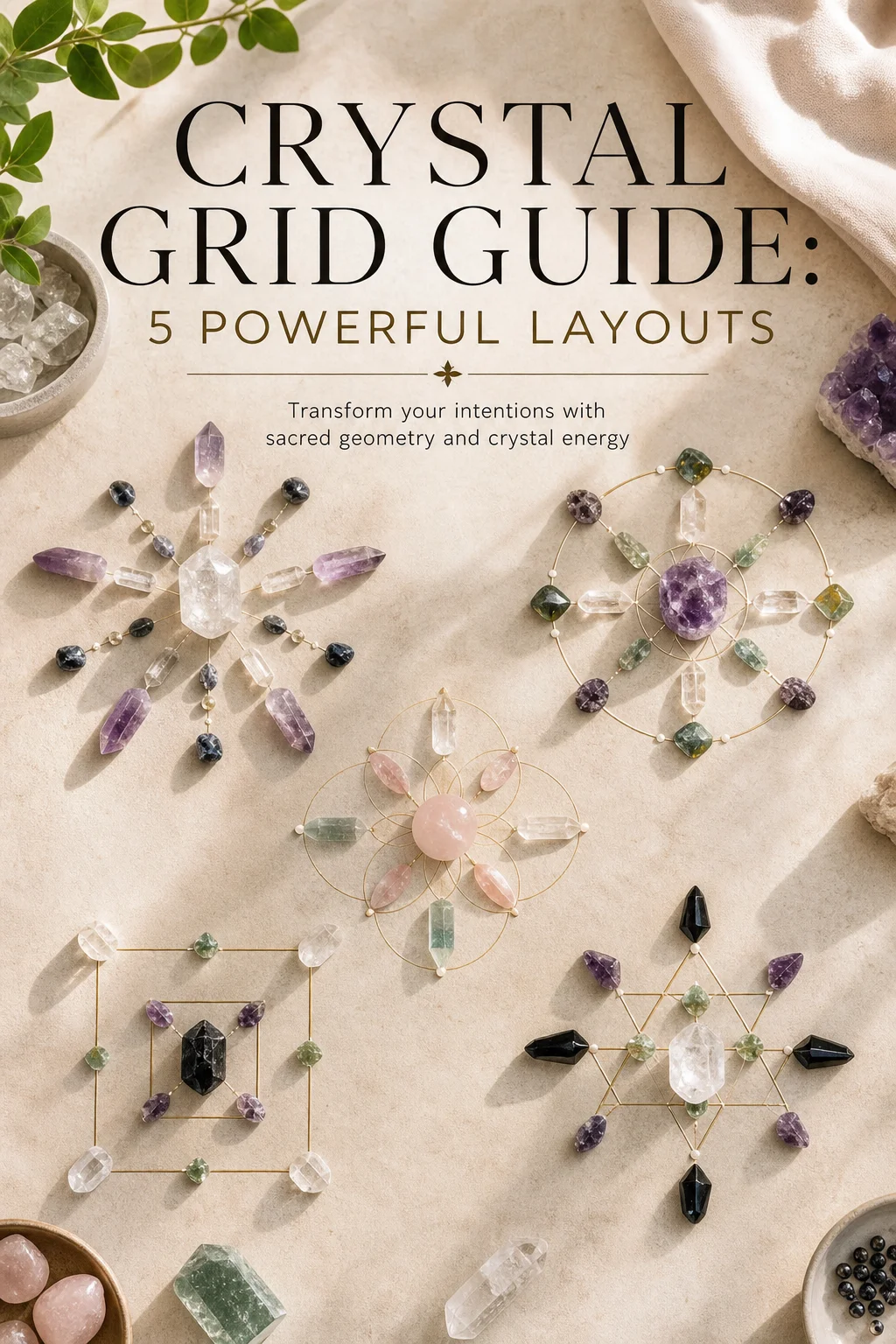
The pattern you choose isn't arbitrary — different geometric shapes have different associations and visual effects:
| Pattern | Shape | Common Use | Minimum Stones |
|---------|-------|-----------|----------------|
| Circle | Ring | Unity, wholeness, protection | 6-8 |
| Triangle | 3-point | Creativity, manifestation, focus | 4 (center + 3) |
| Square | 4-point | Stability, grounding, structure | 5 (center + 4) |
| Hexagon | 6-point | Balance, harmony, integration | 7 (center + 6) |
| Star of David | 6-point | Protection, spiritual connection | 7+ |
| Metatron's Cube | 13-point | Universal pattern, complex intentions | 14 (center + 13) |
| Flower of Life | Overlapping circles | Growth, expansion, creativity | 19+ |
For Beginners: Start With These Three
The Simple Circle (6-8 stones)
Place your focus stone in the center, then arrange 6-8 way stones in a circle around it at equal distances. This is the most beginner-friendly grid because it doesn't require precise measurements — just roughly equal spacing.
The Four Directions (5 stones)
Place your focus stone in the center, then place four way stones at north, south, east, and west positions. This grid references the four cardinal directions found in many cultural traditions and is easy to set up on any flat surface.
The Triangle of Manifestation (4 stones)
Place your focus stone in the center, then place three way stones in a triangle around it. This is the most compact grid, requiring only four stones, and it works well on a small desk or nightstand.
Step-by-Step: Building Your First Crystal Grid
What You'll Need
- A flat surface (table, shelf, desk, or dedicated grid cloth)
- 1 focus stone
- 6-8 supporting stones
- Optional: a printed grid template, grid cloth, or sacred geometry image
- Optional: a candle, incense, or essential oil
Step 1: Cleanse Your Space and Stones
Before you start, clear the physical space where you'll build the grid. Wipe the surface clean. Then cleanse your stones — you can use smoke (sage, palo santo, incense), sound (singing bowl, bell), or simply hold each stone under running water for a few seconds (for water-safe stones).
This isn't about removing "negative energy." It's about creating a clean, intentional workspace where you can focus without distraction.
Step 2: Set Your Intention
Before placing a single stone, take a moment to articulate what this grid is for. Not a vague wish — a specific, actionable intention. "I want to feel less anxious" is vague. "I am building this grid to help me focus during work hours" is specific.
Write it down if that helps. Say it out loud if that feels natural. The point is to get clear on what you're doing before you start doing it.
Step 3: Place the Focus Stone
Put your focus stone at the exact center of your grid space. Take a moment with this placement — the center stone is the anchor, and everything else radiates from it. Make sure it's stable and oriented the way you want it.
Step 4: Place the Way Stones
Working outward from the center, place your way stones in your chosen pattern. Try to maintain roughly equal spacing between stones. If you're using a printed template or grid cloth, use the guide points.
Many people like to place way stones clockwise, starting from the top (12 o'clock position). Others go counterclockwise. Some follow intuitive placement. There's no wrong approach — consistency within the grid matters more than which direction you go.
Step 5: Connect the Stones
This is the step most beginners skip, and it's the one that makes the grid feel cohesive. Using your finger, a crystal wand, or a selenite stick, trace lines between the stones to "connect" them. Start at the focus stone, draw a line to the first way stone, then to the next, and so on, until you've connected all stones back to the center.
You're not drawing physical lines — you're tracing energetic connections between the stones. This physical gesture helps your brain register the grid as a unified system rather than a random collection of rocks.
Step 6: Activate the Grid
Activation is simply the moment you declare the grid complete and active. Some traditions recommend specific rituals — lighting a candle, ringing a bell, or reciting an affirmation. The simplest approach: place your hands over the completed grid, take a deep breath, and say (or think) something like, "This grid is set for [your intention]."
The grid is now "active" in the sense that it exists as a physical representation of your intention. It's a visual reminder of what you're focusing on, visible in your space whenever you pass by it.
Six Ready-to-Use Crystal Grid Recipes
Grid 1: The Focus and Productivity Grid
- Focus stone: Clear quartz point
- Way stones (6): Citrine, fluorite, sodalite
- Pattern: Hexagon
- Best placement: Office desk or workspace
Grid 2: The Calm and Sleep Grid
- Focus stone: Amethyst cluster
- Way stones (6): Lepidolite, blue lace agate, howlite
- Pattern: Circle
- Best placement: Bedside table
Grid 3: The Grounding and Protection Grid
- Focus stone: Black tourmaline
- Way stones (4): Hematite, smoky quartz, obsidian
- Pattern: Square (four directions)
- Best placement: Near the entrance of your home
Grid 4: The Creativity and Expression Grid
- Focus stone: Carnelian
- Way stones (6): Orange calcite, sunstone, labradorite
- Pattern: Hexagon
- Best placement: Art studio or creative workspace
Grid 5: The Self-Love and Compassion Grid
- Focus stone: Rose quartz heart
- Way stones (6): Rhodonite, green aventurine, pink mangano calcite
- Pattern: Circle
- Best placement: Bedroom or bathroom
Grid 6: The Abundance and Growth Grid
- Focus stone: Pyrite cube
- Way stones (6): Green aventurine, citrine, jade
- Pattern: Star pattern
- Best placement: Home office or near financial documents
How Long Should You Leave a Grid Up?
There's no prescribed duration. Some people build grids for a single meditation session and dismantle them afterward. Others leave grids up for weeks or months, refreshing them periodically by re-cleansing the stones and resetting the intention.
Practical considerations:
- Dust — Stones will accumulate dust over time. If your grid is up for more than a week, gently wipe the stones periodically.
- Pets and children — If either has access to your grid space, consider placing it on a higher shelf or in a less accessible area.
- Sunlight — Some stones (amethyst, rose quartz, citrine) fade with prolonged UV exposure. If your grid is in direct sunlight, check periodically for color changes.
Common Mistakes to Avoid
Using too many different stones — A grid with 15 different crystal types looks chaotic and lacks visual coherence. Stick to 2-4 types per grid, with one as the focus and the others as support.
Obsessing over "perfect" geometry — Your grid doesn't need to be measured with a protractor. Approximate spacing works fine. The intention and attention matter more than mathematical precision.
Forgetting about the physical space — A grid in a cluttered, messy environment feels less intentional. Clear the area first.
Never dismantling old grids — Grids that have been sitting for months collecting dust lose their visual impact and can start to feel stagnant rather than intentional. Take them down, cleanse the stones, and start fresh.
FAQ
Q: Do crystal grids actually work?
A: That depends on what "work" means to you. If you mean "do they produce measurable supernatural effects," there's no scientific evidence for that. If you mean "does building and maintaining a physical representation of your goals help you stay focused on them," the answer is yes — this is a well-documented psychological principle. Crystal grids are a form of externalized intention, similar to vision boards or written goals.
Q: Do I need a sacred geometry cloth or template?
A: No. These can be helpful for maintaining consistent spacing, but they're not necessary. You can build effective grids on any flat, clean surface. A piece of paper with hand-drawn geometry works just as well as an expensive printed cloth.
Q: Can I use the same stones in multiple grids?
A: Yes. Stones aren't "used up" by being in a grid. Cleanse them between uses if you want to reset the intention, and reuse them in whatever configuration you like.
Q: What if I don't have enough stones for the pattern I want?
A: Scale down. A triangle grid needs only four stones (one center + three surrounding). A simple circle can work with as few as five stones (one center + four surrounding). Don't let stone quantity stop you from building a grid.
Q: Can I add or remove stones from an active grid?
A: You can modify a grid at any time. If a stone feels wrong or you want to add something new, go ahead. Re-trace the connections between stones after any modification to maintain the visual coherence of the layout.
Frequently Asked Questions
What is the best size for my first crystal grid?
For beginners, start with a small grid using a 1-inch size for each crystal to ensure ease of setup and handling. This allows you to get a feel for the process without overwhelming yourself.
Can I use just one type of crystal in a grid?
Absolutely, you can use just one type of crystal for a grid. This is known as a "single-point" grid and is perfect for focusing on a specific intent or energy. Choose a crystal that resonates with your intention.
How do I know which crystals to use for my intention?
Research the metaphysical properties of various crystals to find ones that align with your intention. For example, rose quartz for love, amethyst for protection, and citrine for abundance. You can also consult crystal guides or a crystal reader for guidance.
Are there any crystals I should avoid when making a grid?
While most crystals are safe for grids, some may carry strong energies that might not be suitable for everyone. For example, black tourmaline can be very protective but can also be overwhelming for sensitive individuals. Always check for any personal sensitivities or specific contraindications before including certain crystals in your grid.
Understanding the Basics
This section covers important aspects of understanding the basics. For detailed information, please refer to the FAQ section below.
Key Factors to Consider
This section covers important aspects of key factors to consider. For detailed information, please refer to the FAQ section below.
Step-by-Step Instructions
This section covers important aspects of step-by-step instructions. For detailed information, please refer to the FAQ section below.
Common Mistakes to Avoid
This section covers important aspects of common mistakes to avoid. For detailed information, please refer to the FAQ section below.

Comments