Top 10 Axinite Facts: The Bicolor Mineral Guide
June 5, 2026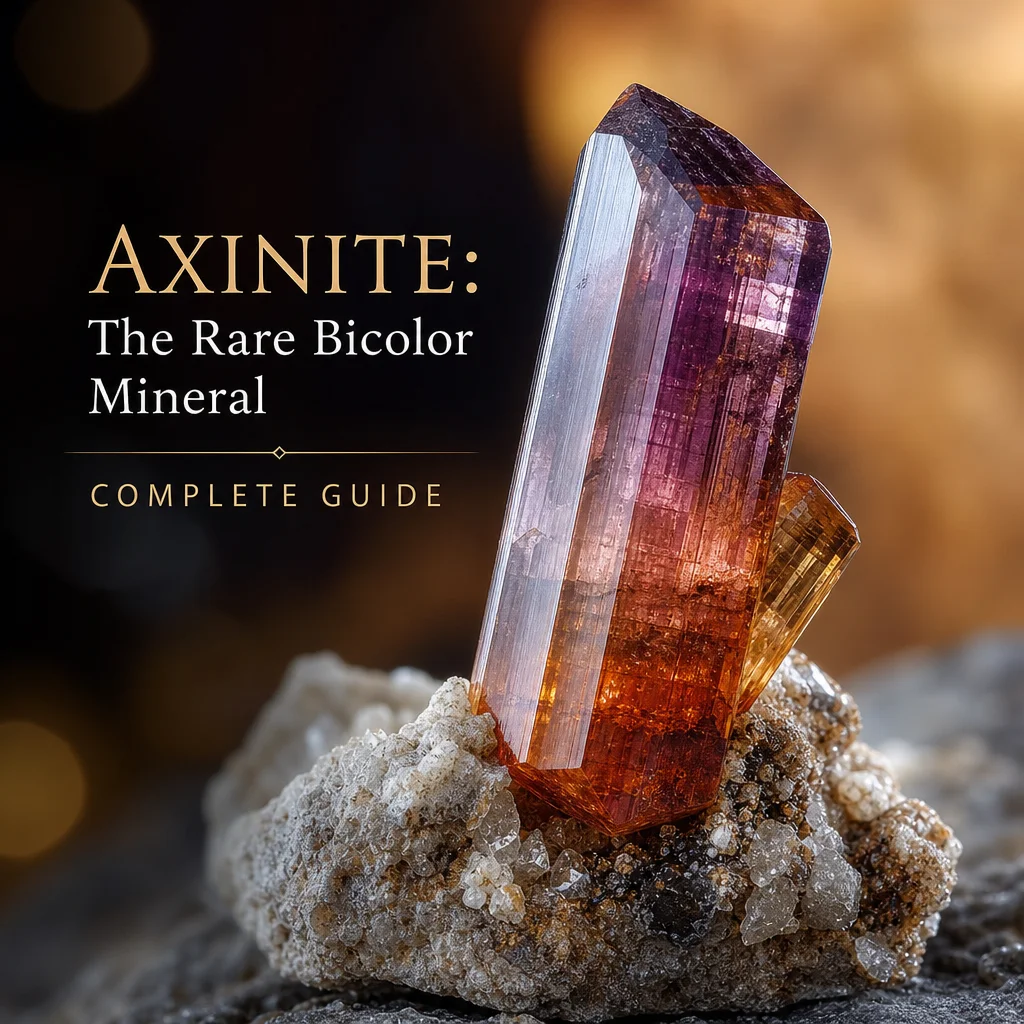
What Is Axinite?
Axinite is one of those minerals that stops collectors in their tracks — not because of exceptional sparkle or extreme rarity, but because of its distinctive, almost sculptural crystal form. The name comes from the Greek axinē, meaning "axe," a reference to its characteristic wedge-shaped or blade-like crystal habit. When you see a well-formed axinite crystal, the reason for the name is immediately obvious: it looks like a small, sharp axe head with defined edges and a flattened, angled termination.
Axinite isn't a single mineral but a mineral group with three main species that share the same basic crystal structure but differ in their calcium, iron, magnesium, and manganese content. The general formula is (Ca,Fe,Mg,Mn)₃Al₂(BO₃)(Si₄O₁₂)OH — a complex borosilicate that incorporates multiple elements into its structure. This complexity is what gives axinite its range of colors, from clove-brown to honey-yellow to plum-purple to blue-gray.
Chemistry and Crystal Structure
The Borosilicate Framework
What makes axinite chemically interesting is the presence of boron (BO₃ groups) within a silicate framework. Boron isn't common in silicate minerals — it appears more frequently in evaporite minerals like borax. In axinite, the boron groups (BO₃ triangular units) are integrated into the crystal lattice alongside silicate tetrahedra (SiO₄ units), creating a layered structure that contributes to axinite's perfect cleavage along one direction.
The three main axinite species are:
Ferroaxinite — Ca₂Fe²⁺Al₂(BO₃)(Si₄O₁₂)OH — iron-rich, typically clove-brown to dark brown. This is the most common species and the one most collectors encounter first.
Manganaxinite — Ca₂Mn²⁺Al₂(BO₃)(Si₄O₁₂)OH — manganese-rich, typically honey-yellow to amber. The manganese substitutes for iron in the crystal structure, shifting the absorption spectrum and producing warmer colors.
Magnesioaxinite — Ca₂MgAl₂(BO₃)(Si₄O₁₂)OH — magnesium-rich, typically gray to violet. The rarest of the three main species, found primarily in metamorphic deposits.
In nature, most axinite specimens are intermediate between these end-members — a particular crystal might be 60% ferroaxinite and 40% manganaxinite, giving it a brownish-yellow color that doesn't fit neatly into any single species category.
Triclinic Symmetry: The Lowest Symmetry Class
Axinite crystallizes in the triclinic system — the least symmetrical of all seven crystal systems. Triclinic crystals have no axes of symmetry, no mirror planes, and no center of symmetry. This means that every angle and every face of the crystal is unique. The practical result is axinite's distinctive blade-like, lopsided crystal form — there's literally nothing symmetrical about it, which paradoxically gives it a striking, recognizable silhouette.
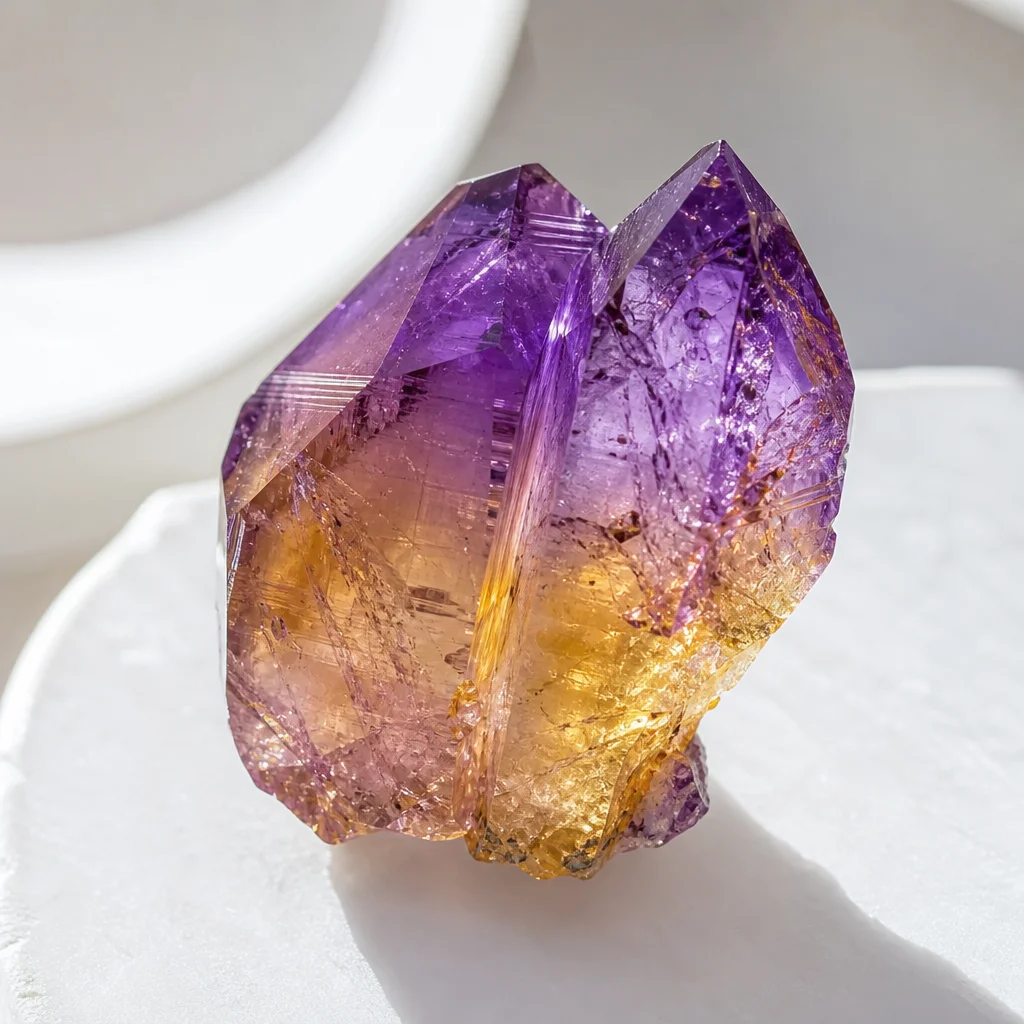
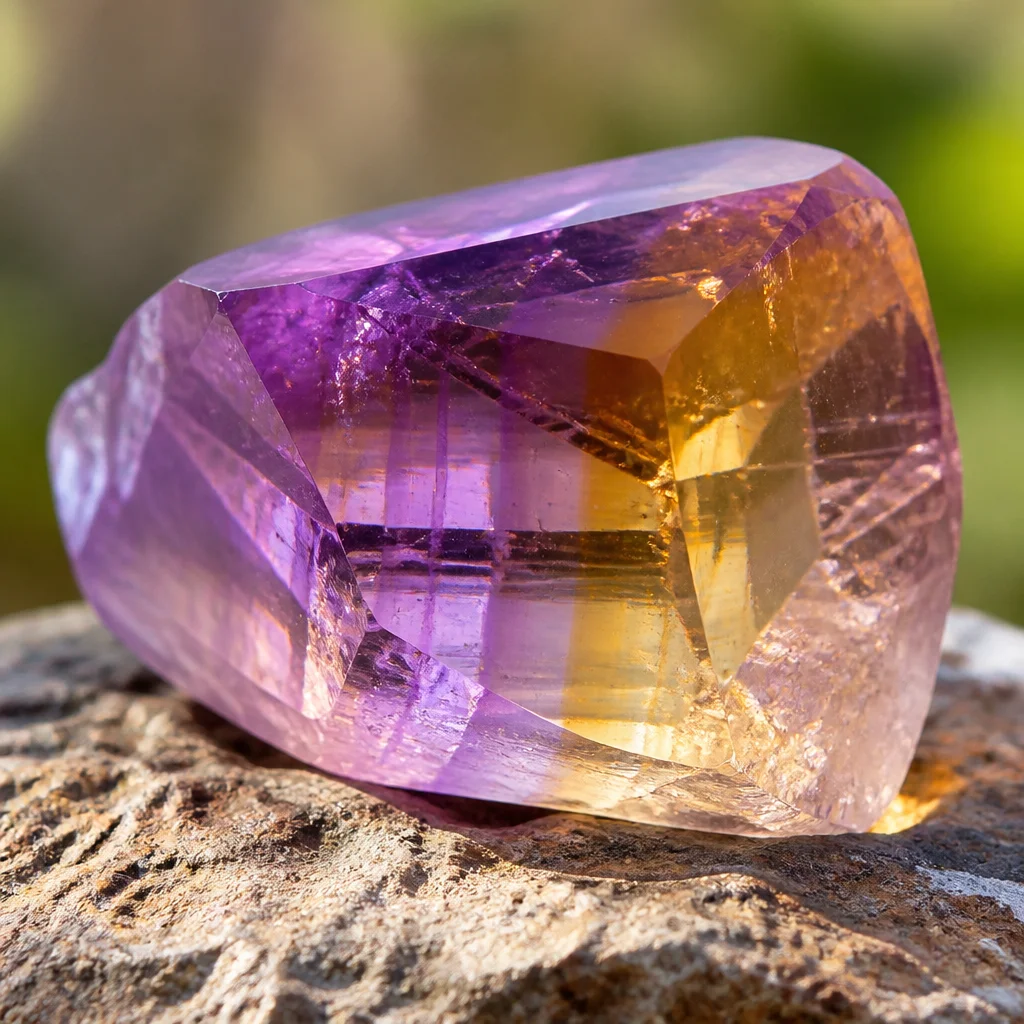
This low symmetry also produces axinite's strong pleochroism. When you view a transparent axinite crystal from different angles, it shows markedly different colors — brown, violet, and honey-yellow, sometimes simultaneously. This is because the different atomic planes within the crystal absorb different wavelengths of light, and the lack of symmetry means each viewing direction encounters a different combination of planes.
Physical Properties
| Property | Value |
|---|---|
| Crystal System | Triclinic |
| Hardness (Mohs) | 6.5 – 7 |
| Specific Gravity | 3.27 – 3.35 |
| Cleavage | Perfect on [001] |
| Fracture | Uneven to conchoidal |
| Luster | Vitreous to resinous |
| Streak | White to gray |
| Transparency | Transparent to translucent |
| Pleochroism | Strong — brown, violet, yellow-green |
The 6.5-7 hardness range makes axinite suitable for jewelry with protective settings, though its perfect cleavage means it can split if struck at exactly the wrong angle — similar to the risk with topaz (also cleavage-prone). Bezel settings provide much better protection than prong settings for axinite jewelry.
Notable Localities
France: Bourg d'Oisans
The French Alps locality of Bourg d'Oisans, in the Isère department, has produced some of the world's finest axinite specimens. These crystals are typically ferroaxinite with rich clove-brown color and excellent crystal form, often associated with quartz, adularia, and epidote. French axinite specimens from the 19th-century mining era remain prized by museum collectors. The crystals from this locality are notable for their sharp, well-defined edges and large size — specimens exceeding 5cm across are known.
Mexico: Baja California and Sonora
Mexican axinite is typically manganaxinite, displaying honey-yellow to amber colors with excellent transparency. The best specimens show vivid tricolor pleochroism when viewed under strong light. Mexican axinite is found in skarn deposits (calc-silicate metamorphic rocks formed at the contact between limestone and igneous intrusions), often alongside garnet, vesuvianite, and wollastonite. The color tends to be warmer and more saturated than French material, making Mexican specimens particularly attractive to collectors who favor color over crystal size.
Japan: Nagano Prefecture
Japan has produced distinctive violet to purple axinite specimens, often of the magnesioaxinite species. These are rarer than the brown ferroaxinite and are sought after by specialist collectors. The violet color is attributed to trace amounts of titanium in the crystal structure. Japanese specimens tend to be smaller (1-3cm) but show exceptional color saturation and strong pleochroism.
Tasmania: Dundas and Zeehan
Australian axinite from Tasmania's mineral-rich west coast has been collected since the late 19th century. These specimens are typically dark brown ferroaxinite, often found in quartz veins associated with cassiterite (tin ore) and sulfide minerals. The Tasmania specimens are noted for their metallic luster and deep, saturated color — some approach black in low light but reveal rich chestnut-brown tones under strong illumination.
United States: California and New Jersey
California has produced axinite from several localities, most notably the Inyo County and Riverside County deposits. Franklin, New Jersey, is famous for its fluorescent minerals, and while axinite isn't the star mineral there, small specimens have been found showing weak orange fluorescence under short-wave UV light — an unusual property for a typically non-fluorescent mineral.
Axinite in Metamorphic Geology
Axinite's geological significance extends beyond its beauty as a collector specimen. In petrology, axinite serves as an indicator mineral for specific metamorphic conditions. Its presence in a rock tells geologists that the rock experienced contact metamorphism at moderate temperatures (roughly 350-500°C) and moderate pressures, typically at the boundary where limestone meets an igneous intrusion (a skarn environment).
The chemical composition of axinite is sensitive to the metamorphic conditions — the relative amounts of iron, manganese, and magnesium in a given specimen reflect the specific chemistry of the parent rock and the temperature of metamorphism. By analyzing axinite compositions, geologists can reconstruct the metamorphic history of a region with considerable precision.
Axinite also forms in low-grade regional metamorphic environments, particularly in manganese-rich sedimentary sequences. In these settings, manganaxinite is the dominant species, and its presence indicates metamorphic grades corresponding to the greenschist facies.
Axinite in Jewelry
Axinite is not a common jewelry stone, and this is partly intentional. While its hardness (6.5-7) is adequate for rings and pendants with protective settings, its perfect cleavage makes cutting and setting risky. A single accidental strike along the cleavage plane can split a finished gem in two.
When axinite is used in jewelry, it's almost always in earrings or pendants — settings where the stone is less likely to receive a physical impact. Bezel settings are strongly preferred over prong settings because the bezel wraps around the stone's girdle, protecting the cleavage plane from side impacts.
The pleochroic color play is axinite's main jewelry appeal. A well-cut axinite gem shows shifting brown-to-violet tones as the stone moves, creating an effect similar to (but subtler than) iolite's strong trichroism. Cutting orientation is critical — the lapidary must align the table facet to optimize the most attractive color direction while minimizing the least attractive one.
Collecting Axinite
For mineral collectors, axinite represents excellent value. Fine specimens can be purchased for significantly less than comparably rare minerals because axinite has never been a "fashion" mineral — it doesn't appear in trendy crystal shops or social media aesthetics. This means the market is driven by genuine mineral enthusiasts rather than casual consumers, keeping prices reasonable.
What to look for in a collector specimen:
Crystal form: Sharp, well-defined edges with minimal damage. The blade-like habit should be clearly recognizable. Axinite crystals that are just broken fragments without terminations have minimal collector value.
Color: Rich, saturated color with visible pleochroism. Brown specimens are most common and least valuable per carat; violet and honey-yellow specimens command premium prices due to rarity.
Association: Matrix specimens with associated minerals (quartz, epidote, garnet) are more valuable than loose single crystals because they provide geological context and visual contrast.
Size: Anything over 3cm is considered large for axinite. Specimens over 5cm from Bourg d'Oisans or over 4cm from Baja California are particularly collectible.
Transparency: Transparent to translucent crystals are preferred over opaque material. Gem-quality transparent axinite is extremely rare — a well-cut axinite gemstone over 2 carats is a genuine collector's item.
Axinite vs. Andalusite: Spotting the Difference
Both axinite and andalusite are brown, pleochroic, triclinic/orthorhombic minerals that can appear similar at first glance. Key differences:
Crystal habit: Axinite has a distinctive wedge or blade shape (the "axe"). Andalusite forms prismatic, nearly square cross-section crystals that are longer than they are wide. If the crystal looks like a small axe head, it's axinite; if it looks like a rectangular column, it's andalusite.
Cleavage: Axinite has one direction of perfect cleavage. Andalusite has one direction of good cleavage — slightly less developed. In practice, this difference is hard to observe without testing.
Pleochroism: Both are strongly pleochroic, but the colors differ. Axinite shows brown/violet/yellow-green. Andalusite shows brown/green/red — the red component is distinctive and helps distinguish the two.
Association: Axinite typically occurs in skarn deposits with garnet and vesuvianite. Andalusite typically occurs in contact metamorphic aureoles around igneous intrusions or in regionally metamorphosed rocks.
Caring for Axinite Specimens
Axinite's moderate hardness and perfect cleavage require careful handling. Store loose specimens in padded boxes or individual compartments — contact with harder specimens can chip edges. Avoid ultrasonic cleaners and steam cleaning. Warm, soapy water and a soft brush is the safest cleaning method. For display, keep away from direct sunlight (prolonged exposure can slightly alter the color of manganese-rich specimens) and areas where they could be knocked over.
FAQ
Is axinite expensive?
Not compared to most gemstones of similar rarity. A fine 2-carat faceted axinite might cost $50-150, while a comparable-quality tanzanite could cost $500-1,000. Collector mineral specimens range from $20 for small, modest examples to $500+ for exceptional large crystals with strong color and perfect form. The relative affordability is partly because axinite isn't well-known outside specialist mineral circles.
Can axinite be synthesized?
There are no commercially available synthetic axinites. Laboratory synthesis of axinite's complex borosilicate chemistry has been achieved in research settings but requires precise control of temperature, pressure, and chemical composition that isn't economically viable for commercial production. Any axinite you encounter on the market is natural.
What gives axinite its pleochroic colors?
The pleochroism is caused by iron and manganese ions in specific positions within the triclinic crystal lattice. Because triclinic crystals have no symmetry, the absorption of light varies significantly along different crystallographic directions. Iron ions (Fe²⁺) absorb preferentially in certain directions, producing brown tones, while the manganese ions (Mn²⁺) produce honey-yellow tones. The combination creates the multi-color pleochroic effect.
Frequently Asked Questions
Is axinite considered a rare gemstone?
Yes, axinite is highly sought after by collectors and jewelry enthusiasts because fine, gem-quality crystals are quite rare. While the mineral itself is found in various locations globally, transparent pieces large enough to be cut into stunning, faceted gemstones for artisan rings or pendants are exceptionally difficult to find, making each handcrafted piece truly unique and highly valued.
Can I wear axinite jewelry every day?
Axinite ranks between 6.5 and 7 on the Mohs hardness scale, making it fairly durable but best suited for mindful wearing. It is perfect for handcrafted pendants and earrings. If you choose an axinite ring for daily wear, treat it gently to prevent scratches. Always remove your jewelry before exercising or cleaning to keep this beautiful natural crystal looking its absolute best.
Comments