The $5 Flea Market Pin That Changed Everything
The $5 Flea Market Pin That Changed Everything
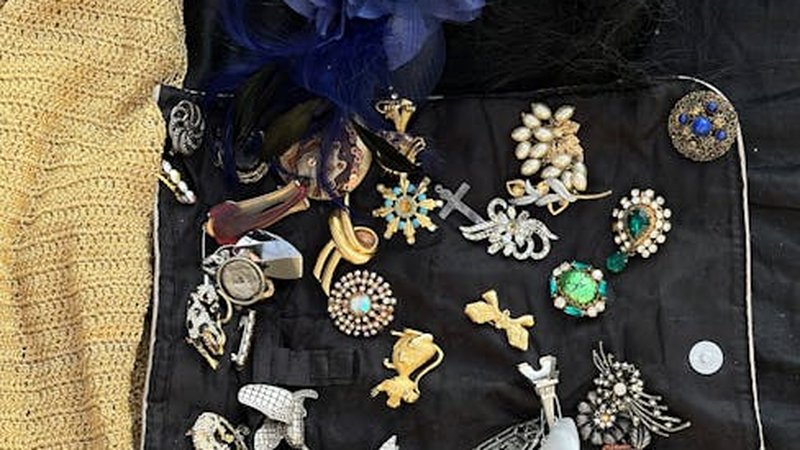
A few years back, I was killing a Saturday morning at a random flea market in upstate New York when I spotted a brooch tangled in a cardboard box of costume jewelry. The seller wanted $5 for the whole box. I fished out this tarnished little piece — a floral design with tiny seed pearls and what looked like a faded signature on the back — and something told me to hold onto it.
Fast forward three months. After posting photos in a vintage jewelry forum, a collector offered me $200 on the spot. Turns out it was a 1940s Coro piece in surprisingly good condition. I didn't sell it — mostly because I was too curious about how I'd gotten so lucky. That curiosity sent me down a rabbit hole I'm still falling through.
If you've ever stared at a piece of jewelry and wondered whether it's genuinely old or just made to look old, this guide is for you. I'm not a certified appraiser, but I've handled enough vintage pieces over the past few years to know what clues actually matter — and which ones are red herrings.
Vintage vs. Antique vs. Retro: Know the Difference First
Before you can identify anything, you need to agree on what the words mean. The jewelry world throws these terms around loosely, but there's a generally accepted framework:
Antique jewelry is at least 100 years old. If it was made before 1926, it qualifies. That includes Georgian, Victorian, and Edwardian pieces. These are the heavy hitters — museum-quality stuff, mostly.
Vintage jewelry is between 20 and 99 years old. So anything made roughly between 1926 and 2006 falls into this bucket. That's a massive range, which is why "vintage" can feel almost meaningless without more context. A 1980s neon plastic bracelet and a 1930s platinum brooch are both technically vintage. They're just... not the same kind of vintage.
Retro (or reproduction) refers to pieces made in a style that references an earlier era. A brand-new ring designed to look Art Deco is retro, not vintage. There's nothing wrong with retro jewelry — some of it is genuinely beautiful — but it shouldn't command vintage prices.
The age ranges matter because they affect value, care requirements, and collecting strategy. An antique needs museum-level conservation. A mid-century vintage piece can usually be worn every day. A retro reproduction? Wear it anywhere.
Start With the Marks: Your Best Evidence
When I pick up a piece of jewelry, the first thing I do is flip it over. Marks — those tiny stamps, engravings, and etchings on the back or inside — are the closest thing jewelry has to a birth certificate.
1. Maker's Marks
Most quality jewelry carries the maker's signature, even if it's just initials. Trifari, Coro, Miriam Haskell, Schiaparelli, Napier — these names are practically shorthand for collectible vintage. But even lesser-known makers stamped their work.
You'll need a jeweler's loupe (10x magnification is standard) to read most marks. Look on the back of brooches, the inside of ring bands, the clasp area of necklaces, and the post backs of earrings. Some marks are obvious — "CORO" in block letters, for instance. Others are tiny script initials that take patience to decode.
There are reference databases online — Jewelry Marks and Illusion Jewels are good starting points — where you can look up unfamiliar marks. I've spent whole evenings cross-referencing tiny stamps. It's oddly addictive.
2. Metal Purity Marks
These tell you what the piece is made of, and they're surprisingly informative about age:
- 925 or STERLING — Sterling silver (92.5% pure). Widely used across all eras, so this alone doesn't date a piece, but combined with other clues it helps.
- 14K, 18K, 10K — Gold purity. 14K has been the U.S. standard for a long time. 18K is more common in European pieces.
- 750, 585, 375 — European gold marks (750 = 18K, 585 = 14K, 375 = 9K). Seeing these suggests European manufacture.
- PLAT or PLATINUM — Platinum marks became common in the 1910s-1920s during the Art Deco era.
- GF or GP — Gold filled or gold plated. Very common in mid-century costume jewelry.
- SILVER, GERMAN SILVER, ALPACA — Base metal alternatives. German silver contains no actual silver (it's copper-nickel-zinc).
The absence of metal marks doesn't necessarily mean a piece is fake. Some artisan pieces and early costume jewelry were unmarked. But a mark gives you a starting point.
3. Patent Numbers
Here's a fun one: from roughly the 1940s through the 1950s, many American jewelry makers stamped patent numbers on their designs. Coro, Trifari, and Boucher did this extensively. If you find a number like "Pat. 152,847" on the back of a brooch, you can look it up in the U.S. Patent Office database and find the exact design registration with drawings and dates.
I once identified a brooch this way and discovered it was patented in 1947. That single number told me more than an hour of stylistic analysis could have. Not all vintage pieces have patents — it was mainly larger manufacturers who bothered — but when you find one, it's a gold mine of information.
Era Identification: What Does the Style Tell You?
Even without marks, jewelry design follows trends closely enough that you can often narrow down the era by looking at the piece. Here are the major style periods you'll encounter, and what to look for in each.
Victorian Era (1837–1901)
Victorian jewelry is romantic, sentimental, and sometimes a little morbid by modern standards. Queen Victoria's personal taste shaped an entire industry.
The most distinctive Victorian sub-category is mourning jewelry. After Prince Albert died in 1861, Victoria went into decades of mourning, and the whole country followed. Lockets containing locks of a loved one's hair, jet (black fossilized wood) brooches, and pieces woven from human hair were wildly popular. If you find a brooch with a compartment for hair or a glass-fronted locket, there's a good chance it's Victorian.
Other Victorian hallmarks: serpent motifs (symbolizing eternity), acrostic jewelry where the first letter of each gemstone spells a word, and heavy gold work with engraved patterns. Cameos are strongly associated with this era too, though they've been made in every period since.
Art Nouveau (1890–1910)
Art Nouveau is probably the easiest era to recognize visually. Think organic, flowing lines inspired by nature — vines, flowers, insects, and the female form rendered in soft, asymmetrical curves. If a piece looks like it grew rather than was manufactured, it might be Art Nouveau.
Enamel work is a big giveaway. Plique-à-jour enamel — a translucent technique where light passes through the enamel like a stained glass window — was perfected during this period. Dragonflies, peacock feathers, and lilies are recurring motifs. René Lalique is the superstar name here, but there were many talented Art Nouveau artisans.
Common materials included yellow gold, opals, moonstones, and horn. The overall feeling is dreamy and slightly otherworldly.
Art Deco (1920–1935)
Art Deco is the sharp, geometric antidote to Art Nouveau's softness. If Art Nouveau was a garden, Art Deco was a skyscraper. Think symmetrical patterns, bold contrasts, and an unapologetically modern sensibility.
White metals — platinum and white gold — dominated. Diamonds were the stone of choice, often paired with onyx, emerald, ruby, or sapphire for dramatic color contrast. Geometric shapes like triangles, hexagons, and stepped forms (echoing the architecture of the Chrysler Building) appear everywhere.
Long pendant earrings, cocktail rings, and double clip brooches are signature Art Deco forms. If a piece feels like it belongs in a 1920s jazz club, you're probably in the right neighborhood.
Retro Modern (1935–1950)
The Retro period is a strange and wonderful beast. During WWII, platinum was reserved for military use, so jewelers pivoted to rose gold and yellow gold. Pieces got bigger, bolder, and more sculptural — think wide cuff bracelets, oversized cocktail rings, and ribbon-like motifs.
Large semi-precious stones — citrine, aquamarine, amethyst — took center stage because precious gems were scarce. The overall vibe is glamorous but slightly chunky, like Hollywood Golden Age jewelry scaled up. If a piece feels simultaneously luxurious and a bit heavy-handed, it might be Retro.
Mid-Century Modern (1950–1965)
After the war, design went through a creative explosion. Mid-century jewelry embraces abstraction, organic asymmetry, and what designers of the era called "space age" aesthetics. Textured metals, freeform shapes, and unconventional materials (like wood, resin, and ceramic) started appearing alongside traditional gems.
Signed Scandinavian pieces from this period — especially Georg Jensen and other Danish designers — are highly collectible. In the U.S., brands like Miriam Haskell created elaborate bead-and-wire constructions that feel almost wearable sculpture. If a piece looks like it could hang in a modern art museum, consider the mid-century.
Construction Clues: The Telltale Details
How a piece is physically put together often reveals more than its design. These are the details that experienced collectors check almost instinctively.
Earring Backs
Earring findings are one of the best dating tools available:
- Screw backs (the kind you twist to tighten) were the standard before the 1930s. If you find screw-back earrings, there's a good chance they're pre-1930s, though some makers used them into the 1950s.
- Clip-ons became enormously popular in the 1930s and dominated through the 1960s. The invention of the padded clip (for comfort) happened in the 1950s.
- Pierced post with butterfly back — Pierced earrings were considered déclassé for much of the early 20th century. They made a comeback in the 1960s-1970s.
Clasps and Closures
Necklace and bracelet clasps evolved significantly over the decades:
- C-ring clasp — Common on Victorian and Edwardian necklaces. Simple, slightly crude-looking C-shaped hook.
- Spring ring clasp — Patented in the early 1900s, became standard by the 1920s.
- Lobster clasp — Didn't appear until the 1970s. If a supposedly "vintage" piece has a lobster clasp, it's probably no older than the 1970s, if that.
- Box clasp with safety chain — Very common on quality pieces from the 1900s-1940s.
Hinge Construction
On bracelets and brooches, look at the hinge. Older pieces tend to have tube hinges — a hollow cylinder that the pin rotates through. Newer pieces often use a simpler, stamped hinge. A well-constructed tube hinge on a brooch is a strong indicator of age.
Patina and Wear: Reading the Story
One of the trickiest aspects of vintage jewelry identification is assessing wear. Genuine age produces a specific kind of patina — a gradual, even softening of edges and surfaces that's hard to replicate convincingly.
Here's what I look for:
Even wear on high points. On a ring, the shoulders and setting edges should show consistent, gradual wear. Sharp, new-looking edges on a supposedly 80-year-old piece are suspicious. But the wear should be organic and uneven — not uniform in a way that suggests chemical treatment.
Tarnish patterns. Silver develops a natural patina that settles into crevices and low points. This tarnish is usually darker in recessed areas and lighter on raised surfaces. If the tarnish looks evenly distributed or has a chemical smell, it might be artificially induced.
Enamel condition. Chips, hairline cracks, and slight color shifts in enamel are normal signs of age. Perfectly intact enamel on a 100-year-old piece is possible but unusual.
Thread and string. On beaded necklaces, the original silk thread darkens and weakens over decades. If the threading looks brand new but the beads appear old, the piece may have been restrung — which is fine, but it means the string isn't an age indicator.
Beware of deliberate aging. Some reproduction pieces are chemically treated or physically distressed to simulate age. If a piece looks too perfectly "old" — like every surface has exactly the right amount of patina — that uniformity can actually be a red flag. Real age is messy and inconsistent.
Where to Learn More
If you're getting serious about vintage jewelry identification, here are resources that have helped me enormously:
Books: "Warman's Jewelry" by Christie Romero is the field guide I wish I'd found sooner — it covers identification, dating, and pricing for all major eras. "Vintage Jewelry: A Price and Identification Guide" by Leigh Leshner is another solid reference with lots of photographs. For costume jewelry specifically, "Collecting Costume Jewelry 101" by Julia Carroll is excellent.
Online databases: The Jewelry Patents section of the U.S. Patent Office website is free and incredibly detailed once you learn to navigate it. Collectors Weekly has a good archive of manufacturer information and discussion threads. The Vintage Jewelry Hangout on Facebook is surprisingly knowledgeable — I've had pieces identified within minutes of posting a photo.
Professional appraisers: If you think you've found something valuable, a certified appraiser (look for GIA or ISA credentials) can give you a proper assessment. Expect to pay $50–$150 per piece, but it's worth it for anything you suspect might be significant.
Hands-on practice: Honestly, the best teacher is handling a lot of jewelry. Visit antique shops, estate sales, and flea markets regularly. Pick things up, turn them over, look at them under magnification. After a few hundred pieces, you start developing an instinct that's hard to explain but surprisingly reliable.
That $5 brooch from the flea market is sitting on my desk as I write this. It's not worth a fortune — Coro pieces are common enough that even good examples stay in the hundreds rather than thousands. But what it gave me was something better: a way of seeing. Every piece of old jewelry has a story embedded in its construction, its marks, its wear patterns. Learning to read those stories is what makes collecting worthwhile.
Comments