Understanding Ring Sizes: International Conversion Chart and How to Measure at Home
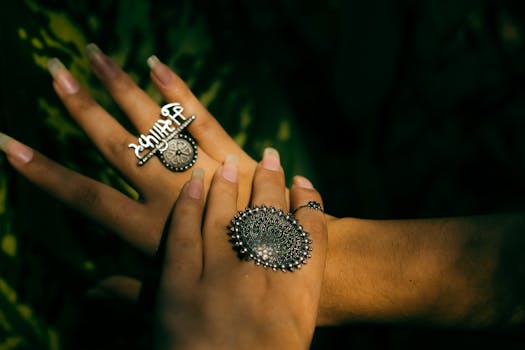
Buying a ring online without trying it on first feels like a gamble. You pick a size, place the order, and cross your fingers for two weeks. Then the package arrives and it either spins around your finger or won't slide past your knuckle. Neither outcome is fun. The problem isn't you — it's that ring sizing is genuinely confusing, especially when different countries use completely different numbering systems.
Why ring sizes are a mess
There is no single universal ring size standard. The United States uses a numbered system from 1 to 16, with quarter-size increments. The United Kingdom uses an alphabetical scale from A to Z, plus half sizes. Europe uses the internal circumference in millimeters. Japan uses yet another numbered system. Hong Kong has its own scale based on internal diameter. Walking into a jeweler in Paris and asking for a "size 7" means nothing without conversion.
This confusion costs people money. Returns on rings range from 15% to 30% depending on the retailer, and resizing fees run $25 to $75 per ring. Getting it right the first time matters more than most people realize.
International ring size conversion chart
Here is a practical conversion chart covering the most common systems. These are approximate — different sources disagree by a fraction of a millimeter here and there — but close enough for real-world use.
US Size → Inner Diameter (mm) → UK Letter → EU Size → Japan Size → Hong Kong Size
3 → 14.1mm → F → 44 → 4 → 7
4 → 14.9mm → H → 47 → 7 → 9
5 → 15.7mm → J → 49 → 9 → 11
6 → 16.5mm → L → 52 → 11 → 14
7 → 17.3mm → N → 54 → 14 → 16
8 → 18.2mm → P → 57 → 16 → 18
9 → 19.0mm → R → 59 → 18 → 21
10 → 19.8mm → T → 62 → 20 → 23
11 → 20.6mm → V → 65 → 23 → 25
12 → 21.4mm → X → 67 → 25 → 27
The most commonly purchased women's sizes in the US are 5 through 7, and men's sizes cluster around 8 through 11. If you fall outside those ranges, finding off-the-shelf rings gets harder, and custom sizing becomes more relevant.
How to measure your ring size at home
You don't need fancy tools. Three methods work well enough for online shopping, each with its own trade-offs.
The string or floss method
Wrap a piece of string or dental floss around the base of your finger — not the knuckle, the part where the ring will actually sit. Mark where the string overlaps, then measure that length against a ruler. Divide the circumference by 3.14159 (pi) to get the diameter, and match it to the chart above.
This method works, but string stretches. Use dental floss instead — it doesn't stretch, and the thin width gives a more accurate measurement. Pull it snug but not tight. If you yank it like a tourniquet, you'll get a size that's too small.
The paper strip method
Cut a narrow strip of paper — about 5mm wide — and wrap it around your finger the same way. Mark the overlap point, measure the length, convert to diameter. The advantage of paper over string is that it's stiffer and easier to get a consistent wrap. The disadvantage is that paper tears if you wrap it too tight, which can actually help you calibrate pressure.
Printable ring sizers exist online, and some of them are reasonably accurate. The catch: you have to print at exactly 100% scale. Any "fit to page" scaling in your printer settings throws off every measurement by enough to matter. Check with a ruler against the reference line on the printout.
The existing ring method
If you already own a ring that fits the target finger, this is the most reliable approach. Place the ring on a ruler and measure the inner diameter — the distance across the inside of the band, not the outside edge. Match that diameter to the chart.
For better accuracy, measure across the ring at two or three different angles and average the results. Rings are rarely perfectly circular, especially after years of wear. A difference of 0.2mm between measurements is normal and won't affect sizing.
Using a ring mandrel
A ring mandrel is a tapered metal rod with size markings. You slide the ring onto the mandrel and read where it stops. Jewelers use these constantly, and you can buy a basic aluminum one for $8 to $15 online. If you plan to buy multiple rings over time, this tool pays for itself in avoided return shipping.
Why your finger size changes throughout the day
Fingers are not static. They swell and shrink based on at least five factors, and ignoring these will lead you to the wrong size.
Temperature. Cold fingers shrink. Warm fingers swell. This is basic physiology — blood vessels dilate in heat and constrict in cold. The difference can be half a ring size between a freezing morning and a hot afternoon. Measure at room temperature, around 68°F to 72°F (20°C to 22°C), for the most reliable result.
Time of day. Fingers tend to be slightly swollen in the morning because of fluid retention overnight. Late afternoon to early evening gives a more "average" measurement. Most jewelers recommend measuring after lunch.
Humidity and salt intake. High humidity and salty food both cause water retention, which makes fingers swell. If you just ate a bag of chips and it's 90°F outside, your fingers are bigger than they'll be on a cool, dry day.
Physical activity. Exercise increases blood flow to your hands. If you measure right after a run or while gripping weights, your reading will be artificially large.
Pregnancy and hormones. Hormonal changes during pregnancy, menstruation, or certain medications can cause noticeable finger swelling. This is temporary but relevant if you're buying an engagement ring or anniversary gift — measure at a neutral time.
The width of the band matters more than you think
Here is something most ring size guides don't mention: wider bands need a larger size. A thin 2mm band in size 7 might fit perfectly, but a chunky 8mm band in the same size will feel uncomfortably tight. The reason is simple geometry — more metal wrapping around your finger means more contact area and more pressure on the tissue underneath.
The rule of thumb: for every 2mm of additional band width beyond 4mm, go up about a quarter size. So if you wear a 7 in a thin band, you might need a 7.5 in a 8mm-wide band. Some jewelers recommend going up a full half size for anything wider than 6mm. This varies by person — some people's fingers are more sensitive to band width than others — but it's a real factor that catches a lot of buyers off guard.
Resizing reality: bigger down is easy, bigger up is hard
Most rings can be resized, but the direction matters enormously.
Making a ring smaller is straightforward and cheap. A jeweler cuts a small section from the band, re-solders it, and polishes the seam. This costs $25 to $50 in most shops and is nearly invisible when done well. You can generally go down 1 to 2 full sizes without structural issues.
Making a ring larger is a different story. The jeweler has to cut the band, stretch it, add metal to fill the gap, and re-solder. This costs $40 to $75 and is not always possible. Engraved rings may lose part of the engraving. Rings with channel-set stones or intricate patterns can't always be stretched without damage. Some rings with gemstones all the way around (eternity rings) have virtually zero resizing flexibility because there's no bare metal to cut.
Plain bands resize easily. Stone-set rings are riskier. Hollow rings should not be resized at all — they collapse under the pressure.
The takeaway: if you're unsure between two sizes, go with the slightly larger one. It's cheaper and safer to size down than up.
Tips for buying rings online
Online ring shopping is here to stay — the selection is better, the prices are lower, and you're not dealing with a salesperson hovering over your shoulder. But you need to be smart about it.
First, measure three times at different times of day. Don't just measure once in the morning and call it done. If your three measurements land on the same size, buy with confidence. If they straddle two sizes, go with the larger one.
Second, check the retailer's return policy before ordering. Some stores charge a 15% to 20% restocking fee on returned rings. Others offer free resizing within 30 days. A good return policy is effectively insurance on a sizing mistake.
Third, be honest about your knuckles. If your knuckle is significantly wider than the base of your finger — which is common for people who do manual work or have arthritis — you need the ring to fit over the knuckle. It will be slightly loose at the base, but that's better than a ring you can't put on. Ring guards (small metal clips that clip inside the band) cost $5 and can snug up a loose ring.
Fourth, don't assume your size is the same on every finger. Your dominant hand tends to be slightly larger than your non-dominant hand. Ring and middle fingers are usually the same size or close to it. Index fingers are often a half size smaller. Pinky fingers are much smaller — don't guess, measure.
Finally, consider ordering a cheap ring sizer set online before buying the actual ring. These plastic ring gauges cost $3 to $5 on Amazon, give you a physical sense of what each size feels like on your hand, and eliminate most of the guesswork. It's the best $5 you'll spend on this entire process.

Comments