Turquoise: The Stone That Built Empires and Bankrupted Miners
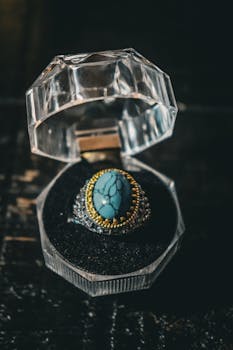
Turquoise is one of the oldest gemstones humans have ever bothered to dig out of the ground. We know this because archaeologists keep finding it in graves and ruins that are absurdly old — 7,000 years old in some cases. The ancient Egyptians were mining it at Sinai around 3000 BCE. The Persians prized it enough to wear it in their jewelry and inlay it into their architecture. Native American cultures across the Southwest built entire trade networks around it. And the Chinese emperors liked it well enough to import it across thousands of miles of Central Asian desert.
That's a lot of civilizations agreeing on something. And the thing they agreed on was that this opaque blue-green stone was worth traveling for, fighting over, and burying their dead with.
What turquoise is, chemically
Turquoise is a hydrated copper aluminum phosphate — CuAl₆(PO₄)₄(OH)₈·4H₂O. The blue color comes from copper. The green tinge comes from iron replacing some of the aluminum. More iron means greener stone. More copper means bluer stone. A pure, ideal turquoise with no iron at all would be a deep sky blue, but that almost never happens in nature.
The mineral forms in arid climates where copper-bearing groundwater seeps through aluminum-rich rock, usually near the surface. It needs specific conditions: low pH, the presence of phosphate (often from weathering apatite or other phosphate minerals), and a dry environment that prevents the mineral from dissolving again. This is why turquoise deposits tend to cluster in deserts and semi-arid regions worldwide — the American Southwest, Iran, China, Chile, and parts of the Sinai Peninsula.
Turquoise is soft. It rates 5 to 6 on the Mohs scale, which puts it below window glass. It's porous too — it can absorb oils, water, and other liquids, which changes its color over time. A turquoise ring that you wear every day will gradually darken as it absorbs skin oils. Some people like this. Others don't. Either way, it's going to happen if you actually wear the stone.
The Persian turquoise trade
For most of human history, the finest turquoise came from Persia — specifically from mines in the Khorasan Province of northeastern Iran, near the city of Nishapur. The Persians called it pirouzeh, meaning "victory." The mines there have been worked for over 2,000 years, and for most of that time, Persian turquoise was considered the standard against which all other turquoise was measured.
What made Persian turquoise special was the color. The best material from Nishapur is an even, intense blue with minimal matrix — the dark veining that runs through a lot of turquoise. The ancient Persians believed turquoise changed color to warn its wearer of danger or illness. This is almost certainly a myth, but it's a persistent one because turquoise does actually change color in response to its environment — heat, light, acidity, and skin contact can all shift its hue.
The Persian turquoise trade was serious business. Marco Polo mentioned turquoise in his writings about Persia. The stone traveled along the Silk Road to China, where it was carved into snuff bottles, hair ornaments, and decorative objects. The Mughal emperors of India set turquoise into their weapons and jewelry. By the medieval period, turquoise was moving through virtually every major trade route connecting Europe, the Middle East, and Asia.
Egyptian turquoise and the afterlife
The Sinai Peninsula has turquoise deposits at two main locations: Serabit el-Khadim and Wadi Maghareh. The ancient Egyptians started mining these around 3000 BCE, making them some of the oldest known mining operations in human history.
Egyptian turquoise was important for more than decoration. The Egyptians associated the stone with Hathor, the goddess of love, music, and motherhood — but also with the afterlife. Turquoise was found in Tutankhamun's tomb, set into a gold scarab pendant. Miners at Serabit el-Khadim carved a temple to Hathor directly into the rock face above the mines. They left behind inscriptions recording their expeditions, complaints about working conditions, and prayers for safe journeys. Some of these inscriptions are over 3,500 years old.
The mining was brutal. Sinai turquoise occurs in narrow veins in sandstone, and the Egyptians extracted it with copper chisels, stone hammers, and fire-setting — heating the rock with fire and then dousing it with water to crack it. The mines are at altitude, in a harsh desert environment, and the expeditions lasted months. Miners died out there. Their graffiti suggests they knew the risks and went anyway, which tells you something about the value placed on the stone.
Turquoise in the American Southwest
The story of turquoise in the Americas is different from the Old World, and in some ways more interesting. Native American cultures in what's now the southwestern United States have been working with turquoise for at least 2,000 years — possibly longer. The Ancestral Puebloans (often called Anasazi) mined turquoise at Cerrillos, New Mexico, and traded it across hundreds of miles. Turquoise from New Mexico has been found at the Aztec capital of Tenochtitlan, which is roughly 1,200 miles away.
The Navajo, Hopi, Zuni, and Pueblo peoples all developed distinct turquoise-working traditions. The Zuni became known for intricate inlay work, setting small pieces of turquoise (and other stones) into silver channels. The Navajo adopted silversmithing in the mid-1800s — the technique was introduced by a Navajo smith named Atsidi Sani, who learned it from a Mexican silversmith — and combined it with turquoise to create the heavy, bold jewelry style that most people associate with Native American turquoise today.
The turquoise used in this tradition came primarily from mines in Nevada, Arizona, New Mexico, and Colorado. The Sleeping Beauty mine in Globe, Arizona, produced some of the most sought-after American turquoise — an even, clear blue with little to no matrix. The Bisbee mine in Arizona produced darker blue turquoise with a distinctive brown matrix. The Lone Mountain mine in Nevada had material ranging from blue to green, often with spiderweb veining.
Most of these mines are now closed or producing very little. Sleeping Beauty shut down in 2012. The costs of mining — environmental regulations, declining ore quality, and the sheer expense of extracting turquoise from hard rock at depth — made most American turquoise operations uneconomic. The turquoise that's still sold as "Sleeping Beauty" or "Bisbee" today comes from old stockpiles, and the prices reflect the scarcity.
The boom and bust of turquoise mining
Turquoise mining has a pattern, and it's not a happy one. A deposit is discovered. Miners rush in. The best material comes out first. Production declines. The mine gets deeper and more expensive. Eventually it closes. The miners move on. The deposit is forgotten until someone decides to rework the tailings, or until the turquoise from that specific location becomes collectible and old stock starts commanding premium prices.
This happened at the Royston district in Nevada. The mines there produced exceptional turquoise in the early 20th century — rich blue and green material with dramatic matrix patterns. The area went through multiple booms and busts. Today, Royston turquoise is considered some of the finest American material, and old rough from the original mining era sells for more per pound than the miners ever imagined.
The economics of turquoise mining are brutal. Turquoise occurs in narrow veins, often just a few inches wide. You can dig a lot of rock to find very little gem-quality material. Unlike gold or copper, where bulk extraction and economies of scale work in your favor, turquoise mining rewards the opposite: small, careful operations that can selectively extract good material from bad. That's hard to do profitably in an era of rising labor and regulatory costs.
Stabilized turquoise — real or fake?
Most turquoise on the market today has been treated in some way. This is a contentious topic among collectors and dealers, and opinions range from "it's perfectly fine" to "it's basically fake." The reality is somewhere in between.
Low-grade turquoise — material that's too soft, too porous, or too pale to be usable in jewelry — can be stabilized. The most common method involves impregnating the stone with a clear polymer resin under pressure. This hardens the stone, deepens the color, and makes it durable enough for jewelry. The material is still turquoise. The chemistry hasn't changed. But it's been reinforced, and the color has been enhanced.
Stabilized turquoise is widely sold and widely used. Most of the turquoise in affordable Native American-style jewelry is stabilized. It's not a scam — it's a manufacturing process. But it should be disclosed, and it often isn't, especially at the lower end of the market.
Then there's reconstituted turquoise, which is turquoise that's been crushed into powder, mixed with resin, and pressed into blocks. This is where things get murkier. The material contains real turquoise, but the stone has been destroyed and reassembled. Whether that counts as "real" depends on how strict your definition is.
And then there are outright imitations: dyed howlite, dyed magnesite, plastic, and ceramic. Howlite is the most common turquoise simulant — it's a white mineral that takes dye well and has natural veining that looks convincingly like turquoise matrix. It's cheap, and it's everywhere.
How turquoise fits into modern jewelry
Turquoise has never really gone out of style, but its popularity goes through cycles. It was huge in the 1970s, faded in the 80s and 90s, and has come back strong in the last 15 years. Part of the appeal is that it works in both casual and formal settings — a turquoise pendant looks right with a T-shirt and with a dress. Part of it is the cultural associations, especially with Native American craftsmanship. And part of it is simply that good turquoise is distinctive in a way that's hard to replicate with other stones.
At the high end, untreated, natural turquoise from closed American mines is becoming genuinely scarce. A fine Sleeping Beauty cabochon — solid, even blue, no matrix — can sell for $50 to $100 per carat at retail, and exceptional pieces go higher. Persian turquoise in similar quality is harder to find and often more expensive. Chinese turquoise, much of which comes from the Hubei Province mines, is widely available at lower prices, though the quality varies considerably.
For someone just getting into turquoise, the practical advice is straightforward. Buy from dealers who disclose treatments. If a stone is stabilized, that's fine — just don't pay natural-turquoise prices for it. Learn to recognize howlite (it's noticeably lighter in weight and the dye sometimes pools in the veins under magnification). And if you find a piece of natural turquoise from a named American mine that you can afford, buy it. The supply isn't getting bigger.
Turquoise has been valued for 7,000 years because there's nothing else quite like that particular blue-green color occurring naturally in a wearable form. The chemistry is simple — copper, aluminum, phosphorus, water. The story behind it isn't simple at all.
Comments