Treated vs untreated gemstones: what actually happens to your stones
Most of the gemstones you see in jewelry stores have been treated in some way. The industry estimate is around 90 to 95 percent. This isn't a scandal or a secret — it's standard practice, and it has been for centuries. The Roman writer Pliny the Elder described heat treatment of gems in the first century AD. What has changed is the sophistication of the techniques and the growing gap between what consumers assume they're buying and what they're actually getting.
I think the treatment conversation suffers from two problems: people either don't know treatments exist at all, or they assume all treatments are deceptive. Neither is accurate. Some treatments are so mild they barely count. Others fundamentally alter the stone. The key is knowing which is which.
The most common treatment: heat
Heat treatment is the oldest, most widespread, and generally most accepted gemstone treatment. It accounts for the vast majority of treated stones on the market. The process is conceptually simple: heat the stone to a specific temperature (typically 400°C to 1800°C, depending on the mineral) in a controlled atmosphere, hold it there, and cool it slowly.
What does this actually do at the atomic level? It depends on the stone, but the general mechanisms are color improvement, clarity improvement, or both.
For sapphires, heat dissolves silk — fine rutile needle inclusions that make the stone look cloudy or milky. The rutile dissolves into the crystal lattice, the stone becomes transparent, and the color often intensifies because there's less scattering of light. A milky, pale blue sapphire can become a vivid, clear blue after heating. The color is not "added" — it was always there, obscured by the silk.
For rubies, heat does similar work. It removes silk, improves clarity, and can modify the red color by changing the oxidation state of chromium and iron within the crystal. Some rubies turn from purplish-red to pure red after heating. Others show little visible change. The outcome depends on the specific chemistry of each stone.
For aquamarine, heat removes the green component, leaving a purer blue. Most aquamarine on the market has been heated to around 400°C. The untreated material tends to be a greenish-blue that many consumers don't find as appealing.
Here's what matters: heat treatment is permanent. It doesn't fade, wear off, or reverse over time. The changes happen at the atomic level. A heated sapphire is chemically and structurally the same as an unheated one — the only difference is the arrangement of atoms within the lattice. Most gemologists consider heated stones to be "natural" in the meaningful sense, because no foreign material has been added.
Blue zircon: heat created the market
Most zircon comes out of the ground brown or colorless. The vivid blue zircon that's popular in jewelry is almost always the result of heat treatment at around 900–1000°C. Without this treatment, blue zircon barely exists as a commercial product. Some gemstone dealers argue that heated zircon shouldn't be called "treated" at all — it's more like "finished," the way cutting and polishing are finishing steps.
I mention this because it illustrates how blurry the line between "natural" and "treated" really is. A brown zircon heated to blue isn't chemically different from a hypothetical naturally-blue zircon. The color mechanism is the same. You just skipped a few million years of geological heating.
Fracture filling: where opinions diverge
Fracture filling is more controversial than heat, and for understandable reasons. In this process, a substance — typically glass, resin, or oil — is forced into surface-reaching fractures in the stone to make them less visible. The filler has a refractive index close to the stone, so light passes through the fracture rather than reflecting off the crack walls.
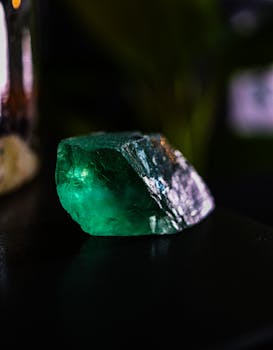
This is most commonly done with emeralds. Emeralds naturally contain fractures (that's why most emeralds are oiled — literally, with cedar oil or synthetic oils). The oil seeps into the fractures and makes the stone look cleaner. If you've ever seen an emerald with a slightly oily-looking surface, that's why.
Fracture filling is not permanent in the same way heat treatment is. Oils can dry out or leak out over years, especially if the stone is exposed to heat, ultrasonic cleaning, or strong solvents. Glass-filled rubies can have their filling damaged by acids, heat, or even the torch flame of a jeweler doing repair work. Resin fillers last longer than oils but can degrade with UV exposure.
The disclosure issue is real here. A glass-filled ruby might cost 10 to 50 times less than an untreated ruby of similar appearance. Both look beautiful in the display case. If the seller doesn't tell you which one you're buying, that's a problem. Most reputable dealers disclose fillers — but not all of them do, and the language used can be deliberately vague.
Surface diffusion: color on the outside
Surface diffusion is a treatment where coloring elements are diffused into the surface layer of a stone at high temperatures. The result is a stone whose color is concentrated at the surface — the core may be colorless or a different color. If you cut or chip the stone, the color layer is gone.
This technique is most commonly applied to sapphires. Titanium and iron are diffused into the surface of pale or colorless corundum to create a blue layer. More recently, beryllium diffusion has been used to create orange, yellow, and padparadscha colors that penetrate deeper into the stone.
Surface-diffused stones are not fake. They are natural corundum with an enhanced color layer. But the color is fundamentally different from a stone that is the same color throughout. A chipped surface-diffused sapphire will show a colorless or differently-colored interior, which doesn't happen with a fully colored stone.
Irradiation: changing color with nuclear physics
Irradiation uses high-energy radiation — gamma rays, electron beams, or neutron bombardment — to alter the color centers in a gemstone. The most common applications are blue topaz (almost all blue topaz on the market is irradiated), colored diamonds, and certain shades of quartz.
Blue topaz provides a good case study. Natural blue topaz exists but is rare and typically pale. The vivid Swiss blue and London blue topaz you see in jewelry is created by irradiating colorless or pale topaz, then heating it to stabilize the color. The process is safe — the stones are not radioactive by the time they reach consumers — but it's a significant departure from "as found in nature."
Irradiated diamonds are a more complex topic. Irradiation can create fancy colors — green, blue, yellow — that are genuinely beautiful and often indistinguishable from naturally colored diamonds without laboratory testing. The price difference is substantial: a natural fancy-color diamond might cost 10 to 100 times more than an irradiated diamond of similar appearance. Laboratory certification (from GIA, IGI, or similar labs) is the only reliable way to know.
Coatings and other surface treatments
Surface coatings are exactly what they sound like: a thin layer of material applied to the outside of the stone. These range from harmless protective coatings to deceptive color treatments. A thin film of titanium dioxide can create an iridescent "mystic" topaz or quartz. Green coating on the pavilion of a diamond can mask a yellowish body color.
Coatings are the least durable of all treatments. They scratch, wear off, and dissolve in common solvents. A coated stone that looks vivid in the store may look dull six months later. Most gemological labs consider coatings a significant treatment that must be disclosed, and some industry bodies consider certain coatings deceptive if not prominently labeled.
How to know what you're buying
The single best protection is a laboratory report from a reputable gemological lab. GIA, AGL (American Gemological Laboratories), Gübelin, and SSEF are the most respected names. These labs use spectroscopy, microscopy, and other analytical techniques to identify treatments that are invisible to the naked eye.
Key terminology to understand:
"No indications of heating" or "unheated" — the stone has not been heat-treated, or if it has, there's no evidence detectable by current technology.
"Heated" or "H" — heat treatment detected. Standard for most sapphires and rubies.
"Minor heating" — low-temperature treatment with minimal effect on inclusions.
"Filled" or "F" — fracture filling detected. Common for emeralds.
"Diffused" — surface diffusion detected.
"Irradiated" — irradiation treatment detected.
The cost difference between treated and untreated stones can be enormous. An unheated Burmese ruby of good color and clarity is one of the most expensive gemstones per carat in the world — regularly exceeding $50,000 to $100,000 per carat at auction. A heated African ruby of similar appearance might sell for $1,000 to $5,000 per carat. Both are real rubies. The question is how much you value natural vs. enhanced color.
The honest answer
There is nothing inherently wrong with buying treated gemstones. Heat-treated sapphires are beautiful, durable, and represent excellent value. Oiled emeralds have been the industry standard for centuries. Most blue topaz has always been irradiated — there's no meaningful "untreated" alternative at that price point.
What's wrong is not knowing. If you're paying a premium for an untreated stone, you need documentation proving it's untreated. If you're buying a treated stone at a treated-stone price, that's fine — but you should know that's what you're doing. The treatment itself isn't the issue. Transparency is the issue.
Comments