The Ring That Didn't Fit (and the Two-Week Wait That Followed)
The Ring That Didn't Fit (and the Two-Week Wait That Followed)
Last month I ordered a gorgeous moonstone ring online — the kind you see on Instagram and immediately add to cart. It arrived after a week of tracking the package like a hawk, and I ripped open the box with way too much excitement for a Tuesday afternoon. Slipped it on my ring finger and… it wouldn't go past the knuckle. Half a size too small. Maybe even a full size.
So began the returns process. Ship it back, wait for the warehouse to process it, wait for the replacement to ship, wait for delivery again. Two full weeks before I was finally wearing the right size. Two weeks of checking my finger and feeling like something was missing.
If I'd taken five minutes to measure my ring size before placing that order, I could have saved myself the whole ordeal. That's exactly why I'm writing this — so you don't have to learn the hard way like I did.
Why Getting the Right Ring Size Actually Matters
It's tempting to just guess, especially when you're buying something fun and casual. But wearing the wrong ring size isn't just uncomfortable — it can actually cause problems.
A ring that's too tight restricts blood circulation. Your finger might swell, feel numb, or even turn slightly blue in extreme cases. I've heard stories of people having to get rings cut off at the emergency room because their fingers swelled and the ring became stuck. Not fun, not cheap, and definitely not the vibe you want.
On the flip side, a ring that's too loose is basically an accident waiting to happen. It slips off when you wash your hands, when you're swimming, when it's cold outside and your fingers shrink. My sister lost a really nice silver band at the beach because it was half a size too big. Gone forever in the sand and waves.
Getting the size right the first time saves you money (no resizing fees), saves you time (no returns), and honestly just makes the whole experience better. A ring should feel like it belongs on your finger — not like you're wearing it at gunpoint.
Method 1: Measure a Ring You Already Own
If you have a ring that already fits the finger you're shopping for, this is by far the easiest and most accurate method. You don't need any special tools — just the ring and a ruler (or a measuring tape with millimeter markings).
Step-by-step
Take the ring that fits well and place it flat on a ruler. Measure the inside diameter — that's the distance from one inside edge to the other, straight across. Don't measure the outside, because that includes the metal thickness and will give you a reading that's too big.
If you're using a ruler with millimeters, read the measurement as precisely as you can. If the inner diameter measures 16.5mm, for example, that corresponds to roughly a US size 6. Write the number down and compare it to a ring size chart (I've included one below).
Pro Tip
If you don't have a ruler handy, you can trace the inside circle of the ring on a piece of paper and measure the diameter of the circle. It's slightly less accurate than measuring the ring directly, but it works in a pinch.
This method is the gold standard because you're measuring something that already fits. There's no guesswork about finger circumference, no tension on a string, no wondering if you pulled too tight. The ring IS the measurement.
Method 2: The String or Paper Strip Method
Don't have a ring that fits? No problem. This method uses stuff you already have in your desk drawer.
What You Need
A strip of paper about 1cm wide, or a piece of string, or even dental floss in a pinch. A pen to mark with. And a ruler.
Step-by-step
Wrap the paper strip (or string) around the finger you want to measure. The base of the finger is where a ring sits naturally, so wrap it there — not too tight, not too loose. You want it to feel like a comfortable ring would. Mark the point where the paper overlaps with your pen.
Lay the strip flat and measure the length from the end to your mark. That's your finger circumference in millimeters.
Now here's the math part: divide that number by 3.14 (pi) to get the diameter. So if your circumference is 51.8mm, your diameter is about 16.5mm — which, again, is roughly a US size 6.
Or, if you hate math (no judgment), just compare your circumference measurement directly to a ring size chart. Most charts list both circumference and diameter, so you can skip the pi entirely.
Common Mistakes
The biggest error people make with this method is pulling the string too tight. When you wrap something around your finger, there's a natural instinct to snug it up. Resist that. The string should slide over your knuckle with a tiny bit of resistance — the same way a well-fitting ring would.
Another mistake: wrapping it around the wrong part of the finger. Don't measure the tip, don't measure the middle. Measure the base, where the ring will actually sit. And make sure your finger isn't swollen when you do it (more on timing below).
Method 3: Get a Free Ring Sizer
If you're going to be buying rings regularly — or if you're shopping for an engagement ring and absolutely cannot afford to get it wrong — get yourself a proper ring sizer. They're cheap, easy to use, and eliminate almost all the guesswork.
Plastic Ring Sizers
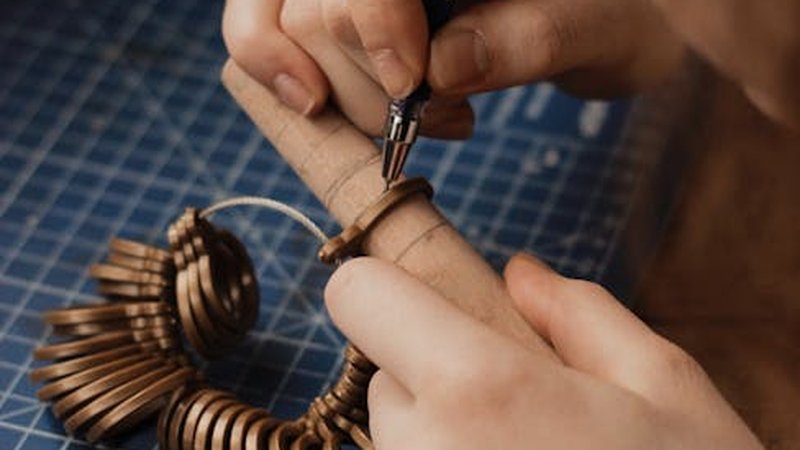
You can buy a set of plastic ring gauges on Amazon for about $2-3. They look like a keychain with a bunch of plastic rings in different sizes. You just try them on until you find the one that fits. Dead simple.
There are also the belt-style ring sizers — a plastic strip with sizes printed on it that you wrap around your finger like a zip tie. These work well too, though I slightly prefer the individual gauges because you can really feel the difference between sizes.
Free Options
Many jewelry stores will give you a free ring sizer if you ask nicely. Some online jewelers will mail you one for free when you create an account or sign up for their newsletter. Blue Nile, James Allen, and a bunch of others do this. It's worth checking before you buy anything.
You can also print a paper ring sizer from home — most jewelry websites offer a free printable PDF. Just make sure you print it at 100% scale (not "fit to page") and verify with a credit card or a coin that the scale is correct before using it.
When Is the Best Time to Measure Your Ring Size?
This is something most guides don't mention, and it matters more than you'd think.
Your fingers change size throughout the day and throughout the year. Here's what you need to know:
Measure in the evening. Your fingers tend to be at their largest in the late afternoon and evening. First thing in the morning, they're slightly smaller because you haven't been active and your circulation is still warming up. If you measure in the morning and buy based on that, the ring might be tight by dinner time.
Make sure your hands are warm. Cold fingers are smaller fingers. If you've just come in from the cold — or if your room is air-conditioned to Arctic temperatures — wait until your fingers have warmed up. Cold constricts blood vessels, and your finger measurement will be smaller than normal.
Don't measure right after exercise. Working out increases blood flow and can temporarily swell your fingers. Wait at least an hour after a workout.
Don't measure when you're pregnant, on your period, or after eating a lot of salty food. All of these can cause temporary finger swelling that doesn't represent your normal size.
The ideal measuring conditions: room temperature, evening time, relaxed hands, normal day. That gives you the most accurate baseline.
International Ring Size Conversion Chart
Ring sizes are like shoe sizes — every country has its own system, and none of them line up neatly. Here's a quick reference for the most common sizing systems:
US Size 4 = UK/AU Size H½ = EU Size 47 = Japan Size 7 = 14.9mm diameter
US Size 5 = UK/AU Size J½ = EU Size 49 = Japan Size 9 = 15.7mm diameter
US Size 6 = UK/AU Size L½ = EU Size 52 = Japan Size 11 = 16.5mm diameter
US Size 7 = UK/AU Size N½ = EU Size 54 = Japan Size 14 = 17.3mm diameter
US Size 8 = UK/AU Size P½ = EU Size 57 = Japan Size 16 = 18.2mm diameter
US Size 9 = UK/AU Size R½ = EU Size 59 = Japan Size 18 = 19.0mm diameter
US Size 10 = UK/AU Size T½ = EU Size 62 = Japan Size 20 = 19.8mm diameter
If you're buying from an international seller, always double-check which sizing system they use. A "size 6" means very different things depending on whether you're in the US, UK, or EU.
Your Finger Size Changes More Than You Think
A lot of people assume their ring size is fixed — like their height or their shoe size. It's not. Your fingers can and do change size over time, and being aware of this can save you from sizing headaches.
Pregnancy is the big one. Many women find their ring size increases by half to a full size during pregnancy due to fluid retention and increased blood volume. Sometimes it stays that way permanently, sometimes it goes back. If you're shopping for a ring during pregnancy, consider sizing up or buying a resizable design.
Weight changes affect your fingers just like they affect everything else. Gain weight and your fingers might go up a quarter to half a size. Lose weight and they might shrink.
Temperature and humidity cause temporary fluctuations. Summer heat makes fingers swell; winter cold makes them shrink. This is why summer rings sometimes feel tight and winter rings sometimes spin.
Age plays a role too. As we get older, our joints can change, and some people find their knuckles get slightly larger while the base of their finger stays the same. This can make rings harder to get on and off even if the base size hasn't changed much.
Smart Ring Buying Tips
After my ring sizing mishap, I picked up a few tricks from jewelers and from my own trial and error.
When in doubt, size up. It's almost always better to be slightly too big than slightly too small. A ring that's a quarter size too big can be snugged up with a ring adjuster (those little silicone inserts that cost like $5). A ring that's too small needs professional resizing or a return. Go bigger.
Wide bands need a bigger size. If you're buying a ring that's more than 4-5mm wide, go up at least a quarter to half a size. Wide rings take up more space on your finger and fit tighter than narrow ones at the same size. A size 6 thin band might feel fine, but a size 6 wide band could feel like a tourniquet.
Consider stacking. If you're going to wear multiple rings on the same finger, the combined width matters. Each additional ring adds to the squeeze. You might need to go up a quarter size for every extra ring you plan to stack.
Knuckle size vs. base size. If your knuckles are significantly larger than the base of your finger (common with arthritis or just genetics), you need a ring that's big enough to slide over the knuckle but not so big that it spins at the base. This is tricky — you might need a hinged ring or a spring-loaded design.
Buy from places with free returns and exchanges. Even with careful measuring, sometimes you still get it wrong. Knowing you can exchange without paying shipping makes the whole process way less stressful.
What If the Ring Doesn't Fit?
So you measured carefully, ordered the right size, and it still doesn't fit. It happens. Here's what you can do.
Ring resizing is the most common solution. Most jewelry stores offer this service, and it's more affordable than you might think. Making a ring larger typically costs $20-50, and making it smaller costs about the same. It usually takes a few days to a week.
Good news: making a ring bigger is generally easier and less risky than making it smaller. When you size down, the jeweler has to cut the band, remove a section, and solder it back together. When you size up, they can often just stretch the band slightly (for small adjustments) or add a small piece of metal. Less cutting means less stress on the ring.
Exceptions: Not all rings can be resized. Eternity bands (stones all the way around), tungsten carbide rings, ceramic rings, and some titanium rings can't be resized. If you're buying one of these, sizing is extra critical.
Ring adjusters are a great temporary fix. Those little silicone ring guards slip inside the band and make the ring fit tighter. They're cheap, invisible from the outside, and you can remove them anytime. Perfect if your ring is slightly too big but you don't want to deal with resizing.
Ring sizing beads are a more permanent solution for loose rings. A jeweler solders two tiny metal beads inside the band that grip your finger and prevent spinning. Costs about $20-30 and can be removed later if needed.
Bottom Line
Take the five minutes. Measure your finger. Use one of the three methods above (preferably method 1 if you have a ring that fits, or method 3 if you want to be really precise). Measure at the right time of day, under the right conditions. And when you order, go slightly bigger if you're between sizes.
I learned this the slow and annoying way. You don't have to. Happy ring shopping.

Comments