How to Test if a Crystal Is Real at Home
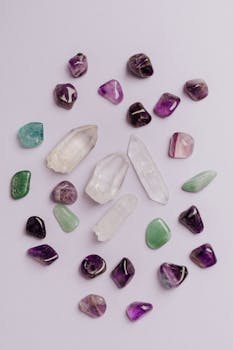
The crystal market is flooded with fakes. Glass, plastic, and lab-grown stones get sold as natural crystals at craft fairs, online marketplaces, and sometimes even in shops that should know better. I've bought my share of imposters — a "citrine" that was actually heat-treated amethyst (technically real, but misleadingly labeled), a "turquoise" that was dyed howlite, and a chunk of green glass someone insisted was emerald. After years of collecting and getting burned, I've developed a testing workflow that uses nothing more than what's already in most homes. No gemological equipment needed.
One important caveat upfront: no single test is definitive on its own. Run several tests and look at the pattern of results. A genuine crystal will pass most of them. A fake will fail most of them. The few ambiguous cases are where experience matters.
Temperature test — the simplest starting point
Hold the stone in your closed hand for 30 seconds, then set it down and pick up a piece of glass or ceramic you know is genuine (a drinking glass, a plate). Compare how they feel.
Natural crystals feel cold to the touch and take noticeably longer to warm up in your hand than glass does. This is because crystal has a different thermal conductivity than glass — it conducts heat away from your skin faster, so it feels colder and stays cold longer. Quartz, in particular, has a thermal conductivity roughly 2 to 3 times higher than window glass.
Plastic warms up almost instantly. If a "crystal" feels room-temperature or warm within 5 seconds of holding it, that's a red flag. Genuine crystals will still feel cool after 30 seconds in your palm.
This test works best in a room-temperature environment. If you just pulled the stone out of a hot car or a cold mailbox, wait until it reaches ambient temperature first. And it's a relative test — you need to compare it against something you know is real glass, not just go by feel alone.
Weight test — density doesn't lie
Pick up the stone and bounce it lightly in your hand. Does it feel heavier than you'd expect for its size? That's actually a good sign.
Most natural crystals are denser than glass. Quartz has a specific gravity of 2.65, while window glass sits around 2.4 to 2.5. That 6% to 10% difference is subtle but detectable with practice. A piece of quartz the size of a golf ball should feel noticeably heavier than a glass marble of the same size.
For a more precise test, use a kitchen scale. Weigh the stone dry, then weigh it suspended in water (tie it to a piece of thread and lower it into a glass of water without letting it touch the bottom). Divide the dry weight by the difference between dry and wet weights. That gives you the specific gravity. Quartz comes out around 2.65. Glass comes out around 2.4 to 2.5. Calcite is 2.7. Pyrite is 5.0. Garnet is 3.5 to 4.3. There are reference tables online for common crystal densities.
This water-displacement method is accurate enough to distinguish glass from most natural stones. It takes 2 minutes and costs nothing.
Scratch test — with caution
Quartz ranks 7 on the Mohs hardness scale. Window glass sits at about 5.5. A genuine quartz crystal will scratch glass — easily, visibly, with moderate pressure. If your "quartz" can't scratch a piece of scrap glass, it's almost certainly glass or a softer imitation.
Run the test on something disposable: an old bottle, a junk-store drinking glass, the back of a ceramic tile. Don't scratch your good glassware or your phone screen. Draw the stone across the surface with firm, even pressure. A real quartz crystal leaves a clear, distinct scratch line. Glass imposters will just slide across without marking the surface.
Here's where this gets tricky: some real crystals are softer than glass and will fail this test. Fluorite (Mohs 4), calcite (Mohs 3), and malachite (Mohs 3.5 to 4) won't scratch glass, but they're still real. So a "fail" on the scratch test doesn't automatically mean fake — it just means you need other tests to confirm.
Also, don't use the scratch test on stones you want to keep in good condition. It can leave a visible mark on softer crystals and damage polished surfaces. Use it as a last resort or on inexpensive pieces.
Light transmission test
Hold the stone up to a bright light source — a desk lamp, a flashlight, or direct sunlight. Look through it.
Genuine crystals have internal characteristics that are hard to fake convincingly. Natural quartz typically contains tiny inclusions: wispy veils, microscopic mineral specks, irregular growth lines, or slightly cloudy zones. These imperfections are actually proof of authenticity. No two natural crystals have identical internal patterns.
Glass, on the other hand, is either perfectly clear (too perfect — suspicious) or contains spherical air bubbles. If you see round bubbles inside the stone, especially multiple uniform ones, you're almost certainly looking at glass. Natural inclusions in crystals are irregular, angular, and never perfectly round.
Some high-quality glass fakes are made with controlled inclusions to mimic natural stones, but they usually overdo it or get the patterns wrong. Real mineral inclusions follow crystalline growth patterns — they look like frozen frost or tiny geometric shapes, not random specks.
For opaque stones (like turquoise, malachite, or lapis lazuli), the light test is less useful. Instead, check the edges where light hits the surface at an angle — natural stones show depth and layering in their color, while dyed imitations often look like the color is painted on the surface.
Magnification — get a loupe
A 10x jeweler's loupe costs about $5 to $10 online and is the single most useful tool for crystal identification. With 10x magnification, you can see details invisible to the naked eye.
Under magnification, look for:
Surface texture: Natural crystals have microscopic surface irregularities even when polished. Glass fakes often show mold seam lines or injection point marks from manufacturing.
Internal structure: Real crystals show growth zoning (subtle color banding from trace minerals during formation), cleavage planes, and natural fracture patterns. Glass shows conchoidal fractures (smooth, curved break patterns) that look different from crystal fractures.
Gas bubbles: Round, perfectly spherical bubbles are a glass giveaway. They're sometimes visible to the naked eye in cheap fakes, but a loupe reveals even tiny ones.
Surface scratches: If the stone is supposed to be quartz (Mohs 7) but shows scratches from normal handling, something is wrong. Glass scratches much more easily.
Friction test — for amber specifically
Amber is one of the most commonly faked crystals. Real amber is fossilized tree resin, and it has a distinctive property: rubbing it vigorously with a soft cloth produces a faint pine or resinous smell. This works because amber contains succinic acid and other organic compounds that release odor when warmed by friction.
Plastic and copal (young, immature amber) don't produce this smell. If your amber is odorless when rubbed, be suspicious. Some high-quality copal fakes might have a slight resin smell, but it's different from the warm, woody scent of genuine Baltic amber.
Also, real amber floats in saturated salt water (about 1 part salt to 2 parts water). Most plastics and glass sink. This is a quick supplementary test.
UV light test
A cheap UV flashlight ($5 to $8) reveals fluorescence in many natural stones. This isn't a definitive authenticity test (some real stones don't fluoresce), but it's a useful data point.
Fluorite is the classic example — it glows vivid blue, green, or purple under UV light, sometimes in multiple colors from different zones within the same specimen. Scheelite fluoresces bright blue-white. Some calcites fluoresce red or pink. Willemite glows green. Autunite glows bright yellow-green.
Most glass and plastic fakes are inert under UV light — they don't fluoresce at all. If a stone that's supposed to be fluorite doesn't glow under UV, that's a strong indication it's fake. Conversely, if a "ruby" glows under UV but real rubies from that source typically don't, something is off.
The UV test requires some reference knowledge — you need to know which stones are supposed to fluoresce and in what colors. A mineral identification guide or a quick web search covers the basics.
What about hardness testing on the stone itself?
Some guides recommend trying to scratch the stone with a steel knife (Mohs 5.5) or a copper penny (Mohs 3). I don't recommend this for pieces you care about. It leaves permanent damage and isn't necessary when you have several non-destructive tests available.
The scratch-on-glass test (testing whether the stone can scratch something else) is much less destructive than trying to scratch the stone itself. Reserve direct hardness testing for rough specimens you don't mind marking up.
Putting it all together
No single home test guarantees a correct identification. But running 4 to 5 of these tests in combination gives you a reliable answer for most common crystals:
For clear stones sold as quartz: temperature test + light test + scratch test + magnification. If it's cold, has natural inclusions, scratches glass, and shows growth zoning under a loupe, it's almost certainly real quartz.
For colored stones: the light test is your best friend. Look for depth, layering, and natural color variation. Dyed stones look flat — the color sits on the surface rather than permeating the material.
For amber: friction smell + salt water float test + magnification for natural inclusions (tiny insect parts, plant debris, or air bubbles with irregular shapes).
When tests conflict — say, the stone feels cold but has round bubbles inside — trust the internal structure test. Bubble patterns are harder to fake than thermal properties. If you see round bubbles, it's probably glass regardless of how cold it feels.
The crystal market rewards skepticism. Prices that seem too good to be true usually are. A fist-sized piece of "natural amethyst" for $15 is almost certainly glass. Natural amethyst of that size from a reputable source runs $50 to $200 depending on color quality. Know the approximate market value of what you're buying, run your tests, and don't be afraid to walk away from a deal that doesn't feel right.

Comments