How to Style Statement Necklaces for Different Occasions
Why statement necklaces intimidate people
There's a specific moment most people have experienced: standing in front of a mirror with a bold necklace on, turning sideways, wondering if it's too much. The piece looks great on the display stand. On the mannequin in the window. On literally everyone else who seems to wear these things effortlessly. But on you, right now, it feels like it's wearing you instead of the other way around.
This isn't a confidence problem. It's a styling problem. Statement necklaces are genuinely harder to wear than almost any other jewelry category, and most of the advice out there makes it worse by treating them like a personality test rather than a design challenge. A statement necklace is just a large piece of jewelry with specific proportional requirements. Learn those requirements and the "too much" feeling mostly goes away.
Understanding necklace-to-outfit proportion
The single biggest factor in whether a statement necklace works is the relationship between the necklace and the neckline it sits against. This isn't subjective — it's geometry. A collar-length bib necklace (sitting 14-16 inches from the neck) needs a bare collarbone area to work. That means crew neck, boat neck, or off-shoulder tops. If you wear the same bib over a turtleneck, it floats awkwardly with a gap between the necklace and the fabric, breaking the visual unit.
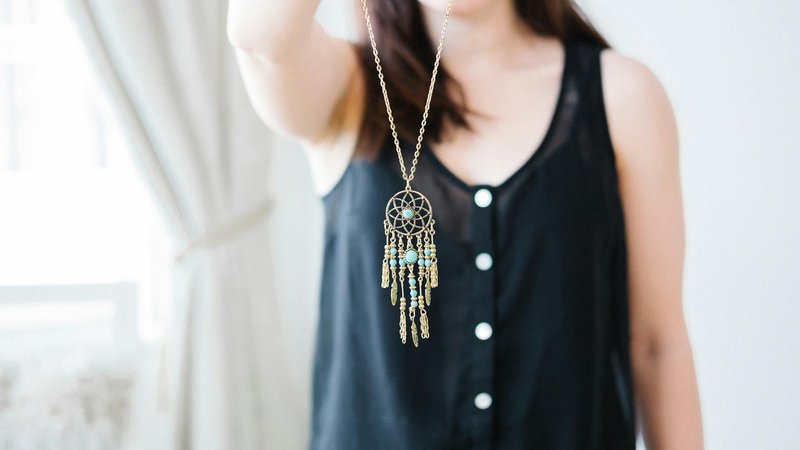
Conversely, a long pendant necklace (28-36 inches) works over high necklines because it drapes down onto the chest, creating a vertical line that complements the covered-up top half. Try that same long pendant with a deep V-neck and the pendant either gets lost in the skin space or competes with the neckline geometry.
The practical rule: match the necklace's coverage area to the fabric coverage area. High-coverage necklines (crew, mock neck, turtleneck) pair with long necklaces. Low-coverage necklines (V-neck, scoop, strapless) pair with shorter, wider necklaces that fill the exposed space. Mid-coverage (round neck, square neck) works with either, depending on whether you want the necklace or the neckline to be the focal point.
Workplace styling: visible but not distracting
The office is where statement necklaces get tricky because the line between "put-together" and "look at me" is narrow. The key distinction is complexity. A statement necklace with a single bold element — a large polished stone, a wide geometric bar, a chunky chain — reads as confident but professional. A statement necklace with multiple moving parts, dangling elements, or high-contrast color combinations reads as attention-seeking in a professional context.
Color is the other workplace consideration. Gold and silver are universally acceptable. A single colored stone in a muted tone (deep green, navy, burgundy) works in most office environments. Bright reds, neon accents, and multi-color pieces push into casual territory. This isn't about corporate conservatism — it's about visual noise. In a meeting where people are trying to focus on a presentation, a necklace that catches the light with every hand gesture becomes genuinely distracting.
The most reliable workplace statement necklace style is probably the chunky chain. It's been adopted widely in professional settings since around 2018, and it works because chains have a uniformity that doesn't compete with facial expressions or hand movements. A thick-link gold chain over a crisp white shirt has become something of a modern power-dressing staple, and it's versatile enough that the same piece transitions to evening wear without any changes.
Casual outfits: where you can actually have fun
Weekend styling is where statement necklaces repay the learning curve. With casual clothes — jeans, t-shirts, simple dresses — a bold necklace does most of the heavy lifting for an outfit. The classic t-shirt-and-jeans combination goes from "running errands" to "actually dressed" with the right necklace, and it takes about three seconds to add one.
The most effective casual pairing is a graphic-free solid-color tee with a contrasting necklace. White tee, gold bib necklace. Black tee, silver collar piece. Navy tee, turquoise pendant. The contrast between the plain fabric and the decorative jewelry creates visual interest without any effort. Where people go wrong is trying to match a statement necklace with a busy top — stripes, patterns, prints — which creates visual competition and makes both the shirt and the necklace look worse.
Sundresses and wrap dresses are the other natural pairing. A statement necklace with a simple sundress is essentially a complete outfit. The dress provides the canvas and the necklace provides the interest. The necklace should sit in the open area created by the neckline — if there's a V-neck, the necklace should fall within the V, not above or below it.
Formal events: scale and restraint
Formal styling with statement necklaces requires a counterintuitive shift: you need to choose either the necklace or the earrings as the hero piece, not both. A dramatic statement necklace with matching statement earrings creates a "jewelry face" where the accessories overwhelm the wearer. Pick one, keep the other minimal, and the overall effect is much more sophisticated.
For black-tie events, the necklace scale typically needs to increase. A small-medium statement piece that looks proportional in a restaurant will look underwhelming in a ballroom with high ceilings and formal attire. Larger stones, longer drops, and more substantial metalwork all work at this scale. The formal context provides enough "quiet" that a bigger necklace doesn't read as excessive — it reads as appropriate to the occasion.
One useful trick for formal styling: look at old photographs of women at formal events from the 1950s-1970s. The jewelry styling in those images is consistently well-proportioned because the conventions of the time were more rigid. A single large pendant on a thin chain, worn with a strapless gown. A choker-style piece with an evening dress. The combinations are limited but they work, and they still work now because the proportional logic hasn't changed.
Seasonal adjustments
Statement necklaces interact with seasons in ways that smaller jewelry doesn't. In summer, when skin is more exposed and clothing is lighter, bold necklaces have more visual impact because there's less competition from fabric. A chunky necklace over a tank top looks different from the same necklace over a winter sweater — and the summer version is usually the one that photographs better.
Winter styling requires a different approach because heavy knits and high necklines either hide the necklace entirely or force it to sit on top of the fabric in a way that looks awkward. The winter solution is either longer necklaces that drape over outer layers or smaller statement pieces that can be worn inside collars. Collar necklaces (sitting right at the base of the neck) actually work well with turtlenecks because they sit on the fabric edge rather than floating above it.
Color temperature shifts with seasons too. Warm metals (gold, rose gold, brass) tend to look more natural in spring and summer. Cool metals (silver, white gold, platinum) have a crispness that works well with winter's darker palette. This isn't a rule — mixing warm metals with winter outfits creates deliberate contrast — but it's a useful default when you're not trying to make a specific statement.
The neckline cheat sheet
For quick reference, here's how common necklines interact with statement necklace styles:
Crew neck: Best with princess-length (17-19 inch) necklaces that sit just below the collarbone. Bib styles work well. Avoid chokers that sit above the neckline.
V-neck: Pendant necklaces that fall within the V are ideal. The pendant tip should stop at or just above the V's lowest point. Chains without pendants also work if they follow the V angle.
Boat neck: Wide collar pieces and bibs that span the horizontal neckline. This is the best neckline for showing off a truly dramatic piece because the wide expanse of bare skin provides a clean frame.
Turtleneck: Long chains (28+ inches) or collar pieces that sit right at the top edge. Anything in between will either bunch up on the fabric or float awkwardly.
Strapless/sweetheart: Chokers and collar-length pieces that fill the space between the shoulders and chin. This is where the boldest, widest pieces look proportionally correct.
Off-shoulder: Similar to strapless — the bare shoulder creates a frame that supports wider pieces. A thin dainty necklace here will look lost.
Building a versatile statement collection
You don't need a dozen statement necklaces. Three well-chosen pieces cover virtually every occasion: one in gold (warm, works with most skin tones and casual wear), one in silver (cool, works with formal wear and winter outfits), and one with a colored element (a stone or enamel in a color you wear often). These three, combined with the proportional rules above, will handle 90% of situations where you'd want a statement piece.
The order matters. Start with the metal you wear most often. For most people, that's gold (in its various shades). Wear it until you know what size and shape works with your wardrobe, then buy the second metal. The colored piece comes last, and its color should be dictated by what you already own — if half your closet is blue, a blue-stone necklace will get more wear than a red one, regardless of which you prefer in theory.
Comments