How to Start a Crystal Collection Without Wasting Money
May 14, 2026
How to Start a Crystal Collection Without Wasting Money
Walk into any crystal shop and the sensory overload is immediate — towers, spheres, raw chunks, tumbled stones, jewelry, wands. Everything shimmers. Everything calls to you. And most of what catches your eye is overpriced, underwhelming, or both. I learned this the hard way so you do not have to.
Step One: Decide What You Actually Want
"I just like crystals" is a valid starting point, but it leads to buying random pieces that gather dust. Before spending a single dollar, answer three questions:
- Display or study? Are you building something beautiful to look at, or are you learning geology and mineralogy? Display collectors prioritize aesthetics. Study collectors prioritize labeled specimens with known provenance.
- What size? Thumbnail specimens (under 3cm) fit in display cabinets and cost less. Cabinet specimens (10cm+) make dramatic centerpieces but cost dramatically more and need dedicated space.
- What budget? A meaningful starter collection can begin at $30-50 total. A meaningful intermediate collection runs $200-500. Beyond that, you are in enthusiast territory where individual pieces cost more than your first collection did.
Write your answers down. Revisit them before every purchase. This sounds tedious. It saves real money.
The First Five Pieces
Instead of buying 20 cheap tumbled stones, invest in five specimens that teach you something different about minerals:
1. Clear Quartz Cluster ($5-15)
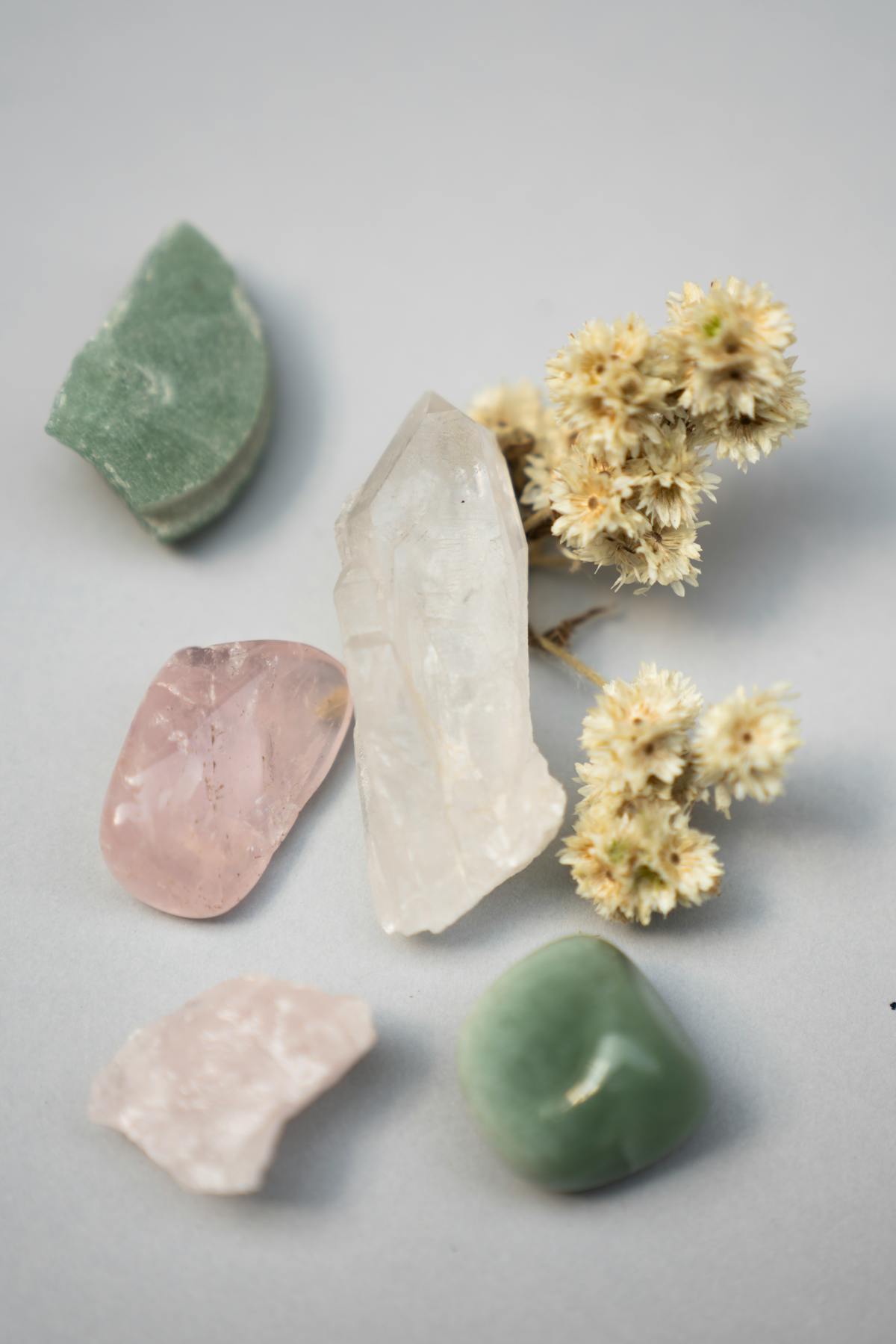
Quartz is the reference mineral. Once you know quartz well — its hexagonal habit, its conchoidal fracture, its weight — you have a baseline for comparing everything else. A small cluster shows crystal terminations, growth patterns, and inclusions better than any tumbled stone.
2. Polished Labradorite ($10-20)
Labradorite teaches you about optical phenomena in minerals. The flash (labradorescence) is caused by light interference in microscopic lamellae — twin planes in the feldspar structure. No other common mineral demonstrates this effect as dramatically. A good piece will show blue, green, and occasionally orange flash from multiple angles.
3. Raw Pyrite Cube ($8-15)
Pyrite demonstrates crystal habit — the characteristic shape a mineral grows into naturally. Those perfect cubes are not carved. They grow that way because of pyrite's isometric crystal system. Your non-collector friends will assume you bought a manufactured object. That conversation is worth the price alone.
4. Tumbled Malachite ($5-12)
Malachite introduces you to mineral banding and color zoning. The green rings are layers of copper carbonate deposited over time, each layer recording a slight change in growth conditions. It also teaches you about soft minerals (Mohs 3.5-4) and why they need different handling than quartz.
5. Amethyst Geode Slice ($10-25)
A geode slice shows crystallization in a cavity — how crystals grow inward from a shell. The outer layer is chalcedony (microcrystalline quartz), the inner crystals are amethyst (quartz colored by iron impurities and natural irradiation). One specimen, two mineral forms, and a geology lesson built in.
Total estimated cost: $38-87 for all five. These pieces give you hardness range (3.5-7), crystal systems (isometric, hexagonal, monoclinic), optical effects, growth patterns, and structural differences. You learn more from these five than from fifty random tumbled stones.
Where Not to Buy
The following are common traps for new collectors:
Tourist Trap Shops
Crystal shops in tourist areas mark everything up 200-400% above market rate. The specimens are usually low quality for the price. The labels are frequently wrong — "citrine" that is heat-treated amethyst, "emerald" that is green dyed quartz, "obsidian" that is manufactured glass.
Unlabeled Online Listings
If a listing does not specify the mine, country of origin, or at minimum the locality, assume it is either misidentified or the lowest grade available. Reputable dealers list provenance because it is a selling point. Omitting it is a red flag.
"Mystery Box" Deals
$20 for "10 mystery crystals" is $2 per stone. You will receive the cheapest, most common specimens the seller has in bulk — quartz, agate, howlite, maybe some dyed howlite pretending to be turquoise. You learn nothing. You overpay for what you get. Skip these entirely.
Where to Buy
Mineral Shows
The best value for new collectors. Dealers at shows compete with each other on price and quality. You can handle specimens before buying. You can ask questions directly. Entry fees are usually $5-15, and you make that back on your first purchase compared to retail prices.
Search "mineral show [your area]" or check the website of your local gem and mineral society. Most regions have at least one annual show.
Direct from Miners
Etsy and eBay host individual miners who sell their own finds. Look for shops with detailed locality information, clear photographs showing the actual specimen (not stock photos), and responsive communication. Prices are often 30-50% below retail because you skip the middleman markup.
Reputable Online Dealers
Established mineral dealers with physical storefronts and long track records. They cost more than miners but less than retail shops. The specimens come correctly identified with locality data. If you later decide to sell or trade, provenanced specimens hold value; unprovenanced ones do not.
Red Flags That Save You From Fakes
Color That Looks Too Perfect
Natural minerals show variation. If every piece in a batch has identical color saturation, it is almost certainly treated or dyed. Natural citrine is pale yellow to smoky amber, not bright orange. Natural malachite has varied band patterns, not uniform repeating stripes.
"Crystal" That Has No Crystal Structure
If something is sold as a crystal but shows no crystal faces, growth lines, terminations, or any evidence of natural crystal formation — it might be glass. Molded glass is shaped in molds and lacks the internal structural features of real minerals. A 10x loupe reveals the difference immediately.
Price That Defies Geology
Genuine emerald, ruby, sapphire, and alexandrite are expensive because they are rare. If someone offers you a "natural emerald" for $5, it is either glass, beryl of a non-emerald variety, or so heavily treated it barely qualifies. The price should raise suspicion, not excitement.
Essential Tools (Under $30 Total)
You do not need expensive equipment, but four inexpensive tools dramatically improve your collecting experience:
- 10x jeweler's loupe ($8-15) — reveals crystal structure, inclusions, and surface features invisible to the naked eye. The single most useful tool in any collection.
- Microfiber cloths ($3-5 for a pack) — for cleaning display specimens without scratching. Paper towels contain wood fibers that can scratch softer minerals.
- Gem scale ($10-15) — measures to 0.01g. Essential for tracking your collection and identifying materials by specific gravity.
- Notebook or spreadsheet app (free) — record what you bought, where, when, and for how much. Future you will be grateful.
The Labeling Habit
Start labeling immediately. Write the mineral name, variety, locality, and purchase date on a small card that stays with each specimen. This takes seconds per piece and prevents the "what is this again?" problem that plagues every collection after it grows past about 20 pieces.
If you buy from a dealer who provides labels, keep those labels with the specimen. Original dealer labels add provenance and value.
Storage Basics
How you store your collection matters as much as what is in it:
- Separate by hardness. Store hard stones (6+ Mohs) together and soft stones (below 5) together. Mixed storage causes scratches.
- Individual compartments. Specimen boxes with divided compartments prevent pieces from knocking against each other.
- Away from windows for light-sensitive minerals. Amethyst, citrine, rose quartz, kunzite, and hiddenite fade under prolonged UV.
- Stable humidity for water-sensitive minerals. Pyrite, marcasite, and halite degrade in humid conditions.
A plastic tackle box or hardware organizer with foam-lined compartments works perfectly for starter collections. No need for museum-grade cabinetry.
Building Beyond the Basics
Once you have your first five pieces and understand what you gravitate toward, expand with intention:
- By mineral species: Try to collect one example of each major mineral group — silicates, carbonates, sulfides, oxides, native elements. This gives you a systematic understanding of mineral diversity.
- By locality: Focus on minerals from one region or country. Each locality has a characteristic suite of minerals that reflects its specific geological history.
- By crystal system: Collect examples of all seven crystal systems (cubic, tetragonal, orthorhombic, hexagonal, trigonal, monoclinic, triclinic). This teaches crystallography through direct observation.
- By phenomenon: Fluorescence, chatoyancy, asterism, play of color, labradorescence — collect specimens that demonstrate each optical effect.
Any of these approaches produces a coherent, educational collection. Buying randomly produces a pile of rocks.
The Patience Principle
The best collectors share one trait: they wait. That specimen you want will appear again, probably at a better price, in better condition. Rushing to fill gaps in your collection leads to overpaying for mediocre specimens.
Set a per-piece budget and stick to it. If something exceeds your budget, note it and move on. The right specimen at the right price is always coming, usually sooner than you expect.
Your collection will outlast trends, fads, and whatever the current "must-have" mineral happens to be. Build it with care and it rewards you for decades.
Comments