How to Start a Jewelry Business from Home
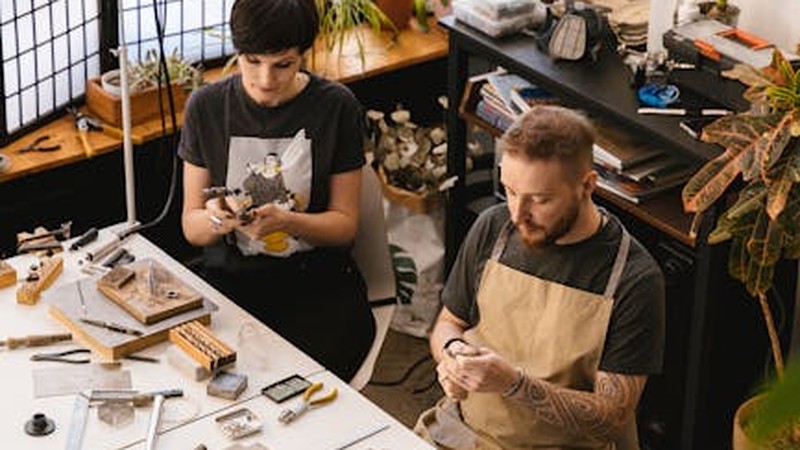
The first necklace I ever made was a birthday gift for my mom. Simple freshwater pearls on silk thread, knotted between each pearl. It took three attempts to get the tension right, and the finished piece had one crooked pearl and a backward-facing clasp. My mom cried when she opened it — not because it was flawless, but because I'd spent five hours making something with my hands just for her.
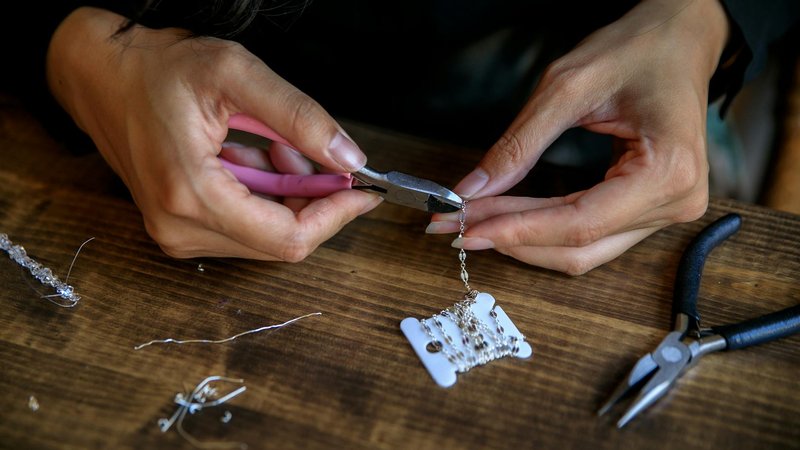
I didn't think about selling anything until eight months later, when a coworker noticed my wire wrapped earrings and asked if I had an online shop. I said no, because the idea felt presumptuous — who'd pay for something I made at my kitchen table? She asked again the following week. And the week after. On the fourth time, I mumbled "thinking about it" and went home with a strange flutter in my chest.
Within three months I had an Etsy shop with 30 listings. Within six, I'd done my first craft fair and made $420 in a day. Within a year, jewelry income surpassed my part-time retail job. I'm not selling you a dream — I'm telling you what's possible and what it actually takes.
Step One: Figure Out What You're Selling
Before opening a shop, registering a business, or ordering packaging, answer one question: what do you make, and who is it for?
I spent my first three months making a little of everything — wire pendants one week, beaded bracelets the next, resin earrings after that. My Etsy shop looked like a craft store clearance bin, and my sales reflected it: maybe one order every two weeks, always the cheapest item.
Then I narrowed my focus to minimalist, everyday-wear jewelry for professional women. Gold-filled ear studs, delicate chain necklaces, simple stacking rings. Sales tripled within three months — not because I got better, but because my shop became recognizable. People knew what to expect from me.
Defining Your Niche
Ask yourself three things. What materials do you genuinely enjoy working with — not what's trendy, but what you reach for when nobody's watching? Who would wear your favorite pieces — a specific person with an age, style, and budget? And what price range fits both your costs and that customer's expectations? If you're working with sterling silver and genuine gemstones, you're in a different market than someone using copper and glass beads. Both are valid, but you can't serve both simultaneously.
The Legal and Tax Stuff
Business Registration
In most US states, you can operate as a sole proprietor without filing anything — your Social Security number serves as your tax ID, and you report income on Schedule C. This works fine while testing the waters. Once you're consistently earning $500+ monthly, consider an LLC. It costs $100-300 depending on your state and creates a legal wall between your personal assets and business liabilities. If someone claims an allergic reaction to a piece you sold and decides to sue, an LLC protects your bank account, your car, your home. File articles of organization with your state and get a free EIN from the IRS online — the whole process takes maybe an hour.
Sales Tax
After the 2018 South Dakota v. Wayfair ruling, you may need to collect sales tax in states where you've hit economic nexus thresholds — certain sales volumes or transaction counts — even if you've never been there. Rather than tracking this manually (which will make you want to scream), use TaxJar or Avalara at $20-50/month. They calculate, collect, and remit automatically. After a year of doing it myself with spreadsheets, subscribing to TaxJar saved me 10 hours monthly and eliminated constant compliance anxiety.
Insurance
General liability insurance runs $30-60/month for a home-based jewelry business. It covers injury claims, lost packages, and craft fair mishaps. Some market organizers require proof of insurance. I did three fairs without it and felt physically ill the entire time someone wore one of my rings near my table. Not worth the stress.
Product Photography That Sells
Lighting Is Everything
Natural window light is your best friend. Set up near a large window during morning or late afternoon — not midday direct sun, which creates harsh shadows. Overcast days are ideal because clouds diffuse light naturally. Never use overhead room lighting or your phone's flash. Both make silver look gold and everything look flat. No good window? A $20 ring light or two $8 LED desk lights aimed at a white surface works fine.
Backgrounds
A white foam board ($2) is the standard e-commerce background. For warmth, try marble-patterned contact paper, raw wood, or neutral linen fabric. Avoid busy backgrounds — your jewelry is the star. Include a coin or ruler in at least one shot per listing. This reduced my "it's smaller than I expected" returns by roughly 80%.
Worn Shots
Photos of jewelry on a real person consistently outperform product-only shots. You don't need a professional model — a friend with nice hands or a simple collarbone shot works. The goal is showing customers how the piece looks on an actual human body at real scale.
Where to Sell
Etsy
Ninety million active buyers, $0.20 per listing (renewed every four months), plus 6.5% transaction fee and 3% + $0.25 payment processing. The upside: built-in traffic from people specifically looking for handmade jewelry. The downside: 7 million sellers including dropshippers. Standing out requires excellent photography, SEO-optimized descriptions, and ideally 50+ listings before you launch. My Etsy shop brings in 60-70% of my total revenue.
Instagram builds your brand and community. Reels showing your process — wire wrapping, beading, polishing — perform dramatically better than static product photos. Post 3-5 times weekly and engage genuinely with your niche. The biggest mistake: treating Instagram like a catalog. People follow makers for the making, not just the result.
Local Craft Fairs
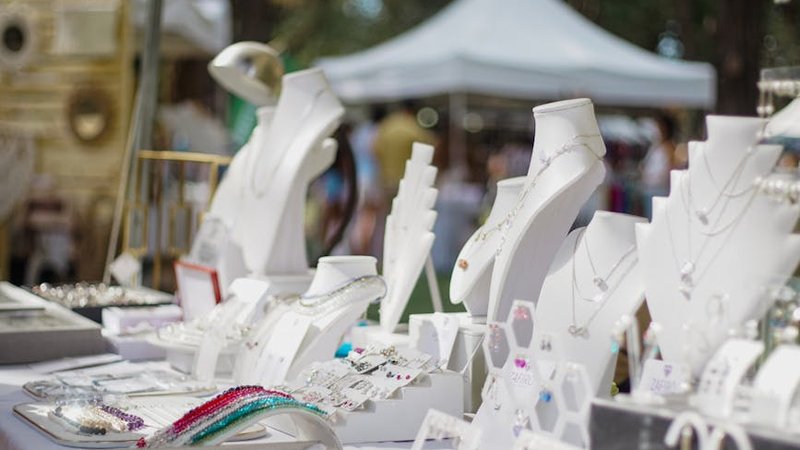
In-person selling is underrated. Watching someone try on your earrings and decide to buy in that moment — no online photo replicates that. Booth fees run $50-150 per day; I average $300-500 in sales at well-attended markets. Bring a mirror (non-negotiable), business cards, and a Square reader for card payments.
Your Own Website
Shopify ($39/month), WooCommerce (free plugin + $5-20 hosting), or Squarespace ($26/month). Your site won't match Etsy traffic initially, but it's a long-term asset where every customer belongs to you — no algorithm changes, no fee increases, no dropshippers burying your listings. Think of it as a slow-building investment that compounds annually.
Pricing Without Undervaluing Yourself
My first ring — four hours of work, $6 in materials — sold for $15. After materials, packaging, and Etsy fees, I made about $2.50. I was paying myself 63 cents an hour.
Here's the formula that saved my business: (Materials + Hourly Wage × Hours) × 2 = Wholesale. Multiply by 2 again for retail. So ($6 + $20 × 4) × 2 = $172 wholesale, $344 retail. I'm not saying charge $344 for a beginner ring — but the math reveals how badly you're undervaluing your time. Most handmade jewelry from skilled makers sells at $30-150 for earrings and necklaces, $50-300 for rings and pendants. If your prices are consistently under $20, you're either using inexpensive materials (valid market segment) or not accounting for your time (will burn you out).
Packaging: The $1.50 Investment That Tripled My Repeat Rate
My first year, I shipped in plain plastic bags inside a plain mailer. Functional, cheap, forgettable. Then I switched to kraft paper boxes with tissue paper, a handwritten thank-you card, and a tiny polishing cloth. Total cost: about $1.50 per order. Within two months, repeat purchases jumped from 12% to 35%. Reviews shifted from "nice earrings" to "the packaging was so thoughtful, I felt like I was receiving a gift."
You don't need foil-stamped custom boxes on day one. A small logo (free on Canva), consistent colors, and a handwritten note transform unboxing from "I bought a thing" to "I had an experience." That emotional response is what turns one-time buyers into repeat customers who tell their friends.
What to Expect Your First Three Months
Your first three months will probably feel like shouting into an empty room. Photos with 12 likes. Etsy listings that get zero views for weeks. A craft fair where the vendor next to you sells out while you sell two things. This is normal. It means nobody knows you exist yet.
Month one: build inventory, photograph properly, set up your shop, post consistently even if it feels pointless. Month two: engage with your community — comment on other makers' posts, join jewelry Facebook groups, participate in Instagram challenges. Month three: apply to your first craft fair, run a small giveaway. Most home jewelry businesses don't turn profitable until month four to six. If nothing's happening by month six, diagnose honestly: is it a visibility problem (people can't find you), a product problem (they find you but don't buy), or a pricing problem (they want to buy but the numbers don't work)? Each has a different solution.
Full-Time vs. Side Hustle
I ran my business as a side hustle for 18 months before going full-time — the right call. You need those months to build inventory, understand real costs, develop a customer base, and prove this can support you. Going full-time before consistent sales exist is a recipe for financial stress, and stress kills creativity faster than anything.
While keeping your day job, protect your making time. I used to squeeze work into random gaps — 20 minutes before dinner, an hour after bedtime. Exhausting and unproductive. Eventually I blocked Tuesday and Thursday evenings (7-10 PM) and Saturday mornings (8 AM-noon). That 10 dedicated weekly hours produced more than the scattered 10 hours before, because I wasn't constantly losing my train of thought.
When you go full-time, expect adjustment. Working from home sounds dreamy until you haven't left the house in four days and your cat is giving you concerned looks. Set a schedule, take real lunch breaks, maintain routine. Plan for roughly 30% making, 30% marketing and social media, 20% photography and listing management, 20% admin and customer service. The jewelry-making is the fun part — everything else takes way more time than beginners expect.
Starting a jewelry business from home isn't glamorous at first. It's wire ends on the kitchen table, photos that don't capture how pretty the piece actually is, and orders that take forever to come. But every established maker I know went through exactly this phase. The ones who succeeded weren't more talented — they were more consistent. They kept making, kept listing, kept showing up, and eventually the momentum shifted. It will for you too.
Comments