How to start a crystal business with under $500
Let's talk real numbers
I see a lot of guides that say you can start a crystal business with $50. That is technically true if you buy three tumbled stones at a gem show and list them on Instagram. But a real business — one that has a chance of actually covering rent and groceries — takes more than that. $500 is not a lot of money, but it is enough to buy a decent first batch of inventory, set up basic branding, and start selling online. I have seen people do it with less. I have also seen people blow $2,000 and have nothing to show for it. The difference is usually planning.
This guide is for someone who has a full-time job (or school) and wants to build a crystal business on the side. Not a hobby that occasionally makes money. An actual small business with a path toward profit.
Where your $500 goes (breakdown)
Here is a realistic allocation. I am not pulling these numbers from thin air — this is based on what I have seen work for small crystal sellers who started with limited budgets between 2023 and 2026.
Inventory: $250–300. This is your biggest expense. Buy wholesale. Not retail. There is a massive difference. A piece of amethyst you pay $12 for at a retail shop might cost $3–4 wholesale. I will cover where to source later in this article.
Photography setup: $30–50. Your phone camera is fine. You do not need a DSLR. But you do need a light source. A small ring light or a foldable light box makes an enormous difference. Crystals are shiny and reflective — bad lighting makes even beautiful pieces look dull and cheap.
Packaging: $50–80. Boxes, tissue paper, bubble wrap, thank-you cards. Presentation matters more than most new sellers think. Someone receiving a crystal wrapped in a plastic bag from a grocery store will not order from you again. Someone who opens a small kraft box with tissue paper and a handwritten card? They are posting that on their story.
Platform fees and tools: $30–50. Etsy listing fees, a Canva subscription for graphics, maybe a basic Shopify trial if you go that route. Keep this lean at the start.
Marketing / samples: $40–60. You might send a few pieces to micro-influencers. Or run a small Instagram ad campaign. This is optional in month one but worth budgeting for.
That puts you around $400–540. Tight, but workable. If you are closer to $400, skip the ad spend and focus entirely on organic growth for the first month.
Sourcing crystals on a budget
This is where most beginners lose money. They buy from retail suppliers or middlemen who are marking up 300%. You need to go closer to the source.
Gem and mineral shows
This is still the best option for small buyers in 2026. Shows like the Tucson Gem and Mineral Show (February every year) or smaller regional shows let you buy directly from importers and miners. You can negotiate. You can see the quality in person. And you can often get bulk pricing on smaller lots.
If you cannot get to Tucson, check for gem and mineral shows in your region. There are dozens across the US, Europe, and Asia every year. Entry is usually $5–15. Bring cash — many vendors prefer it, and some will give you a better price for cash purchases.
Wholesale websites
Alibaba is the obvious one, but the minimum order quantities can be a problem for a $500 budget. Some suppliers will do $100–200 minimum orders, though. Look for suppliers with at least 50+ orders and 95%+ positive ratings. Request samples before committing to a larger order.
Other options include Fire Mountain Gems (good for smaller quantities, based in the US), Rio Grande (more jewelry-focused but has loose stones), and various Facebook wholesale groups. The Facebook groups can be hit or miss, but I have found legitimate suppliers there — you just have to vet carefully.
Local rock shops (the flip strategy)
Not every local shop, but some. There are rock shops that overprice common stones simply because they are the only option in town. If you know your prices, you can sometimes find pieces at these shops that you can resell at a markup online — especially if you take better photos and write better descriptions than they do. This is more of a side strategy, not your primary sourcing method.
Picking your first product line
Do not try to sell everything. $500 buys you maybe 30–60 pieces, depending on what you choose. You want those pieces to tell a coherent story.
Here are three product angles that work well for new sellers on a tight budget:
1. Tumbled stone sets. Buy tumbled stones in bulk (you can get them for $0.50–2 each wholesale) and sell them in themed sets of 5–7. "Chakra set," "stress relief set," "dream set." You buy the stones for $5–10 per set and sell for $18–28. That is a decent margin, and sets sell better than individual stones because they feel like a gift.
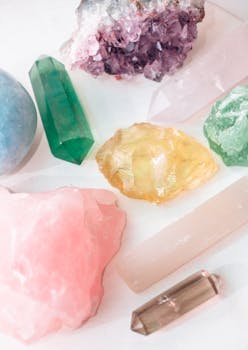
2. Raw crystal specimens in a specific niche. Pick one type — amethyst clusters, rose quartz chunks, citrine points. Become known for that. People who buy crystals tend to buy from specialists, not general stores. "The amethyst person" gets more repeat business than "the crystal store that sells a bit of everything."
3. Wire-wrapped pendants. If you are willing to learn basic wire wrapping (there are hundreds of free tutorials on YouTube), you can buy small tumbled stones for $1–3 each and turn them into $25–40 pendants. Copper wire is cheap. The value add is your labor and design. This has the best margin of any beginner-friendly crystal product I know of.
Setting up shop: Etsy vs Instagram vs your own site
For a $500 budget, I would start on Etsy. Here is why: Etsy already has buyers who are searching for crystals. You do not have to drive all your own traffic. The fees sting (6.5% transaction fee plus $0.20 per listing plus payment processing), but the built-in audience compensates for that when you are starting from zero.
Instagram is essential but not sufficient on its own. Use it for building an audience and driving people to your Etsy shop. Post consistently — three to five times per week minimum. Show your crystals in good lighting. Show yourself packaging orders. Show the sourcing process. People buy from people they feel connected to, especially in the crystal space.
A standalone website (Shopify, Squarespace, WooCommerce) is something to think about after you have proven the concept on Etsy. You will have more control and lower per-transaction fees, but you will also need to bring all your own traffic. That is hard and expensive. Wait until you have some revenue and a social media following before making the jump.
Pricing: the math that kills most beginners
The single biggest mistake new crystal sellers make is pricing too low. They look at what big retailers charge and undercut them by 40%, thinking that is how you win customers. It is not. You just attract bargain hunters who will never pay full price and will leave bad reviews over minor flaws.
Your price needs to cover: cost of goods, packaging, platform fees, shipping, and a reasonable profit margin. For most crystal products, that means a 2.5x to 4x markup on your wholesale cost. If a piece costs you $5, sell it for $15–20, not $8.
Yes, some people will complain about crystal prices being "too high." Let them. Those people were never going to be your customers anyway. Your actual customers are people who appreciate quality and are willing to pay for it.
The legal stuff nobody mentions
You need a business license. Requirements vary by state and country, but in most US states, you can register a sole proprietorship for free or under $50. Do this before you start selling. It protects you legally and lets you buy from wholesalers who require a tax ID or reseller permit.
You also need to understand your tax obligations. In the US, you will owe income tax on your profit and sales tax in states where you have nexus. If you are selling on Etsy, they handle sales tax collection for most states, but you still need to report your income.
Insurance is worth considering once you start shipping regularly. USPS covers up to $100 on priority mail, but if you are shipping a $200 amethyst cathedral, you want additional coverage. USPS insurance is cheap — around $2–3 per $100 of coverage.
Your first 30 days: a practical timeline
Week 1: Research and buy inventory. Visit a gem show if you can, or place a wholesale order online. Set up your Etsy shop (profile, banner, policies). Create your Instagram account and post your first 3–5 photos.
Week 2: Inventory arrives. Photograph everything. Write descriptions. List your first 10–15 items on Etsy. Post on Instagram daily — behind-the-scenes content works well here.
Week 3: Keep posting. Engage with other crystal accounts on Instagram (leave genuine comments, not emoji spam). Consider sending 2–3 small pieces to micro-influencers (under 5,000 followers) in exchange for a shoutout.
Week 4: Evaluate. Which items are getting views? Which are getting saves? Adjust your photography and descriptions based on what is working. If you have made a few sales, ask those customers for reviews — Etsy reviews are gold for a new shop.
Scaling beyond $500
Once you have made your first $300–500 in revenue, reinvest it. Buy more inventory. Upgrade your packaging. Try a small Instagram ad ($20–30 can reach a few thousand people if your targeting is right).
By month three or four, you should have a sense of what sells and what does not. Double down on your bestsellers. Cut the slow movers. Start building an email list — even a simple Google Form where people can sign up for "new drops and exclusive pieces" works at the beginning.
The crystal market is crowded. No question about it. But it is also growing — the global crystal and gemstone market was valued at roughly $2.8 billion in 2024 and is projected to keep expanding through 2030. There is room for small, focused sellers who do things differently. Better photos, better descriptions, better customer experience. That is how you compete, and it does not require a big budget. It requires attention to detail and consistency.
Starting with $500 is not glamorous. You will make mistakes. Some of your inventory will not sell. You will spend an embarrassing amount of time trying to get the right photo angle on a piece of rose quartz. That is normal. The sellers who make it are the ones who keep showing up, keep learning, and keep reinvesting what they earn. $500 is enough to start. Whether it is enough to succeed depends entirely on what you do next.

Comments