Stainless Steel vs Gold Filled vs Solid Gold
May 16, 2026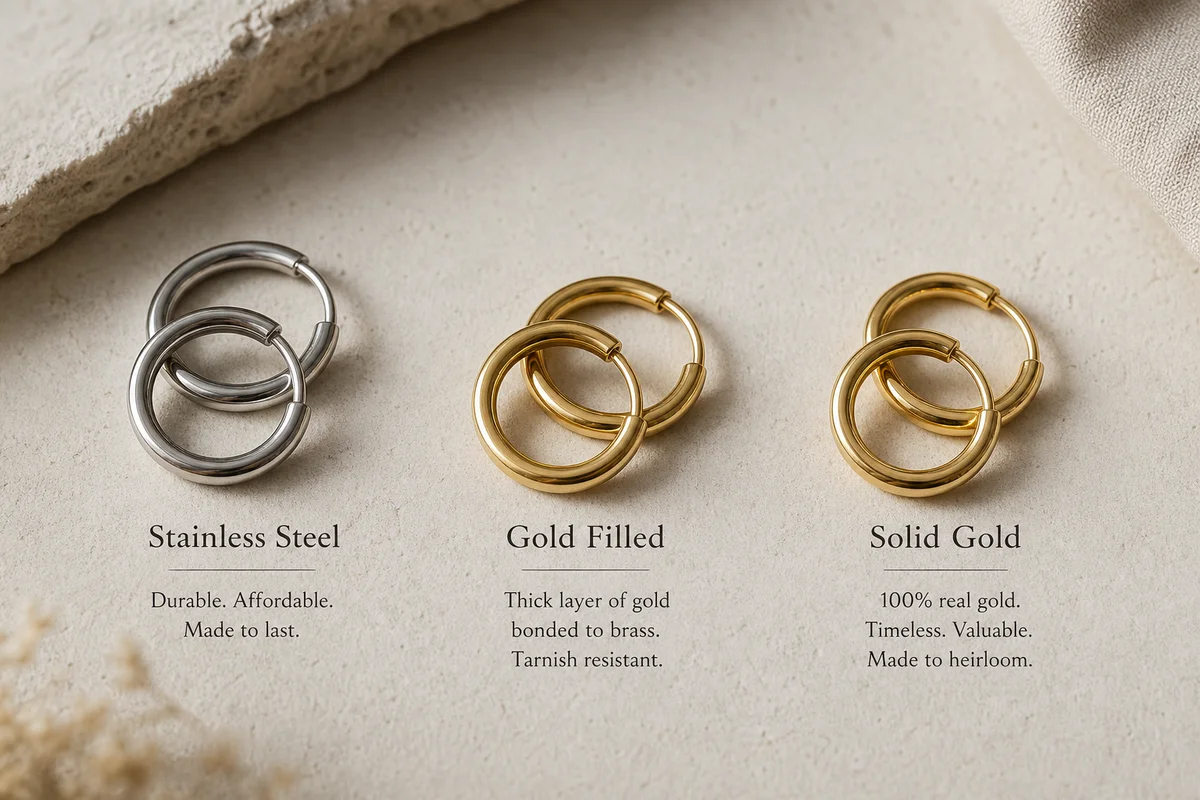
I Made the Same Bracelet Three Times. Here's Why.
I make jewelry for a living. Not the kind you see in department stores behind glass cases — I mean handmade pieces that people actually wear every day. And the question I get more than any other, at every craft show and in every DM, is some version of: "Which metal should I choose?"
Most of the time, people are deciding between stainless steel, gold filled, and solid gold. And honestly, I got tired of giving the same theoretical answer. "Well, stainless is durable, gold filled is a middle ground, solid gold is an investment." That's what every jewelry blog says. But what does that actually mean when you're wearing the piece six months in?
So I did something slightly obsessive. I took my most popular bracelet design — a simple 7-inch rolo chain with a lobster clasp — and made three identical versions. One in 316L stainless steel. One in 14k gold filled. One in solid 14k gold. Then I wore all three every single day for six months. Shower, gym, sleep, cooking, everything. No special treatment. No taking them off "just in case."
This isn't a lab test. I didn't use controlled environments or scientific instruments. I used my eyes, my skin, and a magnifying loupe. What follows is exactly what happened to each bracelet, week by week, with real prices and honest opinions. If you're trying to decide which metal is worth your money, this is the article I wish I'd had three years ago.
What These Three Metals Actually Are
316L Stainless Steel
The "L" stands for low carbon. 316L is surgical-grade stainless steel — the same stuff used in medical implants and marine hardware. It's an alloy of iron, chromium, nickel, and molybdenum. The chromium forms a passive oxide layer on the surface that makes it corrosion-resistant. That layer self-repairs when scratched.
Here's what most people don't realize: 316L is slightly magnetic. Not strongly, but enough that a magnet will stick. This is actually a quick way to verify you're getting real stainless and not some cheaper alloy being passed off as surgical grade. It's hard. Like, noticeably harder than gold or silver. That hardness means it resists scratches but is nearly impossible to resize or bend without specialized tools.
Gold Filled (14k)
Gold filled is not gold plating. This is the single biggest misconception in jewelry. Gold plating is a thin electrochemical layer — usually 0.5 to 1 micron of gold over a base metal. Gold filled, by FTC regulation in the US, must contain at least 5% gold by total weight. The gold is mechanically bonded to a brass core under heat and pressure. That mechanical bond is dramatically thicker and more durable than electroplating.
The gold layer on gold filled wire is typically 50 to 100 times thicker than plating. It can tarnish eventually — the brass core can oxidize through microscopic gaps — but it takes years of heavy wear, not weeks. You can polish it, sweat on it, and shower with it without the gold rubbing off. If someone tells you gold filled "wears off fast," they're thinking of plating. I covered this distinction in more detail in my gold filled explainer.
Solid Gold (14k)
Solid gold isn't pure gold. 24k gold is too soft for jewelry — it scratches if you look at it wrong. 14k gold is 58.3% pure gold mixed with alloy metals (usually copper, silver, zinc, or palladium). 18k is 75% pure. The tradeoff: higher karat means richer color but softer metal. For a bracelet that gets daily wear, 14k is the practical choice. I wrote more about the karat tradeoffs in my gold comparison guide. 18k will scratch and bend faster. 24k is unrealistic for anything you actually plan to wear.
Solid gold doesn't tarnish. Period. The alloy metals can cause very slight surface darkening over decades, but you'll never see the kind of discoloration you get with silver or base metals. It's also the heaviest of the three, which gives it a tangible quality that the other metals can't replicate.
How I Tested (And What I Measured)
Before I started, I needed a system. Free-form observations wouldn't cut it — I wanted actual data I could compare. So I set up a tracking sheet with five categories: scratch depth and count, tarnish level (scale of 1-5), skin reaction (any redness, itching, or green marks), color consistency (comparing to an unworn sample), and structural integrity (clasp tightness, link shape, overall geometry).
I photographed all three bracelets under the same LED light at the same angle every Sunday. Same camera, same settings, no filters. I kept a log book with daily notes — anything I noticed got written down immediately.
The wearing protocol was simple: all three bracelets, left wrist, stacked together. I wore them through my normal life. That includes twice-weekly gym sessions (weight lifting and rowing), daily showers with standard drugstore soap, weekly swimming in a chlorinated pool, sleeping with them on, cooking (lots of hand washing and food contact), and general New England weather — cold dry winters and humid summers.
I did not baby these bracelets. I did not remove them for any activity. That was the whole point. If you're spending money on jewelry, you want to know how it handles real life — not a jewelry box.
One important detail: I tested the clasps by opening and closing each bracelet once per week beyond the daily wear cycle. That's roughly 180 clasp cycles over six months. I wanted to see if the spring mechanism degraded or if the metal fatigued at the hinge point.
Week by Week: What Happened to Each Bracelet
Stainless Steel — The Tank
Weeks 1-4: Nothing. Literally zero visible change. The clasp operated smoothly. The surface stayed mirror-bright. I kept checking for micro-scratches and found almost nothing. The only marks I could see were on the clasp hinge, and even those were barely visible with a 10x loupe.
Weeks 5-12: Gym sessions started leaving faint contact marks where the bracelet pressed against the weight rack. These weren't scratches — more like pressure marks that polished out with a microfiber cloth. The bracelet survived a week at the beach with no reaction to salt water or sand.
Weeks 13-26: By month four, I could see micro-scratches under magnification, clustered around the clasp. But to the naked eye? Still looked new. No tarnish. No color shift. No skin reaction whatsoever. The clasp spring tension felt identical to day one.
Stainless steel didn't care. About any of it.
Gold Filled — The Pleasant Surprise
Weeks 1-4: Looked gorgeous. The 14k gold layer has a warm, rich tone that's slightly different from solid gold — a touch more coppery in certain light, but you'd need to compare side by side to notice. No skin issues.
Weeks 5-12: Around week seven, I noticed the faintest darkening on the inside of the clasp where it touched my skin during workouts. It was a small patch, maybe 2mm across, and it polished off completely with a soft cloth and warm water. Pool chlorine didn't cause any visible reaction.
Weeks 13-26: The tarnish spots came back a little faster after polishing — roughly every three weeks instead of five. But they never spread beyond the high-contact areas (clasp interior, bottom of the links pressed against my wrist). The visible surface still looked gold. No flaking, no exposed brass, no green skin marks. The color remained consistent with the unworn control sample under all but the most critical side-by-side comparison.
At the six-month mark, this bracelet looked like it had been worn for a month. Impressive.
Solid 14k Gold — The Soft One
Weeks 1-4: The weight difference was immediately obvious. Solid gold feels substantial in a way the other two don't. But by week two, I could already see hairline scratches on the clasp from regular opening and closing. This is normal for gold — it's a soft metal — but it was striking compared to the stainless steel version.
Weeks 5-12: The scratches accumulated. Not deep gouges, but a network of fine lines across the clasp and the links that faced outward. No tarnish at all — zero — but the surface had lost its mirror polish and settled into a warm, satin-like finish. At week nine, I noticed the clasp hinge had developed a slight bend. The metal was fatiguing at the stress point.
Weeks 13-26: The bend in the clasp got worse. Not enough to risk the bracelet falling off, but enough that I could see it without magnification. I had to squeeze the clasp slightly tighter to get a secure closure. The links were also slightly elongated at the points where they connected — the weight of the bracelet plus daily movement was slowly stretching the chain geometry.
Zero tarnish. Zero color change. But physically, this bracelet showed its age faster than the other two. Gold's softness is both its luxury and its liability.
The Real Cost Breakdown
Let's talk money. I'm listing my actual material costs for each bracelet — the same 7-inch rolo chain design with lobster clasp. Your costs will vary depending on where you source materials, but the ratios should hold.
316L Stainless Steel: $14.50 in materials. This includes the chain, clasp, and jump rings. At six months with zero degradation, I'd project this bracelet lasting 5+ years of daily wear with no replacement. Cost per wear over five years: less than a penny.
14k Gold Filled: $33.75 in materials. The chain and clasp cost roughly 2.3x the stainless version. The tarnish spots I experienced are manageable, but over years of heavy wear, the gold layer will eventually thin at contact points. I'd estimate one replacement every 3-5 years with daily hard wear. Cost per wear over five years (assuming one replacement): about two cents.
Solid 14k Gold: $147.00 in materials. That's real gold weight at current spot prices. But here's the thing — this bracelet will never need replacing due to tarnish or wear-through. Even if it gets scratched and bent, a jeweler can polish and reshape it indefinitely. The clasp fatigue I experienced is fixable. Cost per wear over a lifetime: essentially zero, because the gold holds its intrinsic value. You can always sell it for melt weight.
The headline: stainless steel wins on price. Solid gold wins on lifetime value. Gold filled wins on the balance between the two.
Which Metal Should You Actually Choose?
Go with Stainless Steel If...
You want a bracelet you can literally forget about. Stainless is the right call for anyone who works with their hands, spends a lot of time outdoors, or just doesn't want to think about jewelry care. It's also the obvious choice for kids' jewelry, sportswear pieces, or anything that's going to get banged around. At $15, replacing it is barely a decision. If you're buying gifts for a group — bridal party, team event — stainless keeps the budget sane without looking cheap.
Go with Gold Filled If...
You want the look of gold without the price tag, and you're willing to give it basic care. Gold filled is ideal for everyday jewelry that needs to look elevated — office wear, dinners out, date nights. It handles daily wear better than plating by orders of magnitude, and with occasional polishing, it maintains its appearance for years. This is also the sweet spot for people with sensitive skin who want a warm gold tone — the thick gold layer acts as a reliable barrier between your skin and the brass core.
Go with Solid Gold If...
You're making an heirloom piece. Engagement jewelry, anniversary gifts, milestone birthdays — these are the moments where solid gold makes emotional and financial sense. The upfront cost hurts, but you're buying something that can be passed down. Solid gold also makes sense if you have severe metal allergies; with no base metal core, there's nothing to react to. And if you ever need to sell, gold retains value in a way that stainless and gold filled simply don't.
How to Tell the Difference at Home
You don't need a jeweler's kit to figure out what you're looking at. Here are three tests that work reliably:
- The magnet test: Hold a small magnet near the piece. Stainless steel (316L) will show slight attraction. Gold filled and solid gold won't react at all. This instantly separates stainless from the gold-family metals.
- The weight test: Pick up the piece. Solid gold is noticeably heavier than gold filled, which is heavier than stainless. If you have a known solid gold piece for comparison, the difference is obvious. A digital kitchen scale can confirm — solid gold will weigh roughly 1.5x the gold filled version of the same design.
- The scratch test (on an inconspicuous area): Lightly scratch the surface with a sewing needle. Stainless will resist strongly. Gold filled will show a gold-colored scratch (the gold layer is thick enough that a light scratch won't expose brass). Solid gold will scratch relatively easily and the scratch will be the same color as the surface. If you see a different color underneath, you're dealing with plating — not gold filled.
- The price tell: A solid gold bracelet of any substance will cost $100+. Gold filled runs $20-60. Stainless is under $20. If someone is selling "solid gold" for $25, it's not solid gold.
My Honest Verdict After Six Months
Here's where I'm supposed to give a clean, definitive answer. I'm going to, but with a caveat: the "best" metal depends entirely on how you live.
That said — for most people, gold filled hits the sweet spot. It gives you the warmth and look of real gold at roughly a quarter of the price. It holds up to daily wear with minimal maintenance. The tarnish I experienced was minor, localized, and easy to clean. For $34, you get a bracelet that looks like it costs $150 and performs like it costs $80.
Stainless steel is the pragmatic choice and I respect it. If I were buying a bracelet for my gym bag, it would be stainless without question. But it doesn't have the warmth of gold, and for some people that matters. There's no shame in wanting your jewelry to look like jewelry.
Solid gold is the dream, and after this test, I appreciate it more — not less. The weight, the permanence, the knowledge that this piece will outlast you. But the clasp issue was real, and it taught me that "expensive" doesn't automatically mean "indestructible." Gold is soft. That's not a flaw — it's a property. If you buy solid gold, buy it knowing you'll need to treat the mechanical parts (clasps, hinges, prongs) with more care than the material itself might suggest.
My daily rotation now? I wear the gold filled version. It's the one I reach for without thinking. That's probably the strongest endorsement I can give. And if you're still on the fence about gold filled specifically, my gold filled FAQ covers the remaining questions.
FAQ
Can you shower with gold filled jewelry?
Yes. I showered with mine daily for six months and the gold layer held up fine. Avoid harsh chemical cleaners, but regular soap and water won't damage it. For more care tips, see my gold filled durability test. The key is drying it afterward — standing water in the links can accelerate tarnish on the brass core.
Does stainless steel jewelry turn your skin green?
No. 316L stainless steel contains nickel, but the chromium oxide layer prevents nickel from contacting your skin. I had zero skin reaction over six months. If your skin turns green from a "stainless" piece, you're likely dealing with a lower-grade alloy. I go deeper on skin sensitivity in my sensitive skin metal guide.
How long does gold filled actually last?
With daily wear and basic care, expect 3-10 years before the gold layer shows visible thinning at contact points. Heavy wear (gym, manual labor, salt water) shortens that. Occasional wear extends it significantly. My six-month test showed only minor surface tarnish, not gold loss.
Is 18k gold better than 14k for a bracelet?
Not for daily wear. 18k is softer and scratches more easily. For rings and earrings that get less physical contact, 18k is great. For a bracelet — which bumps against doorframes, desks, and steering wheels — 14k is the smarter choice. Save 18k for pieces that don't take a daily beating.
Can a jeweler resize a stainless steel bracelet?
Most jewelers won't. Stainless steel is too hard for standard jewelry tools — you need laser welding or specialized equipment. I ran into this same limitation when comparing sterling silver vs stainless steel. If you need a specific size, order it custom. Don't plan on resizing after the fact. This is one of stainless steel's few real downsides compared to gold, which any jeweler can adjust.
Related Guides
- 15 Creative Ways to Display and Store Your Crystal Collection
- Essential Jewelry Storage Tips
- Crystal Pricing: 7 Tricks Shops Use to Make You Overpay
- Crystal Care 101: How to Clean, Store, and Protect Your Jewelry
- 7 Crystal Cleaning Mistakes That Cost Me Hundreds of Dollars
- How to Tell if a Crystal Bracelet Is Real or Fake
- Complete Crystal Guide: Identification and Meanings

Comments