Renaissance Jewelry History: When Adornment Became Wearable Art
I was wandering through the Victoria and Albert Museum in London on a gray Tuesday afternoon, not expecting much, when I rounded a corner and found myself face to face with a collection of Medici family jewelry. These weren't just pretty things to look at — they were intricate, impossibly detailed miniature masterpieces. One pendant had an entire biblical scene carved into a piece of chalcedony no bigger than a quarter. Another featured enameled flowers so lifelike I half-expected them to smell like roses.
I stood there for over an hour, completely mesmerized, and walked out of that museum with a new obsession: Renaissance jewelry. The more I read about it, the more I realized that the period from roughly the 14th to the 17th century wasn't just a golden age for painting and sculpture — it was arguably the most inventive, opulent era in the entire history of personal adornment.
Here's the story of how jewelry went from simple status symbols to wearable works of art.
The World That Made It Possible
To understand Renaissance jewelry, you have to understand the Renaissance itself. Starting in Florence in the late 1300s and spreading across Europe over the next three centuries, this was a period of explosive creativity in art, science, trade, and philosophy. Wealth was flowing into cities like Florence, Venice, and Antwerp through banking and trade routes. A new class of wealthy merchants and bankers wanted to show off their status, and jewelry was one of the most visible ways to do it.
At the same time, advances in gem cutting, metalworking, and chemistry (yes, chemistry — enamel work is essentially applied chemistry) gave artisans tools they'd never had before. The printing press spread ideas and designs across borders faster than ever. And the discovery of new trade routes brought gemstones from India, pearls from the Americas, and gold from Africa into European markets.
It was the perfect storm: money, technology, and ambition all converging at once.
From Craftsmen to Artists
Before the Renaissance, goldsmiths and jewelers were considered skilled tradesmen — respected, certainly, but not in the same category as painters or sculptors. The Renaissance changed that completely.
In cities like Florence, guilds that had once been purely commercial began to blur the line between craft and fine art. Goldsmiths like Benvenuto Cellini were celebrated as geniuses, not just technicians. Cellini's autobiography (which is genuinely entertaining, by the way — the man was insufferable but brilliant) talks about jewelry and metalwork with the same reverence that Michelangelo talked about sculpture.
Many of the most famous Renaissance artists started in goldsmith workshops. Botticelli, Dürer, and Brunelleschi all apprenticed with goldsmiths before becoming painters and architects. The skills were transferable — precision, understanding of materials, composition, and an eye for detail.
This elevation in status meant that jewelry began to be designed with the same seriousness as any other art form. Sketches and models were made. Patrons commissioned pieces the way they commissioned paintings. And the results were extraordinary.
What Renaissance Jewelry Looked Like
Symmetry and Balance
Renaissance design was deeply influenced by classical Greek and Roman ideals, and this shows clearly in jewelry. Pieces tend to be symmetrical, with balanced compositions that feel deliberate and orderly. Even elaborate pieces with dozens of gemstones have an underlying geometric structure that holds everything together.
Naturalism
This was revolutionary. Before the Renaissance, gemstones were often polished into smooth, rounded cabochons and set in simple frames. Renaissance jewelers started cutting stones into complex faceted shapes and designing settings that incorporated realistic flowers, leaves, insects, and animals. Enamel work allowed them to create tiny painted scenes — landscapes, portraits, religious narratives — that sat alongside glittering gems.
The naturalism was often breathtaking. A pendant might feature a enamelled dragon perched on a baroque pearl, with tiny ruby eyes and gold filigree wings. The level of detail in these pieces still astonishes modern jewelers, many of whom admit they couldn't replicate the work without modern tools.
Religious and Mythological Themes
The Renaissance was still deeply religious, and jewelry reflected this. Crosses, saints, and biblical scenes were everywhere. But the period also saw a revival of interest in classical mythology, so you get pieces featuring Venus, Diana, Apollo, and various Greek myths rendered in gold and enamel. Some pieces are almost like tiny paintings you can wear — narrative scenes packed with characters and symbolism.
Portrait Miniatures
One of the most distinctive innovations of Renaissance jewelry was the portrait miniature. Small, incredibly detailed paintings of loved ones (or political allies) were set into lockets, rings, and pendants. Queen Elizabeth I of England was famous for distributing portrait miniatures of herself to favored courtiers — it was basically the 16th-century version of a selfie, but with significantly more political subtext.
These miniatures were painted on vellum or enamel with brushes so fine they were sometimes made from a single squirrel hair. The detail is extraordinary even under magnification.
Materials: What They Worked With
Gold: The foundation of almost everything. Renaissance goldsmiths were masters of manipulation — they could hammer gold into sheets thin enough to see through (gold leaf), draw it into wire finer than human hair, and cast it into complex three-dimensional shapes. Different gold alloys were used for different colors: higher gold content for warm yellow, added copper for reddish tones, added silver for paler shades.
Gemstones: Rubies, sapphires, and emeralds were the big three, imported from India and Sri Lanka. Diamonds existed but were usually left as natural crystals (point cuts) since diamond cutting technology was still primitive. Table cuts — a simple flat top with angled sides — were the most sophisticated cut available. Garnets, amethysts, and quartz were popular for less expensive pieces.
Pearls: The discovery of pearl beds in the Americas flooded the European market with pearls, and Renaissance jewelers went wild for them. Pearls were used as accents, as the main feature of pieces, and even as structural elements — there's a famous style of earring that's basically a large baroque pearl with a small gold figure perched on top of it, using the pearl's irregular shape as a creative asset.
Enamel: If gold was the structure, enamel was the color. Enamel is powdered glass fused to metal at high temperatures, and Renaissance artisans developed techniques that are still considered pinnacles of the craft. Cloisonné enamel (wire boundaries filled with colored enamel), champlevé (channels carved into metal and filled with enamel), and painted enamel (freehand designs applied with a brush) were all used, often in combination on a single piece.
Buffalo horn, ivory, and coral: Less expensive alternatives to gold and gems were used in popular jewelry. Coral was especially valued, believed to have protective properties. Carved ivory pendants and buffalo horn combs decorated with silver filigree were common across all social classes.
Classic Renaissance Jewelry Styles
Chokers and Necklaces
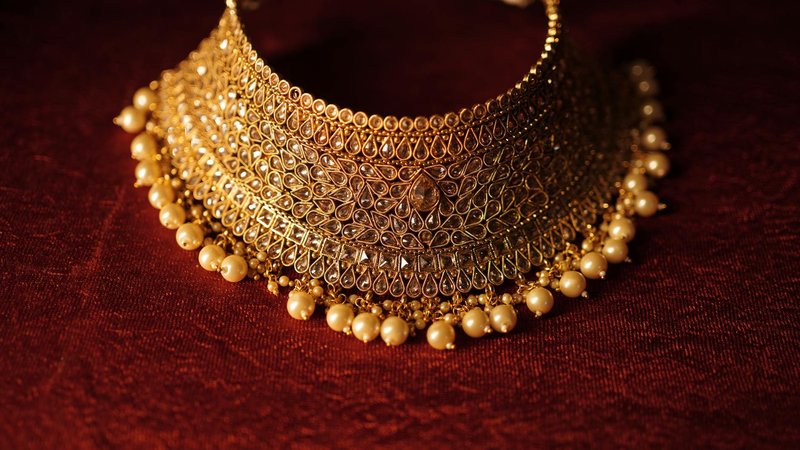
The Renaissance choker — called a "carcanet" in England — was a signature piece. These were wide, elaborate necklaces that sat high on the throat, often featuring alternating gemstones and enamel panels linked by gold chains. Wealthy women wore them layered with longer necklaces and pendant chains. Men wore them too — a bejeweled choker was a standard accessory for a well-dressed Renaissance nobleman.
Long pendant necklaces were equally important. A single spectacular gem or enameled scene would hang from a gold chain, often reaching to mid-chest. These weren't subtle — they were designed to catch the eye from across a room.
Pendants
Renaissance pendants deserve their own category because they were often the most elaborate piece a person owned. These weren't simple lockets. A single pendant could incorporate gemstones, enamel, carved cameos, pearls, and miniature sculpture into one unified design. Religious pendants featured scenes from the Bible. Secular pendants showed mythological stories, coats of arms, or symbolic representations of virtues like Faith, Hope, and Charity.
The most famous type is the "en tremblant" pendant — designed with a spring mechanism so parts of it moved when the wearer walked. Imagine a flower pendant where the petals tremble slightly with every step. It's the 16th-century equivalent of bedazzling, but with significantly more engineering.
Rings
Rings served multiple purposes: decoration, status display, and practical functions like sealing wax. Signet rings with family crests were essential for the nobility. Posy rings (named after "posies" — short poems) had romantic inscriptions engraved on the inside. Gemstone rings ranged from simple single-stone settings to elaborate constructions with multiple stones arranged in patterns.
Gimmel rings — two interlocking rings that join to form one — were popular as betrothal gifts. The idea was that the two halves represented the couple, and only when joined did they become whole. Poetic, right?
Brooches and Hat Badges
Brooches were used to fasten clothing (before buttons and zippers, everything was pinned) and as standalone decorative pieces. Hat badges — ornamental pins worn on caps and hats — were particularly popular with men. These ranged from simple pearl pins to massive, gem-encrusted constructions that must have made wearing a hat a genuine workout.
The Signature Techniques
Cloisonné Enamel
Fine gold or silver wires were bent into shapes and soldered onto a metal base, creating tiny compartments (cloisons) that were then filled with different colored enamels and fired. The result is a vivid, mosaic-like surface with clean lines between colors. Byzantine jewelers invented it, but Renaissance artisans elevated it to new heights of precision and color range.
Cameo and Intaglio Carving
Cameos (raised relief images carved into stone) experienced a massive revival during the Renaissance, inspired by ancient Roman and Greek examples being excavated in Italy. The most prized material was shell, but agate, onyx, and sardonyx were also used. Master carvers could create portraits so lifelike they were almost photographic.
Intaglio — the reverse technique, where the image is carved into the stone as a negative — was used primarily for signet rings. The carved image would leave a raised impression in sealing wax, authenticating documents.
Casting and Repoussé
Lost-wax casting allowed goldsmiths to create complex three-dimensional forms that would be impossible to fabricate by hand. A model was carved in wax, embedded in plaster, heated (melting the wax out), and then molten gold was poured into the resulting mold. This technique made possible the incredible sculptural elements in Renaissance pendants — tiny figures, animals, and decorative elements that look like miniature sculptures.
Repoussé — hammering a thin sheet of metal from the back to create a raised design on the front — was used for larger elements like necklace panels and brooch backs. The combination of repoussé with chasing (refining the design from the front with small tools) produced incredibly detailed, three-dimensional surfaces.
Famous Collections and Iconic Pieces
The Medici Treasure
The Medici family of Florence were the original patrons of the Renaissance, and their jewelry collection was legendary. They commissioned pieces from the best goldsmiths in Italy and amassed gems from across the known world. Much of the collection was dispersed over centuries, but surviving pieces in museums across Europe give a sense of its scale and quality. The Medici were also instrumental in developing the cameo industry, sponsoring carvers who revived ancient Roman techniques.
Queen Elizabeth I
Elizabeth I understood the power of image, and jewelry was central to her personal brand. Her portraits show her draped in ropes of pearls, enormous gem-set rings, and elaborately decorated gowns. She owned over 2,000 pieces of jewelry, many of which were diplomatic gifts from foreign rulers. The "Armada Portrait" — where she rests her hand on a globe — shows her wearing a spectacular pearl-drop earring and multiple pearl necklaces that were designed to project wealth, power, and divine right all at once.
The Habsburg Collection
The Habsburg dynasty, ruling from Vienna and Madrid, assembled what was probably the greatest jewelry collection in Renaissance Europe. Their pieces tend to be larger and more ostentatious than Italian work — think entire parures (matching sets) of necklace, earrings, brooches, and rings, all coordinated in design. The Habsburg taste ran to the dramatic: enormous table-cut gems, cascading pearls, and enamel work depicting hunting scenes and allegorical figures.
Finding Renaissance Style Today
If you've read this far and are now desperately wanting Renaissance-inspired jewelry (I don't blame you), there are several ways to find it.
Vintage and antique dealers specializing in revival pieces are a good bet. The 19th century saw a massive Renaissance Revival movement, so there are plenty of pieces from the 1800s and early 1900s that reinterpret Renaissance designs with Victorian sensibilities. These are more accessible and affordable than genuine Renaissance pieces (which are mostly in museums or worth more than your car).
Contemporary jewelers working in historical styles are another option. Etsy and Instagram are full of artisans creating Renaissance-inspired pieces using traditional techniques like enamel work and gemstone setting. Look for makers who specifically mention historical reproduction or Renaissance influence.
For a more accessible take, look for pieces that borrow Renaissance elements without being direct copies: symmetrical designs, gemstone clusters, enamel accents, and nature-inspired motifs all capture the Renaissance spirit without requiring a Medici-level budget.
And if you ever find yourself in a museum with a Renaissance jewelry collection, give yourself permission to stand there for an hour. The details are worth it. Those artisans spent months, sometimes years, on single pieces. The least we can do is look closely.
Comments