How to Price Handmade Jewelry: The Complete Guide
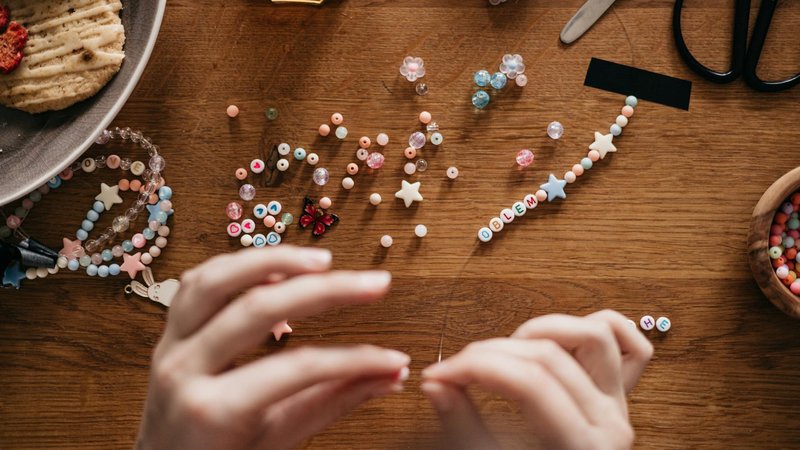
The first time I sold my handmade bracelets at a local craft market, I priced them at $8 each. I sold 15 of them in four hours and walked out feeling like a business genius. Then I got home, sat down with my receipt book, and did the math. My material costs alone were about $10 per bracelet.
I had paid people to take my jewelry.
That night, I sat on my living room floor surrounded by bead trays and crimping tools, genuinely wondering if I was cut out for this. Not because the bracelets were bad — people loved them. But because I had no idea how to price them. And as I'd soon learn, I wasn't alone. Almost every handmade jewelry maker I've talked to since has the same story: they started out pricing way too low, lost money on their first few sales, and then scrambled to figure out what they were actually worth.
This guide is everything I wish someone had handed me before that first market.
Why New Jewelry Makers Always Price Too Low
Before we get to formulas and strategies, let's talk about why this happens in the first place. Because understanding the psychology behind underpricing is half the battle.
You Feel Awkward Asking for Money
This is the big one. When you make something with your hands, pricing it feels personal. Asking $35 for a bracelet you spent two hours on feels audacious — like you're saying "my time is worth that much." Here's the thing: it is. But the internal voice that says "who do you think you are?" is loud, and it makes you shave a few dollars off the price just to avoid feeling like a fraud.
You Don't Know Your Real Costs
Most beginners count the obvious stuff — beads, wire, clasps — and call it a day. They forget about the thread they used to string everything, the crimp beads and jump rings, the packaging, the tools they had to buy, the gas to get to the market, and the hours they spent designing and making each piece. When you add all that up, your "profit" disappears fast.
You're Afraid Nobody Will Buy
This fear drives more bad pricing decisions than anything else. You look at your finished bracelet, think "I should charge $28 for this," and then immediately follow up with "but nobody's going to pay $28 for a bracelet from someone they've never heard of." So you knock it down to $16. Then someone buys it in five minutes and you realize you could have charged $28.
You're Comparing Yourself to the Wrong People
There's a big difference between your handmade bracelet and a $5 bracelet from Shein. Different materials, different craftsmanship, different story. But when you're starting out, it's easy to look at mass-produced prices and think "I can't charge more than that." You can. You should.
You Think Your Work "Isn't Good Enough"
Imposter syndrome is real, especially for creative people. You look at your own work and see every flaw — the slightly uneven spacing, the wire wrap that's not quite perfect, the color combination you're second-guessing. But your customers don't see those things. They see a beautiful, handmade piece that someone put real effort into. Price it accordingly.
The Complete Cost Breakdown
Before you can price anything, you need to know what it actually costs you to make it. Not roughly — specifically. Grab a notebook or open a spreadsheet, because this part matters.
Material Costs
This is the straightforward part. Add up every single material that goes into a piece:
Beads and stones — count every individual bead. If you buy a strand of 50 beads for $15, each bead costs $0.30. Write that down.
Wire, cord, thread — measure how much you use per piece. If a spool costs $12 and you get roughly 100 pieces out of it, that's $0.12 per piece.
Metal findings — clasps, jump rings, crimp beads, ear wires, chain. These add up faster than you'd think. A good lobster clasp might cost $0.40-0.80. Two jump rings at $0.10 each. Ear wires at $0.25 a pair. Don't round down.
Charms and pendants — straightforward, but remember to include any plating or finishing costs if applicable.
Packaging — boxes, bags, tissue paper, labels, stickers, thank-you cards. Even if you buy in bulk, divide the total cost by the number of pieces it covers.
Tool Depreciation
This one's tricky because it's not a per-piece cost, but your tools are real expenses. Round-nose pliers, chain-nose pliers, wire cutters, crimping tools, a bead mat, a ruler — a basic setup runs $50-150. You don't need to amortize this to the cent, but acknowledge that your tools cost money and factor that into your overall pricing strategy.
Time Cost
This is where most beginners lose money. How long does it take you to make one piece? Not just the physical assembly — include design time, material prep, finishing, and quality checking. If a bracelet takes you 45 minutes from start to finish, that's real time you're spending.
Your time has value. We'll talk about how to put a number on it in the formula section, but for now, just start tracking it.
Overhead and Indirect Costs
Booth fees at markets (typically $30-150 per event), Etsy listing fees ($0.20 per listing), Etsy transaction fees (6.5%), payment processing fees (around 3% + $0.25), website hosting if you have your own site, business insurance, photography equipment, shipping supplies — all of this comes out of your pocket before you see a dime of profit.
The Pricing Formula That Actually Works
There are dozens of pricing formulas floating around the internet. Here's the one that's worked best for me and for most of the jewelry makers I know:
Step 1: Calculate your base cost.
Material cost + (Hours worked × Hourly wage) + Overhead allocation = Base Cost
For the hourly wage: pick a number between $15 and $25 per hour to start. I know that feels high if you're a beginner, but think about it — if you were working at a craft store or doing data entry, you'd make at least $15/hour. Your handmade work should be valued at least that much. Many experienced makers charge $25-40/hour once they've built up their skills and reputation.
Step 2: Multiply for retail pricing.
Base Cost × 3 to 4 = Retail Price
That's right — three to four times your base cost. This isn't greed. This multiplier covers all the things you didn't account for in your base cost: the time you spend photographing pieces, writing descriptions, managing inventory, responding to customers, packaging orders, dealing with returns, posting on social media, and all the other invisible work that goes into running a small business.
Step 3: Calculate your wholesale price.
Base Cost × 2 = Wholesale Price
If a boutique wants to carry your jewelry, they need to buy it at roughly half your retail price so they can mark it up and still make a profit. This is standard in the industry. If your retail price can't support a 50% wholesale discount, your retail price is too low.
Let's run a real example. Say a necklace costs you $8 in materials and takes 1 hour to make at $20/hour:
Base cost = $8 (materials) + $20 (time) + $2 (overhead) = $30
Retail price = $30 × 3 = $90
Wholesale price = $30 × 2 = $60
Now, $90 might feel like a lot for a handmade necklace. But think about what you're getting: unique craftsmanship, quality materials, personal customer service, and a product that literally cannot be found anywhere else. If you sell it for $35, you're making about $5 profit after all expenses. That's not a business — that's a hobby that costs you money.
Market Research: Know What People Actually Pay
Before you set your final prices, spend some time researching what comparable pieces sell for:
Etsy: Search for jewelry similar to yours. Look at the price range — not just the lowest prices, but the median and upper range. Sort by "Bestselling" to see what people are actually buying, not just listing. Pay attention to the sellers who have lots of reviews; they've found a price that works.
Instagram: Follow makers in your niche and pay attention to what they charge. Most list prices in their stories or bio link. Don't copy them, but use their pricing as a data point.
Local markets: Walk through craft fairs and farmers' markets. Pick up business cards. Notice which booths have the most traffic and what they're charging. You'll quickly see that successful sellers are not the cheapest — they're the ones who've found their price point.
The goal isn't to be the cheapest or the most expensive. It's to find your position in the market and own it.
Pricing Psychology: Small Tweaks, Big Impact
How you present your price matters almost as much as the number itself. A few tricks that make a real difference:
Charm Pricing
$19 feels significantly cheaper than $20, even though the difference is one dollar. This is one of the most well-documented effects in behavioral economics. For handmade jewelry, charm pricing works well in the $15-50 range. Below that, the effect diminishes. Above $100, it can actually make your product feel less premium.
Bundle Pricing
Offering a set of 3 pieces for $50 (when individual pieces are $18 each) is more attractive than just selling singles. Customers feel like they're getting a deal, and you move more inventory. This works especially well for earrings, stackable bracelets, and matching sets.
Premium Pricing
If you're selling high-end pieces ($100+), skip the charm pricing and use round numbers. A $120 necklace feels more premium than a $119 one. Round numbers signal confidence and quality. Luxury brands have known this for decades.
Anchor Pricing
Show your original price alongside a sale price. Even if the "original" price is what you always intended to charge, seeing "Was $45, Now $35" triggers a perceived value response. Use this sparingly — constant sales train customers to wait for discounts.
Different Channels, Different Pricing
Your pricing shouldn't be identical across every sales channel. Each one has different costs and different customer expectations.
Etsy
Etsy takes a 6.5% transaction fee plus 3% + $0.25 for payment processing, plus $0.20 per listing every four months. Add it all up and you're losing roughly 10-12% per sale. Your Etsy prices should be slightly higher than your in-person prices to account for this. Most successful Etsy sellers price 10-15% above their direct-sale prices.
In-Person Markets
Face-to-face sales have their own costs (booth fees, travel, display materials) but no platform fees. Customers at markets also tend to impulse-buy more and are less price-sensitive than online shoppers. You can price at or slightly below your Etsy prices and still come out ahead.
Wholesale
If you're selling to boutiques or galleries, your wholesale price should be 40-50% of your retail price. This is non-negotiable in the retail industry — shops need that markup to cover their own costs. If you can't make a profit at 50% of retail, your retail price is too low.
Instagram / Direct Sales
This is your most profitable channel because there are no middlemen. You keep the full price minus payment processing (about 2.9% + $0.30 through Stripe or PayPal). Some makers offer a small "Instagram exclusive" discount to reward direct followers, but don't undercut your other channels too much or you'll train people to only buy from you on social media.
Common Pricing Mistakes to Avoid
I've made most of these. Learn from my mistakes so you don't have to make them yourself.
Only Counting Materials
This is the #1 mistake. "These beads cost me $5, so I'll charge $12." You just worked for $7 an hour, minus fees, minus packaging, minus the time you spent taking photos and writing descriptions. You made less than minimum wage for something that required skill and creativity.
Lowering Your Price When Someone Hesitates
A customer picks up your $32 necklace, looks at it, puts it back. Your instinct is to say "I can do $25 if you're interested." Don't. If they wanted it at $32, they'll buy it at $32. If they don't, a $7 discount won't change their mind — it'll just erode your margins and teach them that your prices are negotiable.
Race-to-the-Bottom Pricing
You see a competitor selling similar earrings for $14, so you price yours at $12 to undercut them. They drop to $10. You drop to $8. Congratulations — you're both now losing money on every sale. Someone will always be cheaper. Compete on quality, story, and customer experience instead.
Never Raising Prices
Prices shouldn't be set in stone. As your skills improve, your materials get better, your brand grows, and demand increases, your prices should go up. If you're charging the same price three years after you started, you're almost certainly undercharging.
When Should You Raise Your Prices?
Here are clear signals that it's time to increase your prices:
Your pieces sell out consistently. If every market or shop update sells out quickly, demand exceeds supply. That means your prices are too low.
You're getting regular repeat customers. People who come back to buy from you again and again aren't price-shopping — they're buying because they love your work. They'll pay more.
You've improved your skills. If your work from a year ago looks noticeably worse than your current work (and if you've been practicing, it does), your prices should reflect that growth.
Your costs have gone up. Metal prices fluctuate. Shipping costs rise. If your material costs have increased, your prices need to follow.
You can't keep up with orders. If you're turning away work because you don't have enough hours in the day, raising prices will naturally reduce demand while increasing your per-piece revenue.
You're getting wholesale inquiries. If shops are reaching out to stock your jewelry, you've outgrown hobbyist pricing.
When you do raise prices, do it gradually — 10-15% at a time. Announce it to your audience as a natural part of your business growth. Most customers won't bat an eye, and the ones who do weren't your ideal customers anyway.
The Honest Truth About Pricing Handmade Jewelry
Pricing is the hardest part of running a handmade jewelry business. There's no formula that perfectly captures the value of your creativity, your skill, and the years of practice that went into making each piece. No spreadsheet can account for the fact that your designs are unique, that you personally answer every customer message, or that someone is wearing something you made with your own hands.
But there are principles. And the most important one is this: your time and skill have real monetary value. If you don't respect that value enough to charge for it, nobody else will either.
I still have that first batch of $8 bracelets in a drawer somewhere. They remind me how far I've come and how much I've learned. My bracelets now start at $35 and go up from there. I sell fewer of them than I did at $8, but I actually make money — real money — on every single one.
Stop selling yourself short. Do the math. Pick a price that respects your work. And then hold firm.

Comments