Pearls in ancient Rome: why they were worth more than diamonds
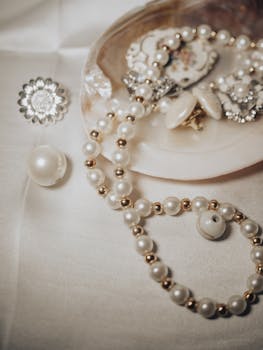
If you walked into a jewelry shop in Rome around 50 BC and asked what the most valuable gemstone was, the answer would not have been diamond. It would have been pearl. Romans of the late Republic and early Empire treated pearls with a reverence that diamond wouldn't achieve for another 1,500 years. Pearls decorated the togas of senators. They hung from the earlobes of empresses. They were embedded in furniture, sewn into shoes, and dissolved in wine as party tricks. Julius Caesar gave pearls as diplomatic gifts. Cleopatra reportedly drank one. Vitellius, a short-lived emperor, funded an entire military campaign by selling a single pearl necklace.
The Roman obsession with pearls was real, and it was expensive. At the peak of the trade, the best pearls from the Persian Gulf could cost more per gram than the most valuable agricultural land in Italy. Pliny the Elder, writing in the first century AD, recorded pearl prices that seem almost incomprehensible by modern standards, and he was not known for exaggeration when it came to market data.
So why pearls? What made them so special to the Romans, and why did diamond not compete?
The pearl trade before Rome
Pearls have been valued for thousands of years, long before Rome existed. Archaeological evidence from Mesopotamia suggests that people in the region were collecting and wearing pearls by 3000 BC. Egyptian tombs from the same period contain pearl ornaments. In China, pearls appear in burial goods dating back to at least 2200 BC.
The primary source of pearls in the ancient world was the Persian Gulf. The coasts of what is now Bahrain, Qatar, and the UAE produced some of the finest natural pearls ever found. The water was warm, the oyster beds were extensive, and the pearls had a particular luster that merchants from India, Persia, and the eastern Mediterranean all recognized as superior. Other sources included the Red Sea, the Gulf of Mannar off Sri Lanka, and scattered locations in Southeast Asia.
Pearl diving was dangerous work. Divers held their breath and descended to depths of 15 to 20 meters, sometimes deeper, grabbing oysters from the seabed before surfacing. A typical dive lasted about 90 seconds. A skilled diver might make 30 to 40 dives in a single session. Most oysters contained no pearl at all. Estimates vary, but roughly one in every few thousand oysters produced a pearl of commercial quality. Finding a large, perfectly round, evenly colored pearl was a rare event.
This scarcity drove prices up. By the time the pearl trade reached the Roman world, a fine pearl had already traveled through several middlemen, each adding a markup, before it reached a Roman buyer.
How Rome fell in love with pearls
The Roman pearl trade expanded significantly after Pompey the Great's eastern campaigns in the 60s BC. Pompey defeated Mithridates VI of Pontus and reorganized the eastern Mediterranean, opening trade routes that brought Persian Gulf pearls directly into Roman markets. The loot from Pompey's victories included enormous quantities of pearls, which he displayed in his triumphal procession through Rome in 61 BC. According to Pliny, the pearl displays in Pompey's triumph were the most impressive things the Roman public had ever seen.
The demand only grew from there. By the late Republic, pearls had become the single most conspicuous marker of wealth in Roman society. Seneca complained about the extravagance of pearl jewelry. Pliny devoted an entire section of his Natural History to pearls. Suetonius recorded that Julius Caesar gave a pearl worth six million sesterces to Servilia, the mother of Brutus. (The gift was widely interpreted as a bribe or a gesture of intimacy, depending on which ancient gossip you believe.)
There were practical reasons for pearl's dominance over other gemstones. Diamond, though known to the Romans, was not particularly prized. Roman diamonds came primarily from India, and the stones available in the ancient world were generally small, cloudy, and poorly cut. Without modern cutting techniques, a rough diamond is not especially attractive. It looks like a piece of dirty glass. Emeralds were valued, but the best ones came from Egypt and were difficult to source in large quantities. Rubies and sapphires were known but rare. Pearls, by contrast, needed no cutting or polishing. They came out of the oyster ready to wear. Their luster was immediate and obvious. Anyone could look at a fine pearl and understand why it was valuable, which made them ideal status symbols.
The Cleopatra pearl story
The most famous pearl story from antiquity involves Cleopatra and Mark Antony. According to Pliny, who got the story from earlier sources, Cleopatra wagered Antony that she could spend ten million sesterces on a single meal. Antony accepted the bet. Cleopatra served a relatively ordinary dinner, and Antony pointed out that the food was not worth anything close to ten million. Cleopatra then took one of her pearl earrings, dropped it into a glass of vinegar, waited for it to dissolve, and drank the contents.
The story is probably exaggerated. Pearls are made of calcium carbonate, and vinegar (acetic acid) can dissolve them, but the process is slow. A large pearl would take hours to fully dissolve in vinegar, not the moments the story implies. Pliny himself seems to have had doubts about it. The anecdote, however, tells us something important about how Romans thought about pearls. They were so valuable that the idea of destroying one on purpose was shocking. It was the ancient equivalent of lighting a cigar with a hundred-dollar bill.
The point of the story, whether or not it happened, is that pearls were understood as liquid wealth. You could wear your fortune, and in an emergency, you could monetize it quickly. This made them different from land or buildings, which were valuable but not easily convertible.
Vitellius and the pearl-funded war
Aulus Vitellius, who served as Roman emperor for about eight months in AD 69, reportedly financed part of his military campaign by selling a single pearl necklace that had belonged to his mother. The story, recorded by Suetonius, is that Vitellius needed money to pay his troops during the chaos of the Year of the Four Emperors. Rather than requisition funds through normal channels, he took his mother's pearls, sold them, and used the proceeds to buy the loyalty of his soldiers.
The detail is revealing. A pearl necklace was portable wealth that could be converted to cash faster than any other asset. Land took time to sell. Bullion had to be transported and verified. A pearl necklace could be handed to a merchant in exchange for a large sum of money on the spot. This liquidity was part of what made pearls so attractive to the Roman elite. They were jewelry and bank account in one.
What Pliny the Elder recorded
Pliny the Elder's Natural History, completed around AD 77, contains the most detailed ancient account of the pearl trade. Pliny was a meticulous compiler, and his sections on pearls draw on earlier Greek and Roman sources, some of which are now lost. He recorded pearl prices, described the different grades of pearls available in Roman markets, and provided information about pearl fishing in the Persian Gulf and the Red Sea.
According to Pliny, the most expensive pearls in Rome were sold by weight, and their price per unit weight exceeded that of gold by a wide margin. He noted that a single exceptional pearl could cost more than an estate. He also complained, at length, about the moral degeneracy of spending such sums on jewelry. Pliny was a moralist as much as a naturalist, and he viewed the pearl trade as a symptom of Roman excess. But his complaints confirm how expensive pearls really were. People don't moralize about affordable luxuries.
Who could wear pearls in Rome
The Roman state attempted to regulate pearl consumption through sumptuary laws. These laws restricted what different social classes could wear and own. Under various enactments during the late Republic and early Empire, pearls were reserved for specific ranks. Women of senatorial families could wear them. Freedmen and foreigners generally could not, at least not in public. Men were technically discouraged from wearing pearls, though this restriction was widely ignored by the imperial family and the very wealthy.
The laws were not particularly effective. Wealthy freedmen and merchants bought pearls regardless of what the law said. Enforcement was inconsistent, and the penalties for violation were not severe enough to deter serious buyers. But the existence of the laws tells us that pearl ownership was politically sensitive. It was a visible marker of social status, and the Senate tried to control who could display it.
Pearl diving in the ancient world
The pearl divers of the Persian Gulf operated in conditions that would be considered intolerable today. The diving season lasted roughly four months, from June to September, when the water was warm enough for extended work. Divers worked from small boats, often family-operated, and used the simplest possible equipment: a nose clip, a rope tied to the boat, and a basket to hold the oysters. No wetsuits, no tanks, no breathing apparatus.
A typical day involved 30 to 60 dives, each lasting about a minute and a half. Divers descended to the seabed, felt around for oysters by touch, stuffed them into a basket, and pulled the rope to signal the boat crew to haul them up. The work caused ear damage, sinus problems, and joint pain. Shark attacks were uncommon but not unheard of. Drowning was a constant risk.
The social structure around pearl diving was complex. In the Persian Gulf region, pearl diving villages were organized around tribal and family networks. Revenue from the pearl trade supported entire communities. Merchants, boat owners, divers, and sorters all had defined roles. The system persisted for centuries and only declined in the early 20th century, when Japanese cultured pearl farming techniques made natural pearls far less commercially important.
What happened to the Roman pearl trade
The Roman pearl trade declined along with the Roman Empire itself. As imperial authority weakened in the third and fourth centuries AD, long-distance trade routes became less secure. Pirates operated in the Mediterranean and the Red Sea. The Persian Gulf trade shifted toward Sassanid Persian control. The economic disruptions of the third-century crisis made luxury imports harder to justify.
When the Western Roman Empire fell in the fifth century, the institutional demand for pearls collapsed. The Byzantine Empire, centered in Constantinople, continued to value pearls, and Byzantine imperial regalia included elaborate pearl decorations. But the scale was smaller than it had been under Rome. In Western Europe, pearls became less common and less culturally important during the early medieval period. They were still valued, but they no longer dominated the gem market the way they had under the Caesars.
Pearls regained prominence in Europe during the Renaissance, when trade routes to the Indian Ocean reopened and natural pearls from the Gulf of Mannar and the Persian Gulf flowed into Venice, Genoa, and later Amsterdam. By the 16th and 17th centuries, pearls were once again among the most expensive gemstones in Europe. They remained so until the development of cultured pearl farming in the early 20th century, which flooded the market and collapsed prices.
Today, natural pearls of the quality the Romans prized are extraordinarily rare and expensive. A single fine natural pearl from the Persian Gulf can sell for tens of thousands of dollars at auction. The Romans, it turns out, were right about the value. They were just operating in a market that no longer exists.
Comments