Obsidian in Mesoamerican Culture: Weapons, Mirrors, and Surgery
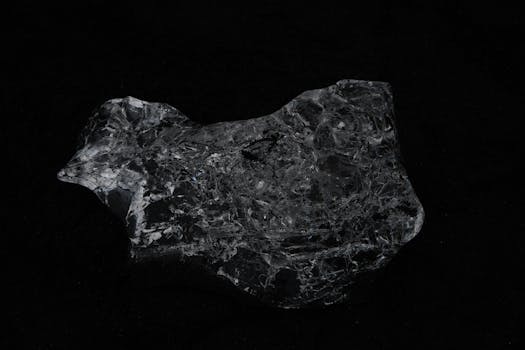
Obsidian is not what most people think of when they hear "crystal." It's not a crystal at all, technically — it's volcanic glass, formed when lava cools too fast for mineral crystals to form. There's no regular atomic structure, no repeating lattice, no crystalline geometry. Just a chaotic, amorphous solid that happens to be absurdly sharp when you break it the right way.
For the Aztecs, the Maya, and virtually every culture in pre-Columbian Mesoamerica, obsidian was the most important material in daily life. More important than gold. More important than jade. Obsidian was tools, weapons, mirrors, jewelry, and surgical instruments, all in one black (and occasionally green or red) package.
Why obsidian breaks so sharp
The key property is conchoidal fracture. When obsidian breaks, it doesn't crack along predictable planes like calcite or mica. It forms smooth, curved surfaces — think of the inside of a seashell. A skilled knapper can control exactly where the fracture propagates by applying pressure at the right angle with a pointed tool. The result is an edge that tapers down to just a few nanometers thick. For comparison, a high-quality steel surgical scalpel has an edge of about 300 nanometers. Obsidian blades routinely achieve 30 nanometers or less.
What this means in practice: obsidian blades can cut between individual cells. Under an electron microscope, a steel scalpel looks ragged next to an obsidian edge. The cells aren't cleanly separated — they're torn. Obsidian slices through them like a hot knife through butter. This isn't metaphor. It's measurable and reproducible.
This property has real medical applications even today. Some research hospitals and specialized surgical centers use obsidian blades for procedures where an exceptionally clean cut matters — certain types of eye surgery, for instance, and some plastic surgery applications. Studies have shown that incisions made with obsidian blades heal faster and with less scarring than those made with steel scalpels. The main reason obsidian isn't more widely used in modern surgery is practicality: the blades are fragile, they can't be sterilized in an autoclave without degrading, and they're single-use only. Steel is good enough for almost everything. Obsidian is better for a few things.
The macuahuitl: not your average sword
When Spanish conquistadors arrived in Mesoamerica in the early 1500s, they encountered a weapon that must have looked primitive at first glance. The macuahuitl (pronounced roughly mah-kwah-WEETL) was a wooden club, about 70 to 100 centimeters long, with obsidian blades set into grooves along both edges. It looked like a cricket bat with embedded glass teeth. The Spanish, accustomed to steel swords and plate armor, reportedly laughed at it — until they saw what it could do.
Contemporary Spanish accounts describe the macuahuitl as capable of decapitating a horse with a single blow. This sounds like exaggeration, and it probably is — but not by much. A macuahuitl with fresh, sharp obsidian edges could cut deep enough to cause immediately life-threatening wounds. The obsidian blades were disposable: they'd chip or shatter on impact with bone or armor, but they could be replaced in minutes. A warrior heading into battle would carry spare blades and the pine pitch adhesive used to set them.
The weapon's effectiveness came from the combination of the club's mass and the obsidian's sharpness. The wooden shaft delivered force. The obsidian edges concentrated that force into a cutting edge that was, molecule for molecule, sharper than anything the Spanish had ever encountered. Steel swords could cleave and thrust. Macuahuitls could slash with surgical precision. Different design philosophy, equally lethal in the right circumstances.
Only one original macuahuitl is known to survive, and it's in a museum in Vienna. Most were destroyed during the Spanish conquest, and the knowledge of how to make them was lost within a generation. Modern reconstructions based on Spanish descriptions and archaeological evidence confirm that the weapon worked essentially as described — though the "decapitating a horse" claim remains unverified by modern testing.
Mirrors and the smoking god
Obsidian has another property that made it invaluable: when polished, it reflects light with a silvery depth that no metal mirror of the era could match. The Aztecs used polished obsidian discs as mirrors, and these weren't vanity objects. They were tools for divination.
The most important deity associated with obsidian mirrors was Tezcatlipoca, whose name translates roughly to "Smoking Mirror." He was one of the most powerful gods in the Aztec pantheon — associated with the night sky, the wind, war, rulership, and sorcery. Aztec rulers were considered the earthly representatives of Tezcatlipoca, and one of the symbols of their authority was an obsidian mirror. Priests used obsidian mirrors in divination rituals, gazing into the reflective surface to see visions or communicate with the spirit world.
The Maya used obsidian mirrors too, particularly in the Classic period (250-900 CE). Archaeological sites have produced dozens of polished obsidian discs, some mounted in carved wooden or jade frames. Some of the finest examples come from the Maya city of Tikal, where elite burials often included obsidian mirrors among the grave goods. The association between mirrors, royalty, and supernatural vision seems to have been widespread across Mesoamerica — it wasn't limited to the Aztecs.
The irony is that obsidian mirrors work so well because the material is homogeneous and free of the crystalline grain boundaries that make polished stone or early metal mirrors imperfect. Volcanic glass is, in a sense, the perfect mirror material — if you don't mind the brittleness and the difficulty of polishing it. The Mesoamericans didn't know about crystallography or atomic structure. They just knew that this particular black stone, when rubbed with a finer and finer abrasive, gave back a clearer image than anything else they'd tried.
An continent-spanning trade network
Obsidian is found at specific volcanic sites, and it doesn't occur naturally in most of Mesoamerica. The fact that obsidian artifacts show up at archaeological sites hundreds of kilometers from any volcanic source tells you immediately that there was a sophisticated trade network in place. And because obsidian from different sources has distinct chemical signatures — trace elements like rubidium, strontium, and zirconium vary predictably by location — archaeologists can use X-ray fluorescence spectroscopy to determine exactly where any given piece of obsidian came from.
This has been one of the most productive areas of Mesoamerican archaeology in the last fifty years. By analyzing the trace elements in obsidian artifacts from sites across Mexico and Central America, researchers have mapped out trade routes that operated for thousands of years. Some of the key sources:
The Pachuca source in Hidalgo, Mexico, produced a distinctive green obsidian that was traded across a huge area — green obsidian from Pachuca shows up at sites in the Maya lowlands, over 1,000 kilometers away. The Sierra de las Navajas source, also in Hidalgo, produced gray obsidian that was used for both tools and ritual objects. The Zaragoza and Orizaba sources in Veracruz supplied obsidian to the Gulf Coast and the Maya region. The El Chayal and Ixtepeque sources in Guatemala were the primary obsidian suppliers for the Classic Maya.
The trade wasn't just about raw material. Obsidian cores — carefully prepared blocks that could be struck to produce standardized blades — were traded as finished products. A skilled knapper at a source site could produce dozens of blades from a single core, and those blades would then be distributed through the trade network in their finished form. This is early industrial production and distribution, and it predates European contact by centuries.
Obsidian in everyday life
Beyond weapons and mirrors, obsidian was the everyday tool material of Mesoamerica. Obsidian blades were used for everything: cutting meat, shaving, bloodletting (a ritual practice), woodworking, hide processing, and agricultural tasks like harvesting maguey for pulque production. The blades were cheap, disposable, and incredibly effective. Archaeological sites are full of obsidian debris — the waste flakes from blade production, worn-out blades, broken tools. At large urban centers like Teotihuacan, the quantity of obsidian debris is staggering: millions of pieces, representing centuries of continuous production and use.
Obsidian was also used for jewelry. The Aztecs made earspools, lip plugs, and beads from obsidian, sometimes layering it with other materials. A particularly striking technique involved embedding small pieces of differently colored obsidian — black, gray, green, red — into a mosaic pattern. Some of the finest surviving Aztec mosaics, like the skull in the British Museum that's covered in turquoise and obsidian, demonstrate a level of craftsmanship that's genuinely impressive by any standard.
The everyday ubiquity of obsidian is easy to underestimate. Think of it this way: in the modern world, plastic is the material that shows up everywhere — in packaging, in tools, in disposable items, in things you barely notice. In pre-Columbian Mesoamerica, obsidian played that role. It was the default material for anything that needed to be sharp, reflective, or precisely shaped. When you hold a Mesoamerican obsidian blade today, you're holding something that was, in its own context, as ordinary as a box cutter.
What obsidian tells us about Mesoamerican technology
There's a persistent tendency in popular history to underestimate pre-Columbian civilizations, to frame them as "primitive" relative to European societies. Obsidian is a good corrective to that. The Mesoamericans didn't have iron or steel. They didn't have wheels (for transport, anyway — they used wheels for toys). They didn't have draft animals. But they developed a material technology around obsidian that was, in its own way, as sophisticated as European metallurgy.
The blade production techniques, the trade networks, the mirror polishing, the weapon design — all of this required accumulated knowledge, specialized skills, and social organization. Obsidian knapping was a profession. Obsidian trade was an industry. The fact that it was based on a single material doesn't make it simple. It makes it focused. The Mesoamericans pushed obsidian about as far as it could go, and in some respects — particularly the sharpness of the edges — they achieved results that modern technology still can't fully replicate with mass-produced alternatives.
Obsidian is volcanic glass. It's the product of a specific geological process. But in Mesoamerican hands, it was something more: a technology platform that supported an entire civilization's material culture for thousands of years. That's worth knowing.

Comments