Minimalist Crystal Jewelry: Less Is More (But Still Meaningful)
What minimalist crystal jewelry actually means
Minimalist jewelry gets misunderstood a lot. People hear "minimalist" and assume it means plain, boring, or barely there. A tiny gold dot on a chain. A stud so small it's practically invisible. That's one version of it, but it's the least interesting version.
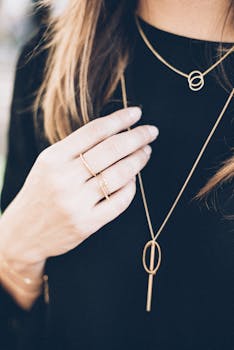
The better definition is this: minimalist jewelry is jewelry where every element has a reason to exist. Nothing is filler. A single small rose quartz pendant on a thin gold chain is minimalist not because it's small, but because there's nothing competing with it — no extra charms, no layered chains, no decorative elements that don't add to the piece. The stone is the entire point, and the setting gets out of its way.
What makes this approach work with crystal jewelry specifically is that natural stones already have visual interest built in. A 5mm amethyst cabochon has color, depth, and light interaction that a plain metal bead doesn't. You don't need to add complexity around it. The stone does the work.
The materials that make minimalist crystal jewelry work
14k gold fill: the sweet spot
Gold fill is a layer of gold (at least 5% of the item's total weight) bonded to a base metal core. It's not the same as gold-plated, which is a microscopic layer that wears off in months. Gold fill lasts 5-10 years with regular wear before the gold layer thins enough to show the base metal underneath. It's also a fraction of the cost of solid 14k gold — typically 15-25% of the price.
For minimalist crystal jewelry, gold fill is the best metal choice because it has the warmth and richness of gold without the $200+ price tag that solid gold commands. A thin gold-fill chain with a small stone pendant typically costs $35-$75. The same design in solid 14k gold would be $200-$500. The visual difference in photos and normal viewing distance is negligible.
Sterling silver is the budget alternative. It looks clean and modern, and it costs less ($20-$50 for comparable pieces). The tradeoff is maintenance — silver tarnishes, and minimalist designs with thin chains show tarnish more obviously than chunky ones because there's less metal to hide it on. If you choose silver, plan to polish your pieces every 2-3 weeks.
Stone size: smaller is usually better for minimalist
In minimalist designs, stone size matters more than stone type. A 3mm stone set in a bezel reads as delicate and intentional. A 12mm stone in the same setting reads as "bohemian" or "statement," which is a different aesthetic entirely. For true minimalist crystal jewelry, stay in the 3-8mm range for pendants and 2-5mm for earrings.
There's a practical reason for this beyond aesthetics. Smaller stones are lighter, which means thinner chains and more delicate settings can support them. A 10mm amethyst on a 0.5mm chain is going to pull the chain out of shape over time. A 5mm amethyst on the same chain will last for years.
The essential minimalist pieces
Solitaire stone studs
A single stone set in a simple bezel or prong setting, on a standard post. That's it. No halo, no accent stones, no decorative gallery. The stone sits directly against the earlobe. This is the most versatile piece of minimalist jewelry you can own — it works with everything from gym clothes to a cocktail dress.
For daily wear, 4-5mm stones are the ideal size. Big enough to see. Small enough to not get caught in your hair or feel heavy after 12 hours. White topaz or clear quartz gives a diamond-like look for under $20 per pair. Colored stones (amethyst, citrine, peridot, garnet) add a subtle pop of color that makes the piece feel more personal.
Tiny pendant on a thin chain
A single stone pendant on a 16-18 inch chain, worn alone. No layering, no additional charms. The chain should be thin — 0.5mm to 1mm — so it reads as a delicate line rather than a visible necklace. The pendant can be a bezel-set cabochon (smooth, domed stone) or a tiny faceted stone in a prong setting.
This piece works because it draws the eye to one focal point: the stone. The chain is just the delivery mechanism. I'd recommend choosing a stone color that you genuinely like rather than trying to match it to specific outfits, because you'll wear it more often if you actually enjoy looking at it.
A single stone ring
Minimalist rings are having a moment. A small stone (3-6mm) set in a thin band (1-1.5mm) on one finger is a clean, modern look. Stacking 2-3 minimalist rings on the same hand is also popular — think one stone ring, one plain band, one textured band in different metals.
The main thing to watch for with minimalist rings is durability. Thin bands bend more easily than thick ones, and small stones can loosen in their settings if the ring takes a lot of impact. If you work with your hands or are generally rough on jewelry, go with a slightly thicker band (1.5-2mm) and a bezel setting instead of prongs. Bezel settings wrap the stone in metal, which protects it better.
Why the minimalist trend keeps growing
Minimalist jewelry isn't new — it's been popular in various forms since the 1990s. But it has gained real momentum in the last five years, and there are concrete reasons why.
First, versatility. A minimalist stone pendant works with a t-shirt and jeans, a work blouse, a party dress, and gym wear. You don't have to take it off and swap it for something else when your day moves between different contexts. For people who don't want to think about accessorizing every morning, this matters a lot.
Second, it layers well. A minimalist pendant can be the base layer for a layered necklace look on days when you want more visual interest. Add a longer chain or a choker, and the original piece still works as part of the combination. Try doing that with a chunky statement necklace — it doesn't layer, it dominates.
Third, it's comfortable. Thin chains don't tangle in your hair. Small studs don't catch on scarves or headphones. Light rings don't leave deep indentations on your fingers after a full day of wear. Comfort sounds trivial until you've spent 10 hours wearing heavy jewelry that you can't wait to take off.
Fourth, remote work normalized it. When your daily interactions are over video calls, subtle jewelry shows up better than you'd expect. A small stone pendant catches light at just the right angle. Big pieces don't translate as well through a webcam — they often just look like a shiny blob. The shift to video-first communication made minimalist jewelry more practical.
Minimalist vs. maximalist: pick a side, or don't
There's a tendency in fashion content to frame these as opposing camps — you're either a minimalist or a maximalist. That's a false binary. Most people fall somewhere in the middle and move between the two depending on context.
Minimalist jewelry is better for: daily wear, professional settings, travel, workouts, and any situation where you don't want to think about what you're wearing. It's the default mode for most people.
Maximalist jewelry is better for: events, parties, creative or fashion-forward contexts, and days when you want to express something specific through your accessories. A stacked arm full of bangles, layered necklaces, multiple rings — this look has energy and personality, but it requires intention.
Neither approach is better. The mistake is wearing maximalist jewelry when the context calls for minimalist (an important client meeting) or wearing minimalist jewelry when the event calls for something more expressive (a fashion-forward party). Read the room.
Smart buying: quality over quantity
Here's a practical recommendation that will save you money in the long run: buy 2-3 high-quality minimalist pieces instead of 10-15 cheap ones. A well-made gold-fill pendant with a genuine stone costs $50-$80 and lasts 5+ years. A gold-plated pendant from a fast-fashion retailer costs $8-$15 and starts looking worn within 2-3 months.
Over two years, the cost difference is minimal. But the experience is very different. Quality pieces look good every day, while cheap pieces start as "okay" and quickly become "tired." You also wear quality pieces more often because they maintain their appearance, which means you actually get your money's worth.
Brands like Mejuri, Catbird, and Gorjana have built their entire businesses on this model — well-made, minimalist jewelry at accessible prices. Their aesthetic is consistent: thin chains, small stones, simple settings, and no unnecessary embellishment. You don't have to buy from them specifically, but looking at their product photos gives you a good visual reference for what minimalist crystal jewelry should look like.
A starter set for someone new to minimalist crystal jewelry
If you're building a minimalist collection from scratch, here's a practical order of acquisition:
First: a pair of 4-5mm stone stud earrings in a neutral color (clear quartz, white topaz, or a pale stone that matches your skin tone). Wear these daily. They become your baseline.
Second: a thin chain (0.7mm, 16-18 inches) with a single 5-6mm stone pendant in a color you genuinely like. This is your everyday necklace.
Third: one minimalist ring, either plain band or with a tiny stone. Add this when you're comfortable with the earrings and necklace and want one more element.
That's three pieces. Total investment: roughly $80-$200 depending on metal choice and stone quality. That's enough for a complete, cohesive daily look. You can expand from there — maybe a second pair of studs in a different color, or a longer pendant for layering — but those three pieces are the foundation.
Everything beyond that is optional. That's the whole point of minimalism: you have enough, and what you have works.
Comments