Larimar: The Caribbean Gemstone — What Makes It So Special and Why Collectors Love It
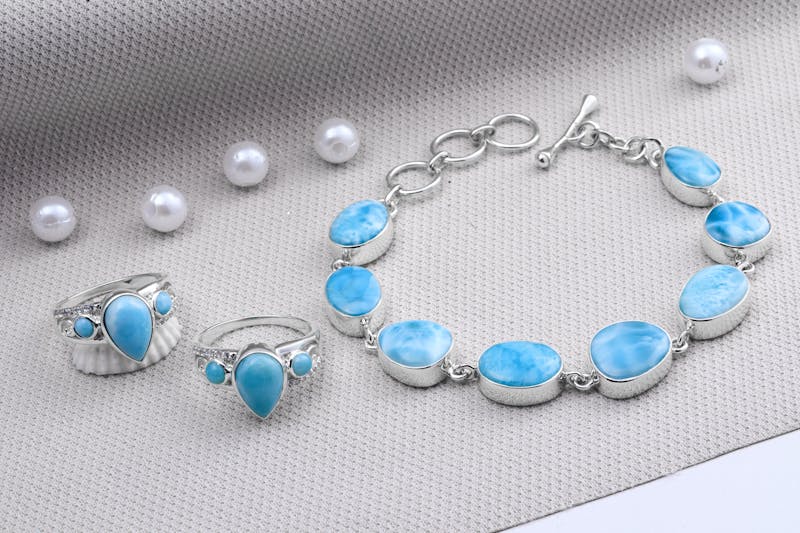
There's something almost unreal about larimar. Its swirls of blue, turquoise, and white look like they were painted by the Caribbean Sea itself. And in a way, they were — larimar is found in only one place on Earth: a small mountainous region in the Dominican Republic, just a few kilometers from the coast.
If you've never held a piece of larimar, imagine the color of shallow tropical water captured in stone. That's larimar. It's one of the few gemstones that genuinely looks like nature's artwork, and it has a fascinating story behind it.
What Exactly Is Larimar?
Larimar is a variety of pectolite, a mineral that's actually quite common around the world. But what makes larimar special is its color. Most pectolite is white, gray, or colorless. The blue and blue-green varieties only occur in the Dominican Republic, where volcanic activity created the specific conditions needed to produce that distinctive color.
The blue comes from trace amounts of copper replacing calcium in the mineral's crystal structure. The more copper present, the deeper and more vivid the blue. The white patterns are areas where the pectolite formed without copper substitution.
The stone was first officially documented in 1974, though local residents had known about it for generations. A Dominican man named Miguel Méndez and a Peace Corps volunteer named Norman Rilling rediscovered it on a beach, where they initially thought it was an unusual type of coral. Méndez named it larimar by combining his daughter's name Larissa with the Spanish word for sea, mar.
Where Does Larimar Come From?
Larimar comes from exactly one location: the Los Chupaderos mine in the province of Barahona, in the southwestern Dominican Republic. This is roughly 100 kilometers from the Haitian border, in a region that's both beautiful and rugged.
The mine is a volcanic tube that runs through a mountainside. Miners extract larimar by hand, using basic tools to chip away at the volcanic rock. The deeper they go, the higher the quality tends to be — deeper stones have more saturated blue colors because they formed closer to the volcanic heat source.
The mine has been active for about 50 years, and geologists estimate there are perhaps 10-15 more years of commercially viable deposits remaining. After that, larimar will become genuinely rare. If you're considering adding larimar to your collection, the supply situation is worth knowing about.
There have been larimar-like stones found in other parts of the world — including some blue pectolite in Canada and Italy — but none match the quality and color range of Dominican larimar. The geological conditions that created it simply don't exist elsewhere.
Understanding Larimar Quality
Not all larimar is created equal. Here's how to evaluate quality:
Color is the most important factor. The most valuable larimar displays deep, vivid blue with visible volcanic pattern — those characteristic swirls and streaks of white and turquoise. Light blue or pale specimens are more common and less valuable. Green-tinged larimar exists but is less sought after than pure blue.
Pattern matters too. The best larimar has an interesting, natural pattern that resembles ocean currents or clouds. Some pieces have a "bull's eye" pattern with concentric rings of color. Others have dramatic streaks. Uniform color without pattern is less interesting to collectors.
Clarity and translucency play a role. Higher quality larimar has a slight translucency when held up to light. Opaque pieces are more common and typically lower quality. The very best specimens have a gemmy, almost waxy translucency.
Size is a consideration for jewelry. Larger pieces with good color are increasingly rare as the mine gets deeper. Cabochons over 15-20 carats with vivid blue color command significant premiums.
How to Spot Fake Larimar
As larimar has become more popular, fakes have flooded the market. Here's what to watch for:
Dyed howlite is the most common fake. Howlite is a white stone that takes dye extremely well. Unscrupulous sellers dye it blue and sell it as larimar. The giveaway is uniformity — dyed howlite has an even blue color without the natural swirling patterns of real larimar. Under magnification, you can often see dye concentrated in the stone's pores.
Synthetic or reconstructed larimar involves grinding up low-quality larimar fragments, mixing them with resin, and pressing them into solid pieces. This is harder to spot because it contains real larimar material. Look for too-perfect patterns, a plastic-like luster, or visible resin bubbles under magnification.
Other blue stones are sometimes mislabeled. Blue lace agate, chrysocolla, and variscite can look somewhat similar to larimar at first glance. But each of these has different properties — different hardness, different crystal structure, different feel in the hand. An experienced eye can usually tell them apart.
The best way to verify larimar is to buy from reputable dealers who can provide origin documentation. Genuine Dominican larimar should come with some proof of where it was sourced.
Larimar in Jewelry
Larimar is most commonly cut into cabochons and set in sterling silver. This is partly because its hardness (4.5-5 on the Mohs scale) makes it somewhat delicate for daily wear, and partly because the blue-silver combination is visually stunning.
Popular jewelry types include pendants and necklaces (the most common form — a larimar cabochon in a silver setting is a classic), rings (best in protective settings — bezels rather than prongs), earrings (dangly or stud, often with silver scrollwork), and bracelets (usually as cabochons in a row or as a single statement stone).
For daily wear, larimar is best in pendants or earrings — pieces that don't take hard knocks. Rings and bracelets need protective settings and should be treated with care. Avoid wearing larimar jewelry while doing housework, exercising, or swimming.
Healing Properties and Metaphysical Meaning
In crystal healing traditions, larimar is associated with the throat chakra and is considered a stone of communication and emotional expression. Practitioners believe it helps people speak their truth calmly and clearly.
Larimar is often called the "Dolphin Stone" because of its connection to the sea and the playful, intelligent energy dolphins represent. It's associated with the element of water and is said to carry the healing energy of the ocean.
Common metaphysical uses include wearing larimar during meditation to promote calm and reduce anxiety, placing it near the throat during energy work to support honest communication, keeping a piece on your desk to reduce workplace stress, and using it in crystal grids focused on emotional healing and self-expression.
The cooling blue color is believed to soothe fiery emotions — anger, frustration, and irritability. Some practitioners compare its energy to standing at the edge of the ocean: vast, calming, and grounding.
Whether or not you believe in crystal healing, there's something undeniably calming about holding a piece of larimar. The color alone seems to slow your breathing and relax your shoulders. Sometimes the simplest metaphysical effects are just the ones that come from surrounding yourself with natural beauty.
How to Care for Larimar
Larimar is relatively soft and porous compared to most gemstones, so it needs gentle care:
Clean with warm soapy water and a soft cloth. No ultrasonic cleaners, no steam cleaners, no harsh chemicals. Pectolite can be damaged by acids, so keep it away from vinegar, lemon juice, and household cleaners.
Store separately from harder stones. Larimar can be scratched by quartz, topaz, sapphire, and even some types of garnet. Keep it in a soft pouch or a separate compartment in your jewelry box.
Avoid prolonged sun exposure. The blue color in larimar is caused by copper ions, which can gradually fade under intense UV light. This is slow and usually only noticeable after years of direct sunlight, but it's worth being mindful of.
Avoid heat and temperature changes. Like many minerals, larimar can develop internal cracks if exposed to rapid temperature changes. Don't wear it in hot baths, saunas, or leave it in a hot car.
Larimar vs Other Blue Stones
People often confuse larimar with other blue gemstones. Here's how to tell them apart:
Larimar vs turquoise: Turquoise is harder (5-6 Mohs) and typically has a more opaque, chalky appearance with matrix patterns. Larimar has a more translucent, waxy luster and distinctive swirling patterns.
Larimar vs blue lace agate: Blue lace agate has banded patterns (straight or wavy lines) rather than the chaotic swirls of larimar. It's also harder (6.5-7 Mohs).
Larimar vs chrysocolla: Chrysocolla can look similar in color but is usually more green-blue than larimar's pure blue. It's softer and more brittle, often appearing in rough, botryoidal (grape-like) formations.
Larimar vs amazonite: Amazonite is green-blue rather than pure blue and has a characteristic white grid pattern (perthite). It's harder (6-6.5 Mohs) with a different crystal structure.
Is Larimar a Good Investment?
Given that larimar comes from a single depleting mine, there's a legitimate argument for its investment potential. High-quality pieces have been steadily increasing in price over the past decade.
However, treat larimar as a collectible rather than a traditional investment. The market is small, liquidity is limited, and prices are influenced by tourism in the Dominican Republic rather than established gemstone trading markets.
The best strategy is to buy pieces you genuinely love at fair prices. If the mine depletes as predicted and larimar becomes truly rare, you'll own something beautiful that happens to be increasingly valuable. If not, you still own something beautiful.
Final Thoughts
Larimar is one of those rare gemstones that tells a story just by existing. A piece of volcanic Caribbean ocean, captured in stone, found nowhere else on Earth. Whether you're drawn to it for its beauty, its metaphysical properties, or its geological uniqueness, larimar is a stone that rewards curiosity.
The next time you see a piece of larimar, hold it up to the light. Look at those blue and white patterns and imagine the volcanic forces that created them millions of years ago. That's not just a pretty stone — it's a piece of the Earth's history, and there won't be any more of it once the Dominican mine runs dry.
Comments