Lapis Lazuli: The Stone That Painted the Renaissance Blue
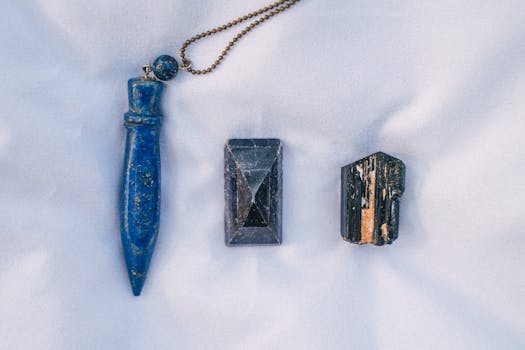
Blue is everywhere now. It's the default color for corporate logos, smartphone wallpapers, and the links on every website you've ever visited. It's so common that it's practically invisible. But for most of human history, a true, vivid blue was almost impossible to produce. The best source was a single mineral — lapis lazuli — and getting usable pigment out of it was so difficult and expensive that a handful of artists built entire careers around the fact that they could afford it.
Afghanistan's six-thousand-year mine
The Sar-i-Sang mines in the Badakhshan province of northeastern Afghanistan are, by a wide margin, the oldest continuously operating mines in the world. People have been pulling lapis lazuli out of these mountains for at least 6,000 years — probably longer. The stone turns up in artifacts from ancient Egypt, Sumer, and the Indus Valley civilization. Cleopatra reportedly used powdered lapis as eyeshadow. The funeral mask of Tutankhamun contains lapis lazuli inlays. These stones all came from the same place: a cluster of high-altitude deposits in the Hindu Kush, accessible only through narrow mountain passes, surrounded by some of the most inhospitable terrain on Earth.
The mines are still operating today, though under dramatically different circumstances. In the 1990s and 2000s, the area was controlled by the Northern Alliance and later by various armed groups. The lapis trade became a funding source for anti-Taliban militias. Geologists estimate that the Sar-i-Sang deposits still contain significant reserves, but the political situation has made systematic mining nearly impossible for decades. Artisans in Afghanistan still work the stone by hand, much as their ancestors did thousands of years ago.
From rock to ultramarine
Raw lapis lazuli is a blue rock speckled with white calcite and gold-colored pyrite. The blue color comes from lazurite, a complex sulfur-containing mineral that makes up maybe 25-40% of a good quality stone. The rest is impurity. Turning this rock into usable pigment was one of the most labor-intensive processes in the entire history of art.
Here's how it worked. First, the stone was ground into a powder. Then the powder was mixed with melted wax, pine resin, and linseed oil to form a dough-like paste. This paste was kneaded in a lye solution — a caustic alkaline wash made from wood ash. The idea was that the blue lazurite particles were the finest and lightest, so they would gradually separate from the heavier impurities and float to the surface. The craftsman would skim off the blue fraction, let it settle, dry it, and repeat the process. Each extraction cycle produced a slightly lower grade of pigment.
The first extraction — the finest particles, the most intense blue — was called ultramarine (from the Latin ultramarinus, meaning "beyond the sea"). It was worth more per ounce than gold. A second or third extraction produced a paler, less saturated blue. The leftover material, after all the usable pigment had been extracted, was a grayish residue with no commercial value.
The yield was abysmal. To produce just 100 grams of quality ultramarine, you might need to process 2 to 3 kilograms of raw lapis lazuli. The journey from mine to European workshop added more cost. The stone traveled overland through Central Asia, then by ship across the Mediterranean. By the time it reached Venice — the main European trading hub for lapis — the price had multiplied many times over.
The economics of blue
In the 14th and 15th centuries, ultramarine was so expensive that painters couldn't just buy it. They needed a patron to fund it. Contracts from the period are remarkably specific about this. A typical commission agreement would stipulate exactly how much ultramarine the painter was to receive, and for which parts of the painting. The Virgin Mary's cloak, naturally, got the real ultramarine. Background skies got cheaper blues — azurite, or a mixture of azurite and ultramarine, or sometimes just indigo. Lesser figures got no ultramarine at all.
The price varied over time and by location, but here are some reference points. In the early 1500s, a high-quality ounce of ultramarine in Florence cost roughly 80 ducats. For comparison, a competent assistant painter earned about 20 to 30 ducats per year. A single ounce of blue pigment — enough to cover maybe a square foot of canvas — cost two to four times a journeyman's annual salary. This is why paintings from this period have such a stark visual hierarchy: the blue areas aren't just blue. They're literally the most expensive real estate on the panel.
Dürer, in his notes, complained about the cost of ultramarine. He wasn't alone. Most painters resented the expense but couldn't do without it because patrons expected it. Ultramarine wasn't just a color. It was a statement about the patron's wealth and the importance of the subject matter.
Michelangelo's unfinished sky
There's a well-known story — possibly apocryphal but widely repeated — about Michelangelo's Entombment (now in the National Gallery, London). The painting was left unfinished, and one of the reasons given is that Michelangelo couldn't afford the ultramarine he needed for the Virgin Mary's robe and the sky. Whether or not this is the precise reason the painting was abandoned, it's entirely plausible. Ultramarine was a serious financial commitment, and Michelangelo was famously bad with money.
The story gets at something real, though. Even the greatest artists of the Renaissance were constrained by the cost of materials. This wasn't like today, where a tube of cerulean blue costs $12 at any art supply store. In 1500, choosing to use ultramarine was a financial decision with real consequences. Painters who used too much of it without patron backing could bankrupt themselves. The blue in a Renaissance painting isn't just a color choice. It's a budget item.
The Vermeer problem
Jump forward a century and a half to the Dutch Golden Age, and the economics had shifted somewhat — ultramarine was still expensive, but it was more available through improved trade routes. Johannes Vermeer used it extensively. The deep blue of the skirt in Girl with a Pearl Earring is natural ultramarine. So is the blue tablecloth in The Milkmaid. Vermeer was not wealthy, and his use of such expensive pigment has puzzled art historians for years.
One theory is that Vermeer received the pigment as payment from a patron. Another is that he bought it on credit and simply couldn't afford to paint quickly enough to make the economics work — which might explain why he produced so few paintings (only about 34 are attributed to him). Whatever the explanation, the blue in Vermeer's paintings is a genuine luxury, every bit as deliberate as the gold leaf on a medieval altarpiece.
The synthetic revolution
In 1828, a French chemist named Jean-Baptiste Guimet announced that he had synthesized ultramarine. He wasn't the only one working on the problem — a German chemist named Christian Gmelin independently developed a similar process around the same time. But Guimet got the patent and the credit, and his synthetic ultramarine hit the market in 1829 at roughly one-tenth the price of the natural pigment.
The chemistry is more complex than it looks. Synthetic ultramarine is essentially a sodium aluminosilicate with sulfur groups (the formula is approximately Na8-10Al6Si6O24S2-4). Making it requires heating a mixture of sodium carbonate, sulfur, kaolin, silica, and charcoal to about 750°C for hours, then grinding and washing the result. The process took years to develop because getting the right shade of blue — the specific shade that matched natural ultramarine — required precise control of the sulfur content and firing conditions.
The impact on the art world was immediate and enormous. Within a few decades, any painter who wanted blue could afford it. The Pre-Raphaelites went wild with it. The Impressionists used synthetic ultramarine so freely that it became unremarkable. A color that had been the exclusive domain of wealthy patrons and master painters was suddenly available to anyone with a few francs. Blue went from being a symbol of wealth to being, well, just blue.
It's hard to overstate how much this changed painting. Before synthetic ultramarine, the color blue in a painting was inherently a statement about value and importance. After it, blue became just another color on the palette. The democratization of blue is one of those quiet revolutions that doesn't get much attention but fundamentally altered the visual language of Western art.
Lapis lazuli today
Natural ultramarine pigment is still produced in small quantities — there are a handful of pigment makers in Europe and the United States who make it the old way, grinding and washing raw lapis lazuli by hand. A 30-gram tube of genuine natural ultramarine oil paint from Kremer Pigmente costs about $250. Artists who use it are making a deliberate choice to work with the historical material, not because it looks dramatically different from the synthetic version (the difference is subtle to most eyes) but because of what it represents.
Meanwhile, the Sar-i-Sang mines keep producing stone. The route from those Afghan mountains to a painter's palette is shorter than it was in 1400, but it's still one of the longest supply chains in the history of art materials. Every time you see a vivid blue in a Renaissance painting, you're looking at something that started in a mine in a war zone and passed through a dozen pairs of hands before it reached the canvas. That's not a metaphor. That's literally what happened.

Comments