The Blue That Changed How Ancient People Thought About Color
The Blue That Changed How Ancient People Thought About Color
Before lapis lazuli, there wasn't really a good blue. Not in the way we think of blue today — a saturated, vivid, cool blue that could be used in art and decoration. Early pigments came from earth: reds and yellows from iron oxides, black from charcoal, white from chalk. Green came from malachite. But blue? The options were limited and mostly unsatisfying. Azurite produced a blue-green that was too green for most purposes. Egyptian blue, a synthetic pigment made from copper, was decent but had a flat, artificial quality.
Then there was lapis lazuli. A rock, dug from mountains in northeastern Afghanistan, that contained the most intense natural blue anyone had ever seen. Not a dye, not a stain, but a color embedded in stone — a blue so saturated and so pure that it seemed to come from somewhere beyond the natural world. The Egyptians called it "ksbd" and later "lapis lazuli," combining the Latin word for stone with the Arabic word for heaven. The stone from heaven. The blue of the sky, made solid.
The story of lapis lazuli is, in many ways, the story of how humans learned to value color itself. It's a story about geology, mining, trade, art, chemistry, and the lengths people will go to possess something beautiful. And it starts in a place that, for most of human history, was almost inaccessible to the outside world.
The Sar-e-Sang Mines: The Only Source That Mattered
For at least six thousand years — and possibly much longer — the world's finest lapis lazuli has come from a single geological region: the Kokcha River valley in Badakhshan, a remote and mountainous province in northeastern Afghanistan. The specific mines, located at Sar-e-Sang ("place of the stone"), sit at an elevation of about 11,000 feet in terrain that is difficult to reach even today, let alone in antiquity.
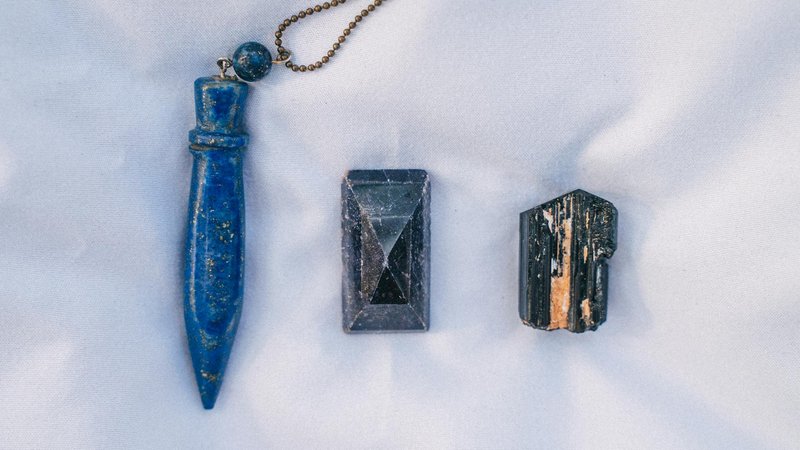
The geology of the deposit is unusual. Lapis lazuli forms in contact metamorphic zones, where limestone is altered by heat and pressure from nearby igneous intrusions. The blue mineral in lapis lazuli is lazurite, a complex sodium calcium aluminosilicate with sulfur. The quality of lapis depends on the proportion of lazurite to other minerals — calcite (white), pyrite (gold-colored metallic flecks), and diopside (green). The best material is deep blue with minimal calcite veining and small, evenly distributed pyrite inclusions. The pyrite flecks that some people consider a flaw are actually a useful identifier — genuine lapis lazuli almost always contains some pyrite, and material that is uniformly blue without any metallic flecks may be dyed.
Mining at Sar-e-Sang has been continuous for millennia. Archaeological evidence shows extraction activity dating back to at least the 4th millennium BCE, and some scholars argue the mines may have been worked as early as 7000 BCE. The methods were basic — fire-setting (heating rock with fire and then dousing it with water to crack it), hand tools, and manual labor — but the output was extraordinary. For most of recorded history, if you had lapis lazuli anywhere in the world, it came through these mines.
Ancient Egypt: The Stone of the Gods
The ancient Egyptians were obsessed with lapis lazuli, and their obsession tells us a lot about how they understood color and its connection to the divine. Blue, in Egyptian cosmology, was the color of the heavens — the sky, the Nile, the primeval waters from which creation emerged. Lapis lazuli, as the most vivid and durable blue material available, became the physical embodiment of these concepts.
Pharaohs were buried with lapis lazuli amulets. The funeral mask of Tutankhamun contains inlays of lapis lazuli in the stripes of the headdress. Scarabs, beads, and pendants made from lapis have been found in tombs across Egypt, from the earliest dynasties through the Ptolemaic period. The stone wasn't just decorative — it was functional in a religious sense, carrying the power of the heavens into the afterlife with the deceased.
But the Egyptians also valued lapis lazuli for something more practical: its use as a pigment. Ground lapis lazuli produced ultramarine, the most prized blue pigment in the ancient and medieval world. The process of making ultramarine from lapis was laborious and wasteful. The stone had to be ground to a fine powder, then repeatedly mixed with wax and kneaded in lye to separate the blue lazurite particles from the calcite and other impurities. The yield was low — a high-quality piece of lapis might produce only 10% to 20% of its weight in usable pigment.
The result, though, was extraordinary. Ultramarine made from lapis lazuli was more vivid, more lightfast, and more saturated than any other blue pigment available. It didn't fade, didn't shift in color, and maintained its intensity for centuries. Egyptian artists used it in tomb paintings and funerary art, where its durability was literally immortal — paintings sealed in tombs for three thousand years still show their original blue.
Mesopotamia and the Bronze Age Trade Network
Lapis lazuli traveled far from its Afghan source. In the ancient Near East, it was traded across thousands of miles — from Badakhshan through the Iranian plateau, into Mesopotamia, and beyond to the Mediterranean. The trade routes that carried lapis were among the earliest long-distance commercial networks in human history, predating the Silk Road by millennia.
The Royal Cemetery of Ur, excavated in the 1920s by Leonard Woolley, contained some of the most spectacular lapis lazuli artifacts ever found. The famous "Standard of Ur" — a wooden box inlaid with lapis, shell, and red limestone — depicts scenes of war and peace in vivid color, with lapis forming the backgrounds and key details. The "Ram in the Thicket" sculpture features a goat made of gold and lapis, with the lapis forming the belly and legs. These pieces date to around 2500 BCE and demonstrate how highly the Sumerians valued the stone.
In Mesopotamian culture, lapis lazuli was associated with the gods and with royalty. The Epic of Gilgamesh, one of the oldest works of literature in existence, describes the walls of Uruk as being built of lapis lazuli — almost certainly an exaggeration, but one that conveys the stone's association with grandeur and divine favor. Cylinder seals made from lapis were status objects, owned by the wealthy and powerful. The stone was, in a very real sense, a currency of prestige.
The Medieval Period: Ultramarine as Artist's Gold
If ancient Egypt and Mesopotamia valued lapis lazuli for its religious and symbolic significance, medieval Europe valued it for a different reason: it was the best blue paint available, and it was obscenely expensive.
Ultramarine pigment made from lapis lazuli was, by some accounts, more expensive than gold by weight during the Middle Ages and Renaissance. The cost was driven by the difficulty of the supply chain — lapis had to be mined in Afghanistan, transported thousands of miles through multiple intermediaries, and then processed into pigment through the laborious extraction method described above. By the time a painter in Florence or Bruges received a small bag of ultramarine powder, its price reflected every hand it had passed through and every mile it had traveled.
Because of the cost, ultramarine was reserved for the most important elements of a painting. Medieval and Renaissance artists used it sparingly — for the robes of the Virgin Mary, for the central figure in a religious scene, or for a particularly important detail. Contracts between artists and patrons sometimes specified exactly how much ultramarine would be used and where, since the cost of the pigment significantly affected the total price of the commission.
Painters who could afford to use ultramarine liberally were making a statement about both their skill and their patron's wealth. A painting with large areas of ultramarine blue was, implicitly, a very expensive painting. The blue was the price tag.
This changed in 1828, when a French chemist named Jean-Baptiste Guimet synthesized ultramarine blue from artificial ingredients — sodium, aluminum, sulfur, and silica — creating a pigment that was chemically identical to natural ultramarine but available at a fraction of the cost. French ultramarine, as it was called, democratized blue. Within decades, the pigment that had once been more expensive than gold was affordable to any painter. The color itself didn't change, but its meaning did. When blue stopped being rare, it stopped being a marker of wealth and power.
Lapis Lazuli in Modern Jewelry
Today, lapis lazuli is widely available as a gemstone and decorative material, though the quality varies enormously. The finest material still comes from Afghanistan, but lapis is also mined in Russia (Lake Baikal region), Chile, and smaller deposits in several other countries. Russian lapis tends to be lighter blue with more calcite veining. Chilean lapis is often paler and less saturated than Afghan material.
In jewelry, lapis lazuli is typically cut as cabochons (smooth, domed shapes) or carved into beads. It's relatively soft — 5 to 5.5 on the Mohs scale — which means it scratches more easily than quartz, garnet, or harder gemstones. It's not ideal for rings that take daily wear, but works well in pendants, earrings, and bracelets that encounter less contact with hard surfaces.
The pyrite inclusions that are characteristic of genuine lapis are worth understanding. Some people love them — the gold flecks against deep blue create a distinctive visual that's immediately recognizable. Others prefer calibrate, which has fewer inclusions and a more uniform blue. Both are genuine lapis lazuli. What you should be wary of is material that is uniformly blue with absolutely no pyrite or calcite — this could be dyed howlite or another less expensive stone. The imperfections in natural lapis aren't flaws; they're authenticity markers.
Lapis lazuli is also frequently treated — dyed, impregnated with wax or polymer, or both. These treatments improve the color and durability of lower-grade material. Treated lapis is still real lapis; the treatment just enhances what's already there. Untreated, natural lapis in a deep, uniform blue with minimal calcite is the most valuable and should be priced accordingly.
A Stone That Earned Its Reputation
Lapis lazuli is one of the few materials that has maintained its cultural significance across thousands of years and dozens of civilizations. The Egyptians valued it. The Sumerians valued it. Medieval European painters valued it. Modern jewelers and collectors still value it. Very few natural materials have that kind of staying power.
Part of the reason is the color itself. That deep, saturated blue is rare in nature, and it triggers a strong aesthetic response in most people. But part of it is also the story — the knowledge that this stone comes from remote mountains in Afghanistan, that it was traded across ancient empires, that it was ground into pigment worth more than gold. Every piece of lapis lazuli carries that history with it, whether you think about it or not.
Comments