The Thrill of Finding Something in the Dirt
The Thrill of Finding Something in the Dirt
There's a particular feeling that hits you when you pick up a rock, turn it over, and see something that doesn't look like regular rock. Maybe it's a slight transparency at the edge. Maybe the surface has a geometry that nature doesn't usually produce. Maybe it's just a flash of color that catches your eye. Whatever it is, that moment of "wait, is this something?" is addictive in a way that's hard to explain to someone who hasn't felt it.
Learning to identify raw crystals in the wild is part science, part pattern recognition, and part stubborn optimism. You will pick up a thousand rocks that turn out to be nothing before you find one that's actually something. The people who get good at it are the ones who keep picking up rocks anyway. Here's how to start.
Start With What's Common in Your Area
This is the single most important piece of advice in this entire article, and it's the one most people skip. Before you go looking for crystals, find out what crystals are actually found in your region. You can waste years looking for turquoise in New England or hoping to find emeralds in Kansas. Neither is going to happen.
Geological maps are your friend here. The United States Geological Survey (USGS) provides free mineral resource maps for every state. Many state geological surveys have more detailed local maps. Rock and mineral clubs in your area are even better — their members know exactly where to go and what to look for.
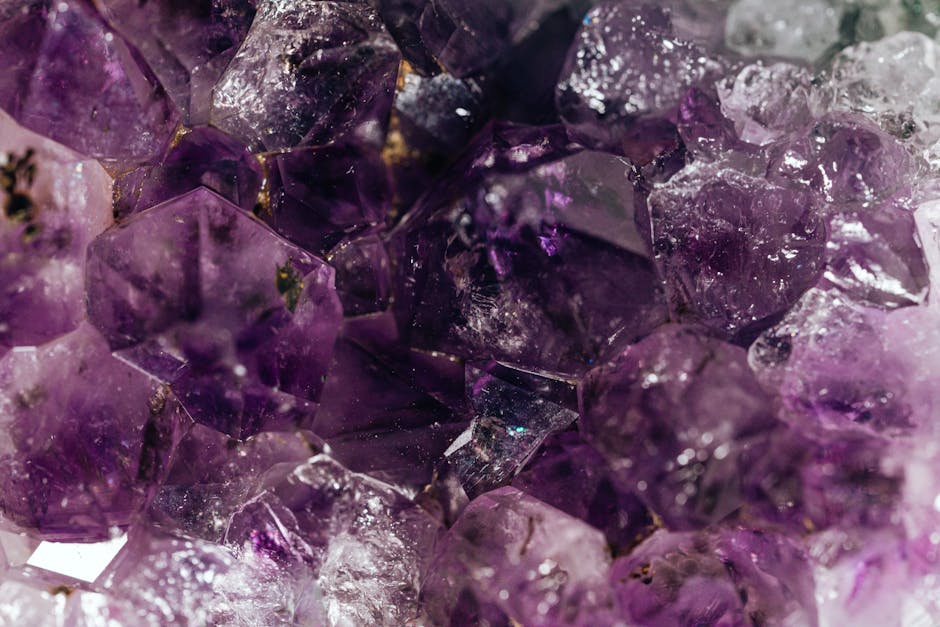
Some commonly found crystals in the US by region: quartz (everywhere), amethyst (Arizona, Georgia, Maine), tourmaline (Maine, California, South Dakota), garnet (Idaho, New York, North Carolina), topaz (Utah, Texas, Colorado), and beryl (New Hampshire, Utah, North Carolina). If you're outside the US, check your national geological survey or local mineralogical society.
Look at the Shape, Not the Color
Beginners almost always focus on color, and color is the least reliable indicator of what a crystal is. Quartz comes in clear, white, pink, purple, smoky, yellow, and nearly black. Calcite comes in clear, white, yellow, orange, blue, green, and pink. Fluorite comes in every color imaginable. Color is affected by trace impurities, radiation exposure, and weathering — the same mineral can look completely different from one specimen to the next.
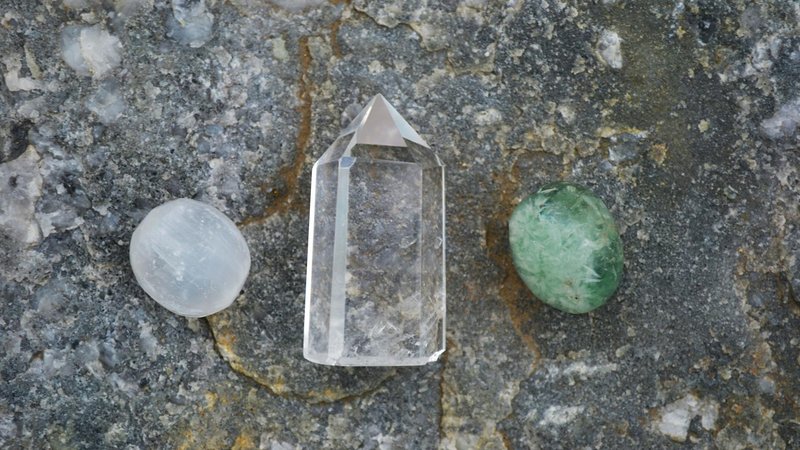
Shape is much more reliable. Crystal faces — the flat surfaces where a crystal grew — have specific angles determined by the mineral's atomic structure. Quartz crystals have hexagonal (six-sided) cross-sections with pointed terminations. Calcite has rhombohedral (diamond-shaped) cleavage. Mica forms in thin, flexible sheets. Pyrite grows in cubes.
Learn to recognize crystal habits — the typical shape a mineral grows in. A mineral identification book with clear photographs of crystal habits is worth more than any color chart.
Check for Crystal Faces and Terminations
A "terminated" crystal is one that has its natural point intact — the shape where it stopped growing. In the wild, most crystals you find won't have perfect terminations because they've been battered by water, other rocks, and weathering. But even partial terminations are identifiable if you know what to look for.
Run your fingernail along the surface. If you feel flat, smooth faces — especially if they meet at regular angles — that's a strong sign you've found a crystal rather than just a rock. Natural crystal faces have a subtle, uniform smoothness that fractured rock surfaces don't. Even heavily weathered crystals often retain traces of their original faces in protected areas.
Look for growth patterns too. Sometimes crystals grow in clusters, with multiple terminations emerging from a shared base. Quartz clusters are common and easy to identify once you've seen a few. The individual points growing in different directions from a matrix is a characteristic pattern that's hard to confuse with anything else.
Test the Hardness
Hardness is one of the most practical field tests for mineral identification. The Mohs scale runs from 1 (talc) to 10 (diamond), and you can test it with common objects. If you can scratch it with your fingernail (hardness 2.5), it might be talc or gypsum. If it scratches glass (hardness 5.5) but not a steel knife (hardness 5.5-6.5), it's in the feldspar range. If it scratches steel easily, it's quartz (7) or harder.
Quartz is probably the most common crystal you'll encounter in the wild, and its hardness of 7 is a useful benchmark. It will scratch glass and steel easily, and nothing except corundum, topaz, or diamond will scratch it. If you find a hard, clear crystal that scratches glass, quartz is the most likely answer.
Be careful with the scratch test on specimens you want to keep — you're literally damaging the surface. Test on the back or bottom of the specimen, not on any crystal faces you want to preserve.
Look in the Right Places
Crystals don't grow just anywhere. They need specific geological conditions: mineral-rich solutions, cavities in rock (geodes, vugs, veins), and time. Knowing where to look is half the battle.
Stream beds and riverbanks are productive because water has done the sorting for you. Heavy minerals (including many crystals) concentrate in certain areas of stream beds — the inside of bends, behind large rocks, and in pockets where the current slows down. After a heavy rain is the best time to look, because fresh material has been washed downstream.
Road cuts and highway embankments are surprisingly good crystal hunting spots. When construction cuts through rock, it exposes fresh surfaces that haven't been weathered. In many states, you can legally collect from road cuts on public land — check local regulations before you start chipping at any highway walls.
Old mines and quarries can be excellent but require caution. Abandoned mines are dangerous — unstable structures, toxic water, and questionable air quality are real risks. If you visit old mine dumps (the piles of waste rock outside mine entrances), stay on the surface and don't go underground.
Use Basic Tools, Not Fancy Equipment
You don't need much to start identifying crystals in the field. Here's what I carry:
A rock hammer (estwing-style, one piece of forged steel — avoid cheap hammers with wooden handles, they can shatter on hard rock). A hand lens or jeweler's loupe (10x magnification). A spray bottle of water (wet rocks show their colors and features much better than dry ones). Small ziplock bags or a cloth pouch for specimens. A small field notebook to record where you found things.
That's it. You don't need a UV light, a hardness testing kit, or a portable spectrometer. Those are great for advanced collectors, but they'll slow you down when you're just starting. Learn the basics first — shape, hardness, location — and add tools as your knowledge grows.
Common Mistakes That Lead to Misidentification
The most frequent mistake beginners make is confusing quartz with glass. Both can be clear, both can have conchoidal (shell-like) fracture patterns, and both feel hard. The difference is that quartz has crystal faces at regular angles and glass doesn't. If you see smooth, flat surfaces meeting at 120-degree angles, it's quartz, not glass. If the surface is curved or irregular with no geometric pattern, it's probably glass or slag.
Pyrite gets confused with gold constantly. Pyrite is brass-yellow, harder than gold, and brittle (it'll break if you hit it with a hammer). Gold is softer, heavier, and malleable (you can dent it). The old saying "all that glitters is not gold" exists because pyrite has been fooling people for millennia.
Calcite and quartz are often mixed up because both are common and both can be clear or white. Calcite is much softer (3 on Mohs vs 7) and reacts with a weak acid (vinegar works in a pinch — if it fizzes, it's calcite, not quartz). Calcite also has perfect rhombohedral cleavage — if you break it, the pieces will be diamond-shaped rhombohedrons.
When to Ask for Help
Even experienced collectors get stumped sometimes. If you find something unusual and can't identify it with your field guide, take clear photos (with something for scale, like a coin), note the location and the type of rock it was in, and post it to a rock and mineral identification group online. Reddit's r/rocks, Facebook mineral groups, and the Mindat.org forums all have knowledgeable members who can help.
Local university geology departments are another resource. Many have public mineral identification days or will look at specimens if you bring them in. Natural history museums sometimes offer this service too.
The mineral world is vast and varied, and nobody learns it all. The joy is in the process — getting out, looking closely at the ground, and occasionally finding something that makes you stop and stare. That's what crystal hunting is really about. The identification part is just how you figure out what you found.
Seasonal Considerations for Crystal Hunting
Timing affects crystal hunting more than most beginners expect. Spring and fall are generally the best seasons — moderate temperatures mean you can spend hours outside comfortably, and the ground is typically more exposed after seasonal vegetation die-back or before summer growth covers everything up.
After heavy rain is consistently the best time to hunt in stream beds and washes. Flash floods and high water dislodge material from upstream and redistribute it, often concentrating heavier specimens in eddies and pockets. Wait a day or two after a major storm for the water level to drop and the new deposits to settle — hunting in flood conditions is dangerous and unproductive.
Winter can be productive in some areas because frozen ground preserves freshly exposed material that would normally weather quickly. In regions with snow, the spring melt reveals fresh material that's been protected under the snowpack. Summer is toughest — tall grass, leaf cover, and undergrowth make spotting rocks on the ground much harder. In desert regions, summer is simply too hot for safe daytime collecting.
Legal and Ethical Considerations
Before you collect anywhere, check the rules. In the US, collecting on public land is generally allowed for personal, non-commercial purposes on Bureau of Land Management (BLM) land and in most national forests, with some restrictions. National Parks and many state parks prohibit collecting entirely — fines can be steep. Private land always requires permission from the owner.
Mining claims complicate things further. Many productive crystal collecting areas in the western US are covered by active or inactive mining claims. Collecting on an active claim without the claim holder's permission is trespassing and potentially theft. Research claim status on the BLM's LR2000 database before visiting any collecting site that might be claimed.
The general ethic among responsible collectors is to take only what you'll actually use, leave the site in the same condition you found it (fill in any holes you dig), and never collect more than a small amount from any single location. There are plenty of crystals out there — no need to strip-mine a productive site for personal specimens.
Building Your Identification Skills Over Time
Crystal identification is a skill that compounds. Every specimen you examine — whether you correctly identify it or not — adds to your mental database of shapes, textures, colors, and contexts. After a few dozen field trips, you'll start recognizing common minerals almost instantly. After a few hundred, you'll develop an intuitive sense for when something is unusual.
Keep a field journal. Record where you found each specimen, what the surrounding rock looked like, what the specimen looks like wet versus dry, and what you think it might be. Later, when you've had a chance to compare with reference materials, go back and note whether your initial guess was right. This feedback loop is the fastest way to improve.
Join a local rock and mineral club. These groups organize field trips to productive collecting sites, have members who can help with identification, and often maintain libraries of reference materials. The social aspect helps too — crystal hunting alone is meditative, but hunting with knowledgeable people is educational in a way that solo trips can't match.
Comments