I Had No Idea What to Get My Mom for Her Birthday — Then I Discovered Birthstone Jewelry
I Had No Idea What to Get My Mom for Her Birthday — Then I Discovered Birthstone Jewelry
Last year, I spent three weeks agonizing over my mom's birthday gift. Perfume? She has a drawer full of unopened bottles. A scarf? She wears the same two every winter. I was about to give up and grab a gift card when a friend casually mentioned, "Why don't you get her something with her birthstone?"
I didn't even know what a birthstone was. A quick search later, and I was down a rabbit hole of colors, meanings, and beautiful jewelry pieces. I ended up buying my mom a garnet pendant — January's stone — and she actually teared up. Not because it was expensive (it wasn't), but because it felt personal. It was picked just for her, tied to the month she was born, and it came with a story.
That experience changed how I think about gifting. If you've ever stared blankly at a birthday calendar wondering what to get someone, birthstone jewelry might be exactly what you need. Let me walk you through everything I've learned.
What Are Birthstones, Exactly?
The concept of birthstones has been around for centuries. The idea is simple: each month of the year is associated with a specific gemstone, and wearing "your" stone is supposed to bring good luck, protection, or personal meaning. The modern list most people use today was standardized by the American National Association of Jewelers back in 1912, though the tradition traces all the way back to the Bible's Book of Exodus, where Aaron's breastplate was decorated with twelve gems representing the twelve tribes of Israel.
Whether you believe in the mystical properties or not (I honestly don't care about that part), birthstone jewelry is just a genuinely thoughtful gift. It shows you put in effort. It's personal without being overly intimate. And it works for almost anyone — moms, sisters, partners, friends, even coworkers.
Birthstones by Month: A Complete Guide
Here's every birthstone broken down by month, with the color range, what it traditionally symbolizes, and roughly what you'll pay for a decent piece of jewelry featuring that stone.
January — Garnet
Colors: Deep red is the most famous, but garnets actually come in almost every color except blue. You'll find orange, green, purplish-red, and even color-change varieties.
Meaning: Trust, friendship, and eternal love. In medieval times, people believed garnets could protect travelers and prevent nightmares.
Price range: $20–$80 for sterling silver pieces. Deep red Mozambique garnets are affordable. Rhodolite garnets (pinkish-purple) run a bit higher at $50–$150 for nice stones. Demantoid garnets (green) are collector territory — don't go there unless you're serious.
February — Amethyst
Colors: Light lilac to deep purple. The most prized shade is a rich, saturated purple with red or blue flashes — called "Siberian" color even if it's from Brazil.
Meaning: Clarity of mind, calmness, and spiritual protection. The ancient Greeks thought amethyst could prevent drunkenness (the name literally means "not intoxicated").
Price range: This is one of the most affordable birthstones. You can find decent amethyst jewelry starting at $15–$30. Larger, deeper-colored stones or designer settings push into $60–$150 territory.
March — Aquamarine
Colors: Pale blue to blue-green, like the ocean on a clear day. The deeper the blue, the more valuable.
Meaning: Courage, tranquility, and safe travel — especially over water. Sailors historically carried aquamarine talismans.
Price range: Light aquamarines in sterling silver start around $30–$60. Stones with deeper blue saturation (especially from Brazil or Nigeria) can hit $100–$300. Very large, high-quality stones go much higher, but you don't need that for a meaningful gift.
April — Diamond
Colors: White/colorless is classic, but diamonds come in every color. Yellow, pink, and blue are the most popular fancy colors.
Meaning: Eternal love, strength, and invincibility. The word "diamond" comes from the Greek adamas, meaning "unbreakable."
Price range: Okay, this is the expensive one. Tiny diamond accents in birthstone pieces start around $50–$100. A standalone diamond birthstone ring or pendant in a meaningful size (0.25–0.5 carat) runs $300–$2,000+ depending on cut, color, and clarity. Lab-grown diamonds are a solid alternative at 30–50% less.
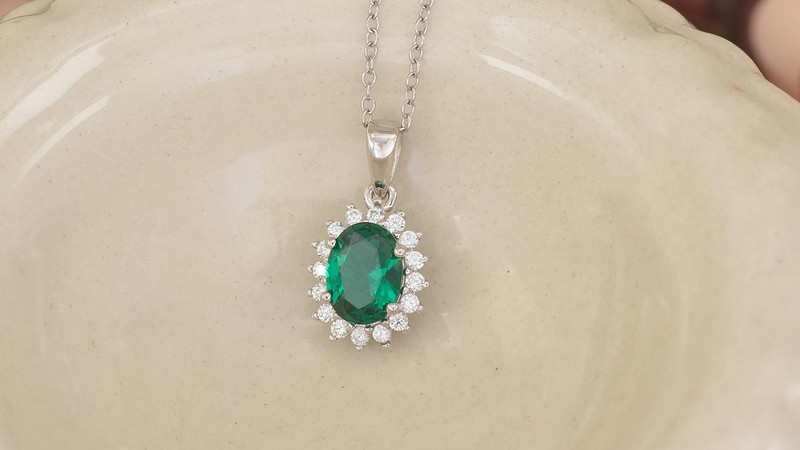
May — Emerald
Colors: Vivid green to bluish-green. The most valued emeralds have a deep, saturated green with a hint of blue.
Meaning: Rebirth, wisdom, and foresight. Emeralds were Cleopatra's favorite gem — she claimed entire mines.
Price range: Natural emeralds are pricey and almost always have inclusions (they're called "jardin," or garden, in the trade). Small emeralds in silver settings: $40–$80. Better-quality stones in gold: $150–$500+. If budget is tight, look for lab-created emeralds — they're chemically identical and a fraction of the price.
June — Pearl
Colors: White, cream, pink, gold, and black. Freshwater pearls are the most accessible; Tahitian pearls are the dark, exotic ones.
Meaning: Purity, humility, and wisdom gained through experience. Pearls are the only birthstone that comes from a living creature.
Price range: Freshwater pearl jewelry is surprisingly affordable — $20–$60 for necklaces and earrings. Akoya pearls (saltwater, rounder, more lustrous) run $80–$300. Tahitian and South Sea pearls start at $200 and climb into the thousands for premium strands.
July — Ruby
Colors: Red is the only color, ranging from pinkish-red to dark blood-red. The ideal is "pigeon's blood" — a vivid red with a slight blue undertone.
Meaning: Passion, protection, and vitality. In ancient Burma, warriors embedded rubies in their skin before battle, believing they made them invincible.
Price range: Small, commercial-quality rubies in silver: $30–$80. Better stones with good color: $150–$500. Fine rubies over 1 carat rival diamonds in price. Like emeralds, lab-created rubies offer the same look at a much friendlier price point.
August — Peridot
Colors: Yellowish-green to olive green. The most valued shade is a pure, bright green without too much yellow.
Meaning: Strength, healing, and protection from nightmares. Peridot is one of the few gemstones that only comes in one color (though the shade varies).
Price range: Peridot is very affordable. Nice pieces start at $15–$40. Even large, well-cut stones rarely exceed $100–$200 in standard jewelry settings.
September — Sapphire
Colors: Blue is the classic (and the September birthstone), but sapphires come in every color except red — those are rubies. "Fancy sapphires" include pink, yellow, peach, and even color-change varieties.
Meaning: Wisdom, loyalty, and nobility. Medieval clergy wore sapphires to symbolize heaven. Princess Diana's (and now Kate Middleton's) famous engagement ring features a blue sapphire.
Price range: Small blue sapphires in silver: $40–$80. Rich, saturated blue stones: $150–$500+. The most prized Kashmir blue sapphires are astronomically expensive, but you absolutely don't need one to give a beautiful gift. Fancy pink and yellow sapphires are trendy alternatives.
October — Opal
Colors: Opals are unique — they display a play of color (called "fire" or "flash") across a spectrum of hues against a white, black, or boulder background. No two opals look alike.
Meaning: Creativity, hope, and spontaneity. The Romans considered opals the most precious of all gems because they contained the colors of every other stone.
Price range: This one varies wildly. White opals: $30–$80. Ethiopian opals with good fire: $50–$150. Australian black opals (the most valuable): $200–$2,000+. Boulder opals offer a nice middle ground with unique patterns at $80–$300.
November — Topaz (Golden/Imperial)
Colors: The traditional November birthstone is golden or imperial topaz — warm amber, orange, and peach tones. Blue topaz is more commonly sold but technically isn't the "official" birthstone (though many jewelers offer it anyway).
Meaning: Friendship, love, and good fortune. The ancient Greeks believed topaz could make its wearer invisible and increase strength.
Price range: Blue topaz is extremely cheap — $15–$40 for nice pieces. Imperial topaz (the real deal in warm golden tones) is rarer: $80–$300 for quality stones. If you're buying for someone born in November, I'd lean toward the golden shades — they're more unique and feel more special.
December — Turquoise
Colors: Sky blue to greenish-blue, often with natural matrix (vein-like patterns) running through it. The most prized turquoise is a pure, even robin's egg blue without visible matrix.
Meaning: Protection, friendship, and good fortune. Turquoise has been used in jewelry for over 5,000 years — Egyptian pharaohs were buried with it, and Native American cultures consider it sacred.
Price range: Stabilized turquoise in silver settings: $25–$60. Natural, untreated turquoise from the American Southwest (like Sleeping Beauty or Kingman): $80–$300. High-grade Tibetan turquoise can be much more. For a gift, look for sterling silver turquoise pieces from reputable Native American or Southwestern artisans — they're beautiful, meaningful, and reasonably priced.
Creative Birthstone Jewelry Gift Ideas
Once you've picked the right stone, the next question is: what kind of jewelry? Here are some ideas I've found work well for different people and situations.
Birthstone Necklaces
This is probably the most versatile option. A simple pendant on a chain works for anyone — your mom, your girlfriend, your best friend. You can go minimalist with a solitaire stone in a bezel setting, or stack multiple birthstones for a family necklace (mom's stone in the center, kids' stones around it). Solitaire pendants in sterling silver typically run $25–$80. Family birthstone necklaces with multiple stones usually start around $60–$150.
Birthstone Bracelets
Charm bracelets with birthstone charms are a fun, buildable gift — you can add a new charm each year. Beaded stretch bracelets featuring birthstone chips are casual and stackable (and very trendy right now). Tennis-style bracelets with alternating birthstones and cubic zirconia or small diamonds feel more formal. Prices range from $20 for simple beaded designs to $200+ for fine jewelry versions.
Birthstone Earrings
Stud earrings are the safest bet if you're not sure about someone's style. Small birthstone studs in silver are classic and can be worn every day. Drop earrings with birthstone accents work for someone who likes a little more drama. Just check whether they have pierced ears first — I've made that mistake and it's awkward. Budget $20–$60 for studs, $50–$150 for drops.
Birthstone Rings
Rings are a bit trickier because sizing matters. But if you know their ring size (or can sneakily find out), a birthstone ring is a beautiful, personal gift. Stackable birthstone rings are popular — you can wear one for each child, family member, or milestone. Cocktail rings with a larger birthstone make a statement. Simple solitaire birthstone rings in silver start at $25–$60. Gold settings and larger stones push into the $150–$500 range.
Personalization Ideas That Make It Extra Special
Here's where birthstone jewelry goes from "nice gift" to "they'll cry" gift. Most jewelers (especially online ones like Etsy sellers and small studios) offer engraving options. Consider these ideas:
On the back of a pendant: The person's initial, their birth date, or a short message like "Forever my [Mom/Sister/Friend]." I put "July 1962 ♥" on the back of my mom's garnet pendant — her birth month and year — and she wears it facing out so everyone can read it.
Inside a ring band: A meaningful date, coordinates of a special place, or a word that's significant between you two. Keep it under 20 characters for the best readability.
On a bracelet clasp: A single initial or a tiny heart symbol.
The key is to keep it short and personal. Long sentences get cramped and hard to read. A few meaningful words hit harder than a paragraph.
What to Watch Out for When Buying Birthstone Jewelry
After buying several birthstone pieces (and making a few mistakes), here's what I wish someone had told me:
Ask about the stone type. Some sellers use glass, cubic zirconia, or synthetic substitutes and still call them "birthstones." There's nothing wrong with lab-created stones — they're often more durable and affordable — but you should know what you're paying for. If you want a natural stone, ask specifically.
Check the metal quality. "Sterling silver" should be stamped .925. "Gold-filled" has a much thicker layer of gold than "gold-plated" and lasts much longer. "Solid gold" should come with a karat stamp (10K, 14K, 18K). If there's no stamp, ask.
Read return policies. Jewelry is subjective. What looks great in a photo might not work in person. Buy from places that offer at least a 14-day return window.
Consider the wearer's lifestyle. A delicate opal pendant might not be the best gift for someone who works with their hands all day. Pearls are porous and can be damaged by perfume and hairspray. Emeralds are relatively soft and can chip. If the person is rough on jewelry, lean toward harder stones like sapphire, ruby, or diamond.
Don't overspend trying to impress. The beauty of birthstone jewelry is in the meaning, not the price tag. A $40 amethyst pendant from a thoughtful gift-giver means more than a $500 generic diamond necklace. Seriously. I tested this theory with my own family and it held up every time.
Final Thoughts
Birthstone jewelry turned me from someone who dreaded gift shopping into someone who actually enjoys it. There's something satisfying about picking a piece that's uniquely tied to the person you're giving it to — their month, their color, their story.
Start with the month. Pick a stone that speaks to you (or to them). Choose a jewelry type that fits their style. Add a small personal touch if you can. And don't stress about the budget — the thought really does count here, probably more than with any other type of gift.
My mom still wears that garnet pendant every day. She told me last month it's her favorite piece of jewelry. Not because the garnet is particularly valuable, but because when someone asks about it, she gets to say, "My daughter got it for me because it's my birthstone." That's the kind of gift that keeps giving.

Comments