<h2>How to Wire Wrap a Crystal Pendant: A Beginner Tutorial</h2>
Tools and Materials
Before you start, gather these items. You do not need anything expensive to get started.
Wire. The standard for beginners is 20-gauge (0.8mm) dead-soft round wire. Dead-soft wire is easy to bend and shape, which is what you want when learning. Half-hard wire is stiffer and holds its shape better but is harder to work with for beginners. Round wire is the most versatile shape. You will want copper wire for practice because it is cheap and looks good. A 50-foot spool of 20-gauge copper wire costs about $6 to $8 at any craft store.
Round nose pliers. These have tapered, cone-shaped jaws and are used for making loops and curves. Every loop you make in wire wrapping starts with round nose pliers. Get a pair with smooth jaws (no serrations) so they do not mark the wire. Expect to pay $8 to $15 for a decent pair.
Chain nose pliers. These have flat, tapered jaws and are used for gripping wire, flattening wraps, and reaching into tight spaces. Again, smooth jaws are important. $8 to $15.
Wire cutters. Flush cutters are ideal because they cut one side flat and one side slightly pointed. You always cut with the flat side toward your finished work so the pointed end (the pinch) faces away from the piece. $6 to $12.
Optional but useful: nylon jaw pliers for straightening bent wire, a ruler or measuring tape, and masking tape for holding bundles of wire together while you work.
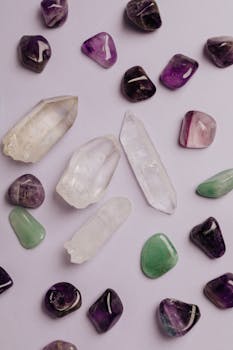
For the crystal itself, start with a tumbled stone or a small rough piece that has at least one somewhat narrow dimension you can wrap around. A stone roughly 1 to 1.5 inches long works well. Avoid very smooth, perfectly round stones at first; they are harder to secure. A slightly irregular shape gives the wire something to grip.
Total startup cost for tools and materials: roughly $30 to $45, assuming you buy copper wire and basic tools.
Wire Choices: Copper, Silver, and Gold
Copper is the best metal to learn on. It is inexpensive, soft enough to shape easily, and develops a warm patina over time. The main downside is that some people's skin reacts to copper, turning it green where it touches sweat. A clear coating of nail polish or jeweler's lacquer on the back of the pendant prevents this.
Sterling silver (92.5% silver, 7.5% copper) is the standard for wearable wire-wrapped jewelry. It is harder than copper, which means your wraps will hold their shape better, but it is also less forgiving of mistakes. A 50-foot spool of 20-gauge sterling silver round wire costs $25 to $35. Dead-soft sterling is still workable but stiffer than dead-soft copper. Half-hard sterling is common for structural elements like bail loops.
Gold-filled wire has a thick layer of gold (at least 5% of the total weight) bonded to a base metal core, usually brass. It looks like solid gold, does not tarnish, and is durable enough for daily wear. A 10-foot spool of 20-gauge gold-filled wire costs $20 to $35, depending on the gold karat (usually 14k). Solid gold wire (24-gauge and finer) is available but expensive and very soft, making it harder to work with for structural wraps.
The practical recommendation: practice everything in copper first. When you can complete a wrap you are happy with, remake it in sterling silver. Save gold-filled wire for pieces you plan to wear regularly or give as gifts.
Style One: The Simple Wrap
This is the most basic wire wrap and the foundation for the other two styles. It uses a single piece of wire to create a bail loop at the top and a few wraps around the stone to hold it in place.
Step 1: Cut a piece of 20-gauge wire about 12 to 15 inches long. You can always trim excess later, so err on the side of too long.
Step 2: About 2 inches from one end, bend the wire at a 90-degree angle using chain nose pliers. This bend becomes the bottom of your bail loop.
Step 3: Grab the bend with round nose pliers, close to the bend, and wrap the short end of the wire over the top of the pliers to form a loop. The loop should be large enough to fit a chain through, roughly 4 to 6mm in diameter.
Step 4: Wrap the short tail of wire around the long tail (the stem below the loop) two or three times. These are your bail wraps. Use chain nose pliers to squeeze them tight and flat. Snip off the excess short tail with flush cutters, and use chain nose pliers to press the cut end down so it does not snag.
Step 5: Place the stone against the wire stem, just below the bail wraps. Bend the long wire up and over the stone, then down the other side. You are creating a U-shape that cradles the stone.
Step 6: Where the wire crosses below the stone, twist it around the stem one or two times to lock the stone in place. Then continue the wire up to the bail and wrap it around the stem two more times below the existing bail wraps.
Step 7: Trim the excess wire, press the end flat, and you are done. The stone should sit snugly in the wire frame with the bail loop centered above it.
This entire process takes about 10 to 15 minutes once you get comfortable with it. Plan on 30 to 45 minutes your first time, including the time spent undoing and redoing steps.
Style Two: The Cage Wrap
The cage wrap (sometimes called a skeleton wrap) encloses the stone in a frame of wire that holds it securely without glue. It works well for stones that are too smooth or round for a simple wrap to grip.
Step 1: Cut three pieces of 20-gauge wire, each about 10 to 12 inches long. Line them up parallel and use a small piece of masking tape at the middle to hold them together in a bundle.
Step 2: Find the midpoint of the bundle and bend it over the stone. You are creating a frame that wraps around the widest part of the stone. Cross the wire ends on the opposite side and twist them together once to hold the shape.
Step 3: Take one of the six wire ends and wrap it around the bundle where the wires cross, circling 2 to 3 times. Repeat with a second wire end on the same spot. This locks the frame together.
Step 4: Now work the wire ends up toward the top of the stone, bending them one at a time to follow the contour of the stone. You are building the cage, with each wire conforming to the stone's shape.
Step 5: When all six wire ends meet at the top, gather them together and use one wire end to wrap around all the others, creating a gathered top. Wrap 3 to 4 times to secure.
Step 6: Use round nose pliers to form a bail loop with two of the longest remaining wire ends. Wrap the tails around the gathered bundle 2 to 3 times below the loop.
Step 7: Trim all remaining wire ends and press them flat. Tuck any sharp ends between the stone and the wire frame so they cannot catch on skin or clothing.
The cage wrap takes about 20 to 30 minutes. It is more forgiving than the simple wrap because the multiple wires distribute tension evenly, but it uses more wire and looks more complex.
Style Three: The Weave Wrap
The weave wrap is the most decorative of the three and the most time-consuming. It involves wrapping thin wire (24 or 26 gauge) around thicker base wires to create a braided or woven texture. The result is a pendant that looks intricate and professional.
Step 1: Cut two pieces of 20-gauge wire (base wires) about 8 inches each. Cut a longer piece of 24-gauge wire (weaving wire) about 3 to 4 feet long. The weaving wire needs to be much longer than you think because each wrap consumes several inches.
Step 2: Place the stone between the two base wires and bend them around the stone to form a frame, similar to the U-shape in the simple wrap. Twist the base wires together at the bottom to hold the stone.
Step 3: Starting near the bottom twist, take the thin weaving wire and wrap it tightly around both base wires together. Make 4 to 6 wraps, then add a small loop or twist in the weaving wire before continuing. Repeat this pattern (wrap several times, make a small decorative loop, wrap several more times) as you work your way up one side of the stone.
Step 4: When you reach the top, cross the weaving wire over to the other side and work your way back down, continuing the same pattern. The decorative loops should nestle against the stone, holding it in place.
Step 5: When you reach the bottom again, wrap the weaving wire around the base wires to finish, trim, and tuck the end.
Step 6: Form the bail at the top using the two base wire ends, wrapping them together and creating a loop with round nose pliers.
The weave wrap takes 45 minutes to over an hour, even for experienced wrappers. It is the most material-intensive style, using roughly 4 feet of thin wire per pendant. The result is worth the effort if you want a piece that looks handcrafted rather than basic.
Common Mistakes and How to Fix Them
The stone is too loose. This is the most common beginner problem. The wire frame needs to make contact with the stone at multiple points, not just rest against it. Add more wraps or tighten existing ones. If the stone is very smooth, consider wrapping a small piece of sandpaper around it and roughing up the contact points slightly so the wire grips better.
The wire is kinked or marked. Pliers with serrated jaws leave marks. Smooth-jaw pliers fix this. If you already have serrated pliers, wrap the jaws in a layer of masking tape while you work. Kinks in the wire can be smoothed out with nylon jaw pliers (or, in a pinch, by rolling the wire between two hard, smooth surfaces).
The bail loop is off-center. This happens when the wraps below the bail are uneven. Undo the wraps, reposition the wire, and rewrap. It is faster to redo it than to try to bend a crooked bail into shape after the fact.
The wraps are loose and gappy. You are not pulling the wire tight enough after each wrap. After each wrap, use chain nose pliers to squeeze it firmly against the previous one. Consistent tension is the single most important skill in wire wrapping.
You ran out of wire. Always cut wire longer than you think you need. An extra 3 to 4 inches costs pennies and saves you from having to start over. If you do run short, you can sometimes add a new piece by tucking the end of the old wire between the stone and the frame and starting the new piece from the same spot.
Time and Cost Summary
For each style, here is what to expect in terms of time, wire usage, and cost per pendant (using copper wire).
Simple wrap: 10 to 15 minutes, about 12 inches of 20-gauge wire, under $1 in materials per pendant. Sterling silver version: about $1.50 in wire.
Cage wrap: 20 to 30 minutes, about 30 inches of 20-gauge wire (three 10-inch pieces), under $1.50 in copper materials. Sterling silver version: about $2.50.
Weave wrap: 45 to 60 minutes, about 8 inches of 20-gauge wire plus 4 feet of 24-gauge wire, under $2 in copper materials. Sterling silver version: about $4 to $5.
None of these require a workspace larger than a kitchen table. The tools fit in a small pouch. The entire hobby is portable enough to do on a train or at a coffee shop, which is part of the appeal. Start with copper, make mistakes freely, and move to silver when your wraps look the way you want them to. The learning curve is steep for the first few attempts and then flattens out fast. By your fifth pendant, you will know whether this is a hobby you want to stick with.
Comments