How to Travel With Your Crystal Collection Without Breaking Everything
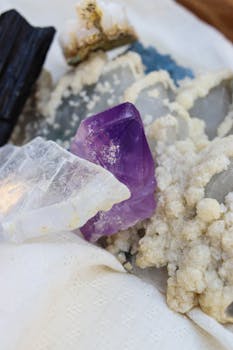
Crystal collectors are, by nature, optimistic people. They carry stones across the country in cardboard boxes lined with t-shirts, toss tumble bags into carry-ons, and somehow expect that fragile minerals formed over millions of years will survive being jammed under an airplane seat. Most of the time, they get lucky. Sometimes they don't, and the sound of breaking quartz in a checked bag is a particular kind of heartbreak.
Traveling with crystals isn't complicated, but it does require thinking about three things: physical protection, temperature changes, and the fact that airport security has opinions about rocks.
The physics of breaking crystals
Crystals break when force exceeds their structural integrity. That sounds obvious, but the type of force matters. A crystal might survive a direct drop onto carpet — the impact force dissipates across the surface area. The same crystal might shatter from a sharp tap on a specific point because the force concentrates on a tiny area.
Natural crystals have cleavage planes — directions along which the atomic bonds are weaker. Hit a calcite crystal on its cleavage plane and it splits cleanly. Hit it at an angle and it chips irregularly. Cleavage is predictable once you understand it: calcite has perfect rhombohedral cleavage, meaning it breaks into rhombus-shaped pieces. Feldspar has two cleavage directions at nearly 90 degrees. Mica has perfect basal cleavage and splits into thin sheets — that's why it peels so easily.
Quartz has no true cleavage, which is why it's so durable. But it has conchoidal fracture — it breaks in smooth, curved patterns like thick glass. A quartz point dropped on its tip concentrates all the force on a single point, which is why points snap. A tumbled quartz piece dropped flat distributes the force and usually survives.
The practical takeaway: pack so that nothing can strike your crystals at a single concentrated point, and so that crystals can't shift and strike each other. Movement during transit is the real enemy. A stone that can't move can't break from impact.
Packing materials that actually work
Individual wrapping
Every crystal needs its own layer of padding. Not a shared compartment — its own wrap. The best materials for this are:
Soft cotton or microfiber pouches are ideal. They're cheap (usually $1-3 each in bulk), they don't shed fibers onto the stone, and they provide a thin cushion layer. For harder stones (quartz and above), a cotton pouch is often sufficient on its own. For softer or more fragile specimens, add a layer of bubble wrap inside the pouch.
Bubble wrap is the standard for a reason. Small-bubble wrap (1/4 inch bubbles) is better than large-bubble for crystals because it conforms to irregular shapes more closely. Wrap each stone separately, tape the wrap closed, and don't stack wrapped stones directly against each other. The tape matters — unwrapped bubble wrap will unroll during transit, leaving the stone exposed.
Tissue paper works for very small tumbles and chips, but it's thin enough that sharp crystal edges can poke through during rough handling. Use at least three layers if tissue is all you have. Toilet paper and paper towels work in a pinch but aren't ideal — they compress too much under pressure.
For raw crystal clusters and points with sharp terminations, foam wrap (the kind with a foam layer bonded to bubble wrap) is worth the extra cost. The foam prevents sharp crystal points from puncturing the bubble layer.
The container
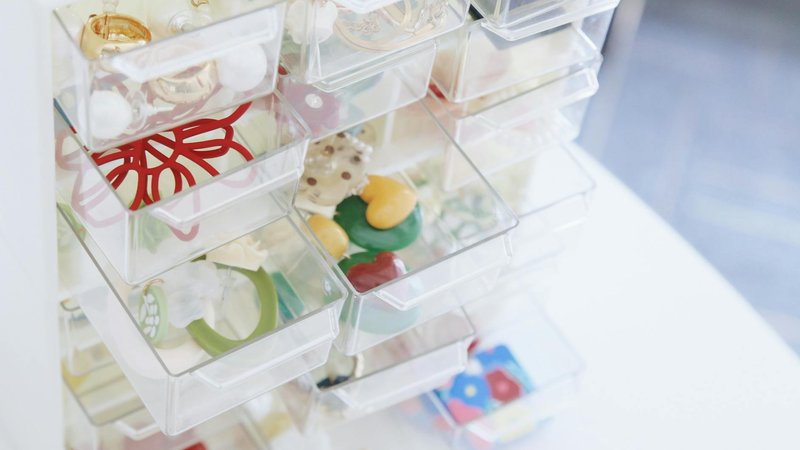
A hard-sided container is significantly better than a soft bag. A small plastic tackle box with adjustable compartments is probably the single best option for most collections — the compartments prevent movement, the plastic shell absorbs impacts, and they're cheap ($8-15 at any hardware store). Line each compartment with a bit of cotton or tissue.
Pill organizers work for small tumbles (the kind with 7+ daily compartments). They're rigid, they seal, and they keep stones completely separated. Cost is about $3-5. The weekly pill organizers with snap-shut lids are particularly good because they won't accidentally open in your bag.
Altoids tins and similar metal containers are decent for a few small stones. The metal dents on impact, which absorbs some energy, but sharp crystal edges can scratch through paint. Line the inside with padding. One advantage of tins: they're nearly free if you eat mints, and they stack neatly in a bag.
For raw crystal specimens and larger pieces, a padded camera case works well. These are designed to protect delicate optical equipment and have foam inserts you can cut to fit your specific stones. They cost more ($15-40) but offer the best protection for valuable specimens. The foam is usually customizable — pluck-foam styles let you remove sections to create a custom-fit space for each stone.
Another option for larger collections: a Pelican case or similar hard waterproof case. These are overkill for casual travel but unbeatable for checked baggage with valuable specimens. They're watertight, crush-resistant, and padded. Prices start around $30 for small sizes.
Filling the gaps
The most common packing mistake is leaving empty space. If a stone can move one inch inside its container, it will — repeatedly — during a two-hour car ride. Fill every gap with cotton balls, tissue, or spare fabric. The container should hold the stone firmly enough that you can shake it without hearing or feeling anything move.
A good test before you leave: close the container, shake it vigorously for 10 seconds, and listen. If you hear rattling, you need more padding. If it's silent, you're good to go.
Temperature and humidity considerations
Most crystals handle normal temperature ranges fine, but some have specific vulnerabilities:
Opals contain 3-21% water and can crack from rapid temperature changes. Don't leave opal jewelry in a hot car (interior temperatures can reach 140°F / 60°C in summer) and don't go from air-conditioned buildings to outdoor heat repeatedly while wearing opal pieces. Ethiopian opals, which are more porous than Australian opals, are particularly sensitive to humidity changes. Store them in a sealed bag with a slightly damp cotton ball if you're traveling to a dry climate.
Halite (rock salt) and selenite are hygroscopic — they absorb moisture from humid air. In tropical or very humid climates, they can develop a sticky, damp surface. Seal them in a plastic bag with a silica gel packet for travel in humid environments. A single silica gel packet (the kind that comes in shoe boxes) is enough for a small container.
Amethyst and other iron-containing quartz varieties can fade with prolonged UV exposure. This isn't usually a problem during a few days of travel, but if you're driving through a desert with crystals on the dashboard, expect color loss. Dashboard temperatures in a parked car can exceed 160°F — that's hot enough to cause thermal damage to some stones and certainly hot enough to fade amethyst over a multi-day road trip.
Fluorite is thermoluminescent and can develop color changes from heat, though this requires sustained high temperatures (above 200°C) that you're unlikely to encounter in normal travel.
Carry-on vs. checked baggage
Always carry your crystals in your personal item or carry-on if possible. Checked bags get thrown, stacked, compressed, and exposed to temperature extremes in the cargo hold. TSA and other security agencies also open checked bags for inspection, and agents don't necessarily repack your items with care. There's no special training for baggage handlers on how to treat fragile items — they process hundreds of bags per hour.
If you must check crystals (large collections, heavy specimens), pack them in the center of your suitcase surrounded by clothing on all sides. The suitcase itself acts as a first layer of shock absorption. Put a fragile sticker on the outside — it won't guarantee gentle handling, but it doesn't hurt. Place the crystal container in the middle of the suitcase, not against any edge or corner where impact forces are highest.
Airport security and crystals
Crystals generally don't trigger security alarms. They're not metallic (with a few exceptions like pyrite and galena) and they're not on any prohibited items list. However, dense mineral specimens can look suspicious on X-ray scanners because they're opaque and irregularly shaped. Security agents may want to inspect the bag by hand.
This happens more often with larger raw specimens than with tumbled stones. If you're traveling with a significant collection, arrive at the airport with extra time and be prepared to open your bag. Don't argue with security agents about rocks — they've seen people try to smuggle all kinds of things inside mineral specimens, and they have every right to inspect. Be polite, explain that they're decorative stones, and you'll be on your way in minutes.
Pyrite, galena, and other metallic minerals will trigger the metal detector if carried loose. Wrapped in fabric and inside a bag, they usually don't, but it depends on the detector sensitivity. If you're traveling with a large pyrite specimen, be prepared for a hand inspection.
Traveling by car vs. flying
Car travel gives you much more control. You choose the packing, the positioning, and the temperature. The main risks are vibration (rough roads) and sudden stops. Place your crystal container somewhere it can't slide — wedged between seats, in a center console, or on the floor behind the front seats. The trunk is acceptable if you pad the container well, but it gets hotter back there in summer. In winter, the trunk can get cold enough to cause thermal stress for some stones when you move them into a heated car cabin.
Flying requires more compact packing and less margin for error. Use a hard container, wrap each stone individually, fill all gaps, and keep it in your carry-on. The overhead bin is better than under the seat for larger containers — less vibration from foot traffic.
A pre-travel checklist
Before you leave, take a quick photo of your collection. If anything gets damaged in transit, you'll know exactly what it looked like before. This is also useful for insurance claims if you're traveling with valuable specimens. A few minutes of phone photography is cheap insurance.
Check each stone for existing cracks, inclusions, or weak points. Stones that are already cracked are far more likely to break during travel. Consider leaving particularly fragile specimens at home. If a stone has a visible fracture line, mark it with a small piece of tape so you remember which side is vulnerable when packing.
For valuable pieces, consider whether the trip is worth the risk. A $500 crystal specimen doesn't become less valuable because you're traveling — it becomes more vulnerable. If you don't need it with you, leave it. This applies doubly to irreplaceable specimens — if it's the only one you have and you can't replace it, don't travel with it unless absolutely necessary.
Bring a small repair kit: a few cotton pouches, some tissue, and a small tube of superglue (for clean breaks that you want to reassemble later). You probably won't need it, but it weighs almost nothing and takes up no space. Superglue works on clean quartz fractures surprisingly well — the bond isn't as strong as the original crystal, but it holds for display purposes.
Traveling with crystals is mostly common sense: pad them, separate them, immobilize them, and keep them with you. The people who have the worst luck are the ones who toss everything into a bag at the last minute and hope for the best. Take ten extra minutes to pack properly and your crystals will arrive in the same condition they left.
Comments