How to Tell if Your Crystal Is Real or Fake: A Complete Guide
The Short Answer
There's no single test that works for every crystal, but combining a few simple checks — temperature, weight, clarity, and light — will help you spot most fakes with confidence.
Let's walk through the methods that actually work, and the ones that don't.
Why Fake Crystals Are Everywhere
The crystal market has exploded in recent years. More demand means more sellers cutting corners. Glass, plastic, resin, and dyed stones are sold as genuine crystals on marketplaces every day. The good news: most fakes are obvious once you know what to look for.
The Temperature Test
This is the simplest and often the most telling test.
Real crystals feel cold when you first pick them up and take a moment to warm up in your hand.
Glass and plastic fakes warm up almost immediately — they reach room temperature in seconds.
How to do it: Hold the crystal in your closed hand for 30 seconds. Then set it down and pick up a piece of glass (a drinking glass works). If the crystal and the glass feel the same temperature, something's off.
The Weight Test
Real crystals tend to be heavier than they look because natural stone is dense. Glass and resin are lighter for their size.
How to do it: Pick up the crystal and compare its weight to a similar-sized object you know is real. If it feels surprisingly light, be suspicious.
Exceptions: Some real crystals like selenite and celestite are naturally lightweight. This test works best for denser stones like quartz, jade, and obsidian.
The Light and Clarity Test
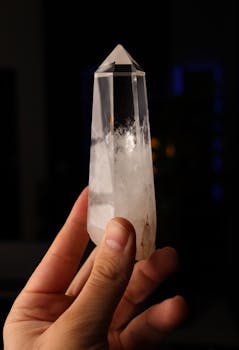
Hold the crystal up to a strong light source and look through it.
Real natural crystals usually have tiny imperfections — micro-cracks, inclusions, slight color variations, or internal cloudiness. These aren't flaws; they're proof that the stone formed naturally over thousands of years.
Glass fakes are often too perfect — perfectly clear, perfectly uniform in color, with zero inclusions. Think of it this way: if it looks like it was manufactured, it probably was.
Dyed stones often show concentrated color in cracks and crevices when held to light. The color looks painted on rather than coming from within.
The Scratch Test (Use With Caution)
Genuine quartz (hardness 7 on the Mohs scale) can scratch glass. Many fake "quartz" pieces are actually glass (hardness 5.5) and won't scratch anything.
Warning: This test can damage your crystal. Only try it on an inconspicuous spot, and skip it entirely for softer stones like turquoise (5-6), malachite (3.5-4), or pearl (2.5-4).
The Specific Gravity Test
If you want to be thorough, weigh the crystal in air and then suspended in water. The ratio tells you its density, which you can compare to known values for genuine stones.
This is the most scientific method but requires a small scale. Not practical for quick checks, but useful if you're buying expensive pieces.
Common Fakes to Watch For
- "Rose quartz" that's neon pink — likely dyed glass. Real rose quartz is a soft, translucent pink.
- "Citrine" that's bright orange — often heat-treated amethyst. Real citrine is rare and tends to be pale yellow to golden.
- "Turquoise" that's perfectly uniform blue — likely dyed howlite or reconstituted powder. Real turquoise has matrix patterns (veins of darker material).
- "Amethyst" clusters with impossibly deep purple tips — often synthetic. Real amethyst fades gradually from base to tip.
- "Jade" that's bright green and translucent — may be serpentine or glass. Real jade is dense, cool, and has a slightly greasy luster.
Red Flags When Buying
- Price too good to be true (a palm-sized amethyst cluster for \$3 is almost certainly fake)
- Perfectly uniform color with no natural variation
- Seller can't tell you where the stone was sourced
- Every piece in the batch looks identical (natural stones are unique)
- Air bubbles visible inside the stone (sign of glass or resin)
The Honest Truth
Not every fake is easy to spot, and some treatments (like heat treatment of amethyst to make citrine) are widely accepted in the industry. The goal isn't to be a gemologist — it's to avoid being sold glass as gemstone.
Buy from sellers who are transparent about their sourcing, who show you the natural imperfections in their stones, and who stand behind what they sell. At SageStone, every piece is hand-inspected and we photograph the actual item you'll receive — because natural beauty includes the imperfections.
Quick Reference Table
| Test | Real Crystal | Fake |
|---|---|---|
| Temperature | Stays cold | Warms quickly |
| Weight | Feels dense | Feels light |
| Clarity | Natural inclusions | Too perfect |
| Color | Natural variation | Uniform, concentrated in cracks |
| Bubbles | None | Visible air bubbles |
Comments