How to store crystals so they don't get damaged
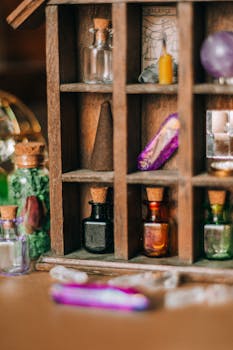
Most crystal damage happens not during use, but during storage. I've talked to collectors who've lost hundreds of dollars worth of stones to preventable storage mistakes — scratched polished surfaces, cracked opals from dry air, faded amethyst from a sunny windowsill. A good storage system isn't expensive, but it does require knowing what each type of crystal needs.
This article covers the practical side of crystal storage: what to prioritize, what materials to use, and how to set up a system that protects your collection without being annoying to maintain.
The golden rule: separate by hardness
If you take away nothing else from this article, remember this: harder stones scratch softer stones. The Mohs scale isn't just an academic concept — it's the single most important factor in deciding how to store your crystals together.
Diamond sits at the top with a Mohs hardness of 10. Corundum (ruby and sapphire) is at 9. Topaz is 8. Quartz — which includes amethyst, citrine, rose quartz, and smoky quartz — is 7. Below that, things get soft fast: feldspar (6), apatite (5), fluorite (4), calcite (3), and so on.
A tumbled piece of quartz in a bag with a piece of fluorite will leave permanent scratches on the fluorite every time the bag moves. It doesn't take much pressure — just contact between the two surfaces over time.
The practical approach: keep three groups. Hard stones (Mohs 7+) can generally coexist. Medium stones (Mohs 5-6) should be separated from hard stones. Soft stones (Mohs 4 and below) need individual protection — wrapped in tissue paper, placed in individual pouches, or stored in divided compartments.
Rough specimens are actually more dangerous than tumbled stones. A piece of rough corundum has jagged edges that act like tiny chisels against any softer material nearby. Wrap rough specimens separately, even from other rough specimens of the same mineral.
Jewelry boxes, display cases, and open storage
There are three main approaches to crystal storage, and each has real trade-offs.
Jewelry boxes with divided compartments are the safest option for most collections. Each piece gets its own slot, eliminating contact between stones. The downside is limited space and poor visibility — you can't see everything at a glance, and your collection will outgrow a standard jewelry box faster than you'd expect.
Display cases with glass tops let you enjoy your collection visually while providing some protection. These work well if your display area has controlled lighting (more on that later) and stable humidity. The risks: glass cases can concentrate heat from sunlight if placed near windows, and they don't prevent stones from touching each other unless you add padding between pieces.
Open storage — shelves, trays, or just arranging crystals on a desk — looks great but offers the least protection. Dust accumulates, pieces can knock into each other, and there's no barrier against humidity changes or light exposure. Open storage is fine for durable stones in a controlled indoor environment, but it's the worst option for anything delicate.
The best setup for a growing collection is usually a combination: a display case for your favorite durable pieces, and a storage box with individual compartments for everything else.
Humidity control: why silica gel packets matter
Most crystals don't care much about humidity. Quartz, garnet, topaz — they're stable in dry or humid conditions. But a few minerals are extremely sensitive to moisture levels, and getting this wrong will ruin them.
Opals are the poster child for humidity sensitivity. They contain 3-21% water, and they need a stable humidity level to maintain their structure. Too dry, and opals develop small cracks called crazing — thin fractures that scatter light and destroy the play of color. Too humid, and they can absorb excess water, which may temporarily improve color but makes them more fragile. Most opal experts recommend storing opals in a sealed plastic bag with a slightly damp (not wet) cotton ball or piece of cloth, maintaining roughly 50-60% humidity.
Pearls also need moderate humidity. They're organic — layers of aragonite (a form of calcium carbonate) held together by conchiolin, an organic protein. In very dry conditions, pearls can crack and yellow. In very humid conditions with poor ventilation, they can develop mold. Store pearls in a breathable pouch (silk or cotton, not sealed plastic) with a silica gel packet nearby to absorb excess moisture.
For the rest of your collection, silica gel packets are cheap insurance. Throw a few into your storage boxes to absorb ambient moisture. Replace them every few months — most silica gel packets change color (blue to pink, or orange to green) when they're saturated and need replacement or regeneration.
Don't store any crystals in airtight containers long-term unless they need specific humidity control. Airtight seals can trap moisture against the stone's surface in humid environments, leading to mineral deposits or degradation.
Light exposure: the fading problem
This one surprises a lot of people. Several popular crystals will lose their color if exposed to sunlight or even bright indoor lighting over time. Amethyst, rose quartz, smoky quartz, citrine, kunzite, and fluorite are all light-sensitive to varying degrees.
Amethyst is the classic example. Its purple color comes from iron impurities that have been irradiated by natural sources over millions of years. UV light from the sun essentially reverses this process — the color centers degrade, and the purple fades to gray or nearly colorless. A deep purple amethyst left in a sunny window for a few months will look noticeably lighter. Leave it there for a year, and you might not recognize it.
Smoky quartz follows the same mechanism. The brownish-black color is radiation-induced, and sunlight bleaches it back toward clear quartz. Rose quartz, colored by trace amounts of titanium, manganese, or dumortierite inclusions, also fades — though usually more slowly than amethyst.
For display pieces, the practical solution is UV-filtering film or glass. 3M makes a window film that blocks 99% of UV rays, and it costs about $15-20 for enough to cover a standard window. Apply it to any windows near your crystal display area. For display cases, UV-filtering acrylic or glass panels are available from specialty suppliers.
For storage, keep light-sensitive stones in opaque containers or boxes. If you use clear plastic bins, store them in a dark closet or drawer rather than on an open shelf near a light source.
Traveling with crystals
Taking crystals on the road requires more planning than you'd think. The main risks are physical damage from movement, temperature changes, and pressure from luggage being stacked.
For durable tumbled stones (quartz, jasper, agate), a padded pouch or a small compartmentalized box works fine. Wrap each piece in a tissue or soft cloth and make sure nothing rattles around.
For fragile pieces — raw crystals with points, clusters, or anything with thin extensions — wrap individually in bubble wrap and place in a rigid container (a small hard-shell case or even a Tupperware box with padding). The goal is zero movement inside the container.
Temperature matters. If you're flying, carry crystals in your carry-on luggage. The cargo hold can get below freezing, and rapid temperature changes can fracture stones with existing micro-cracks. Opals are particularly vulnerable to thermal shock — going from a warm room to a cold cargo hold and back can trigger crazing.
Avoid leaving crystals in a hot car. Interior car temperatures can reach 150°F (65°C) in summer, which is enough to damage opals, degrade adhesives in jewelry, and potentially crack stones with inclusions or internal stress.
Building a labeling system
Once your collection grows past 20-30 pieces, you'll start forgetting what's what. A simple labeling system saves time and prevents the embarrassment of misidentifying a stone when someone asks.
The simplest approach: small paper tags attached to each storage compartment with the mineral name, locality (if known), and date acquired. For a more sophisticated system, use a spreadsheet or notebook with an entry for each stone: name, variety, source, date, price paid, and any treatment information.
Photograph each piece when you acquire it. This gives you a baseline to compare against later — useful for detecting fading, damage, or changes in appearance over time. Store photos in a dedicated folder on your phone or computer.
For displayed pieces, small metal or plastic tags on the shelf next to each crystal look clean and informative. Museum-style labels with the mineral name and locality add a professional touch.
Practical storage materials
A few specific materials worth having on hand:
Tissue paper or acid-free tissue: $5-10 for a large pack. Use for wrapping individual pieces, especially soft or rough specimens. Acid-free is preferable for long-term storage since regular tissue can become acidic over time.
Velvet or cotton pouches: Good for tumbled stones and small jewelry pieces. Cotton is better for pearls (breathable), velvet is fine for everything else.
Foam-lined compartment boxes: These are used for fishing tackle, beads, and small hardware. They're inexpensive ($8-15 for a box with 20-30 compartments) and excellent for organizing a growing collection. Look for boxes with adjustable dividers so you can customize compartment sizes.
Silica gel packets: Available online in bulk. Get the indicating variety so you know when they're spent. A 10-pack costs about $6.
Microfiber cloths: For wiping down pieces before storage. Dust and fingerprints can etch polished surfaces over time if left in place.
What not to do
A few common mistakes worth calling out:
Don't use plastic wrap directly against crystals. It can trap moisture and, in some cases, react with the stone surface. Don't store crystals in newspaper — the ink can transfer onto porous stones and is acidic. Don't use rubber bands or rubberized materials in contact with sulfur-containing minerals like pyrite or galena; the sulfur can react with the rubber.
Don't stack heavy stones on top of lighter ones. It sounds obvious, but I've seen it happen in crowded display cases where someone just ran out of shelf space.
And don't ignore your storage setup. Check on your crystals every few months. Look for fading, new cracks, surface changes, or pest damage (yes, some insects will eat organic gems like amber or pearl if given the chance). A five-minute check every quarter can save you from losing a valuable piece to a problem that started small.
Making it sustainable
The best storage system is one you'll actually use. Don't overcomplicate it. Start with a decent compartment box, some tissue paper, and silica gel packets. As your collection grows and you learn which stones need special care, upgrade specific areas rather than trying to build a perfect system from day one.
Crystal storage isn't glamorous, but it's the difference between a collection that lasts decades and one that deteriorates in a few years. The stones don't need much — just the right environment and a little attention.
Comments