How to Start a Crystal Collection: A Real Beginner's Guide (No Fluff)
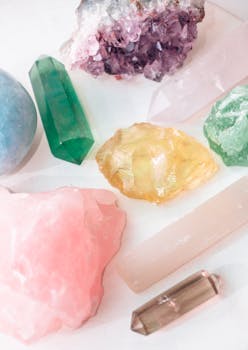
So You Want to Collect Crystals. Now What?
Walking into a crystal shop for the first time is a weird experience. There's amethyst everywhere, the lighting is dim, someone's burning sage, and every stone has a little handwritten card next to it with words like "transformation" and "abundance." It's easy to either get overwhelmed or roll your eyes and leave. Neither reaction helps you start an actual collection.
Here's the thing about crystal collecting: it doesn't have to be mystical, and it doesn't have to be expensive. It's really just a specific type of rock collecting with better marketing. And like any collection, it works best when you start small, learn as you go, and buy what actually catches your eye instead of what a Pinterest board tells you to buy.
Forget the "Must-Have" Lists
Every beginner guide on the internet will tell you that you need clear quartz, rose quartz, amethyst, and citrine. That's fine advice in the sense that those stones are easy to find and fairly cheap. But starting your collection with a checklist feels like homework, and homework kills the fun of collecting.
My real advice: walk into a shop (or browse online) and pick up whatever stops you. Maybe it's a chunk of labradorite that flashes blue when you tilt it. Maybe it's a weirdly shaped piece of jade. Maybe it's literally a rock you found on a hike that looked interesting. That first piece matters more than any "essential" because it's the one that made you curious. Build from there.
Know What You're Actually Buying
This is where most beginners get burned. The crystal market is full of misleading labels, and the difference between a natural stone and a lab-grown one isn't always obvious.
Natural vs. Lab-Grown vs. Fake
Natural stones came out of the ground more or less as they look now. They might have been polished or tumbled, but the material itself is geological. Most collectors prefer these.
Lab-grown stones (also called synthetic) have the same chemical composition as natural stones but were created in a lab. They're not fake — they're real quartz or real corundum, just not from a mine. They tend to be cleaner and cheaper. Some collectors don't mind them at all.
Fake stones are where it gets shady. Dyed agate sold as "natural" turquoise. Glass sold as obsidian. Resin mixed with mineral dust sold as real gemstone rough. These exist, they're common at flea markets and cheap online stores, and they're the main reason you should learn to identify what you're looking at.
Red Flags to Watch For
Colors that are too perfect or too uniform are suspicious. Natural amethyst ranges from pale lavender to deep purple, often within the same crystal. If every piece in a batch is exactly the same vivid color, it was probably dyed. Similarly, if a "natural" stone has perfectly uniform inclusions or no inclusions at all, ask questions.
Price is another signal. Real emerald and real ruby are expensive. If someone's selling a fist-sized emerald for $15, it's either glass, dyed quartz, or a very convincing synthetic. Real turquoise is also pricey — most of what you see in cheap jewelry is howlite dyed blue.
Where to Actually Buy Crystals
Your options range from sketchy to excellent, and the price range is enormous.
Local Crystal Shops
The best starting point if you have one nearby. You can pick things up, feel the weight, see the color in person, and usually talk to someone who knows their stuff. Prices are often mid-range. The downside is selection — most shops carry popular items and may not have unusual specimens.
Gem and Mineral Shows
If you've never been to one, go. These are where serious collectors and dealers gather, and the variety is wild. You'll find everything from tumbled stones for a dollar to museum-quality specimens that cost thousands. Most shows have a mix of both. Dealers are usually happy to talk about what they're selling, which means free education.
Online Sellers
This is where you need to be most careful. There are reputable online mineral dealers (check reviews, look for ones who specialize in minerals rather than "healing crystals"), and there are dropshippers selling the same aliexpress stock with markup. Look for sellers who show multiple photos of each individual piece, mention the mine or region of origin, and have clear return policies.
DIY: Rockhounding
Collecting crystals yourself is the cheapest option and arguably the most rewarding. You'll need to research local collecting sites (there are forums and guidebooks for this), but finding your own piece of quartz or agate in the field hits different than buying one. Start with easy-to-access public sites before venturing onto private property or into mines.
How to Store Your Collection
This sounds boring until you knock a shelf over and watch three months of collecting shatter across the floor.
Display shelves work great for larger, sturdy pieces. For smaller or more fragile specimens, tackle boxes with foam inserts or adjustable dividers are practical and cheap. Some collectors use those clear plastic organizer boxes with individual compartments — you can see everything, nothing touches, and they stack.
A few storage rules that save headaches: keep harder stones away from softer ones (quartz will scratch turquoise), avoid direct sunlight for anything color-sensitive (amethyst fades, rose quartz can pale), and don't store anything in airtight plastic long-term if it came from a humid environment — moisture gets trapped and can damage some minerals.
Learn Enough to Enjoy It More
You don't need a geology degree to collect crystals, but knowing a few basics makes the whole thing more interesting.
Learn the Mohs hardness scale — it's just a ranking of how easily a mineral scratches. Talc is 1 (softest), diamond is 10 (hardest). Most popular crystals fall between 3 and 7. This matters because it tells you how durable a piece is, whether it can go in water, and how to clean it.
Learn what "inclusions" are — those little things trapped inside a crystal. Some inclusions (like rutile needles in quartz, or the tiny gas bubbles in enhydro crystals) make a specimen more interesting and more valuable. Others (like cracks that threaten structural integrity) are defects.
And learn the difference between a crystal's variety name and its mineral name. Amethyst is purple quartz. Citrine is yellow quartz. Rose quartz is pink quartz. They're all the same mineral — silicon dioxide — with different trace elements causing the color. Knowing this stops you from overpaying for "rare" stones that are actually just common minerals in fancy packaging.
Budget Realistically
Crystal collecting can cost $20 or $20,000. You get to pick where on that spectrum you operate.
For a casual collection that grows over time, budgeting $20-50 per month gets you a few new pieces without stress. Tumbled stones and small rough pieces are often $2-10 each. Polished points and palm stones run $8-30. Larger display pieces and rarer minerals go up from there.
Set a monthly limit and stick to it. The market is designed to make you feel like every piece is special and limited. Most of them aren't. Another one will come along.
Join a Community
Crystal collecting is way more fun with other people. Facebook groups, Reddit's r/crystals and r/minerals, local gem and mineral societies — these are places where you can share finds, ask identification questions, and learn from people who've been doing this for decades.
Be warned: mineral collectors and "crystal healing" enthusiasts sometimes clash in these spaces. Both groups are welcome, but they have different priorities. If you're more interested in geology than energy work (or vice versa), find a group that matches your vibe.
What Actually Matters
After years of collecting, the pieces I value most aren't the rarest or the most expensive. They're the ones with stories. The chunk of labradorite from a shop in Sedona where the owner spent 20 minutes showing me every piece in the case. The quartz point I found on a beach in Maine. The tiny opal triplet my grandmother gave me.
A crystal collection should reflect what you find interesting, not what Instagram says is trending this month. Start with curiosity, stay within your budget, learn as you go, and don't let anyone — including this article — tell you there's a wrong way to do it.
Comments