How to Size a Ring at Home: 5 Methods That Actually Work
Last year, I ordered a gorgeous emerald-cut sapphire ring for my girlfriend's birthday. I guessed her size based on... well, nothing really. I just held her hand one day and thought "yeah, probably a 6." Spoiler: it was a 4.5. The ring arrived, she tried it on, and it literally flew off her finger when she waved goodbye to the delivery driver. We spent the next three weeks dealing with resizing, lost the surprise factor, and I paid an extra $80 for something I could've figured out in five minutes at my kitchen table.
Don't be like me. Learning how to size a ring at home is one of those skills you don't think you need until you're staring at a return shipping label and a disappointed partner. Whether you're shopping for an engagement ring, a birthday gift, or just treating yourself to something sparkly, getting the size right the first time saves you money, time, and a whole lot of awkwardness.
Here's everything I've learned since that sapphire fiasco.
5 Ways to Measure Ring Size at Home
You don't need fancy equipment. Most of these methods use stuff you already have lying around. I've tested all of them, and I'll tell you which ones actually work and which ones will lead you down the same path I took with that sapphire.
Method 1: The Paper Strip Method
This is the simplest approach, and it's surprisingly accurate if you do it right.
What you need: A strip of paper (about 3mm wide — cut a narrow strip, don't use a full sheet), a pen, and a ruler.
How to do it:
Wrap the paper strip around the base of the finger you want to measure. Not too tight — the ring should slide over your knuckle, so the paper should be snug but not cutting off circulation. Mark where the paper overlaps with your pen. Lay the strip flat and measure from the end to your mark in millimeters.
Pro tip: Measure the finger at the end of the day. Fingers swell throughout the day, and you want the measurement at their largest. Cold fingers are smaller fingers — don't measure right after coming inside from winter weather.
Accuracy: 7/10. Good enough for most rings, but I'd double-check with a second method if you're buying something expensive or something that can't easily be resized (like a tungsten carbide band).
Method 2: The Existing Ring Method
If the person already wears a ring on the right finger, this is your easiest path. Borrow it (sneaky but effective) and measure the inside diameter.
What you need: The ring, a ruler (preferably one with millimeter markings), or a caliper if you're feeling precise.
How to do it: Place the ring on the ruler and measure the inside diameter — that's the distance across the inside of the ring from one side to the other. Don't measure the outside; you'll get a reading that's too big. Match that diameter to a ring size chart (there's one below).
Better approach: If you have a printer, place the ring on a piece of paper and trace the inside circle. Then measure the diameter of your traced circle. This gives you a cleaner reading than trying to balance a ring on a ruler.
Accuracy: 9/10, assuming the existing ring actually fits properly. Some people wear rings that are too loose or too tight without realizing it.
Method 3: A Ring Sizer (Worth the $5)
After my sizing disaster, I bought a cheap ring sizer set on Amazon — the kind with the little metal loops on a keychain. Best five bucks I've ever spent.
What you need: A ring sizing tool (metal mandrel or plastic sizer gauge). You can find these for $3-10 online.
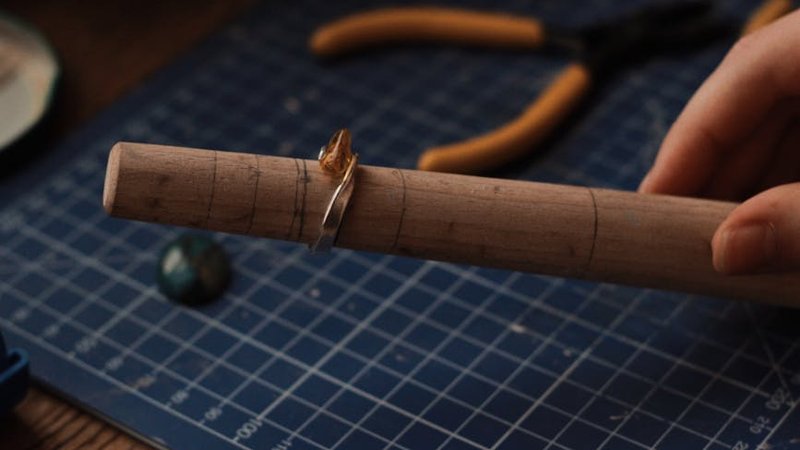
How to do it: If you're using a mandrel (the cone-shaped thing), slide an existing ring onto it and read the size where it stops. If you're using the plastic loop sizer, try each loop on the finger until one fits comfortably. It should go on with a slight pull and come off with a slight pull — not falling off, not requiring soap.
Accuracy: 10/10. This is what jewelers use. If you're buying an engagement ring or something in the $500+ range, just buy one of these. It's cheaper than a single resize.
Method 4: Printable Ring Size Chart
Most jewelry websites offer a free printable ring sizer. You print it out, place a ring over the circles, and find the match. Simple in theory.
What you need: A printer, scissors (sometimes), and a credit card (for scale verification).
How to do it: Download a printable ring sizer from a reputable jewelry site. Critical step: verify the print scale by placing a credit card in the marked box. If the card doesn't fit the box exactly, your printer is scaling the page and your measurements will be wrong. Once verified, place your ring over the circles and find the one that matches.
Accuracy: 6/10. The scaling issue trips up a lot of people. I've seen printouts that were 5-10% off, which is enough to put you in the wrong size. If you use this method, check with at least one other approach.
Method 5: String or Floss Method
The classic "I need to know right now and have zero tools" method. It works in a pinch.
What you need: String, dental floss, or a thin strip of fabric. A ruler.
How to do it: Wrap the string around the base of the target finger. Mark where it overlaps. Measure the length in millimeters. Compare to a size chart.
Accuracy: 5/10. String stretches. Floss is better because it doesn't stretch as much, but it's thin enough to cut into your skin, which can make you wrap it too loose. This is a last resort, not a first choice.
International Ring Size Conversion Chart
Nothing confuses people faster than ring sizes. The US uses numbers. The UK uses letters. Europe uses numbers that are completely different from US numbers. Japan has its own system. If you're buying internationally (or comparing rings from different websites), you need this chart.
US Size | Diameter (mm) | Circumference (mm) | UK | EU
3 — 14.1 — 44.2 — F — 44
3.5 — 14.3 — 45.0 — G — 45
4 — 14.9 — 46.5 — H — 47
4.5 — 15.3 — 47.8 — I — 48
5 — 15.7 — 49.0 — J — 49
5.5 — 16.1 — 50.3 — K — 50
6 — 16.5 — 51.5 — L — 52
6.5 — 16.9 — 53.1 — M — 53
7 — 17.3 — 54.0 — N — 54
7.5 — 17.7 — 55.3 — O — 55
8 — 18.1 — 56.6 — P — 56
8.5 — 18.5 — 57.8 — Q — 58
9 — 18.9 — 59.1 — R — 59
9.5 — 19.4 — 60.8 — S — 60
10 — 19.8 — 62.0 — T — 61
10.5 — 20.2 — 63.3 — U — 62
11 — 20.6 — 64.5 — V — 64
11.5 — 21.0 — 65.7 — W — 65
12 — 21.4 — 67.2 — X — 66
Save this chart. Screenshot it. Print it. You'll need it more often than you think, especially if you're shopping on sites like Etsy where sellers from different countries list different size systems.
Special Situations That Mess With Your Sizing
Wide Band Rings Need a Bigger Size
Here's something that catches almost everyone off guard: a wide band (anything over 6mm) needs to be sized up by about a quarter to a half size compared to a thin band. The reason is simple — a wider ring covers more of your finger, and it has to clear your knuckle. I learned this the hard way with a 8mm comfort-fit band that was supposedly my size but wouldn't go past my knuckle.
If you're buying a wide ring, go up at least a quarter size. If it's really wide (10mm+), consider going up a full size.
Large Knuckles
Some people have knuckles significantly larger than the base of their finger. The ring fits perfectly at the base but won't slide over the knuckle. This is incredibly common and incredibly frustrating.
The solution: measure around the knuckle, not just the base of the finger. The ring needs to clear the knuckle to get on. If the difference between your knuckle measurement and your base measurement is more than one size, you might want to look into "comfort fit" rings — they have a rounded interior that slides over knuckles more easily.
Swollen Fingers and Weather
Your fingers are not the same size all day. They're bigger in the evening, bigger in summer, bigger after exercise, and bigger if you've been eating salty food. If you measure in the morning during winter, you'll get the smallest possible reading. Measure at the end of the day when your hands are warm.
Also: pregnancy, medication, and certain health conditions can cause finger swelling. If any of these apply, you might want to wait until things stabilize before getting a permanent size measurement.
Dominant Hand vs. Non-Dominant Hand
Your dominant hand is typically slightly larger. If you're right-handed, your right ring finger might be a half size bigger than your left. This matters most for wedding bands — don't measure your left hand and assume the same size works for your right.
Buying Rings Online: How to Get the Size Right
Shopping for rings online is where most sizing mistakes happen. You can't try anything on, you're relying on your own measurements, and return policies vary wildly between sellers. Here's my playbook after years of getting it wrong:
1. Measure twice, order once. Use at least two different methods and average the results. If the paper strip says 6.5 and the ring sizer says 7, go with 7. It's easier to size down than to size up.
2. Check the seller's return policy before you buy. Some custom or engraved rings can't be returned. Resizable rings (most gold and silver) can usually be adjusted by a jeweler for $20-60. Non-resizable rings (tungsten, ceramic, titanium) are final sale at many shops. Know what you're getting into.
3. Read reviews about sizing. Some brands run small or large. If multiple reviewers say "order a half size up," listen to them. This is especially common with Etsy sellers and international brands.
4. Consider a resizable design. If you're unsure, choose a ring style that's easy to resize. Plain bands are the easiest. Rings with stones all the way around (eternity bands) are among the hardest because resizing can shift the stones.
5. When in doubt, size up. A slightly loose ring can be tightened with sizing beads or a ring guard. A ring that's too small needs professional resizing or replacement. Sizing up is the safer bet.
What to Do If You Got the Size Wrong
It happens. Even professionals get it wrong sometimes. Here are your options:
Professional resizing: Most jewelers can resize gold, silver, and platinum rings by 1-2 sizes. It typically costs $20-60 and takes 1-2 weeks. If the ring has gemstones, resizing gets more complicated and expensive because the stones may need to be reset.
Sizing beads: Two small metal beads are soldered inside the ring to make it fit tighter. This is reversible and costs around $15-30. Great if the ring is only slightly loose.
Ring guards or adjusters: Temporary plastic or metal clips that slide onto the inside of the ring. They cost a few dollars and work well for rings that are up to a full size too big. Not the most elegant solution, but it works in a pinch.
Return or exchange: Check the seller's policy. Many online jewelers offer free exchanges within 30 days. Some even send you a free ring sizer first so you can confirm before they ship the actual ring.
Quick Reference: Common Mistakes to Avoid
Before you measure, keep these in mind — they're the reasons most at-home sizing attempts go wrong:
Measuring cold fingers — wait until your hands are warm.
Using stretchy string — opt for paper or floss instead.
Measuring the outside of a ring instead of the inside.
Printing a size chart without checking the scale first.
Forgetting to account for wide band sizing (go up!).
Measuring in the morning instead of the evening.
Only using one method — always cross-check.
Guessing based on shoe size, height, or weight (none of these correlate with ring size, despite what random internet charts claim).
Getting the right ring size isn't complicated, but it does require a few minutes of actual effort. Take those minutes. Your future self (and whoever you're buying the ring for) will thank you. And if all else fails, buy a ring sizer — it's genuinely the best $5 you'll spend on jewelry shopping.
Comments