<h2>How to Price Handmade Jewelry Profitably: A Real-World Guide</h2>
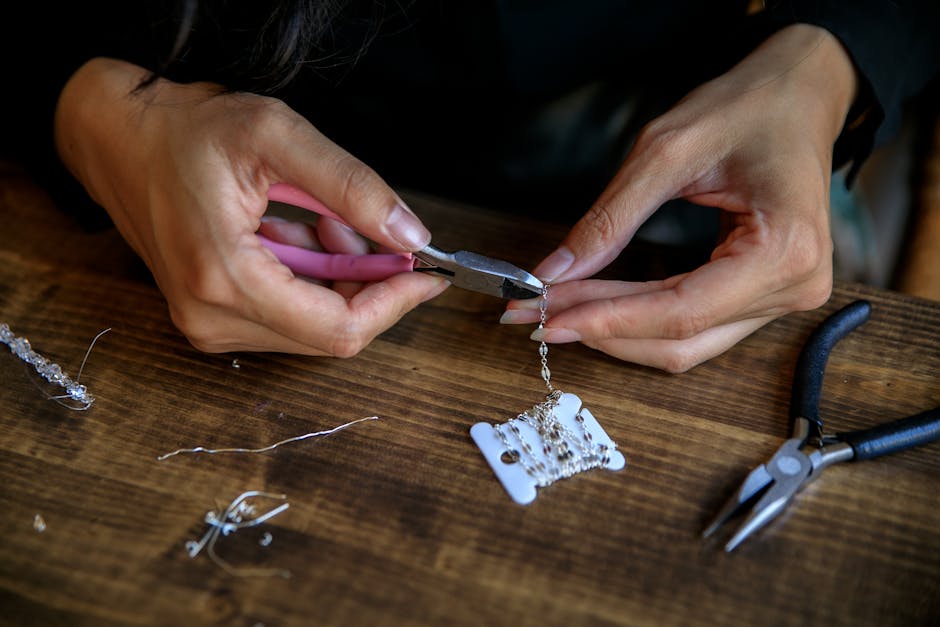
Why Most Jewelry Makers Underprice Their Work
If you've ever sold a necklace for $25 and later realized the materials alone cost $18, you already know the problem. Underpricing is the single most common mistake handmade jewelry makers make, and it's not because they lack skill — it's because pricing feels awkward, arbitrary, and somehow personal.
Here's the uncomfortable truth: if you're not systematically calculating your prices, you're almost certainly leaving money on the table. A 2023 Etsy seller survey found that 67% of handmade sellers initially underpriced their products by 30–50%, and many never corrected course because they feared losing customers.
The good news is that pricing isn't guesswork. It's a formula. And once you understand it, you can price confidently, cover your costs, and actually earn a profit for the hours you put in.
The Core Jewelry Pricing Formula
At its most basic level, pricing handmade jewelry comes down to this:
Materials + Labor + Overhead = Wholesale Price × 2 = Retail Price
Let's break down each component.
Materials Cost
This one seems obvious, but most people forget to account for everything. Your materials cost isn't just the beads, wire, or gemstones. It includes:
• The clasp, jump rings, and crimp beads you used to finish the piece
• The packaging — boxes, bags, tissue paper, stickers
• Shipping supplies for getting materials to your door
• Waste — that 10% of wire you snip off and can't reuse
A practical approach: track every purchase for a month, then divide by the number of pieces you produced. You'll likely find your real materials cost is 15–20% higher than what you initially estimated.
Labor Cost
This is where most jewelry makers stumble. The question isn't "what will people pay?" — it's "what is my time worth?"
Start by deciding on an hourly wage. Be honest with yourself. If you wouldn't work for someone else at $10/hour, don't pay yourself $10/hour. A reasonable starting point for handcrafted jewelry in 2025–2026 is $20–$35/hour, depending on your skill level and the complexity of your work.
Then track your time. Not roughly — actually time yourself. A pair of earrings that feels like it takes "about 20 minutes" might actually take 40 minutes once you include design planning, wire wrapping, polishing, and quality checking.
Overhead Costs
Overhead is the invisible cost of running your business. It includes:
• Tools depreciation (pliers wear out, tumblers need replacement media)
• Workshop space (even a corner of your bedroom has a cost)
• Website hosting, marketplace fees, payment processing (Etsy takes 6.5% + $0.20 per transaction; Stripe takes 2.9% + $0.30)
• Photography equipment, lighting, backdrops
• Accounting software, business insurance, marketing
A simple way to calculate overhead: add up all your monthly business expenses that aren't direct materials or labor, then divide by the number of pieces you produce per month. For a part-time maker producing 15–20 pieces monthly, overhead typically adds $5–$15 per piece.
Keystone Pricing: The Double-It Rule
Keystone pricing is the industry standard for retail markup: you double your wholesale cost to get the retail price. If your total cost (materials + labor + overhead) is $30, your wholesale price is $30, and your retail price is $60.
This 50% gross margin might feel aggressive if you're used to thinking in terms of cost-plus pricing, but it's necessary. That 50% margin covers retail-specific costs like photography, marketing, customer service, returns, and the time you spend on social media instead of making jewelry.
For handmade jewelry specifically, many makers use a 2.5× to 3× multiplier on materials alone as a shortcut formula:
Retail Price = Materials × 2.5 to 3
This shortcut works reasonably well for simple pieces but falls apart for labor-intensive work. If you spend 6 hours hand-weaving a copper bracelet from $4 worth of wire, multiplying by 3 gives you $12 — which values your labor at roughly $1.33/hour. That's not a business; that's a hobby that costs you money.
Wholesale vs. Retail Pricing
If you plan to sell to boutiques, galleries, or online retailers, you need two price tiers:
Wholesale price = Materials + Labor + Overhead + small profit margin (typically 10–20%)
Retail price = Wholesale × 2 (Keystone markup)
The retailer needs that 50% margin to cover their own costs — rent, staff, marketing, and the risk of unsold inventory. If you try to sell wholesale at a price that doesn't leave room for retail markup, boutiques simply won't carry your work.
A common trap: makers set their retail price first, then offer "wholesale" at 40% off. This often means the wholesale price doesn't cover your actual costs. Always calculate from the bottom up, not the top down.
Pricing by Category: Silver, Crystal, and Gold
Sterling Silver Jewelry
Silver is the sweet spot for many handmade sellers. Current silver prices hover around $0.80–$1.00 per gram (as of early 2026), so a 10-gram sterling silver ring has roughly $8–$10 in metal cost. With findings, solder, and finishing materials, budget $12–$18 for materials on a simple ring.
A typical pricing breakdown for a hand-forged sterling silver ring:
• Materials: $15
• Labor (2 hours × $25/hr): $50
• Overhead: $8
• Total cost: $73
• Retail price (×2): $146
This feels high to many new sellers, but handcrafted sterling silver jewelry at $120–$180 is well within market expectations.
Crystal and Gemstone Jewelry
Crystal pricing is tricky because material costs vary enormously. A strand of amethyst chips might cost $3, while a single high-quality piece of larimar could cost $40.
The key principle: price based on the finished piece, not the raw material cost. A wire-wrapped pendant using a $5 stone and 30 minutes of skilled labor should not be priced the same as a simple strung necklace using the same stone and 10 minutes of basic assembly.
For crystal jewelry specifically, consider adding a premium for unique or rare stones. Customers who buy crystal jewelry are often buying the specific stone, not just the design. A piece featuring a high-grade piece of larimar or sugilite commands a higher price than the same setting with a common amethyst.
Gold and Gold-Filled Jewelry
Gold changes the math entirely. At roughly $65–$75 per gram for 14k gold (early 2026), even a delicate 3-gram gold ring contains $195–$225 in metal alone. Your pricing needs to reflect this.
For gold-filled jewelry (which has a much thicker gold layer than gold-plated), material costs are more manageable — roughly $2–$5 per gram — but still significantly higher than sterling silver.
Gold jewelry pricing formula:
• Always track current gold spot price (it fluctuates daily)
• Add a 10–15% buffer for metal waste (filing, polishing, sprues in casting)
• Labor rates should be higher ($30–$50/hr) to reflect the skill level gold work requires
• Overhead is typically higher due to more expensive tools and safety equipment
Common Pricing Mistakes to Avoid
Mistake 1: Pricing Based on Competitors
Looking at what other sellers charge and pricing slightly below is tempting but flawed. You don't know their costs, their wholesale arrangements, or whether they're actually profitable. A seller charging $40 for a pendant might be losing money on every sale.
Mistake 2: Ignoring Your Time
"I enjoy making it, so my time doesn't count" is a thought that keeps handmade businesses unprofitable. Your enjoyment is a benefit of the work, not a reason to subsidize your customers.
Mistake 3>One Price Fits All
Not every piece should have the same markup. High-end pieces with expensive materials can absorb a lower percentage markup while still being profitable. Simple pieces with low material costs need a higher percentage markup to cover fixed labor and overhead costs.
Mistake 4: Never Raising Prices
If you've been selling the same design for a year and it consistently sells out within days, your price is too low. The market is telling you there's more demand than supply at that price point. Raise it by 15–20% and see what happens. Most makers are surprised to find that demand barely drops.
Mistake 5: Discounting Too Aggressively
Sales and discounts train customers to wait for deals. If you regularly offer 30–40% off, your "regular" price becomes the perceived value, and your sale price becomes the real price. Build your regular price correctly, and you won't need deep discounts.
A Practical Pricing Worksheet
Here's a simple worksheet you can use for every piece:
1. List all materials used and their cost
2. Add packaging cost ($1–$5 depending on presentation)
3. Multiply materials total by 1.15 (15% waste/buffer)
4. Record actual time spent making the piece
5. Multiply time × your hourly rate
6. Add monthly overhead ÷ pieces per month
7. Add lines 3 + 5 + 6 = Total Cost
8. Multiply Total Cost × 2 = Retail Price
9. Compare to market range — adjust if clearly out of range
10. Round to a clean number ($59, $89, $125 — prices ending in 9 or 5 tend to perform well)
Do this for your last 10 pieces. If the results make you uncomfortable, that's a sign you've been underpricing — not that the formula is wrong.
When and How to Raise Your Prices
If you've been selling for a while and your prices feel too low, raise them. Here's how to do it without losing customers:
For new designs: Price them correctly from the start. Existing customers won't compare directly to your older work.
For existing designs: Raise prices 10–15% at a time. Announce it as part of a collection refresh or material cost adjustment. Most customers understand that costs increase.
For your best sellers: Raise prices and watch. If they keep selling at the same rate, raise them again. Your best sellers are subsidizing your underpriced work — and they're the pieces most likely to support higher prices.
The Bottom Line
Pricing handmade jewelry isn't about charging the most you can get away with. It's about charging enough to sustain your business, compensate you fairly for your skill and time, and keep you motivated to keep creating. The formula works. The hard part is believing your work is worth what the formula says.
Start tracking your real costs this week. Time yourself. Do the math. Then price accordingly. Your future self — the one with a profitable, sustainable jewelry business — will thank you.


Comments