How to Price Handmade Jewelry: A Complete Guide for Beginners
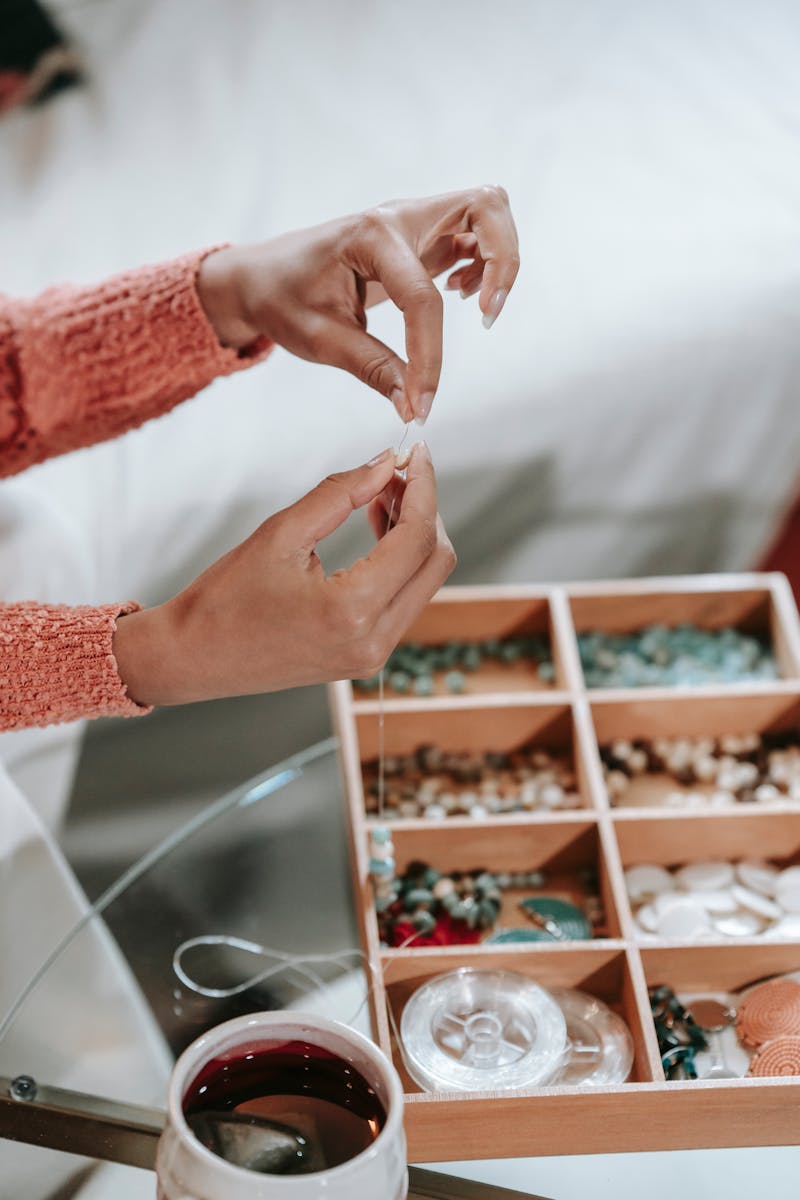
If you've ever made a beautiful piece of jewelry and then sat there wondering what to charge for it, you're not alone. Pricing is honestly one of the hardest parts of running a handmade jewelry business, and most people get it wrong — usually by undercharging.
The problem isn't that pricing is complicated. The problem is that it feels uncomfortable. You made something with your hands, and putting a number on it feels weird. But if you don't price correctly, you won't have a business for very long.
Let's walk through everything you need to know about pricing handmade jewelry, from the basic formula to the psychology behind why people buy.
Why Most Beginners Undercharge
There's a pattern that almost every new jewelry maker follows. You buy some materials. You spend hours making something. You look at it and think, "Well, the beads only cost me $8, so maybe I should charge $15?"
That's where it starts going wrong. That $15 price tag doesn't account for your time, your tools, your overhead, or the fact that you're running a business — not doing a favor for a friend.
The most common reasons beginners undercharge:
Impostor syndrome. You don't feel experienced enough to charge premium prices, even if your work is genuinely good. This is especially common in the first year.
Comparing to mass-produced jewelry. You look at what's on Amazon or Shein and think, "I can't charge more than that." But you're not competing with factory-made pieces — you're selling handmade, one-of-a-kind work.
Fear of rejection. You're worried that if you price too high, nobody will buy. So you price low to feel safe. But low prices actually attract the wrong customers — people who complain and don't value handmade work.
Not tracking costs. If you don't know exactly what you spend, you can't price accurately. Many beginners have no idea what their real material costs are because they buy in bulk and don't track per-piece usage.
The Basic Pricing Formula
Here's the foundation that every pricing method builds on:
Materials + Labor + Overhead = Wholesale Price
Wholesale Price × 2 = Retail Price
Let's break that down with a real example. Say you're making a beaded bracelet:
Materials: $4.50 (beads, string, crimp beads, clasp)
Labor: $15.00 (1 hour at $15/hour — more on this below)
Overhead: $3.00 (portion of tools, packaging, workspace, electricity)
Wholesale: $4.50 + $15.00 + $3.00 = $22.50
Retail: $22.50 × 2 = $45.00
That $45 retail price probably feels high if you're used to charging $15. But that's what it actually costs to make and sell that bracelet sustainably. If you sell it for $15, you're losing money on every single sale, even if it feels like you're making a profit.
Calculating Your Material Costs Accurately
This is where most people mess up. They look at a strand of beads that cost $12 and think, "Okay, each bracelet uses maybe $2 worth of beads." But they're not accounting for waste, broken pieces, or the fact that some beads in the strand aren't usable.
Here's how to calculate material costs properly:
Start with the total cost of your supply package. Count how many usable pieces you get from it. Divide total cost by usable pieces. Add 10-15% for waste and defects.
So if a $12 strand of beads gives you 40 usable beads, and you use 8 per bracelet, that's $12 ÷ 40 × 8 = $2.40 per bracelet. Add 15% for waste: $2.40 × 1.15 = $2.76.
Don't forget the small stuff — crimp beads, jump rings, wire, clasps, ear hooks. These add up fast. A pack of 100 crimp beads for $3 sounds cheap, but if you use 2-3 per piece, it's about $0.06-$0.09 per item. Track everything.
How to Value Your Labor
This is the part that makes people the most uncomfortable, but it's also the most important.
Your hourly rate should reflect your skill level. A complete beginner might start at $12-$15/hour. Someone with 1-2 years of experience should be at $20-$25/hour. Experienced makers with established brands can charge $30-$50/hour or more.
Here's the key insight: your hourly rate isn't just about how fast you work. It's about your expertise, your design sense, and the years of practice that went into being able to make that piece. A surgeon doesn't get paid less because the surgery only takes 30 minutes.
When calculating labor time, include everything: design time, sourcing materials, making the piece, quality checking, photographing, packaging. Most beginners only count the actual making time and ignore the rest.
A realistic breakdown for one piece of jewelry might look like: design (15 min), material prep (10 min), making (45 min), quality check (5 min), photographing (15 min), packaging (10 min). That's 100 minutes total, not 45.
Understanding Overhead Costs
Overhead is all the stuff you have to pay for whether you sell anything or not. This includes:
Tools and equipment. Your pliers, wire cutters, beading boards, kiln, tumbling machine, etc. These depreciate over time, so divide the cost by expected lifespan and number of pieces.
Workspace. If you rent a studio, that's straightforward. If you work from home, allocate a portion of your rent/mortgage, utilities, and internet to your business.
Packaging and shipping. Boxes, bags, tissue paper, labels, bubble mailers, tape. These can add $1-3 per order.
Business expenses. Website hosting, payment processing fees (2.9% + $0.30 on most platforms), marketing, accounting software, insurance.
A simple way to handle overhead: add up all your monthly business expenses and divide by the number of pieces you produce per month. If your monthly overhead is $200 and you make 40 pieces, that's $5 per piece.
The Keystoning Method (Retail = Wholesale × 2)
Keystoning is the industry standard for retail pricing, and here's why: your retail price needs to be high enough that you can still make a profit when selling wholesale to stores.
When a boutique buys your jewelry at wholesale (half your retail price), they need to mark it up to make their own profit. If your retail price is too low, there's no room for wholesale markup, which means stores can't stock your work.
Even if you never plan to sell wholesale, keystoning ensures your prices are sustainable. It gives you room for discounts, sales, and the inevitable costs you didn't plan for.
Pricing for Different Sales Channels
Where you sell affects what you should charge:
Direct to customer (website, craft shows): Full retail price. This is where you make the best margins.
Wholesale to boutiques: 50% of retail. The store handles the customer-facing side, and they need their margin.
Online marketplaces (Etsy, Amazon Handmade): Full retail minus fees. Etsy's fees are roughly 9-12% when you include payment processing and listing fees. Factor this in — don't just absorb it.
Consignment: Usually 60% to the shop, 40% to you. This means your retail price needs to be even higher to make consignment worthwhile.
Instagram/social media: Full retail, but consider that building an audience takes time. You might offer a small "follower discount" occasionally, but keep it rare.
Competitive Market Research
Knowing what others charge isn't about copying their prices — it's about understanding the market you're in.
Look at jewelry makers with similar skill levels and materials. Not the $5 factory-made stuff on Amazon, and not the $5,000 fine jewelry brands. Find your actual competitors: other handmade jewelry makers working with similar materials at a similar quality level.
Pay attention to the full picture, not just the price tag. What's their photography like? Their packaging? Their brand story? Customers pay for the whole experience, not just the physical piece.
If your research shows your calculated price is way above the market, you have two options: find a way to add more value (better photography, packaging, storytelling), or find ways to reduce your costs without sacrificing quality. Don't just lower your price.
The Psychology of Pricing
Here's something that surprises most beginners: pricing too low can actually hurt your sales.
When people see handmade jewelry priced at $8, they assume it's low quality. It doesn't matter how beautiful it is or how long you spent on it. The price itself sends a signal about value.
Conversely, a well-presented $45 bracelet with good photography and a compelling product description will attract customers who appreciate handmade work and are willing to pay for it. These are the customers you want — they buy more, complain less, and tell their friends.
Some specific pricing psychology tips: use whole numbers or numbers ending in .00 for higher-end pieces ($45 not $44.99). Offer tiered pricing — small, medium, large versions at different price points. Bundle items for a slight per-item discount (but keep the total healthy). Never apologize for your prices or explain why they're "fair." Your work has value.
Common Pricing Mistakes to Avoid
Charging by material cost only. This is the fastest way to go out of business. Your materials might cost $5, but your time and expertise are worth far more.
Not raising prices as you improve. As your skills grow and your brand becomes more established, your prices should increase. A piece you charged $20 for two years ago should probably be $30-35 now.
Offering discounts too often. If you're always running sales, customers learn to wait for the sale. Keep discounts rare and meaningful.
Forgetting about fees and taxes. Payment processing, marketplace fees, shipping costs, and sales tax all eat into your margin. Calculate your prices based on what you keep, not what you charge.
Pricing based on what you'd pay. You're not your target customer. You might think $45 is expensive for a bracelet, but your target customer might consider $45 a fair price for handmade work.
When and How to Raise Your Prices
Price increases are normal and expected in business. Here's how to do it without losing customers:
Raise prices gradually. 10-15% increases are manageable and won't shock your existing customers. You can do this once or twice a year.
Give existing customers advance notice. A simple message like "Due to rising material costs, prices will be increasing on [date]. Order now to lock in current prices" can actually drive a burst of sales.
Raise prices on new designs first. Keep your bestsellers at their current price while introducing new pieces at the higher price point. Over time, everything catches up.
Add value with the increase. When you raise prices, also improve something — better packaging, a new insert card, upgraded photography. This makes the increase feel justified.
A Practical Example
Let's put it all together. You're making a wire-wrapped crystal pendant necklace:
Materials: $6.00 (crystal, wire, chain, clasp, jump rings)
Labor: $25.00 (80 minutes at $18.75/hour, including design and packaging time)
Overhead: $4.00 (tools, workspace, packaging)
Wholesale: $6.00 + $25.00 + $4.00 = $35.00
Retail: $35.00 × 2 = $70.00
Etsy adjustment: $70.00 + 10% for fees = $77.00. Round to $75.00.
That $75 price point positions your work as quality handmade jewelry. It covers all your costs, pays you a fair wage, and leaves room for growth.
Final Thoughts
Pricing handmade jewelry isn't about pulling numbers out of thin air or guessing what people will pay. It's a calculation based on your real costs, your time, and the value of your expertise.
If you follow the formula and your prices feel too high, the problem isn't your prices — it's either your efficiency, your material costs, or your confidence. Work on all three over time.
And if someone tells you your prices are too high, smile and thank them. They're not your customer. The right customer will see the value in handmade work and pay for it gladly.

Comments