How to price handmade crystal jewelry (a realistic formula)
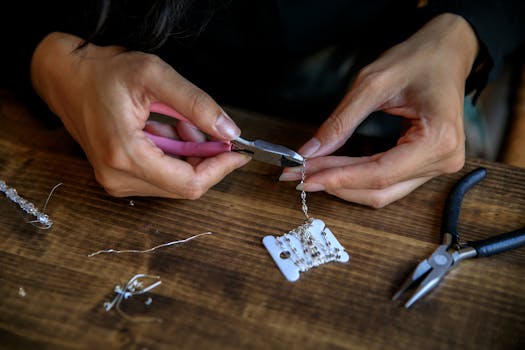
Most advice about pricing handmade crystal jewelry is wrong. The "multiply your material cost by three" formula you see everywhere? It ignores half your actual expenses and will quietly drain your business until you can't figure out why you're working 40 hours a week for $4 an hour.
I've seen this play out dozens of times in crystal-making communities. Someone starts a jewelry side hustle, prices their amethyst pendants at $18 because the wire and stone cost $6, sells out at their first market, feels great — then realizes they can't afford table fees next month. The math was never right.
Here is a pricing method that actually accounts for what you spend. No shortcuts, no guessing.
The real cost formula
Your price needs to cover four things: materials, labor, packaging, and overhead. Then you add profit on top. That's it. Four inputs, one markup. Let's break each one down.
Materials
This is the easiest part. Add up the cost of the stone, wire or bezel, chain, clasps, jump rings, and any other physical components. If you buy a strand of beads for $24 and it makes 8 bracelets, that's $3 per bracelet in stone cost. Simple division.
Don't forget consumables that get used up across multiple pieces: jewelry glue, polishing cloths, flux, pickle solution. Track these for a month, divide by the number of pieces you made, and add that per-unit cost. For most small-scale jewelry makers, consumables run $0.25 to $0.75 per piece. It doesn't sound like much, but across 200 pieces a year, that's $50 to $150 you didn't account for.
Labor
This is where most new sellers fall apart. They either value their time at zero or pick a number that sounds nice without any basis.
Here's what I'd do: look up the minimum wage where you live. That is your floor. In the US, the federal minimum is $7.25/hour, but state minimums range from $9.50 (Montana) to $16.28 (Washington). In the UK, it's £11.44/hour. In Australia, $24.10/hour. Use whatever applies to you.
Now time yourself. Actually do it. Set a timer the next time you make a wire-wrapped pendant from start to finish — including cleaning the stone, cutting and shaping the wire, wrapping, inspecting, and photographing the finished piece. Most crystal jewelry takes 20 to 45 minutes. If you're doing intricate wire weaving, it can take 2 to 4 hours, and that piece should be priced accordingly.
A 30-minute pendant at $15/hour minimum wage adds $7.50 to your cost. A 3-hour wire-wrapped ring at $20/hour adds $60. That labor cost is real. You were doing something else with those hours.
Packaging
Gift boxes, velvet pouches, bubble wrap, tissue paper, branded stickers, thank-you cards, shipping boxes. These add up fast. A decent jewelry box from a supplier like Uline or Packaging Specialties runs $0.40 to $1.20 each. A padded mailer is $0.60 to $1.50. Tissue paper and a sticker add another $0.15.
Total packaging per order usually lands between $1.50 and $3.50. If you sell through a platform like Etsy, you're also paying $0.20 to $0.40 in transaction fees per item on top of this.
Overhead
This is the category everyone forgets, and it's the one that kills hobby businesses.
Overhead includes your tools (pliers, cutters, mandrels, tumblers — these wear out and need replacing), electricity for your workspace, market stall fees, website hosting, photography equipment, and any software subscriptions you use for your business (editing apps, inventory trackers, email marketing platforms).
The simplest way to calculate overhead: add up all your business expenses for a month that aren't materials, labor, or packaging. Then divide by the number of pieces you produced that month. For a part-time maker doing 30-50 pieces per month, overhead typically runs $2 to $5 per piece.
If you do in-person markets, your booth fee is overhead. A $150 table fee spread across 40 sales is $3.75 per item. A $300 fee at a bigger show divided by 60 sales is $5. That's not negotiable — it's a cost of doing business at that event.
Putting it together: a worked example
Let's price a simple rose quartz wire-wrapped pendant:
Materials: Rose quartz cabochon ($4.50) + sterling silver wire ($2.00) + chain ($1.75) = $8.25
Labor: 35 minutes at $15/hour = $8.75
Packaging: Gift box ($0.80) + padded mailer ($0.90) + tissue/sticker ($0.20) = $1.90
Overhead: Estimated at $3.00 per piece
Total cost: $21.90
Now apply a markup. A 40% profit margin means dividing by 0.6, which gives you $36.50. A 50% margin means dividing by 0.5, which gives you $43.80.
Most handmade crystal jewelry in this category sells between $32 and $55. So pricing this pendant at $38 to $42 puts you in a realistic range. You're not the cheapest option, but you're not pricing yourself out either.
Why you shouldn't price based on "what the market will bear"
A lot of people look at what similar pendants sell for on Etsy and set their price to match. The problem? You don't know the other seller's costs. They might be buying stones in bulk from a direct supplier in Brazil while you're paying retail from a US distributor. They might be working in a country with a much lower cost of living. They might be using plated wire instead of sterling silver.
If you match their price without knowing their cost structure, you might be selling at a loss without realizing it. I've seen sellers underbid themselves by $10-15 per piece because they "researched the market" by looking at listings from overseas manufacturers who were charging wholesale prices.
Price based on your costs first. Then check if the market price for comparable work is above your cost-plus-profit number. If it is, great. If the market price is lower than your break-even point, you have a design problem, not a pricing problem.
What to do when your prices feel too high
This happens to almost everyone at some point. You do the math, and the "right" price feels expensive compared to what you see online. Your instinct is to lower it. Don't.
Instead, redesign the piece to cost less to make. Here are concrete ways to do that:
Switch from sterling silver to gold-filled or copper wire — both are cheaper and still look good. Use smaller stones or simpler cuts. Reduce the amount of wire in your wrap (less intricate = less time = lower labor cost). Simplify your packaging — a kraft paper box with a wax seal looks premium but costs less than a velvet box.
The point is that you protect your margin by changing the product, not by accepting less money for the same work. Dropping your price $8 on a $40 pendant is a 20% pay cut. Redesigning it to cost $5 less to make is a $5 raise.
Common mistakes that cost you money
Not counting your own time
This is the single biggest mistake. If you don't pay yourself, you don't have a business — you have an expensive hobby that occasionally makes money. Every piece you sell below your labor cost is a piece you paid someone (you) to make and then gave away for free.
Having no minimum price
Some makers price each piece individually and end up with a $12 pendant that cost $14 to make. Set a floor. Calculate your minimum viable price (materials + 15 minutes labor + basic packaging + overhead) and never go below it. If the math doesn't work for a particular design, either redesign it or stop making it.
Racing to the bottom with competitors
There is always someone on Etsy selling wire-wrapped crystals for $8. You cannot win that game, and you shouldn't try. That seller is either operating at a loss, using the lowest-quality materials available, or running a factory in a country with very different economics. Compete on quality, photography, branding, and customer experience — not on price.
Forgetting to raise prices over time
Material costs go up. Your skill improves (which means your time is worth more). You start getting consistent positive reviews and repeat customers. All of these are reasons to raise your prices 10-15% per year. If you made a pendant for $32 in 2024 and you're still charging $32 in 2026 despite silver prices rising 18% and your technique improving substantially, you're effectively giving yourself a pay cut.
A simple pricing template
If you want something you can put in a spreadsheet, here's the formula:
Base Cost = Materials + (Labor Hours × Hourly Rate) + Packaging + Overhead
Selling Price = Base Cost ÷ (1 - Target Profit Margin)
For a 40% margin: divide by 0.6. For a 50% margin: divide by 0.5. For a 30% margin (minimum I'd recommend): divide by 0.7.
Target a 30-50% profit margin. Below 30%, you don't have enough buffer for slow months, unexpected expenses, or reinvestment in your business. Above 50%, you might be pricing out your target audience — though some high-end wire wrappers and crystal artists do run at 60-70% margins and do fine because their work is genuinely distinct.
The formula isn't glamorous. It won't go viral on TikTok. But it works, and it keeps you in business. That matters more than any shortcut.


Comments