How to Fix a Scratched Crystal or Gemstone (Without Making It Worse)
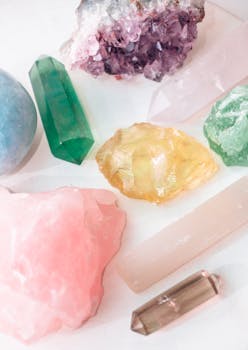
It happens. You drop your polished quartz point on a tile floor, or your favorite amethyst pendant scrapes against a doorframe, or your tumbled carnelian ends up rattling around in a bag with your house keys. The scratch is right there on the surface, catching light in a way that makes it impossible to ignore.
Before you reach for sandpaper, toothpaste, or any of the dozen "miracle fix" methods circulating online, understand this: the right fix depends entirely on what mineral you're dealing with and how deep the scratch is. Some scratches can be polished out. Others can't. And some popular home remedies will make the damage permanent.
First: figure out what you're working with
Scratch removal is fundamentally about abrasion. You're removing material around the scratch until the surrounding surface drops down to the scratch's depth, making everything level again. This means you need an abrasive that's harder than the stone.
The Mohs scale runs from 1 (talc) to 10 (diamond). A general rule: you need an abrasive at least 1-2 points harder than the material you're trying to polish. Cerium oxide (Mohs ~6) works well on glass (Mohs ~5.5) but won't do much on quartz (Mohs 7). Diamond paste (Mohs 10) works on essentially everything.
If you don't know what your stone is, start by testing its hardness. A copper penny won't scratch anything harder than about 3.5. A steel knife blade is around 5.5. A piece of window glass is about 5.5. If your stone can be scratched by a steel blade, it's relatively soft and easier to polish. If not, you'll need proper abrasives.
There are also visual clues. Stones with a waxy or pearly luster (like turquoise or moonstone) tend to be softer. Stones with a glassy or adamantine luster (like quartz or zircon) tend to be harder. This isn't always reliable — fluorite has a glassy luster but is only Mohs 4 — but it's a starting point.
Surface scratches vs. deep scratches
Run your fingernail across the scratch. If your nail catches on it, it's deep enough to feel. If your nail glides over smoothly and you can only see the scratch under bright light, it's a surface mark that may be polishable.
Surface scratches on polished stones are the best case scenario. These are often just deposits of harder material (like metal from a ring or setting) dragged across the surface. Sometimes they're not even scratches in the stone — they're transfer marks that look like scratches. A simple test: if rubbing the mark with a soft cloth removes it, it was never a scratch in the first place. Metal transfer from silver or gold settings is surprisingly common and easily mistaken for damage.
Deep scratches that you can feel with your fingernail are more serious. Removing them requires taking off a visible layer of material, which changes the dimensions of the stone slightly and may affect how it sits in its setting. For tumbled stones, this usually doesn't matter much. For calibrated gemstones cut to specific dimensions for commercial settings, it can be a real problem.
The toothpaste method: when it works and when it doesn't
Toothpaste as a mild abrasive is one of the most common suggestions online. Standard toothpaste contains silica (Mohs ~5-6) as a cleaning abrasive. Whitening toothpaste sometimes uses hydrated silica at slightly higher hardness.
For glass (Mohs 5.5) and soft stones like malachite (Mohs 3.5-4), fluorite (Mohs 4), or calcite (Mohs 3), toothpaste can actually work as a very gentle polish. The technique is simple: apply a small amount, buff with a soft cloth in circular motions for several minutes, rinse, and repeat. Don't press hard — let the abrasive do the work. Excessive pressure creates uneven surfaces.
For quartz (Mohs 7) and harder stones, toothpaste is essentially useless. The silica in toothpaste is softer than quartz, so you're rubbing something soft against something hard. No material removal happens. You might create a very faint polish effect from the extended rubbing, but you won't remove a visible scratch. Save your toothpaste for your teeth.
The risk with toothpaste: some "natural" or "baking soda" toothpastes contain particles that are too large and uneven, which will create new micro-scratches instead of removing the existing one. Use standard white paste toothpaste, not gel, not baking soda paste. Gel toothpaste contains no abrasive particles — it's the paste kind that works.
Diamond paste: the real solution for hard stones
If you're dealing with quartz, topaz, sapphire, or any stone above Mohs 6, diamond paste is the way to go. It comes in graded grits from 6 microns down to 0.25 microns. The grit size determines how aggressively it cuts: 6 micron removes material fast but leaves visible scratches, while 0.25 micron produces a mirror finish but takes much longer.
The process works like this: start with a coarser grit (3-6 micron) to level the scratch, then step down through progressively finer grits (1 micron, then 0.5, then 0.25) to restore the polish. Each grit removes the scratches left by the previous one. You need a felt or leather pad to apply it, and each grit stage takes 5-15 minutes of steady circular buffing. The whole process for a single scratch might take 30-60 minutes.
A 5-gram syringe of 3-micron diamond paste costs roughly $8-12. A full polishing kit with multiple grits runs $20-35. This is the same technique professional gem cutters use, scaled down. You can buy diamond paste on Amazon, from lapidary suppliers, or at some rock and gem shows.
One critical thing: if your stone has a curved surface (like a cabochon or crystal point), hand polishing with diamond paste works fine. If it has a faceted surface, polishing one facet flat will change its angle relative to adjacent facets, which affects how light bounces inside the stone. Faceted stones really need a professional faceting machine to fix properly. A slight change in facet angle can dramatically affect the stone's brilliance and fire.
Cerium oxide for glass and soft stones
Cerium oxide polish is the standard for optical glass, telescope mirrors, and polished stone countertops. It's a fine powder (typically 1-2 microns) that you mix with water to form a paste. Cost is about $6-10 for a small container that will last through dozens of polishing jobs.
It works on glass, obsidian, fluorite, calcite, and other stones below Mohs 6. For anything harder, it's too soft to be effective. The technique is the same as toothpaste but much more consistent — cerium oxide particles are uniform in size, so you get predictable results. Mix it to the consistency of thick cream, apply with a felt pad, and buff in circular motions.
Cerium oxide is also excellent for removing water stains and mineral deposits from glass and polished stones. If your crystal has developed a cloudy film from hard water exposure, cerium oxide will remove it.
Tin oxide as a middle ground
Tin oxide is another polishing compound worth knowing about. It sits between cerium oxide and diamond paste in terms of hardness (Mohs ~6.5) and cost (about $8-15 for a small container). It's particularly good for polishing quartz, feldspar minerals (like moonstone and labradorite), and other stones in the Mohs 5-7 range. Lapidaries often use tin oxide as a final polish step after diamond paste for stones that benefit from a slightly different surface character.
What NOT to do
Steel wool is a terrible idea for any stone. It deposits metal particles in the scratch and creates new scratches. It's too coarse for polishing and too soft to cut hard minerals. The metal particles it leaves behind can also oxidize over time, creating rust spots on the stone surface that are much harder to remove than the original scratch.
Nail files and emery boards are aluminum oxide or silicon carbide, which is fine as an abrasive but the grit is inconsistent and the shape is wrong for curved surfaces. You'll create flat spots and uneven areas. The rigid backing of an emery board also makes it nearly impossible to follow the contour of a cabochon or tumbled stone.
Vinegar, lemon juice, or any acid-based "soak" method does not remove scratches. It can etch the surface of calcite, malachite, and other carbonate minerals, which actually makes things worse by adding chemical damage on top of the physical scratch. Acid etching creates a matte, frosted appearance that is not the same as a polished surface.
Clear nail polish as a "filler" is a desperation move. It fills the scratch optically, making it less visible, but it peels, yellows over time, and looks bad under close inspection. If the stone has any monetary or sentimental value, don't do this.
When to see a professional
If the scratch is deeper than you can feel with your fingernail, or if it covers a large area relative to the stone's size, or if the stone is faceted, valuable, or has inclusions that make it fragile — find a lapidary or jeweler who does stone polishing. They have the equipment (flat laps, diamond wheels, proper polishing compounds) and the experience to assess whether the scratch is even worth removing.
Sometimes the honest answer is that the scratch is too deep and removing it would require taking off too much material. A deep scratch on a small tumbled stone might be better left as character. A deep scratch on an expensive faceted gem almost certainly needs professional assessment. Professional polishing for a single stone typically costs $15-50 depending on the stone and the work required.
Prevention is cheaper than repair. A $3 velvet pouch for each stone, separate compartments in a jewelry box, and not wearing crystals during manual work will prevent most scratches before they happen. The best fix is the one you never need.
Comments