How to Clean Crystal Jewelry — The Do's and Don'ts for 10 Popular Stones
This article was created with the help of AI writing tools, then reviewed and edited by a human editor for accuracy and clarity. We believe in transparency about how our content is made.
If you're wearing crystal jewelry regularly, you already know the drill — it gets dull, it picks up skin oils, and sometimes it just looks... tired. But here's the thing most people don't realize: cleaning crystal jewelry isn't one-size-fits-all. What works beautifully for one stone might completely ruin another. I've seen people ruin gorgeous amethyst pendants by leaving them in the sun to "charge." Yikes.
So let's walk through exactly how to clean 10 of the most popular crystal stones, what to do, what to avoid, and the few tools you actually need.
The Three Tools You Actually Need
Before we get into specific stones, let's talk about what you'll use. The good news? You don't need fancy equipment. Just three things:
Soft-bristle toothbrush (~$2): A baby toothbrush or a super-soft adult one. Nothing with stiff bristles — you're cleaning gemstones, not scrubbing grout. This gets into the tiny crevices around prongs and settings where gunk loves to hide.
Microfiber cloth (~$3): Skip paper towels (they scratch) and cotton cloths (they leave lint). Microfiber picks up oils without scratching the surface. Get a few — one for polishing, one for drying.
Ultrasonic cleaner ($25–50): This one's optional, and as you'll see below, it's not safe for every stone. But for the ones that can handle it, ultrasonic cleaners are incredible. They use high-frequency sound waves to shake dirt loose from places your brush simply can't reach. Just don't go cheap on this — read reviews and pick one with decent ratings.
1. Amethyst (Purple Quartz)
DO: Wash with mild soapy water and a soft brush
Mix a drop of gentle dish soap (nothing with lemon or citrus additives) into lukewarm water. Dip your soft brush in, give the amethyst a gentle scrub, then rinse under running water. Pat dry with your microfiber cloth. That's it. This works for both polished stones and raw crystal points.
DON'T: Leave it in direct sunlight for long
Amethyst gets its beautiful purple color from iron impurities exposed to natural radiation deep underground. Heat and UV light can reverse that process. I've left an amethyst bracelet on a sunny windowsill for a single afternoon and watched the color noticeably fade. Store it in a dark place, and if you're one of those people who "charges" crystals in sunlight — switch to moonlight for this one.
2. Rose Quartz
DO: Use warm water and a soft cloth
Rose quartz is pretty forgiving. Run it under warm (not hot) water, wipe it gently with a soft cloth, and you're good. If there's buildup around the setting, a quick pass with a soapy soft brush will handle it. Rose quartz scores a 7 on the Mohs scale, so it's not delicate in terms of scratching — but its color is another story.
DON'T: Expose it to high heat
The pink color in rose quartz comes from trace amounts of titanium, manganese, or dumortierite. Prolonged heat exposure can cause that lovely blush tone to wash out. No hot water, no hair dryer, no sitting next to the radiator. Keep it cool, keep it pink.
3. Citrine
DO: Clean with mild soapy water
Citrine is one of the easier stones to maintain. A quick wash with mild soap and water, a gentle brush if needed, and a soft dry. Its warm golden color is relatively stable under normal conditions. Just treat it like you'd treat amethyst — gentle and quick.
DON'T: Leave it in prolonged direct sunlight
Here's where it gets interesting. Most citrine on the market today is actually heat-treated amethyst or smoky quartz. The heat treatment creates that honey-gold color, but it also means the stone is essentially sitting at its color stability limit. More sun exposure can push it over the edge and cause fading. If you're not sure whether your citrine is natural or treated, play it safe and keep it out of the sun.
4. Clear Quartz
DO: Ultrasonic cleaner is fine
Clear quartz is the tough guy of the crystal world. It's one of the few stones where you can confidently use an ultrasonic cleaner without worrying about damage. It handles soap, water, and vibration like a champ. If you have a clear quartz pendant that's gotten grimy behind the setting, the ultrasonic cleaner will make it look brand new.
DON'T: Subject it to sudden temperature changes
Despite being hard (Mohs 7), clear quartz can crack from thermal shock. Going from a hot car to cold air conditioning, or from hot water to cold rinse, can create tiny fractures. Always use lukewarm water for rinsing, and never wear your quartz jewelry in a hot tub and then jump into a cold pool.
5. Black Obsidian
DO: Pretty much any cleaning method works
Obsidian is volcanic glass — it's not a crystal structure at all. It doesn't have cleavage planes, it doesn't have internal inclusions that water could damage. Soap, water, ultrasonic, steam — go wild. The surface polish is what you're protecting, and as long as you use soft materials, it'll stay glossy for years.
DON'T: Drop it or bang it against hard surfaces
Here's the catch with obsidian: it's glass. While it scores around 5–5.5 on the Mohs scale (so it scratches fairly easily), the real problem is brittleness. A single drop onto tile or concrete can shatter or chip it. Be extra careful when taking rings on and off over hard floors, and don't toss it into a jewelry box where it can knock against harder stones.
6. Turquoise
DO: Wipe with a dry, soft cloth only
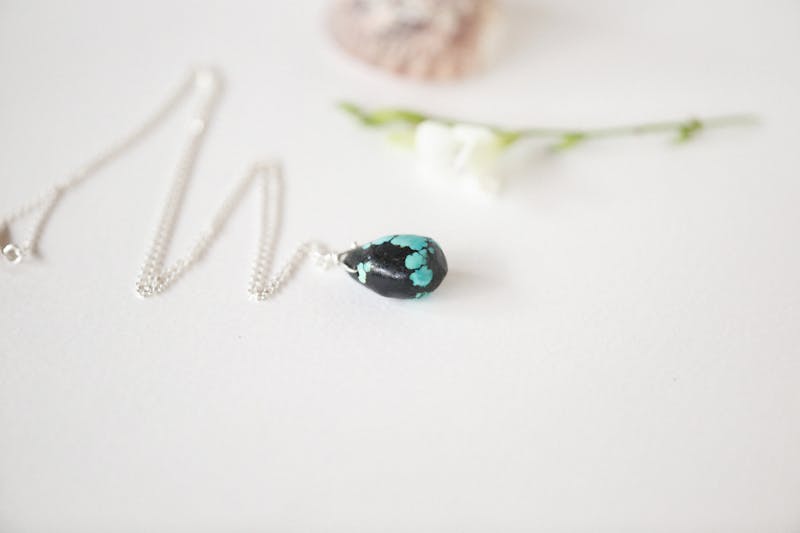
Turquoise is one of the most finicky stones you'll encounter in jewelry. It's porous — like, really porous. Even "stabilized" turquoise (which has been injected with resin to reduce porosity) can be damaged by improper cleaning. A dry microfiber cloth after each wear is really all you need. Gently wipe away fingerprints, oils, and dust. Done.
DON'T: Soak it, use ultrasonic cleaners, or apply any chemical cleaners
Water, steam, vibrations, and chemicals are all enemies of turquoise. Soaking can cause the stone to absorb liquid and change color (sometimes permanently). Ultrasonic vibrations can crack it. Chemical cleaners — even mild ones — can eat away at both natural and stabilized turquoise. If your turquoise is set in silver and you want to clean the metal, use a silver polishing cloth and carefully avoid touching the stone.
7. Lapis Lazuli
DO: Wipe with a slightly damp soft cloth
Lapis lazuli is a composite stone — it's not a single mineral but a rock made up of lazurite, calcite, and pyrite (those gold flecks you see). The calcite content makes it sensitive to moisture. A cloth that's barely damp — just wring it out so it's almost dry — is all you should use. Quick wipe, and let it air dry completely before storing.
DON'T: Soak it or use ultrasonic/steam cleaners
The calcite in lapis lazuli is relatively soft and water-soluble compared to the rest of the stone. Soaking can cause the calcite to dissolve over time, creating a pitted, dull surface. Ultrasonic cleaners can literally shake the stone apart at its mineral boundaries. Steam cleaning is just as bad. Treat your lapis like a delicate painting — gentle, dry, and minimal.
8. Moonstone
DO: Clean with mild soapy water
Moonstone is a feldspar mineral with a lovely adularescence — that floating light effect that moves across the surface. It's moderately hard (Mohs 6–6.5) and can handle a gentle soap-and-water wash. Use your soft brush for settings and crevices, then pat dry. Nothing complicated here.
DON'T: Use ultrasonic or steam cleaners
Feldspar minerals often contain tiny internal cleavages and inclusions. Ultrasonic vibrations can worsen existing micro-fractures or even create new ones. Steam cleaning can force moisture into these tiny openings, leading to discoloration or cracking over time. Stick to room-temperature water and gentle hand cleaning.
9. Opal
DO: Wipe quickly with a barely damp soft cloth
Opals contain between 3% and 21% water. That's what gives them their incredible play-of-color — light refracting through microscopic water-filled spheres. To clean an opal, barely dampen a soft cloth and give it a quick, gentle wipe. Don't linger. Dry immediately with a clean cloth. Think of it like cleaning a very delicate, very expensive camera lens.
DON'T: Soak it, expose it to high heat, or use ultrasonic cleaners
Opals are probably the most fragile stone on this list. Soaking can cause them to absorb water and either turn cloudy or crack. Heat accelerates moisture loss — an opal left in a hot car or under direct sunlight can literally dry out and develop "crazing" (a web of tiny surface cracks). Ultrasonic cleaners will destroy them, no question. Some jewelers even recommend periodically soaking opals in water to keep them hydrated — but that's a controversial topic and I'd suggest consulting a gemologist before trying it with any valuable piece.
10. Pearl
DO: Wipe with a soft cloth after every wear
Pearls aren't stones at all — they're organic, made by mollusks layering nacre around an irritant. They're surprisingly soft (Mohs 2.5–4.5) and their luster comes from those delicate nacre layers. The single best thing you can do for your pearls is wipe them down with a soft, lint-free cloth after every wear. This removes body oils and acids from your skin before they have a chance to eat into the nacre. Put them on after applying perfume and hairspray, not before.
DON'T: Soak them, use ultrasonic cleaners, or apply any chemical cleaners
Pearls and water are a bad combination. Soaking can weaken the silk thread that most pearl necklaces are strung on, and moisture can seep into the drill holes and cause discoloration. Ultrasonic cleaners will chip and crack them. Chemical cleaners — including jewelry dips and even some "gentle" formulations — will dissolve the nacre. If your pearls need deeper cleaning, use a cloth very lightly dampened with water and a tiny drop of mild soap. Rinse quickly and dry flat on a soft towel. Never hang a wet pearl necklace — the weight will stretch the thread.
Universal Rules for All Crystal Jewelry
No matter what stone you're cleaning, these rules apply across the board:
Take it off before cleaning. Cleaning jewelry while wearing it seems obvious, but you'd be surprised how many people try. You can't reach all the surfaces, and you risk getting soap in places it shouldn't go — like between the stone and its setting.
Clean pieces individually. Don't throw a handful of rings into a bowl and scrub them together. Harder stones will scratch softer ones. Clear quartz will scratch amethyst, amethyst will scratch opal, and opal will basically just cry. One at a time, or at least group them by hardness.
Dry thoroughly with a soft cloth. Don't air-dry. Water left on the surface can leave mineral deposits (water spots) and, for porous stones, can seep in and cause damage. A quick pat with microfiber takes two seconds.
Store in sealed bags. Small ziplock bags or anti-tarnish pouches keep out moisture and air. This is especially important for turquoise, lapis, opals, and pearls — the stones that hate humidity. It also prevents harder stones from scratching softer ones during storage.
A Quick Reference Cheat Sheet
Want to save this for later? Here's the too-long-didn't-read version:
Safe for soap and water: Amethyst, rose quartz, citrine, clear quartz, moonstone
Ultrasonic cleaner OK: Clear quartz, black obsidian
Damp cloth only (no soaking): Lapis lazuli, moonstone, opal, pearl
Dry cloth only: Turquoise
Keep away from sunlight: Amethyst, citrine
Keep away from heat: Rose quartz, opal, pearl
Most fragile: Opal, pearl, turquoise
Most durable: Clear quartz, black obsidian, citrine
Take care of your crystals and they'll stay gorgeous for years. Mismatch your cleaning method to the stone, though, and you might end up with a very expensive lesson in mineralogy.
Comments